
How AI Agents Transform Workflows and Cut Manual Tasks
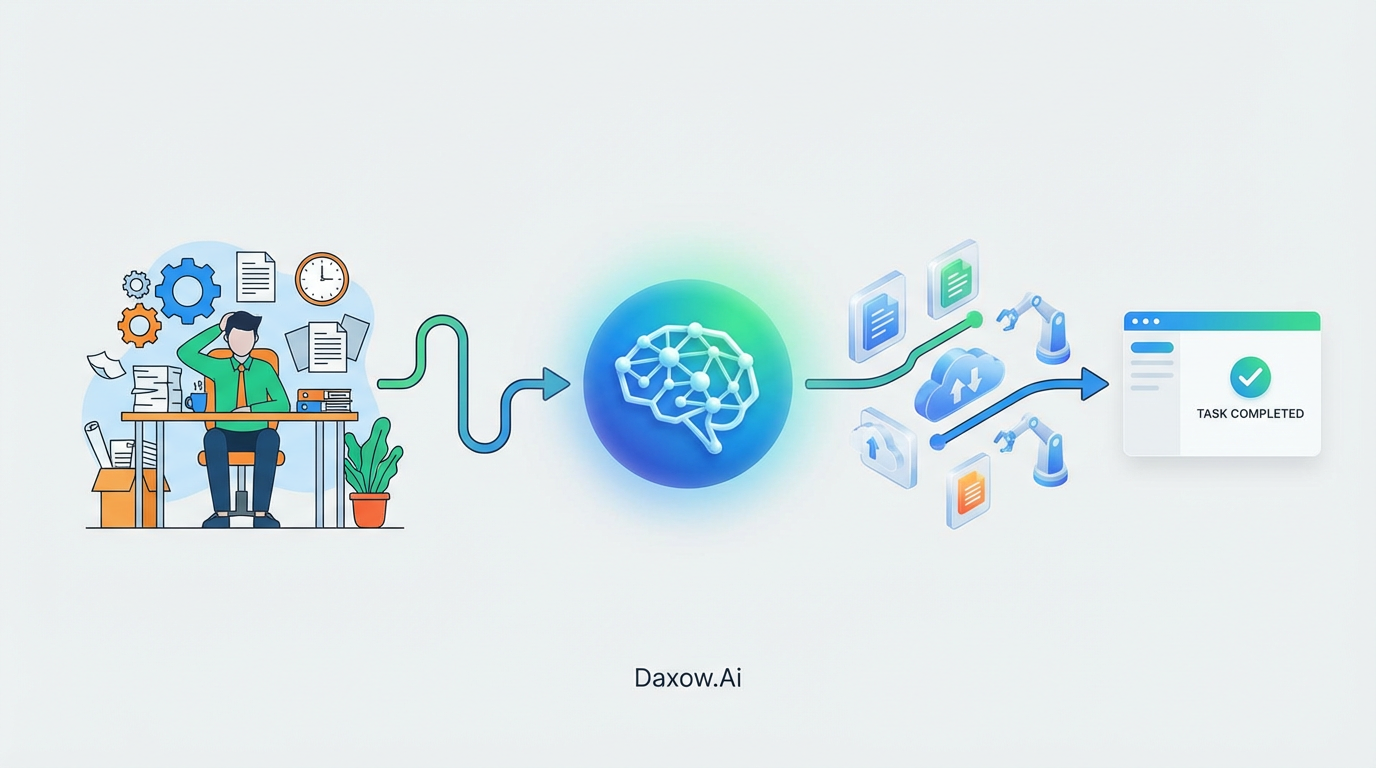
Discover how AI workflow automation and AI agents (Daxow.ai) reduce manual tasks, lower costs, and scale operations with use cases and a practical roadmap.
AI Workflow Automation: How AI Agents Transform Business Operations and Reduce Manual Tasks
Estimated reading time: 15 minutes
Key Takeaways
- AI workflow automation embeds intelligence into processes to reduce costs and manual tasks.
- Industries like e-commerce, healthcare, finance, real estate, and HR benefit from targeted AI-driven automation.
- Successful implementation follows discovery, data assessment, prototyping, deployment, and scaling stages.
- Daxow.ai partners with businesses to design custom AI agents that deliver measurable ROI and scalability.
- Security, compliance, and ethical design are critical throughout AI automation projects.
Table of Contents
- AI workflow automation — Strategic importance and business value
- Practical use cases of AI workflow automation across industries
- How AI agents and automation deliver measurable results
- Implementation roadmap — From identification to scaling
- Best practices and common pitfalls
- How Daxow.ai designs and delivers custom AI automation
- Measuring ROI and scaling automation
- Security, compliance, and ethical considerations
- Getting started — pragmatic next steps for leaders
- Frequently Asked Questions
AI workflow automation — Strategic importance and business value
AI workflow automation integrates artificial intelligence into business processes so systems can autonomously execute tasks, optimize flows, and adapt based on outcomes. The strategic importance for businesses includes:
- Cost reduction: Automating repetitive, high-volume tasks cuts manual labor and error-related costs.
- Faster decision-making: AI-driven insights and automated routing reduce latency in approvals and responses.
- Scalability: Processes handle higher volumes without proportional increases in headcount.
- Improved customer experience: Faster responses, consistent handling, and proactive problem detection boost satisfaction and NPS.
- Compliance and auditability: Automated logs and rule enforcement support regulatory requirements.
Prioritize processes with clear, measurable impact—invoice processing, lead qualification, customer inquiries, and document automation are typical high-ROI candidates. For executives, framing automation as an evolving platform rather than a point solution ensures long-term value and continuous improvement.
Practical use cases of AI workflow automation across industries
E-commerce — Faster support, better personalization
- Automated customer support agents handle tier-1 queries (order status, returns), reducing average handling time and deflecting volume from human agents.
- AI analyses reviews to surface recurring product issues and sentiment trends, informing product and supply chain decisions.
- Campaign automation drafts personalized product descriptions and social media captions based on inventory and customer segments.
Business impact:
- Reduced support costs, faster response times.
- Improved conversion rates from targeted messaging.
- Inventory issues highlighted earlier, preventing stockouts.
Healthcare — Streamlining onboarding and document workflows
- AI agents extract structured data from intake forms, insurance documents, and clinical notes.
- Automation routes patient requests, schedules, and follow-ups while preserving compliance and audit trails.
- Anomaly detection flags inconsistent records for human review.
Business impact:
- Reduced administrative overhead, faster patient throughput.
- Improved data quality, better care coordination and compliance.
Finance — Fraud detection and reconciliations
- Continuous monitoring agents detect suspicious patterns and escalate potential fraud for investigation.
- Automated invoice reconciliation matches payments and flags discrepancies.
- Batch processing reduces audit preparation time.
Business impact:
- Lower fraud losses, faster audits.
- Higher accuracy in financial reporting and reconciliations.
Real estate — Intelligent lead qualification and document processing
- AI agents score leads based on communications, engagement, and external data, routing qualified prospects to sales.
- Lease and title documents are parsed and key fields populated automatically.
- Market trend models analyze listing data to suggest pricing or timing strategies.
Business impact:
- Higher lead-to-deal conversion, lower time-to-close.
- Streamlined closings and reduced document errors.
HR — Scalable recruitment and onboarding
- Resume screening and candidate matching automate initial shortlists based on role criteria and historical hiring success.
- Onboarding workflows provision accounts, schedule training, and ensure compliance checklists are completed.
- Performance analytics identify talent trends for retention strategies.
Business impact:
- Faster hiring cycles, reduced bias in initial screening.
- Lower administrative load on HR teams.
How AI agents and automation deliver measurable results
AI agents execute real tasks, not just provide recommendations. They integrate with CRMs, ERPs, ticketing systems, and analytics platforms to create closed-loop workflows. Key value mechanics:
- Task execution: Agents complete repetitive work—data entry, triage, routing—freeing people for strategic activities.
- Predictive actions: Forecasting models (demand, churn, fraud) trigger preemptive workflows.
- Data enrichment: Automated extraction and validation populate systems of record, improving downstream processes.
- Auditability and compliance: Built-in logging and rule enforcement support risk management.
Typical performance improvements organizations report include significant processing time reductions and error decreases. Many projects deliver 30–50% efficiency gains in targeted processes when designed and executed correctly.
Implementation roadmap — From identification to scaling
1. Discovery and prioritization (2–4 weeks)
- Map current workflows and identify bottlenecks.
- Score processes by ROI potential (volume, manual effort, cost per error).
- Define success metrics: cost-per-transaction, response time, NPS, error rate.
Deliverables:
- Prioritized backlog of automation candidates.
- Baseline KPI measurements.
2. Data assessment and preparation (2–6 weeks)
- Audit data sources for quality, completeness, and accessibility.
- Standardize formats and build pipelines to break down silos.
- Address privacy and compliance requirements.
Deliverables:
- Data readiness plan.
- ETL/connectors design for core systems (CRMs, ERPs, document repositories).
3. Prototype and rapid validation (4–8 weeks)
- Build Minimum Viable Automation (MVA) for the highest-impact workflow.
- Use small-scale pilots to test accuracy, integration, and user acceptance.
- Define monitoring metrics and feedback loops.
Deliverables:
- Working prototype connected to live data.
- Measurement dashboard and user feedback plan.
4. Production deployment and integration (4–12 weeks)
- Expand automation into production with robust error handling and security.
- Integrate with existing tools and workflows (calendar systems, ticketing, monday.com-style boards).
- Implement role-based access and audit logging.
Deliverables:
- Production-ready automation.
- Runbooks, training materials, and change management plan.
5. Monitor, iterate, and scale (ongoing)
- Continuous monitoring and automated alerts for performance drift.
- Scheduled retraining and workflow tuning informed by usage data.
- Expand modular automation components to adjacent processes.
Deliverables:
- SLA-backed automation operations.
- Roadmap for scaling across departments and geographies.
Best practices and common pitfalls
Adopt these best practices to maximize value and minimize risk.
- Start with measurable outcomes: Define KPIs before building solutions.
- Address data quality early: Bad input data undermines automation outcomes.
- Design for modularity: Build reusable components to accelerate future projects.
- Embed change management: Train staff and create champions to prevent shadow automation.
- Prioritize security and compliance from day one.
- Plan for model drift: Establish retraining schedules and human-in-the-loop escalation.
Common pitfalls to avoid:
- Tackling highly ambiguous tasks before core rule-based processes.
- Ignoring integration costs with legacy systems.
- Skipping pilot testing with real users.
How Daxow.ai designs and delivers custom AI automation
Daxow.ai provides end-to-end services that align strategy, technology, and operations:
- Process discovery and mapping: Our team identifies high-impact workflows and quantifies ROI potential.
- Custom AI agents: We build agents that perform real tasks — from lead qualification to invoice reconciliation — integrating with your CRM, ticketing systems, and data stores.
- Workflow automation: We design robust workflows that combine AI decisions with deterministic automation and human checkpoints.
- Data extraction and document automation: We implement extraction pipelines for structured data capture from contracts, invoices, and medical records.
- Integrations and system connectivity: We connect automations to existing systems (CRMs, ERPs, analytics) to maintain a single source of truth.
- Governance and monitoring: We set up logging, performance dashboards, retraining pipelines, and compliance controls to sustain performance.
Case example:
- Problem: A mid-size fintech experienced delays in invoice processing and a high rate of reconciliation errors.
- Daxow.ai solution: Built an AI agent to extract invoice fields, match them to purchase orders, and route exceptions to finance staff with suggested resolutions.
- Outcome: 45% reduction in processing time, 60% fewer reconciliation exceptions, and faster month-end close.
Learn more about our custom AI automation services and how we collaborate with businesses to scale AI-driven workflows.
Measuring ROI and scaling automation
To justify and expand automation programs, focus on quantifiable outcomes:
- Track direct cost savings (FTE-hours reduced × fully loaded rate).
- Monitor process KPIs (cycle time, average response time, accuracy).
- Measure customer-centric metrics (NPS, CSAT, first-contact resolution).
- Capture indirect benefits (faster decision-making, scalability).
Build a business case using pilot results and forecasted scaling benefits. Automation platforms that are modular enable you to replicate successes across departments, compounding ROI over time.
Security, compliance, and ethical considerations
Automation must uphold privacy, security, and ethical standards:
- Implement role-based access and encryption for sensitive data.
- Maintain auditable logs and versioned models to support compliance.
- Use human-in-the-loop designs for high-risk decisions.
- Document model behavior and ensure explainability where needed.
Daxow.ai embeds governance into every project and collaborates with legal and compliance teams to align solutions with regulatory requirements.
Getting started — pragmatic next steps for leaders
If you are evaluating AI workflow automation:
- Begin with a short discovery engagement to map processes and estimate value.
- Run a focused pilot on a single, high-volume process to validate outcomes quickly.
- Invest in data readiness and integration architecture to avoid future friction.
- Assemble a cross-functional team including operations, IT, and domain experts.
Daxow.ai offers tailored engagements that move teams from discovery to production with minimal friction. Our clients benefit from deep implementation experience, prebuilt connectors, and a pragmatic approach that prioritizes measurable business value.
Discover how our expertise can accelerate your automation journey by visiting our about page or exploring our case studies.
Frequently Asked Questions
What types of tasks can AI workflow automation handle?
AI workflow automation excels at repetitive, high-volume, and rule-based tasks such as data entry, lead qualification, invoice processing, and basic customer support queries.
How does Daxow.ai ensure compliance and security in AI automation?
We implement role-based access, encrypted data handling, auditable logs, and human-in-the-loop designs to maintain security, privacy, and meet regulatory requirements throughout the automation lifecycle.
Can AI workflow automation scale across different departments?
Yes, by designing modular and reusable AI components, we enable scalable automation that can be deployed across multiple teams and geographies, compounding ROI over time.
What is the typical timeline for implementing AI workflow automation?
Depending on scope, it ranges from a few weeks for discovery and prototyping to several months for full production deployment and scaling. Continuous improvement is ongoing after launch.