
Unlock Business Growth with AI Workflow Automation
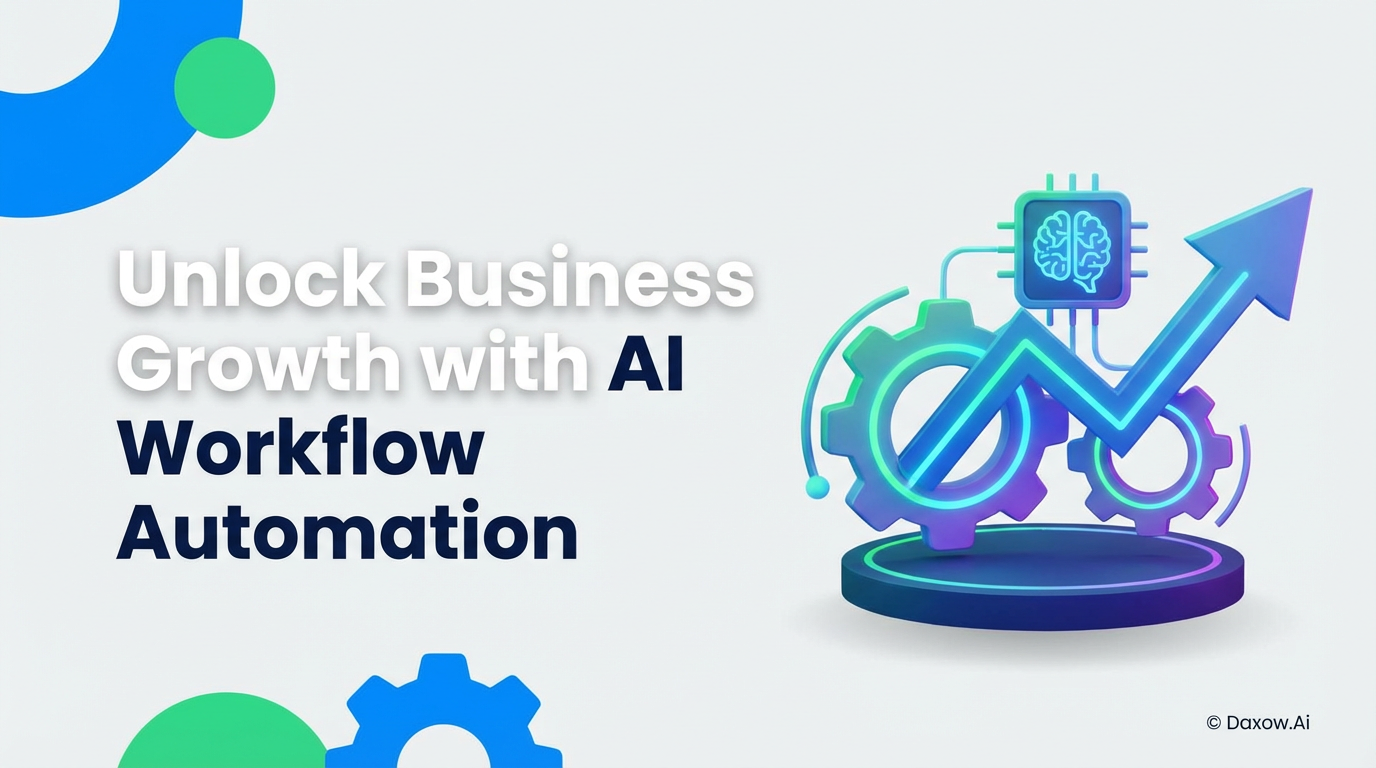
How AI workflow automation and agents cut costs, boost productivity, and deliver 6-12 month ROI, with practical steps and industry use cases from Daxow.ai.
Unlocking Business Growth: The Strategic Imperative of AI Workflow Automation
Estimated reading time: 15 minutes
Key Takeaways
- AI workflow automation transforms repetitive work into measurable value like cost reduction up to 40% and productivity gains of 30–50%.
- AI agents orchestrate multi-step intelligent workflows improving speed, accuracy, and freeing human capacity for higher-value tasks.
- Applications span industries including e-commerce, healthcare, finance, real estate, HR, and cross-functional sales automation.
- Successful implementation follows structured steps: goal definition, process prioritization, tool selection, team building, testing, monitoring, and scaling.
- Daxow.ai builds custom AI agents that automate tasks end-to-end with integrations to CRMs, ERPs, and collaboration platforms.
- Measuring KPIs like cost savings, processing time, accuracy, and customer metrics justify ROI and ongoing investment.
Table of Contents
- Unlocking Business Growth: The Strategic Imperative of AI Workflow Automation
- What AI Workflow Automation Means for Businesses
- Practical Use Cases Across Industries
- How to Implement AI Workflow Automation
- Measuring ROI and Business Value
- How Daxow.ai Delivers End-to-End AI Automation Solutions
- Practical Next Steps for Decision-Makers
- Frequently Asked Questions
Unlocking Business Growth: The Strategic Imperative of AI Workflow Automation
AI workflow automation integrates artificial intelligence into business processes so that organizations move from reactive operations to proactive, data-driven workflows. Instead of merely automating single tasks, AI agents orchestrate multi-step processes: they extract data from documents, make classification decisions, trigger actions in CRMs or ERPs, and escalate exceptions to humans. The result is faster response times, improved accuracy, and freed human capacity for higher-value work.
Why this is strategic now
- Digital maturity and readily available AI tooling remove previous barriers to adoption.
- Market expectations require faster service and personalization; automation enables both.
- For leadership teams, AI workflow automation is a way to scale without linear headcount growth — crucial for startups, enterprises, and fast-moving industries.
What AI Workflow Automation Means for Businesses
AI workflow automation combines rule-based automation with intelligent decision-making. It can handle simple repeatable tasks (data entry, invoice matching) and complex cognitive tasks (fraud detection, sentiment analysis, dynamic pricing).
Core business benefits
- Reduce manual tasks across departments — from support ticket triage to invoice reconciliation.
- Boost productivity by 30–50% through faster processing and fewer errors.
- Lower operational costs by as much as 40% by removing repetitive labor and preventing costly mistakes.
- Improve customer experience via faster responses and personalized journeys.
- Enable data-driven decisions using models that surface trends and risks in real time.
The role of AI agents
AI agents are autonomous workflows that can:
- Read, interpret, and route documents and messages.
- Integrate with CRMs, ERPs, and collaboration tools to complete tasks end-to-end.
- Learn from feedback to improve over time.
Daxow.ai builds AI agents that don’t just suggest actions — they execute bounded tasks and coordinate human handoffs where necessary.
Practical Use Cases Across Industries
E-commerce — customer support and inventory forecasting
Use case: An AI agent handles pre-sales chat, qualifies intent, issues discounts within policy, and raises orders to fulfillment systems. Parallel processes analyze purchase patterns to predict inventory needs.
Outcomes:
- Customer support automation reduces response times and deflects 40–60% of common queries.
- Fewer stockouts and less overstock through demand forecasting, lowering carrying costs and improving conversion rates.
How Daxow helps:
- Integrate chatbots with e-commerce platforms and CRMs.
- Build predictive models for inventory and automated reorder workflows.
Healthcare — document automation and patient flow
Use case: Automate intake forms, extract structured data from medical documents, and flag anomalies for clinician review.
Outcomes:
- Reduced administrative overhead for scheduling and billing.
- Faster diagnostics and improved compliance through consistent data capture.
How Daxow helps:
- Deploy secure document extraction pipelines with audit trails.
- Connect outputs to EHR systems and generate clinician alerts.
Finance — fraud detection, reconciliation, and audits
Use case: AI agents monitor transactions, score risk in real time, reconcile invoices, and prepare audit-ready summaries.
Outcomes:
- Faster fraud detection and fewer false positives.
- Accelerated month-end close and reduced manual reconciliation time.
How Daxow helps:
- Implement anomaly detection models integrated with payment and accounting systems.
- Automate reconciliation workflows and create compliance dashboards.
Real Estate — lead qualification and market analysis
Use case: Automate lead capture, initial qualification using property preferences and credit signals, and draft property listings optimized for search.
Outcomes:
- Faster lead response and higher conversion rates.
- Data-driven pricing decisions and shorter sales cycles.
How Daxow helps:
- Build AI agents that qualify leads, create follow-up tasks in CRMs, and automatically generate listing drafts.
HR — recruiting and employee experience
Use case: Resume parsing, automated candidate screening conversations, and sentiment analysis from employee feedback.
Outcomes:
- Reduce hiring time by up to 50% for routine roles.
- Proactively address retention risks and improve engagement.
How Daxow helps:
- Automate screening workflows, schedule interviews, and integrate candidate data with HRIS systems.
Cross-functional — sales automation and processes
Use case: AI agents enrich leads, prioritize accounts based on propensity models, and create tailored outreach sequences.
Outcomes:
- Higher-quality pipeline and shorter sales cycles.
- Sales teams focus on closing rather than data entry.
How Daxow helps:
- Integrate with major CRMs, implement lead-scoring models, and automate task generation for sales reps.
How to Implement AI Workflow Automation
1. Define clear goals and audit readiness
- Clarify objectives: cost reduction, NPS improvement, speed of service, or compliance.
- Audit data quality: completeness, structure, and privacy constraints.
- Set measurable KPIs tied to business outcomes (cost per process, accuracy, TTR).
2. Identify high-impact processes
- Prioritize tasks that are high-volume, rule-based, and error-prone for quick wins.
- Map end-to-end workflows to capture handoffs and exceptions.
3. Select tools and plan integrations
- Choose platforms that integrate with your CRM, ERP, and collaboration tools.
- Favor modular architectures so workflows can scale and evolve.
- Plan for secure connectors and data governance.
4. Build a cross-functional team and manage change
- Assemble product owners, engineers, process SMEs, and compliance partners.
- Include a change management plan: training, internal champions, and phased rollouts.
- Monitor for shadow AI and enforce governance.
5. Test, deploy, and monitor continuously
- Use validation datasets and pilot groups.
- Deploy dashboards tracking accuracy, throughput, cost per case, and customer metrics.
- Retrain models and refine rules based on observed performance.
6. Optimize and scale
- Use modular design to replicate successes across departments.
- Ensure monitoring, logging, and retraining pipelines are in place.
- Capture ROI and expand into higher complexity processes.
Common implementation challenges and mitigations
- Data quality: conduct targeted audits and construct ETL pipelines to standardize inputs.
- Integration hurdles: design middleware or use proven connectors to CRMs and ERPs.
- Team resistance: demonstrate early wins and provide role-specific training.
- Scalability: architect workflows as reusable modules and choose scalable infrastructure.
Measuring ROI and Business Value
Primary KPIs to measure
- Cost per process and total operational cost savings.
- Processing time or time-to-resolution (TTR).
- Accuracy and error rates.
- Revenue impact: faster sales cycles, improved conversion rates.
- Customer metrics: NPS, CSAT, first-response time.
- Time-to-value: typical payback is 6–12 months for many deployments.
Long-term value drivers
- Models improve with data, creating compounding returns.
- Reduced manual errors and faster insights drive better strategic decisions.
- Scalable workflows let organizations grow without proportional staff increases.
How Daxow.ai Delivers End-to-End AI Automation Solutions
Discovery and process analysis
- We start with a detailed process audit to identify where automation yields the highest impact.
- We map data flows and measure current baseline KPIs to quantify potential gains.
Custom AI design and engineering
- We design AI agents that perform bounded tasks and integrate with your systems to complete workflows end-to-end.
- Our capabilities include NLP for document automation, predictive models for demand and risk, and conversational agents for support automation.
Integrations and data connectivity
- We connect AI systems to CRMs, ERPs, ticketing systems, and internal databases to eliminate manual handoffs and create closed-loop workflows.
- We implement secure connectors and maintain data lineage for compliance.
Deployment, monitoring, and governance
- We deploy in phases, validate with rigorous testing, and monitor performance through executive dashboards.
- We establish governance to avoid shadow AI, ensure bias monitoring, and maintain ethical guidelines.
Operational outcomes
- Reduce manual tasks across departments and reallocate talent to strategic initiatives.
- Improve productivity and reduce operational costs while increasing service quality.
- Scale automation across functions with reusable modules and continuous improvement.
Practical Next Steps for Decision-Makers
If you are evaluating AI automation, consider an initial process analysis that delivers a prioritized roadmap and expected ROI.
- Start with a short discovery audit (2–4 weeks) to identify quick wins.
- Pilot one high-impact workflow with clear KPIs and executive sponsorship.
- Expand iteratively, using lessons from pilots to standardize architecture and governance.
Frequently Asked Questions
What is the difference between AI automation and traditional workflow automation?
Traditional workflow automation follows predefined rules to automate tasks, while AI automation incorporates machine learning and intelligent decision-making to handle complex, variable tasks dynamically.
How quickly can companies see ROI from AI workflow automation?
Many companies realize payback within 6–12 months, driven by cost savings, productivity gains, and improved customer experience.
What industries benefit most from AI workflow automation?
Industries like e-commerce, healthcare, finance, real estate, HR, and sales functions have demonstrated strong benefits from AI-driven automation.
How does Daxow.ai ensure compliance and governance in AI automation?
Daxow.ai implements data lineage, audit trails, monitors for bias, enforces governance policies, and avoids shadow AI through transparent and controlled deployments.