
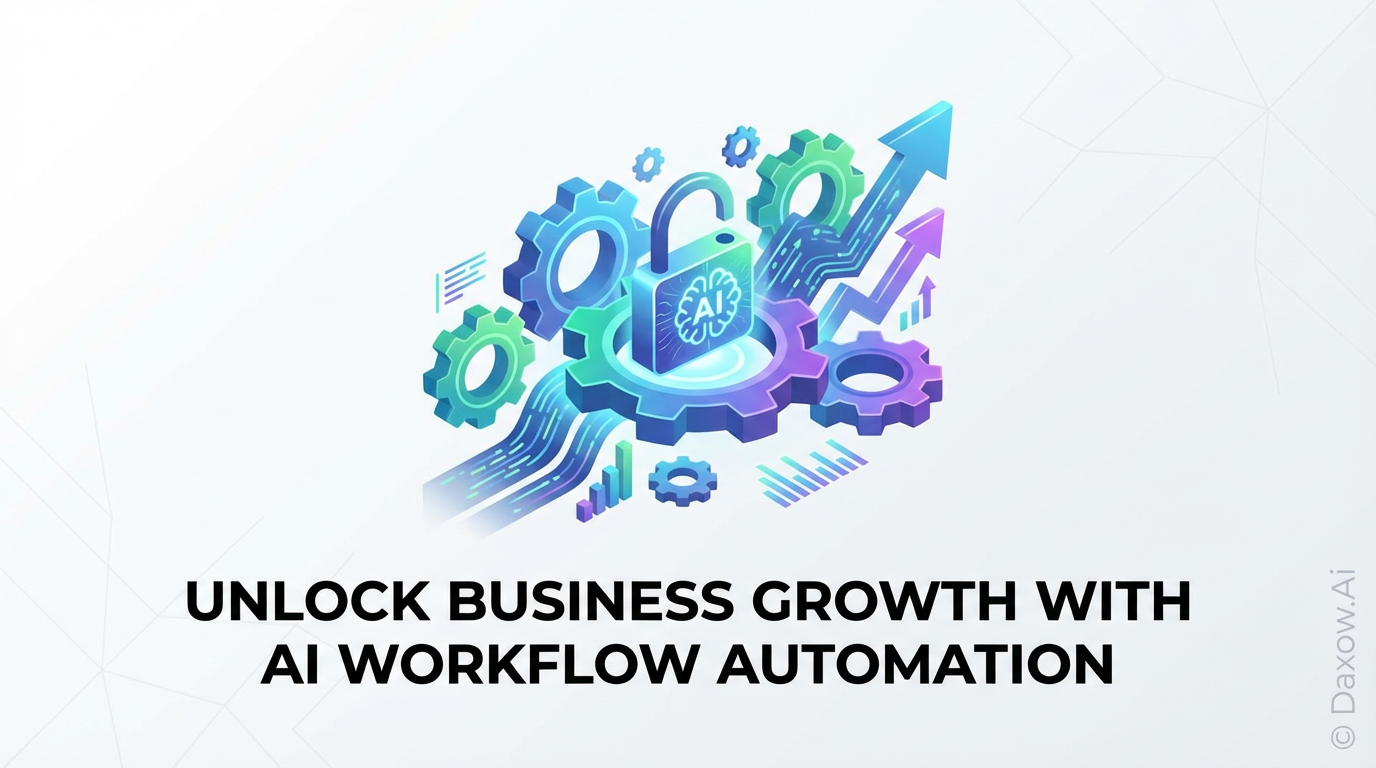
Unlock Business Growth with AI Workflow Automation
Learn how AI workflow automation and custom AI agents reduce manual work, boost productivity, and scale operations, with Daxow.ai's roadmap and use cases.
Unlocking Business Growth: The Power of AI Workflow Automation
Estimated reading time: 15 minutes
Key Takeaways
- AI workflow automation integrates intelligent software to optimize and scale business processes with measurable ROI.
- Core AI capabilities include task automation, decision support, conversational automation, and document automation.
- Custom AI agents can autonomously execute multi-step workflows, reducing manual effort and errors.
- Industry use cases span e-commerce, healthcare, finance, real estate, HR, and customer support, delivering operational savings and productivity gains.
- A structured implementation roadmap helps organizations define goals, assess data, build cross-functional teams, and scale automation efficiently.
- Daxow.ai offers end-to-end AI automation solutions integrating with legacy systems to ensure compliance, enable scalability, and maximize business value.
Table of Contents
- What AI Workflow Automation Means for Businesses
- How AI Agents and Automation Drive Transformation
- Practical Use Cases Across Industries
- Implementation Steps and Best Practices
- Measuring ROI and Business Value
- Common Risks and How to Mitigate Them
- How Daxow.ai Delivers End-to-End Business Automation
- Quick-Start Checklist for Decision-Makers
- Frequently Asked Questions
What AI Workflow Automation Means for Businesses
AI workflow automation integrates cognitive capabilities into operational workflows. Unlike basic automation that follows fixed rules, AI-driven automation learns from data, makes probabilistic decisions, and can interact with humans via conversational interfaces. This combination unlocks new value across the enterprise.
Core capabilities
- Task automation: Automate high-volume, repeatable tasks like invoice reconciliation, ticket triage, and data entry.
- Decision support: Score leads, detect anomalies, and predict inventory shortages using machine learning.
- Conversational automation: Route or resolve customer queries using natural language understanding and AI-driven chatbots.
- Document automation: Extract structured data from unstructured documents, contracts, and forms.
Business outcomes to expect
- Productivity gains: Organizations commonly see 30–50% productivity improvements where AI workflow automation is applied.
- Time reclaimed: Up to 40% of employee time spent on routine tasks can be eliminated or reduced.
- Faster processing: Processes that previously took days can be compressed to minutes through intelligent automation.
- Risk reduction: Proactive anomaly detection reduces fraud and compliance breaches.
How AI Agents and Automation Drive Transformation
AI agents are autonomous software entities that can execute multi-step processes end-to-end. They orchestrate data retrieval, decision logic, system updates, and human handoffs. When combined with workflow automation, AI agents enable complex tasks to be completed with minimal human oversight.
What AI agents do
- Monitor incoming data streams and take pre-defined actions.
- Interact with CRMs, ERPs, and third-party APIs to collect and update information.
- Escalate exceptions to humans with context-rich summaries and recommended next steps.
- Continuously learn from outcomes to improve future decisions.
Why combining agents with workflow automation matters
- Scale with control: Agents handle high volumes while governance and approval gates retain oversight.
- Reduce manual tasks: Agents automate repetitive touchpoints and reduce human error.
- Faster decision cycles: Real-time data analysis leads to quicker, better-informed actions.
Daxow.ai builds AI agents that execute real-world tasks — from autonomous lead qualification across multiple channels to full-cycle invoice automation — while integrating with legacy systems so your technology stack continues to provide value.
Practical Use Cases Across Industries
E-commerce — personalize and optimize at scale
- Automate customer support via AI chatbots that handle returns, order tracking, and product questions.
- Use AI to generate personalized product recommendations and targeted marketing content.
- Predict inventory shortages and trigger replenishment processes to reduce stockouts by up to 25%.
Business impact: Lower support costs, higher conversion rates, and fewer lost sales from stockouts.
Healthcare — streamline administration and improve compliance
- Automate patient onboarding, insurance verification, and appointment scheduling using conversational agents.
- Extract clinical and billing information from forms and medical records into structured datasets.
- Monitor claims patterns for anomalies and potential fraud.
Business impact: Faster patient processing, reduced administrative overhead, and improved compliance.
Finance — accelerate reconciliations and detect fraud
- Reconcile invoices and transactions automatically, reducing manual matching and exceptions.
- Real-time transaction surveillance and fraud detection that flags irregularities with high precision.
- Score investment and lending leads using predictive models fed by internal and external data.
Business impact: Faster month-end closes, lower fraud losses, and improved decision quality.
Real estate — qualify leads and speed listings
- Automatically qualify inbound inquiries using AI agents that analyze messages and property preferences.
- Generate property listings and descriptions with generative AI from structured property data.
- Predict market trends to advise pricing and marketing tactics.
Business impact: Shorter sales cycles, higher lead-to-deal conversion, and more accurate pricing.
HR — recruit and onboard efficiently
- Screen resumes, rank candidates, and schedule interviews automatically.
- Generate candidate briefings and summarize interview feedback.
- Automate onboarding workflows to ensure compliance and consistent experiences.
Business impact: Reduced time-to-hire by 40%, smoother onboarding, and better candidate experience.
Customer support and sales automation — raise revenue and satisfaction
- Route tickets, draft responses, and escalate complex cases to human agents with suggested replies and context.
- Qualify and prioritize leads, triggering tailored outreach sequences and handoffs to sales reps.
Business impact: Faster resolution times, improved NPS, and higher sales productivity.
Each use case combines AI agents, workflow automation, and system integrations to reduce manual tasks and increase throughput. Daxow.ai helps map these workflows, build the agents, and integrate them with your CRM, ERP, or ticketing systems for seamless execution.
Implementation Steps and Best Practices
1. Define goals and prioritize high-impact processes
- Identify processes with high volume, high manual effort, or high error rates.
- Set measurable KPIs (e.g., reduce processing time by 30%, lower cost per transaction by 20%).
- Target quick wins to build momentum.
2. Assess data readiness and choose tools
- Audit the quality, accessibility, and compliance requirements of your data.
- Select platforms that provide scalable connectors for your CRM, ERP, and other systems.
- Favor modular architectures to support incremental rollouts.
3. Build cross-functional teams
- Combine domain experts, data engineers, product owners, and change managers.
- Run workshops to align stakeholders and define success criteria.
- Plan for user training and adoption activities.
4. Develop, pilot, and iterate
- Start with a pilot on one process to validate assumptions and measure impact.
- Monitor performance, retrain models, and refine rules to combat drift and bias.
- Document governance and discourage unmanaged or “shadow” AI deployments.
5. Scale and optimize
- Use results from pilots to prioritize the next processes.
- Standardize monitoring, alerts, and model retraining schedules.
- Maintain a modular, API-driven integration layer to connect new tools quickly.
Best practices:
- Integrate with legacy systems to avoid costly rip-and-replace projects.
- Embed compliance and security from day one.
- Design modular and reusable components to speed future deployments.
- Measure continually with operational KPIs and user satisfaction metrics.
Daxow.ai supports organizations at each step: from process discovery and data assessment to building agents, integrating systems, and operating models that maximize adoption and ROI.
Measuring ROI and Business Value
Short-term returns (6–12 months)
- Cost reductions: 20–50% reduction in operational costs through fewer errors and faster processing.
- Process acceleration: Key workflows can be completed up to 3x faster.
- Revenue uplift: 15–30% uplift through improved customer experience and sales automation.
Long-term returns
- Scalability: Achieve 2–5x ROI as automation is extended across processes.
- Operational savings: Daxow.ai clients commonly realize 40% operational savings by Year 2 through end-to-end automation and continuous optimization.
- Employee enablement: Freeing 20–30% of time for strategic work improves retention and innovation capacity.
Key metrics to track
- Cost per process, throughput, and error rate.
- Time-to-resolution for support tickets.
- Lead-to-deal conversion and sales cycle length.
- Employee time reclaimed and satisfaction scores.
- Model accuracy, false positive/negative rates, and drift indicators.
Daxow.ai helps design measurement frameworks and dashboards so you can track ROI and justify continued investment.
Common Risks and How to Mitigate Them
AI projects fail when they ignore data quality, governance, or user adoption. Common pitfalls include poor data, unrealistic expectations, and fragmented toolchains.
Mitigations:
- Start small and prove value with a pilot.
- Ensure data quality improvements are part of the project scope.
- Establish governance policies for model updates, privacy, and access control.
- Invest in training and change management to reduce resistance.
Daxow.ai embeds governance and compliance into every project and supports organizational change to prevent shadow AI and ensure sustainable value.
How Daxow.ai Delivers End-to-End Business Automation
Daxow.ai is a full-service AI automation partner that helps organizations move from process discovery to production-grade AI systems.
Our approach:
- Discovery: Map current workflows and quantify manual tasks and costs.
- Design: Architect modular AI agents and integration patterns tailored to your systems.
- Build: Develop models, automation logic, conversational agents, and connectors.
- Deploy: Roll out pilots, monitor performance, and iterate quickly.
- Operate: Provide ongoing optimization, model retraining, and support.
Services we provide:
- AI agents that execute real tasks across CRM, ERP, and support platforms.
- Workflow automation to reduce manual handoffs and accelerate throughput.
- Customer support automation, chatbots, and ticket triage systems.
- Sales automation and lead qualification agents to improve conversion.
- Document automation and data extraction for finance, HR, and legal teams.
- Integrations and data connectivity to ensure systems operate as one.
Our clients benefit from lower operational costs, faster time-to-value, and measurable productivity improvements. We design solutions that minimize disruption by integrating with existing tools, ensuring compliance, and delivering modular automation that scales.
Quick-Start Checklist for Decision-Makers
- Identify one high-volume process to pilot (e.g., invoice processing, lead qualification, or ticket triage).
- Define clear KPIs and success criteria.
- Audit data sources and accessibility.
- Assemble a small cross-functional team.
- Engage a partner to architect integrations and build the pilot.
- Plan training and change management for end users.
- Measure outcomes and prepare to scale successful pilots.
Frequently Asked Questions
What is AI workflow automation?
AI workflow automation is the integration of AI technologies such as machine learning, natural language processing, and generative AI into business processes to automate repetitive tasks, enable smarter decision-making, and improve operational efficiency.
How do AI agents improve business operations?
AI agents autonomously execute complex, multi-step workflows by orchestrating data retrieval, decision logic, system updates, and human handoffs, thereby reducing manual work, minimizing errors, and accelerating process cycles.
Which industries benefit most from AI workflow automation?
Industries such as e-commerce, healthcare, finance, real estate, human resources, and customer support gain significant operational improvements and cost efficiencies with AI workflow automation.
How should organizations begin implementing AI workflow automation?
Organizations should start by defining goals, prioritizing high-impact processes, assessing data readiness, building cross-functional teams, piloting targeted workflows, and iterating before scaling broadly.
How can Daxow.ai assist in AI automation projects?
Daxow.ai provides end-to-end services from process discovery through design, development, deployment, and ongoing optimization of AI agents and workflow automations integrated with legacy systems to maximize ROI and operational resilience.