
AI Workflow Automation for Business Process Optimization
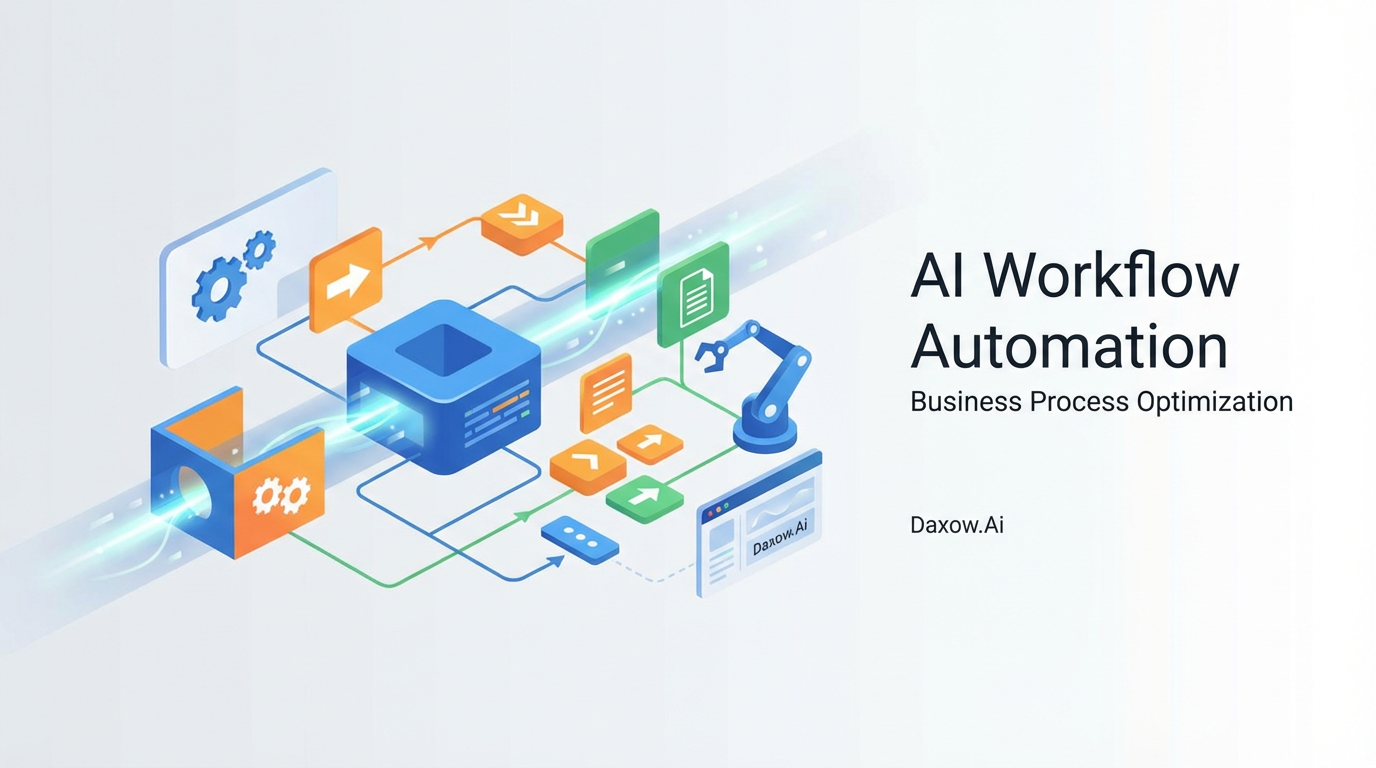
Practical guide to AI workflow automation for optimizing business processes—assess opportunities, design AI agents, run pilots, and measure ROI with Daxow.ai.
AI workflow automation for business process optimization: Practical strategies and use cases for decision-makers
Estimated reading time: 15 minutes
Key Takeaways
- AI workflow automation reduces manual tasks, improves accuracy, and enhances customer experience across industries.
- Effective automation focuses on high-impact, repetitive processes with measurable KPIs and ROI.
- Design principles emphasize business outcomes, human-in-the-loop models, data quality, and modular, auditable automation.
- Daxow.ai provides end-to-end custom AI automation solutions integrated with existing business systems.
- A phased implementation framework and governance practices ensure secure, scalable, and compliant deployments.
Table of Contents
- Why AI workflow automation for business process optimization matters now
- Assessing opportunity: where to apply AI workflow automation for business process optimization
- Design principles for AI workflow automation for business process optimization
- Practical use cases across industries
- Implementation framework: from discovery to production
- Technology and governance considerations
- Measuring impact and calculating ROI
- Common pitfalls and how to avoid them
- How Daxow.ai builds AI agents and automations that deliver business value
- Frequently Asked Questions
Why AI workflow automation for business process optimization matters now
AI-driven workflow automation converts repetitive, rules-based, and semi-structured work into reliable, scalable processes. The business case is clear:
- Reduce manual tasks: Free teams from repetitive work so they can focus on higher-value activities.
- Improve consistency and accuracy: AI systems reduce human error in data capture, routing, and decisioning.
- Increase productivity: Automations accelerate cycle times and throughput.
- Improve customer experience: Faster response times and consistent support increase satisfaction and retention.
- Capture hidden capacity: Automation often delivers more capacity than hiring additional staff at lower cost.
These outcomes are achieved by combining AI agents, workflow orchestration, integrations with business systems, and clear governance. Daxow.ai specializes in designing and delivering these integrated solutions end-to-end.
Assessing opportunity: where to apply AI workflow automation for business process optimization
Identify high-impact processes
Start with processes that share these characteristics:
- High volume and predictable patterns (e.g., ticket triage, invoice processing).
- Repetitive tasks that consume significant FTE hours.
- Processes that rely on semi-structured documents or data (emails, PDFs).
- Workflows where faster response yields direct revenue or retention benefits.
Measure baseline metrics
Before building automation, capture these KPIs:
- Average handling time (AHT) per task.
- Error and rework rates.
- Throughput (tasks per day/week).
- Cost per transaction.
- Customer response time and Net Promoter Score (NPS).
These baselines let you quantify automation benefits and compute ROI.
Design principles for AI workflow automation for business process optimization
Build around business outcomes
Design automation with the end goal in mind: cost reduction, faster time-to-resolution, or increased lead conversion. Map the process steps to outcomes and prioritize high-impact automations.
Hybrid models: human-in-the-loop where it matters
Not every decision should be fully autonomous. Use AI agents to handle routine cases and escalate exceptions to humans. This balances speed and risk.
Data-first approach
AI systems require quality data and consistent access. Ensure integrations to CRMs, ERPs, document stores, and communication platforms are built early.
Modular and auditable automations
Design automations as modular components (data extraction, validation, decisioning, execution) with logging and version control. This supports governance and continuous improvement.
Practical use cases across industries
Customer support automation
Use case:
- Automate ticket triage, intent classification, and initial response with AI agents.
- Perform knowledge-base search and auto-suggest replies to agents.
- Route complex tickets to specialists and create follow-up tasks.
Business benefits:
- Reduce manual tasks for support agents.
- Shorter response times and higher first-contact resolution.
- Scalable during peak demand without proportional headcount increases.
How Daxow helps:
- Design AI agents that integrate with your helpdesk.
- Build workflow automation for triage, SLA enforcement, and analytics.
Sales and lead qualification
Use case:
- Automate lead scoring using historical CRM data and enrichment from external sources.
- AI agents perform initial outreach, qualify leads via conversational workflows, and update CRM records.
Business benefits:
- Faster qualification cycles.
- Higher conversion rates due to timely follow-up.
- Sales teams focus on high-probability deals.
How Daxow helps:
- Implement AI-powered lead qualification pipelines.
- Integrate with CRMs and marketing automation platforms to close the loop.
Finance and accounts payable automation
Use case:
- Intelligent document processing (IDP) extracts invoice data from PDFs and emails.
- Automate matching, exception handling, and payment initiation.
Business benefits:
- Reduced invoice processing time and late payment penalties.
- Lower error rates in payment data.
- Lower operational cost per invoice.
How Daxow helps:
- Build IDP systems tailored to your invoice formats.
- Orchestrate approvals and integrate with ERPs for full end-to-end automation.
HR and employee onboarding
Use case:
- AI-driven onboarding workflows that collect documents, perform background checks, and provision accounts.
- Chatbot handles common HR queries and schedules orientation tasks.
Business benefits:
- Faster time-to-productivity for new hires.
- Reduced administrative load for HR teams.
- Better compliance with consistent document capture and audit trails.
How Daxow helps:
- Create secure automations for sensitive HR data.
- Integrate with HRIS and identity providers.
Healthcare administrative automation
Use case:
- Automate patient intake, insurance verification, and prior authorization submissions.
- Extract and normalize data from clinical documents.
Business benefits:
- Faster patient throughput.
- Reduced claim denials and faster reimbursements.
- Lower administrative overhead.
How Daxow helps:
- Design compliant workflows that meet healthcare data regulations.
- Connect to EHRs and payment systems securely.
Real estate operations
Use case:
- Automate property listing ingestion, lease document processing, and tenant support via chatbots.
- Schedule viewings and manage maintenance requests automatically.
Business benefits:
- Faster listing updates and conversion.
- Better tenant satisfaction and reduced vacancy times.
How Daxow helps:
- Build integrations to property management systems and CRMs.
- Deploy AI agents that handle multi-channel tenant interactions.
Implementation framework: from discovery to production
1. Discovery and process mapping
- Conduct workshops to map current workflows and pain points.
- Quantify baseline metrics and prioritize automations by ROI and complexity.
Deliverables:
- Process maps
- Opportunity backlog
- Baseline KPIs
2. Data readiness and integration design
- Inventory data sources and access methods.
- Design secure integrations with CRMs, ERPs, document stores, and messaging channels.
Deliverables:
- Data schema and access plan
- Integration architecture
3. Prototype and pilot
- Build an MVP that automates a bounded scope (e.g., invoice OCR + matching or ticket triage).
- Run a pilot to validate accuracy, cycle time improvements, and user acceptance.
Deliverables:
- Pilot automation
- Performance metrics and learnings
4. Scale and productionize
- Harden the solution with monitoring, error handling, and governance.
- Deploy phased rollouts across teams and regions.
Deliverables:
- Production-grade automation
- Runbooks and SLA definitions
5. Continuous improvement and analytics
- Use operational data to retrain models and refine rules.
- Monitor KPIs and adapt automations as processes evolve.
Deliverables:
- Continuous improvement roadmap
- Dashboards for business metrics
How Daxow supports each stage:
We run discovery workshops, design integrations, build and test prototypes, and manage rollouts. Our teams handle model tuning, observability, and compliance so your organization realizes ROI faster.
Technology and governance considerations
Security and compliance
- Ensure data encryption in transit and at rest.
- Implement role-based access and audit logs.
- Align automations with industry regulations (e.g., healthcare, finance).
Model transparency and explainability
- Use explainable AI techniques for decisioning models in regulated contexts.
- Keep human-overrides and audit trails for high-risk decisions.
Integration and API strategy
- Prefer API-first integrations for reliability.
- Use message queues and orchestration layers for scalability.
Change management and adoption
- Provide training for staff who will interact with AI agents.
- Start small and demonstrate wins to build organizational buy-in.
Measuring impact and calculating ROI
Common ROI components
- Labor savings: reduction in FTE hours after automation.
- Throughput gains: additional transactions processed per period.
- Error reduction: lower rework and correction costs.
- Revenue uplift: higher conversion rates or faster collections.
Example ROI calculation (illustrative)
Process: invoice processing
Baseline: 1,000 invoices/week, 30 minutes per invoice = 500 hours/week
After automation: average handling time reduced to 6 minutes for 80% of invoices; 20% require human exception handling (30 minutes)
New weekly hours = (800 invoices × 0.1 hrs) + (200 invoices × 0.5 hrs) = 80 + 100 = 180 hours
Labor hours saved = 320 hours/week
If fully loaded FTE cost = $40/hour, weekly savings = $12,800 → annualized ≈ $665,600
This simplified example demonstrates how even modest reductions in handling time can yield large savings. Daxow builds these calculations into proposals so you can see expected payback periods.
Common pitfalls and how to avoid them
Over-automation
- Pitfall: Automating without human oversight for edge cases.
- Avoidance: Implement human-in-the-loop and phased automation.
Ignoring data quality
- Pitfall: Poor input data leads to poor AI performance.
- Avoidance: Invest in data cleaning and standardization before model training.
Underestimating integration complexity
- Pitfall: Siloed systems make data access and orchestration difficult.
- Avoidance: Conduct thorough API and systems audits during discovery.
Lack of governance
- Pitfall: No audit trails or access controls.
- Avoidance: Build governance policies and monitoring from day one.
How Daxow.ai builds AI agents and automations that deliver business value
- Discovery-led design: We start by mapping processes and quantifying ROI opportunities.
- Custom AI agents: We build agents that can read, reason, and act across systems — from extracting data to executing transactions.
- End-to-end automation: From document ingestion to CRM updates and payment processing, we automate full workflows, not just point solutions.
- Systems integration: Our engineers connect automations to your existing tech stack securely and reliably.
- Operationalization and support: We deliver monitoring, retraining, and governance so automations remain accurate and compliant.
- Measurable outcomes: Every project includes KPI baselines, success criteria, and ROI models.
Typical engagement flow with Daxow.ai
- Workshop and opportunity assessment.
- Pilot implementation of a high-value use case.
- Scale-up and production rollout.
- Ongoing optimization and managed services.
Frequently Asked Questions
What types of business processes are best suited for AI workflow automation?
Processes that are high volume, repetitive, rules-based, or involve semi-structured data such as invoices, ticket triage, or lead qualification are ideal candidates.
How does Daxow.ai ensure the security and compliance of AI automations?
We implement data encryption, role-based access control, audit logging, and design solutions aligned with industry regulations like healthcare and finance.
Can I integrate AI automations with my existing CRM or ERP?
Yes, Daxow.ai specializes in building secure, reliable integrations with your current business systems to enable seamless end-to-end automation.
How quickly can I expect to see ROI from automation projects?
This varies by use case but with proper discovery, baseline measurement, and phased rollout, many clients see measurable savings and productivity gains within months.