
AI Workflow Automation: Optimize Business Processes
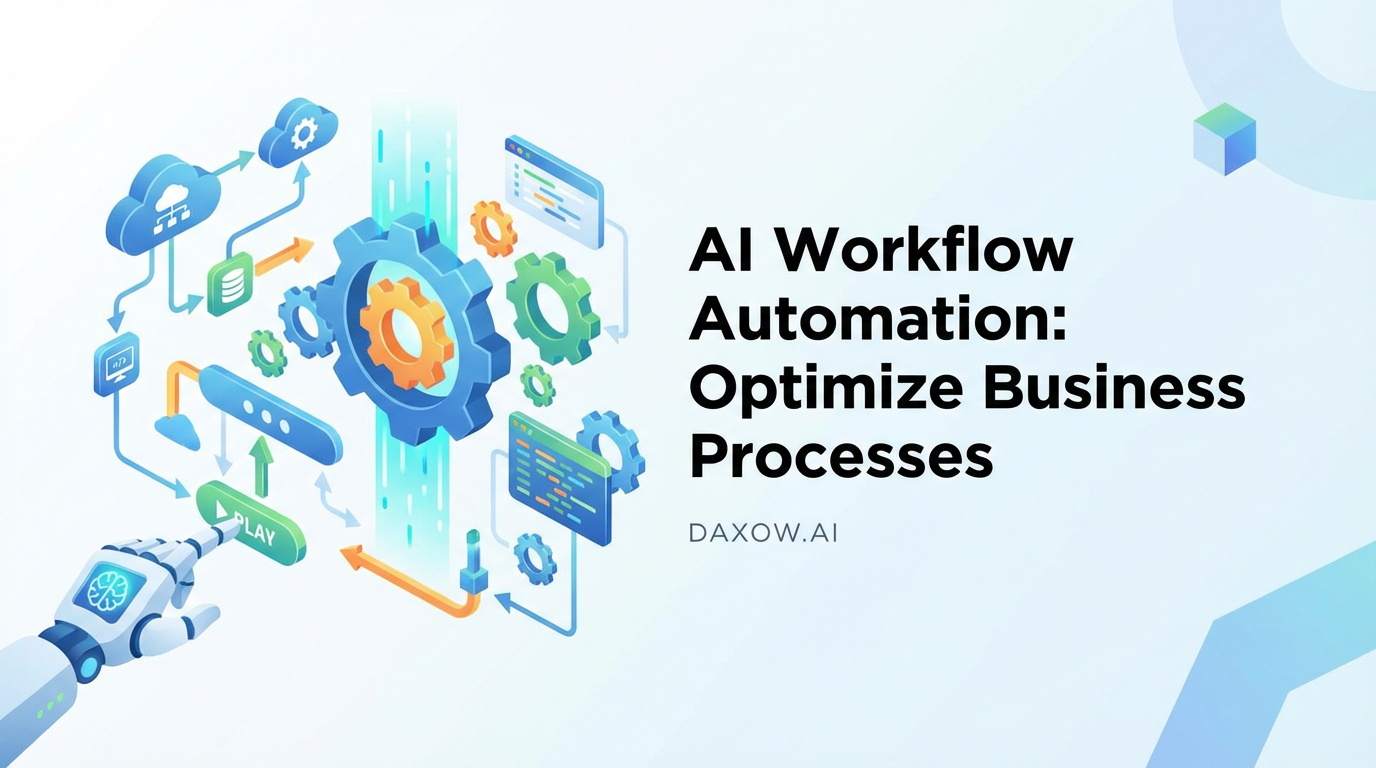
Practical guide to AI workflow automation that reduces manual work, boosts productivity, and delivers measurable ROI with industry use cases and a clear roadmap.
AI Workflow Automation for Business Process Optimization
Estimated reading time: 15 minutes
Key Takeaways
- AI workflow automation integrates intelligent agents with workflow orchestration to optimize business processes.
- Benefits include reduced manual tasks, improved productivity, enhanced accuracy, better customer experience, and cost optimization.
- Measurable outcomes focus on cycle time reduction, error minimization, and improved customer satisfaction metrics.
- Practical use cases span various industries including technology, finance, healthcare, retail, and manufacturing.
- A structured implementation roadmap guides organizations from discovery through scaling with governance and security controls.
- Daxow.ai offers end-to-end AI automation services designed to deliver measurable ROI and scalable business value.
Table of Contents
- AI Workflow Automation for Business Process Optimization
- Business Value and Measurable Outcomes
- Industry Use Cases and Practical Examples
- Implementation Roadmap — From Process Discovery to Scale
- Technical Architecture and Integrations
- Governance, Security, and Compliance
- Practical Considerations and Common Pitfalls
- How Daxow.ai Helps You Implement AI Workflow Automation
- Next Steps — Start Your Automation Journey Today
- Frequently Asked Questions
AI Workflow Automation for Business Process Optimization
AI workflow automation for business process optimization is no longer a theoretical advantage — it has become a strategic imperative for companies seeking to reduce manual tasks, boost productivity, and improve customer experience. Advances in AI agents, large language models, and integrations with existing business systems enable organizations to automate knowledge work, orchestrate cross-system processes, and free teams to focus on higher-value activities. This article explains how AI workflow automation drives measurable business value, provides practical use cases across industries, and outlines an implementation roadmap you can apply today.
What this means for your organization
AI workflow automation combines rule-based workflow orchestration with intelligent AI agents that can interpret unstructured inputs, make decisions, and execute tasks across systems. The result is end-to-end process automation that not only speeds up routine tasks but also adapts dynamically to exceptions, learns from data, and integrates with CRMs, ERPs, support platforms, and document repositories.
Core benefits
- Reduce manual tasks by automating repetitive work such as data entry, ticket triage, and document processing.
- Improve productivity through faster cycle times and higher throughput without proportional headcount increases.
- Increase accuracy and compliance by reducing human error and producing auditable trails.
- Enhance customer experience via 24/7 intelligent support and faster resolution times.
- Optimize costs and ROI by reallocating staff to revenue-generating or strategic work.
Key enablers
- Large language models and AI agents for natural language understanding and decision-making.
- Modern integration platforms and APIs for connecting disparate business systems.
- Workflow engines to orchestrate multi-step processes with human-in-the-loop controls.
- Secure cloud infrastructure and data governance frameworks to manage risk.
Business Value and Measurable Outcomes
How to quantify impact
To turn automation into a business case, map current process metrics to target outcomes. Typical KPIs include:
- Cycle time reduction (hours/days saved per process)
- Full-time equivalent (FTE) reduction or redeployment
- Error rate reduction and compliance improvements
- Customer satisfaction (CSAT) and Net Promoter Score (NPS)
- Lead-to-close time and conversion lift
Build a simple ROI model:
- Calculate current cost: time per case × number of cases × average labor cost.
- Estimate automation uplift: percentage reduction in manual time or error rate.
- Estimate implementation and operating costs: one-time build plus ongoing cloud/compute and maintenance.
- Project payback period and 12–24 month ROI.
Example (illustrative)
A support center handles 50,000 tickets per year at an average handling time of 12 minutes. Automating initial triage and response for 40% of tickets reduces handling time by 8 minutes on those tickets. The labor savings quickly offset build and operating costs, and improvements in first-response time increase CSAT and reduce escalations.
Operational efficiencies that matter
- Faster response and throughput: Shorter lead times across sales, onboarding, and support.
- Reduced rework: Fewer manual corrections from automated data extraction and validation.
- Scalability: Peak volumes handled without linear increases in headcount.
- Better resource utilization: Employees focused on exceptions, upselling, and innovation.
Industry Use Cases and Practical Examples
Technology and SaaS
- AI agents for customer onboarding: Automated account setup, entitlement checks, and configuration based on contract data.
- Sales automation: Intelligent lead qualification bots that scrape inbound data, score leads, and create prioritized opportunities in your CRM.
- Support automation: Automated troubleshooting flows integrated with knowledge bases and remote diagnostics.
E‑commerce and Retail
- Order exception handling: AI identifies orders with address or inventory issues, corrects likely errors, or routes high-value exceptions for manual review.
- Customer support automation: Conversational agents handle order tracking, returns, and refunds with dynamic escalation.
- Personalized promotions: Automated workflows that connect customer behavior signals to campaign engines and CRM segments.
Finance and Banking
- Document automation: Intelligent data extraction from invoices, KYC documents, and loan applications, feeding downstream systems.
- Compliance workflows: Automated monitoring, alerting, and case creation for suspicious transactions.
- Accounts reconciliation: AI-assisted matching and exception resolution across disparate ledgers.
Healthcare
- Patient intake automation: Extract patient data from forms, validate against records, and schedule appointments.
- Prior authorization workflows: Automate data gathering, request generation, and follow-up with payers.
- Clinical documentation: Assist clinicians with summarization and coding to reduce administrative burden.
Real Estate and Property Management
- Lease processing: Extract lease terms, automate renewals and notices, and manage maintenance requests via AI agents.
- Tenant communication automation: Chatbots for routine inquiries and automated escalation for urgent issues.
- Valuation workflows: Combine market data and internal records to auto-generate preliminary valuations.
Manufacturing and Logistics
- Procurement automation: Automate purchase order creation, supplier onboarding, and exception handling.
- Inventory optimization workflows: AI-driven reordering and cross-system orchestration for fulfillment.
- Quality assurance: Automate inspection data capture and follow-up workflows.
HR and Administration
- Resume screening and candidate qualification: AI agents extract and score candidate information and schedule interviews.
- Employee onboarding automation: Orchestrate IT provisioning, compliance training, and document collection.
- Payroll exception handling: Detect anomalies and automate case routing.
Implementation Roadmap — From Process Discovery to Scale
Phase 1 — Process discovery and prioritization
- Map current workflows and quantify manual effort and pain points.
- Prioritize processes with high volume, repeatability, and measurable outcomes.
- Daxow approach: We run targeted workshops and time-motion analysis to identify the highest-value automation opportunities.
Phase 2 — Design and prototyping
- Define the end-to-end process, data inputs, decision points, and human checkpoints.
- Build lightweight prototypes or pilots focused on a single, high-impact use case.
- Validate with business users and iterate.
Phase 3 — Integration and build
- Connect the AI agent and workflow engine to systems of record (CRM, ERP, support platforms).
- Implement data extraction, validation, and transformation layers.
- Include test suites and logging for observability.
Phase 4 — Pilot, measure, and refine
- Run the automation in a controlled environment.
- Measure KPIs against baseline and adjust models and rules.
- Expand the scope as confidence grows.
Phase 5 — Scale and governance
- Roll out across departments or geographies, with standardized monitoring and SLA tracking.
- Establish governance for model updates, data privacy, and auditability.
Technical Architecture and Integrations
Components to plan for
- Data ingestion layer: APIs, connectors, file imports, and RPA for legacy systems.
- AI layer: LLMs, domain models, and AI agents for decision making and natural language interfaces.
- Workflow orchestration: Engines to manage stateful processes and human approvals.
- Integration bus: Secure connectors to CRM, ERP, ticketing, and other business systems.
- Monitoring and observability: Dashboards for throughput, error rates, and model performance.
Integration best practices
- Use idempotent operations to avoid duplicate actions.
- Maintain canonical records of process state.
- Implement role-based access and encrypted secrets management.
- Ensure end-to-end tracing for compliance and troubleshooting.
Governance, Security, and Compliance
Data governance essentials
- Clear data lineage and documented sources.
- Access controls and least-privilege policies.
- Data retention and deletion policies to meet regulatory requirements.
Model governance
- Version control for models and prompts.
- Human-in-the-loop review for high-risk decisions.
- Continuous monitoring for drift and periodic revalidation.
Security controls
- Encryption in transit and at rest.
- Secure API gateways and token management.
- Audit logs and tamper-evident records for regulated environments.
Practical Considerations and Common Pitfalls
Avoid these mistakes
- Over-automating without exception management: Not every path should be fully automated — design for human escalation.
- Neglecting data quality: Automation amplifies bad data; invest in cleansing and validation.
- Skipping measurable goals: Deploy with clear KPIs and a measurement plan.
- Ignoring integration complexity: Underestimating legacy systems and manual workarounds increases cost and timelines.
- Treating AI as a turnkey replacement: AI agents augment workflows; plan for training, feedback loops, and updates.
How Daxow.ai Helps You Implement AI Workflow Automation
End-to-end services
- Process analysis and discovery: We map your current workflows, quantify manual tasks, and identify high-impact automation candidates.
- Custom AI agents and workflow automation: We design and build AI agents that execute real tasks — from lead qualification to document automation and support orchestration.
- System integrations and data connectivity: We connect AI systems to CRMs, ERPs, support platforms, and bespoke databases to enable seamless end-to-end automation.
- Pilot to scale delivery: We run pilots, measure impact, and scale proven automations with governance and observability.
- Ongoing optimization: Continuous monitoring, model updates, and ROI tracking to maximize long-term value.
Business outcomes you can expect
- Reduced operational costs through targeted automation of repetitive tasks.
- Faster time-to-value with modular pilots that transition into enterprise-scale automations.
- Improved productivity as teams shift from manual work to strategic activities.
- Stronger ROI from automations directly tied to revenue, retention, or operational savings.
Next Steps — Start Your Automation Journey Today
If your organization is ready to reduce manual tasks, boost productivity, and capture the business value of AI automation, Daxow.ai can help. Our structured approach identifies the highest-impact processes, designs resilient AI agents, and delivers secure, scalable workflow automation integrated with your systems.
Book a free consultation or request a process analysis for your company to identify the first high-value automations and build a clear roadmap to production. Contact us to build a custom AI system that transforms your operations and delivers measurable ROI.
Frequently Asked Questions
What types of business processes are best suited for AI workflow automation?
Processes with high volume, repeatability, and structured or semi-structured data inputs are ideal candidates. Examples include customer support ticket triage, invoice processing, and employee onboarding workflows.
How does AI workflow automation improve customer experience?
By providing faster response times, 24/7 intelligent support, and adaptive processes that reduce errors and escalations, AI automation enhances overall customer satisfaction and retention.
What are the key security considerations when implementing AI automation?
Key considerations include data encryption at rest and in transit, secure API access, role-based access controls, and tamper-evident audit trails to comply with regulatory requirements.
How can I measure the ROI of AI workflow automation?
Measure ROI by calculating reductions in manual labor time, error rates, customer escalations, and operational costs, then compare these savings against implementation and ongoing operation expenses.