
AI Workflow Automation for Business Processes: A Practical Guide
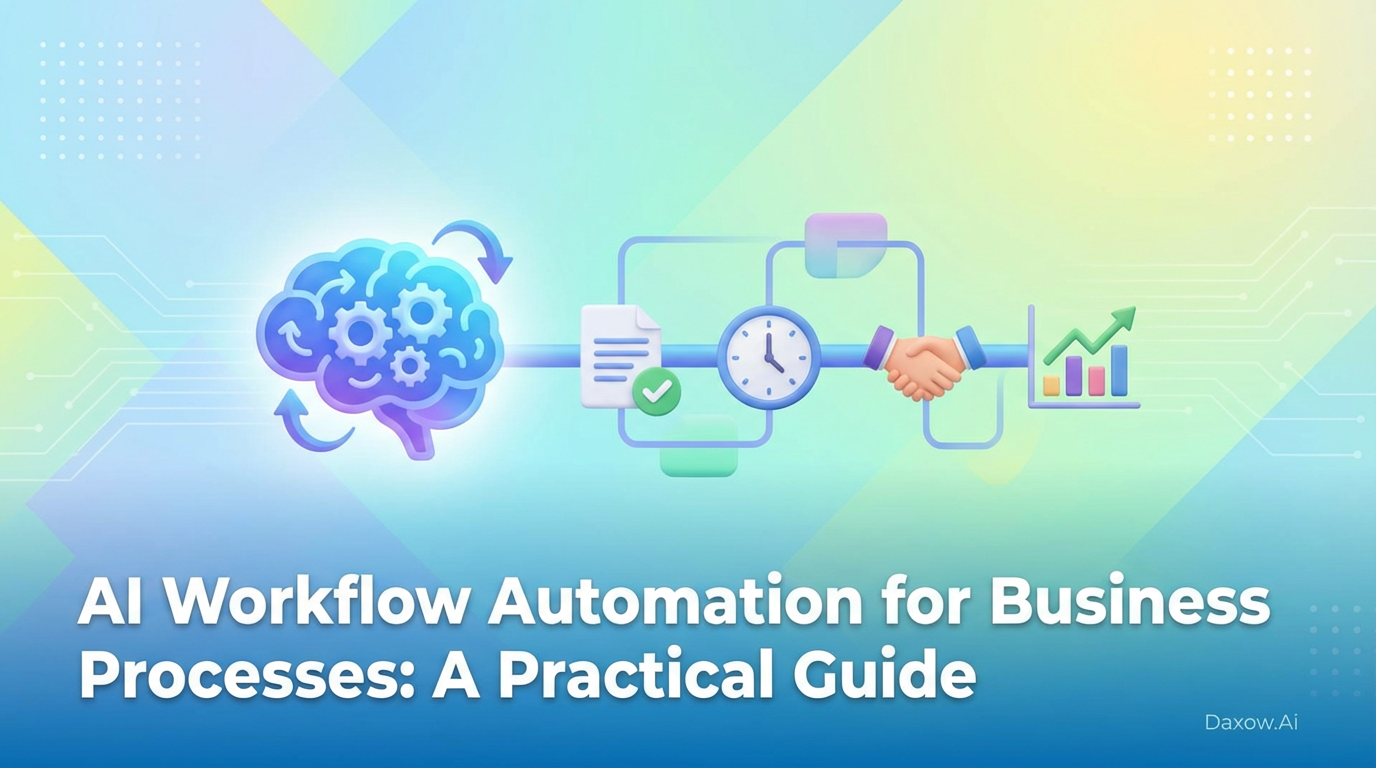
Discover how AI workflow automation streamlines business processes, boosts ROI, and how Daxow.ai builds custom AI agents and implementation roadmaps.
AI workflow automation for business processes: What it is and why it matters
Estimated reading time: 15 minutes
Key Takeaways
- AI workflow automation transforms business operations by reducing manual tasks and enabling data-driven processes.
- AI agents differ from traditional automation by adapting to variability and executing multi-step workflows end-to-end.
- Businesses experience significant productivity gains, cost reductions, and risk mitigation through AI automation.
- Industry-specific use cases demonstrate how AI optimizes workflows in e-commerce, finance, healthcare, real estate, HR, and sales.
- A practical, step-by-step framework helps organizations implement, monitor, and scale AI workflow automation successfully.
- Daxow.ai offers tailored AI agents, seamless integrations, and comprehensive support for measurable automation ROI.
Table of Contents
- AI workflow automation for business processes — core concepts and business impact
- Measurable benefits of AI automation for business processes
- Use cases — AI workflow automation for business processes across industries
- Designing and implementing AI workflow automation — a practical framework
- Technical considerations and system integrations
- Common pitfalls and how to avoid them
- How Daxow.ai helps businesses implement AI workflow automation
- Getting started — a practical next step
- Frequently Asked Questions
AI workflow automation for business processes — core concepts and business impact
What we mean by AI workflow automation
AI workflow automation combines traditional workflow orchestration with artificial intelligence capabilities — natural language understanding, document processing, predictive models, and decision automation — to execute multi-step business processes with minimal human intervention. Unlike rules-only automation, AI automation adapts to variability in inputs and can handle unstructured data, learn patterns, and make contextual decisions.
Why it matters for decision-makers
- Reduce manual tasks: Automation replaces repetitive, error-prone human work such as data entry, triage, and basic decisioning.
- Improve productivity: Teams can focus on higher-value activities; operations scale without linear headcount growth.
- Improve customer experience: Faster responses, 24/7 availability, and consistent outcomes increase satisfaction and retention.
- Lower cost and increase ROI: Faster cycle times and fewer errors reduce operational costs and accelerate revenue recognition.
- Enable data-driven processes: AI extracts actionable insights from unstructured content and connects systems for seamless workflows.
How AI agents differ from traditional automation
- AI agents are task-executing entities that can interpret human language, access systems through APIs, and make decisions across multiple steps. They are designed to execute tasks end-to-end, not just trigger single actions.
- Traditional RPA typically follows brittle UI-level scripts; AI agents use models and APIs to be more resilient and adaptable.
Measurable benefits of AI automation for business processes
Productivity and efficiency
Industry implementations consistently show productivity gains through automation. Typical improvements include:
- 50–80% reduction in manual processing time for document-heavy workflows (e.g., invoices, claims).
- 30–60% ticket deflection in customer support when AI handles routine queries and triage.
- Shorter sales cycles when lead qualification and follow-ups are automated.
Cost reduction and ROI
- Automating repetitive tasks produces immediate cost savings by lowering FTE hours on transactional work.
- Early pilots usually recover investment within months when automation targets high-volume, low-complexity tasks.
- Key financial levers: labor cost avoidance, error reduction, faster time-to-revenue, and improved utilization of specialized staff.
Risk reduction and compliance
AI automation standardizes processes and maintains audit trails, reducing compliance risk. AI can monitor for anomalies, flag exceptions for human review, and produce documentation for audits.
Use cases — AI workflow automation for business processes across industries
E-commerce and retail
Use case: Order exception handling and returns management
- Problem: High volume of returns and exceptions require manual review — impacting speed and customer satisfaction.
- AI solution: An AI agent reads return requests, classifies reasons (e.g., defective, wrong item, fit), checks order and warranty data via API, processes refunds or creates RMA labels, and escalates only complex cases to humans.
- Impact: Faster processing, fewer manual steps, reduced return fraud, and higher customer satisfaction.
Use case: Product data enrichment and catalog automation
AI extracts product attributes from vendor documents and images, maps to taxonomy, and updates the catalog automatically.
Result: Faster product onboarding and improved search/recommendation accuracy.
Finance and insurance
Use case: Invoice processing and AP automation
- Problem: Manual invoice capture, matching, and approval is time-consuming and error-prone.
- AI solution: Document extraction models read invoices, validate amounts against purchase orders, create AP records in ERP, and route exceptions to finance teams.
- Impact: Reduced processing time, fewer late payments, and improved cash flow visibility.
Use case: Claims triage and fraud detection
AI agents analyze incoming claims, extract narrative and evidence, assess risk using predictive models, and recommend settlement or deeper investigation.
Result: Faster claims resolution and lower leakage.
Healthcare
Use case: Patient intake and clinical documentation
- Problem: Administrative burden on clinicians reduces time with patients.
- AI solution: Natural language intake agents capture symptoms, pre-fill EHR fields, and summarize patient interactions. AI-enabled document automation processes consent forms and insurance verification.
- Impact: Reduced clinician administrative time, faster patient throughput, and higher coding accuracy.
Real estate and proptech
Use case: Lease abstraction and due diligence
- Problem: Reviewing leases and extracting clauses is labor-intensive.
- AI solution: Document AI extracts key terms, expiry dates, and obligations; triggers calendar reminders and compliance workflows.
- Impact: Faster transactions, reduced legal hours, and better portfolio management.
HR and administrative teams
Use case: Candidate screening and onboarding
AI automates resume parsing, initial qualification, scheduling interviews, and onboarding paperwork. AI agents can integrate with ATS and HRIS systems for a seamless experience.
Impact: Shorter time-to-hire, improved candidate experience, and lower HR overhead.
Sales and customer support
Use case: Lead qualification and sales automation
AI agents qualify leads via conversational channels, enrich records from public and internal data, prioritize by predicted conversion probability, and create CRM tasks for sales reps.
Result: Higher lead-to-opportunity conversion and more productive sales teams.
Use case: Customer support automation
- AI chatbots handle routine queries, process refunds, and escalate issues with contextual summaries. Integration with ticketing systems ensures consistent case handling.
- Impact: Higher first-contact resolution, reduced ticket volume, and lower support costs.
Designing and implementing AI workflow automation — a practical framework
Step 1 — Process discovery and prioritization
- Map existing processes and identify volumes, cycle times, cost per transaction, and pain points.
- Prioritize processes with high volume, repetitive tasks, structured decision points, and measurable KPIs.
Step 2 — Data assessment and preparation
- Evaluate data sources: documents, emails, CRM records, ERP logs.
- Address data quality, labeling needs, and integration points.
- Key outcome: a prioritized dataset pipeline that supports model training and automation reliability.
Step 3 — Prototype and pilot with an AI agent
- Build a narrow-scope pilot where the AI agent automates a subset of the process end-to-end.
- Validate accuracy, exception rates, and operational impacts.
- Use an iterative test-and-learn approach to refine models and business rules.
Step 4 — Integration and orchestration
- Integrate AI agents with CRMs, ERPs, ticketing systems, and communication channels via APIs.
- Implement workflow orchestration that combines AI decisions with human review gates.
Step 5 — Monitoring, governance, and continuous improvement
- Monitor accuracy, throughput, error rates, and business KPIs.
- Establish governance for model retraining, drift detection, and exception handling.
- Iterate on models and rules based on feedback loops.
KPIs to measure success
- Reduction in manual processing time (hours/day or %).
- Ticket deflection rate and first-contact resolution.
- Time-to-resolution or processing cycle time.
- Cost per transaction and headcount savings.
- Conversion rates for sales automation and lead-to-opportunity velocity.
- Model accuracy and exception rates.
Technical considerations and system integrations
Data connectivity and systems integration
- APIs and connectors: Reliable integrations with CRMs, ERPs, HRIS, and document stores are essential.
- Event-driven orchestration: Use event streams to trigger agents and maintain state across long-running processes.
Security, privacy, and compliance
- Enforce role-based access control, encryption in transit and at rest, and data minimization.
- For regulated industries, maintain audit trails and model explainability for decisions.
Scalability and observability
- Design for horizontal scaling and monitor latency, throughput, and failure modes.
- Implement observability for AI performance (accuracy, drift) and process metrics.
Human-in-the-loop design
- Define clear exception handling and escalation workflows.
- Provide operators with context-rich summaries and suggested actions to speed decision-making.
Common pitfalls and how to avoid them
Over-automation and unrealistic expectations
- Avoid trying to automate everything at once. Start with high-impact, low-complexity processes.
- Best practice: set measurable pilot goals and expand incrementally.
Poor data quality
Garbage in, garbage out. Invest in data cleaning and annotated examples before large-scale training.
Siloed systems and stakeholder misalignment
- Ensure cross-functional alignment between IT, operations, compliance, and business owners.
- Secure executive sponsorship and change-management plans.
How Daxow.ai helps businesses implement AI workflow automation
End-to-end process analysis and discovery
Daxow.ai begins with a structured process analysis that identifies automation opportunities and quantifies potential savings. We map workflows, measure current metrics, and prioritize by business value.
Custom AI agents and solution design
We design AI agents that perform real tasks: read documents, converse with customers, make API calls, and orchestrate multi-step processes. Each agent is tailored to your data, systems, and compliance needs.
Workflow automation and systems integration
Daxow.ai integrates automation into your existing stack — CRMs, ERPs, ticketing systems, and databases — ensuring end-to-end execution and data consistency. Our connectors and API-first designs reduce implementation time.
Pilot, scale, and ROI optimization
We run fast pilots that validate assumptions and deliver measurable outcomes. After a successful pilot, Daxow.ai scales solutions, optimizes for cost and performance, and establishes monitoring and governance frameworks.
Ongoing support, governance, and continuous improvement
Post-deployment, Daxow.ai provides model monitoring, retraining, and process tuning so automation remains accurate and aligned with evolving business needs.
Getting started — a practical next step
Quick assessment checklist
- Identify one high-volume, repetitive process with clear KPIs.
- Confirm data availability (documents, CRM entries, logs).
- Secure a sponsor and a small cross-functional team.
- Define success metrics for a 3-month pilot.
What a Daxow.ai engagement looks like
- Week 0–2: Discovery and process mapping.
- Week 2–6: Prototype AI agent and integrations.
- Week 6–12: Pilot deployment, measuring outcomes.
- Month 3+: Scale, governance, and continuous improvement.
AI workflow automation for business processes delivers clear, measurable value: it reduces manual tasks, improves productivity, standardizes decisions, and frees teams to focus on strategic work. Daxow.ai helps organizations design, build, and scale custom AI agents and automation that integrate with your systems and drive ROI quickly and securely.
Book a free consultation with Daxow.ai to request a process analysis for your company and start automating the workflows that matter most to your business. Contact us to build a custom AI system that reduces costs, increases productivity, and delivers better customer and employee experiences.
Frequently Asked Questions
What distinguishes AI workflow automation from traditional automation?
AI workflow automation leverages AI technologies to handle unstructured data, adapt to variability, and execute multi-step workflows end-to-end, whereas traditional automation generally relies on fixed rules and brittle UI-level scripts.
How can I measure the ROI of AI workflow automation?
ROI can be measured through reduced manual processing time, cost savings, increased throughput, error reduction, faster time-to-revenue, and improved customer or employee satisfaction metrics.
Which industries benefit most from AI workflow automation?
E-commerce, finance, insurance, healthcare, real estate, HR, and customer support are just a few examples of industries where AI workflow automation delivers significant impact and measurable benefits.
What steps should my organization take to get started with AI workflow automation?
Begin with process discovery and prioritization, assess your data, prototype with AI agents, integrate systems, and establish monitoring and governance for continuous improvement, following a structured framework like the one provided by Daxow.ai.