
AI Workflow Automation: Transform Operations & Deliver ROI
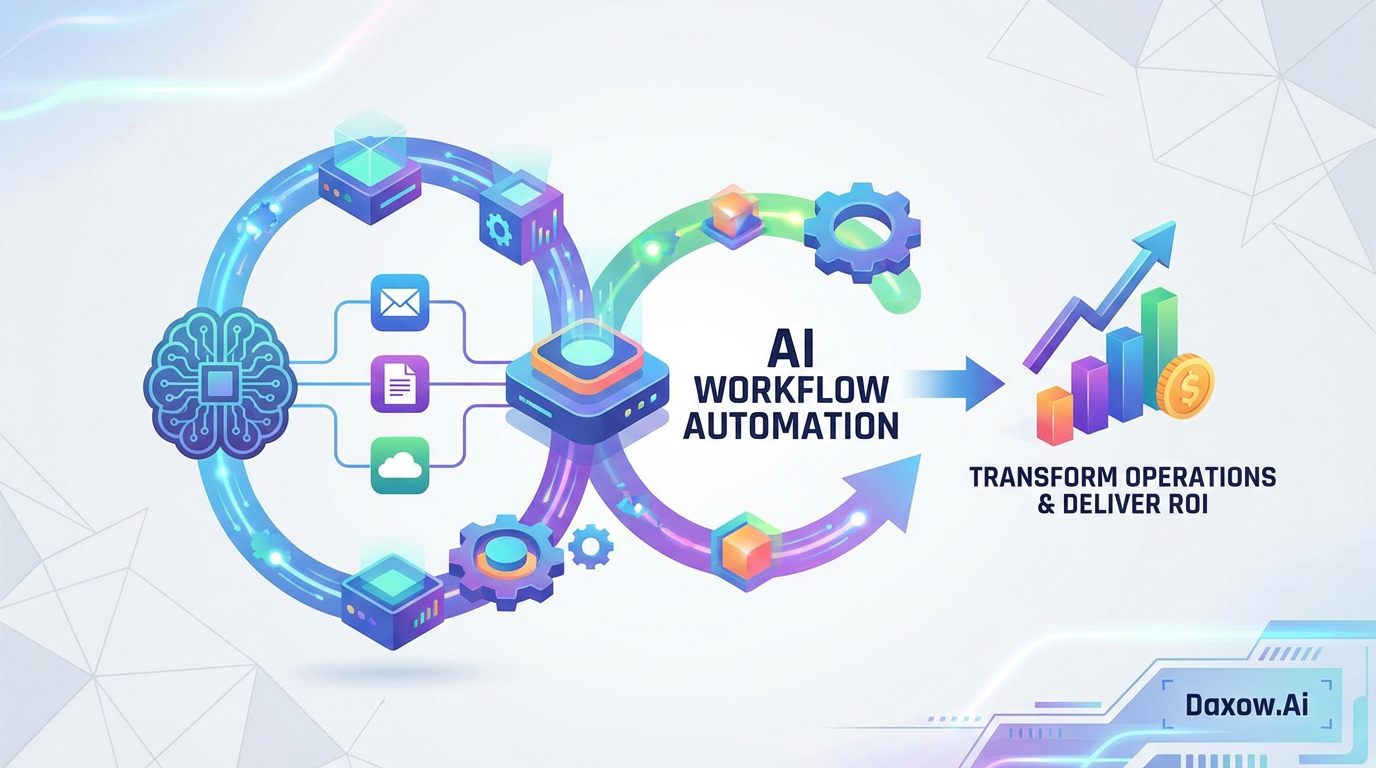
Daxow.ai's AI workflow automation streamlines processes, cuts costs 20-50% and delivers measurable ROI in 6-12 months.
AI Workflow Automation: Transforming Business Operations for the AI Era
Estimated reading time: 15 minutes
Key Takeaways
- AI workflow automation reduces manual tasks, accelerates decisions, and boosts productivity by integrating machine learning and rule-based systems.
- Businesses can expect lower operational costs, significant efficiency gains, faster time-to-decision, and improved compliance.
- Practical use cases span e-commerce, healthcare, finance, real estate, and HR, each benefiting from tailored AI agents and automation stacks.
- Daxow.ai delivers end-to-end automation solutions with a focus on measurable ROI, seamless integrations, and continuous optimization.
- Successful implementation requires a phased, business-aligned approach combined with strong governance and monitoring.
Table of Contents
- AI Workflow Automation: Transforming Business Operations for the AI Era
- Practical Use Cases Across Industries
- How AI Agents and Automation Drive Impact
- Implementation Steps and Best Practices
- Measuring ROI and Scaling Automation
- How Daxow.ai Delivers End-to-End Business Automation
- Getting Started — Practical Next Steps
- Frequently Asked Questions
AI Workflow Automation: Transforming Business Operations for the AI Era
What AI workflow automation means for businesses
AI workflow automation integrates machine learning, natural language processing, and rule-based automation into routine operations. Rather than simply automating a single task, it creates systems that:
- Execute repetitive, rule-based work such as data entry, invoice processing, and ticket triage.
- Analyze patterns and predict outcomes to optimize workflows in real time.
- Reduce errors and increase throughput while freeing employees for higher-value activities.
The result is faster response times, fewer mistakes, and material cost reductions. Early adopters report operational cost improvements in the range of 20–50% for targeted processes, and response times compressed by 30–70% across customer-facing pipelines.
Business outcomes you can expect
When applied correctly, AI workflow automation delivers clear, measurable outcomes:
- Lower operational costs through reduced manual effort and error correction.
- Higher productivity, commonly 3–5x efficiency gains in automated workflows.
- Faster time-to-decision, enabling proactive operations and better customer experiences.
- Improved compliance and auditability with automatic logging and traceability.
Daxow.ai focuses on these outcomes, coupling business-first KPIs with technical design to ensure automation delivers tangible ROI within 6–12 months in most deployments.
Practical Use Cases Across Industries
E-commerce — streamline order-to-cash and customer experience
Problems: Siloed inventory, slow returns processing, high volume of repetitive support tickets.
AI workflow automation delivers:
- Automated order validation, inventory reconciliation, and routing to fulfillment centers.
- Personalization engines that drive product recommendations and dynamic pricing.
- AI agents that triage customer tickets, qualify leads, and route critical issues to human agents.
Business impact: 40% faster fulfillment times, higher conversion rates from personalized experiences, and reduced support headcount for repetitive inquiries.
Daxow deliverable: A modular automation stack that integrates your e-commerce platform, CRM, and fulfillment APIs to automate order lifecycles and support flows.
Healthcare — reduce administrative burden and improve throughput
Problems: High administrative load, appointment no-shows, manual billing reconciliation.
AI workflow automation delivers:
- Automated patient scheduling and reminder systems with adaptive rescheduling.
- Triage chatbots that collect symptom information and escalate urgent cases.
- Document automation for claims processing and billing reconciliation with anomaly detection.
Business impact: Increased patient throughput, improved billing accuracy, and reduced administrative costs while maintaining compliance.
Daxow deliverable: Compliant AI agents that connect EHR systems, scheduling platforms, and billing systems, with audit trails for regulatory needs.
Finance — accelerate reconciliation, compliance, and fraud detection
Problems: Manual invoice processing, long audit cycles, undetected anomalies.
AI workflow automation delivers:
- Automated invoice capture, validation, and three-way matching with vendor systems.
- Predictive models for fraud detection and risk scoring.
- Continuous monitoring and automated reporting to accelerate audits.
Business impact: Shorter audit cycles, lower error rates, and faster close processes.
Daxow deliverable: Secure, auditable automations that integrate with ERP and accounting systems to reduce manual reconciliation and detect anomalies in real time.
Real Estate — faster lead qualification and contract processing
Problems: Slow lead follow-up, manual contract reviews, fragmented listings.
AI workflow automation delivers:
- Automated lead qualification and nurturing sequences based on behavior and criteria.
- Contract parsing and clause extraction to speed reviews and approvals.
- Market data aggregation for real-time valuations and recommendations.
Business impact: Shortened sales cycles, higher lead conversion, and lower legal review overhead.
Daxow deliverable: AI agents that connect listings, CRM, and document management systems to automate qualification and contract workflows.
HR — speed hiring and increase retention
Problems: High volume of resumes, lengthy onboarding, unpredictable churn.
AI workflow automation delivers:
- Resume screening and candidate shortlisting using role-specific models.
- Automated scheduling for interviews and onboarding checklists.
- Predictive analytics for employee churn and personalized retention programs.
Business impact: Up to 50% reduction in hiring time, faster onboarding, and targeted retention actions.
Daxow deliverable: End-to-end recruitment pipelines that integrate ATS, communications, and HRIS systems with AI-driven decision support.
How AI Agents and Automation Drive Impact
What are AI agents and why they matter
AI agents are autonomous software components that perform tasks, make decisions, and learn from outcomes. Unlike simple macros or rule engines, they:
- Process structured and unstructured data (emails, documents, images).
- Execute multi-step workflows across systems without human intervention.
- Adapt based on feedback and changing data patterns.
This agentic approach converts static automation into proactive intelligence, enabling workflows such as dynamic lead scoring, adaptive scheduling, and automatic compliance checks.
Integration and orchestration
True value comes when AI agents are integrated with enterprise systems—CRMs, ERPs, ticketing systems, and custom APIs. Key points:
- Seamless integration ensures data flows without manual exports.
- Orchestration layers coordinate multi-system processes and provide centralized monitoring.
- Auditability and logging maintain compliance and make outcomes explainable.
At Daxow.ai, we build AI agents that orchestrate end-to-end processes, integrate with tools like CRMs and project platforms, and expose dashboards for continuous monitoring and governance.
Implementation Steps and Best Practices
A phased, business-aligned approach
Successful AI automation follows clear phases:
- Discovery and objective-setting: Map processes and select high-impact workflows. Define KPIs (cost reduction, processing time, NPS).
- Data assessment: Audit data quality, accessibility, and compliance constraints. Standardize formats and build pipelines.
- Tool selection and architecture: Choose scalable platforms and integration patterns with security and APIs in mind.
- Cross-functional team building: Combine technical experts, process owners, and change managers.
- Prototype and pilot: Start with non-critical workflows, validate performance, and measure against KPIs.
- Iterate and scale: Retrain models, monitor drift, and expand to adjacent processes.
Best practices and governance
- Start with high-ROI, low-risk processes to demonstrate value quickly.
- Embed compliance and ethics into design from day one.
- Establish monitoring and retraining loops to prevent performance drift.
- Involve IT early to avoid integration bottlenecks and security gaps.
- Use phased rollouts to limit scope creep and secure stakeholder buy-in.
Daxow.ai applies these best practices across every engagement, offering governance templates, retraining schedules, and measurable success criteria to ensure sustained impact.
Measuring ROI and Scaling Automation
Metrics that matter
Track the right KPIs to quantify impact:
- Cost savings and labor hours reduced.
- Throughput and cycle time improvements.
- Error rate reductions and compliance incidents.
- Customer satisfaction (NPS) and conversion lift.
- Time to value and payback period.
Typical ROI and timelines
Organizations implementing AI workflow automation commonly see:
- Payback in 6–12 months from labor savings and efficiency gains.
- 20–50% reductions in operational costs for targeted workflows.
- 30–70% faster process times, depending on the function automated.
Daxow clients often report 3–5x productivity improvements in automated areas and long-term efficiency gains around 25% annually.
Scaling without losing control
When expanding automation:
- Maintain a central catalog of automated processes and outputs.
- Use role-based access and audit logs for governance.
- Standardize retraining cadence to incorporate new data and edge cases.
- Apply lessons from pilots to accelerate subsequent rollouts.
How Daxow.ai Delivers End-to-End Business Automation
From analysis to production
Daxow.ai follows a proven engagement model:
- Process analysis: We map workflows, identify automation opportunities, and quantify potential ROI.
- Solution design: We architect AI agents and integrations tailored to your stack.
- Build and test: Rapid prototyping with real data, followed by controlled pilots.
- Deployment and governance: Secure production rollout with monitoring, retraining, and compliance controls.
- Ongoing optimization: Continuous improvement to expand capabilities and drive long-term value.
Where Daxow adds unique value
- Custom AI agents that execute real tasks, not just recommendations.
- System integrations and data connectivity across CRMs, ERPs, ticketing, and bespoke tools.
- End-to-end automation that reduces manual tasks and improves customer support automation and sales automation simultaneously.
- Clear ROI focus with measurable KPIs and rapid time-to-value.
- Industry experience across e-commerce, healthcare, finance, real estate, and HR.
Getting Started — Practical Next Steps
Quick checklist to evaluate readiness
- Do you have repetitive, manual processes that consume staff time?
- Are your data sources accessible and reasonably clean?
- Do you have measurable KPIs to track automation success?
- Are integrations available for your core systems (API access, connectors)?
If you answered yes to two or more, you likely have high-impact opportunities for AI automation.
How Daxow.ai partners with you
- We begin with a focused process analysis to identify the highest ROI opportunities.
- We deliver a pilot that demonstrates measurable improvements within weeks.
- We scale through governed, phased rollouts that protect operations and maximize value.
Learn more about our approach on the solutions page.
Frequently Asked Questions
What types of tasks can AI workflow automation handle?
AI workflow automation can manage repetitive rule-based tasks such as data entry, invoice processing, ticket triage, document parsing, lead qualification, and more complex workflows involving prediction and adaptation.
How quickly can businesses expect ROI from AI automation?
Most organizations see measurable ROI within 6 to 12 months from labor savings and efficiency gains, depending on the scope and complexity of automated workflows.
Is AI workflow automation secure and compliant?
Yes, when designed with compliance and governance in mind, AI automation solutions integrate audit logging, traceability, and adhere to regulatory standards to ensure data security and compliance.
How does Daxow.ai ensure seamless integration with existing systems?
Daxow.ai specializes in system integrations, connecting AI agents to CRMs, ERPs, ticketing systems, and APIs, ensuring seamless data flow and orchestration without disrupting existing workflows.