
AI Workflow Automation: How Daxow.ai Delivers Measurable ROI
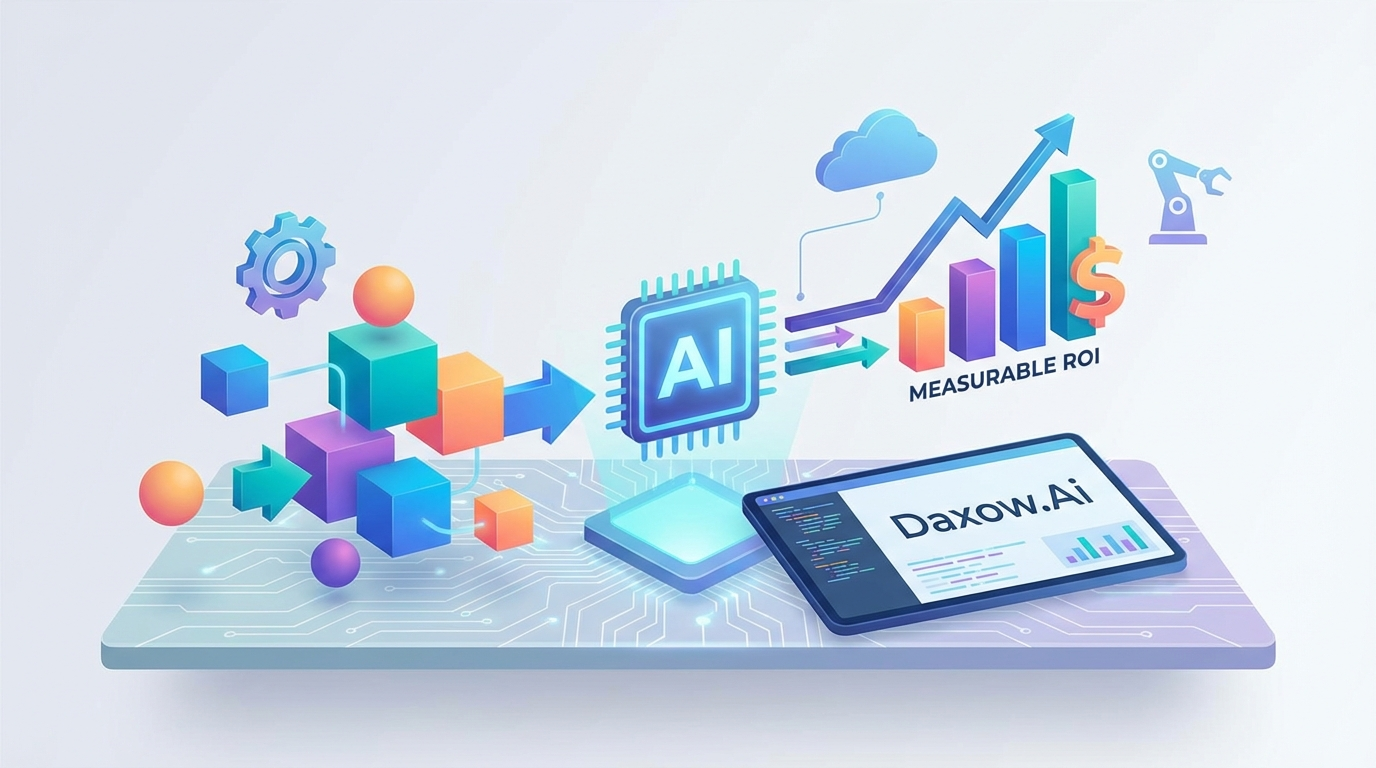
Explore how Daxow.ai builds AI agents and end-to-end workflow automation to cut costs, speed processes, and deliver measurable ROI across industries.
AI Workflow Automation: Transforming Business Operations for the AI Era
Estimated reading time: 12 minutes
Key Takeaways
- AI workflow automation integrates AI into routine processes to boost efficiency and reduce costs.
- Businesses benefit from faster decision-making, higher accuracy, scalability, and improved customer experiences.
- Industry use cases include e-commerce, healthcare, finance, real estate, and HR.
- AI agents provide advanced capabilities beyond traditional automation, enabling context-aware and adaptive actions.
- A phased approach, combined with data governance and stakeholder involvement, ensures successful AI automation deployments.
- Daxow.ai offers custom end-to-end AI automation solutions tailored to business needs with security and compliance at the core.
Table of Contents
- AI Workflow Automation: Transforming Business Operations for the AI Era
- What AI Workflow Automation Means for Businesses
- Practical Use Cases Across Industries
- How AI Agents and Automation Deliver Value
- Implementation Steps and Best Practices
- Measuring ROI and Business Value
- How Daxow.ai Designs and Delivers Custom AI Automation
- Practical Roadmap: What a Daxow.ai Engagement Looks Like
- Frequently Asked Questions
AI Workflow Automation: Transforming Business Operations for the AI Era
A concise definition and the business promise
AI workflow automation integrates artificial intelligence into routine business processes to automate repetitive tasks, enhance decision-making, and scale operations without proportional headcount increases. It combines rule-based automation with intelligent components — AI agents, NLP, predictive models — to handle tasks that previously required human judgment. The business outcomes are clear: faster processing, fewer errors, improved customer satisfaction, and lower operational costs.
Where automation creates immediate value
- Reduce manual tasks such as data entry, invoice reconciliation, and ticket triage.
- Boost productivity by freeing skilled staff to focus on strategic work.
- Improve customer support automation with faster, context-aware responses.
- Enable sales automation that qualifies leads and routes opportunities automatically.
- Deliver business automation across finance, HR, operations, and service functions.
What AI Workflow Automation Means for Businesses
Operational improvements and strategic benefits
AI workflow automation transforms manual, error-prone processes into reliable, measurable systems. Key business benefits include:
- Faster decision-making through predictive analytics and automated approvals.
- Higher accuracy with AI-powered data extraction and validation.
- Scalability: process volume can grow without linear staffing increases.
- Compliance and traceability via logged decisions and configurable rules.
- Customer experience gains from personalized interactions and reduced wait times.
Metrics to track
Focus on tangible KPIs:
- Processing time reduction (%) — target 20–50% improvements in early projects.
- Error rate (target <5% after stabilization).
- Time-to-resolution for support tickets.
- Lead-to-opportunity conversion lifts for sales automation.
- Cost per transaction or cost per incident.
Practical Use Cases Across Industries
E-commerce — from order to repeat customer
Use case: Automate order-to-cash and customer support workflows.
- Tasks automated: inventory checks, fraud scoring, personalized recommendations, returns processing, and support ticket routing.
- Business impact: faster fulfillment, reduced cart abandonment, and higher average order value through tailored upsells.
- Typical KPI improvements: reduced fulfillment time by 30%, customer service response times cut in half.
Healthcare — streamline administrative burden and triage
Use case: Patient scheduling, records reconciliation, and preliminary triage.
- Tasks automated: intake form extraction, eligibility checks, appointment reminders, and symptom-based triage routing.
- Business impact: improved accuracy in patient records, better compliance, and shorter wait times.
- Typical KPI improvements: administrative time reduced by up to 40%, appointment no-shows decreased.
Finance — secure, faster back-office operations
Use case: Invoice processing, fraud detection, and regulatory reporting.
- Tasks automated: invoice data extraction, anomaly detection in transactions, reconciliation, and automated escalations.
- Business impact: lower processing costs, faster close cycles, and stronger audit trails.
- Typical KPI improvements: invoice processing time reduced by 50%, error rates below 5%.
Real Estate — speed up deals and improve lead conversion
Use case: Listing updates, lead nurturing, and contract review automation.
- Tasks automated: market data aggregation, lead scoring, automatic property updates across channels, and document extraction for contracts.
- Business impact: faster deal cycles, higher lead conversion, and reduced administrative overhead.
- Typical KPI improvements: deal closure times shortened, lead qualification rates increased.
HR — smarter hiring and employee support
Use case: Resume screening, onboarding workflows, and internal helpdesk automation.
- Tasks automated: CV parsing, pre-screening questionnaires, onboarding checklist execution, and employee query resolution by bots.
- Business impact: faster hiring, better candidate matching, and more consistent employee experiences.
- Typical KPI improvements: time-to-hire reduced by up to 50%, onboarding completion rates improved.
How AI Agents and Automation Deliver Value
What distinguishes AI agents from traditional automation
Conventional automation executes rules; AI agents add learning, adaptability, and context awareness. They can:
- Interpret unstructured data (emails, contracts, chat logs).
- Make context-aware decisions (prioritize urgent tickets, route leads based on intent).
- Learn and improve from feedback and new data.
Real-world capabilities of AI agents
- Dynamic routing: route high-value leads to senior reps based on intent and opportunity signals.
- Anomaly detection: flag potential fraud or data quality issues in real time.
- Conversational automation: handle multi-turn customer interactions and escalate when necessary.
- Autonomous workflows: trigger cross-system processes (CRM updates, ERP entries, notifications) end-to-end.
Integration and interoperability
For practical impact, AI agents must connect with existing tools: CRMs, ERPs, ticketing systems, and databases. Successful integrations enable:
- Single source of truth for customer and transaction data.
- Automated updates across systems to prevent data silos.
- Secure, auditable flows that align with IT and compliance requirements.
Implementation Steps and Best Practices
A phased, business-aligned roadmap
- Discovery and goal-setting
- Conduct a process audit to identify high-impact automation candidates.
- Define measurable objectives (e.g., reduce invoice processing costs by 30%).
- Use an AI-first scorecard to evaluate readiness.
- Data assessment and preparation
- Audit data quality, completeness, and accessibility.
- Standardize formats and implement secure data pipelines.
- Address privacy and compliance requirements early.
- Tool selection and team composition
- Choose scalable platforms with robust integration capabilities.
- Assemble cross-functional teams: domain experts, data engineers, ML specialists, and product owners.
- Ensure IT involvement for security and governance.
- Prototype and validate
- Start with a controlled pilot on a non-critical but high-impact workflow.
- Validate models using defined metrics (precision, recall, F1 where applicable).
- Measure business KPIs — not just model accuracy.
- Deploy, monitor, and iterate
- Roll out in phases with monitoring dashboards and automated alerts.
- Implement retraining pipelines and feedback loops.
- Regularly review and expand automation scope based on ROI.
Best practices to avoid common pitfalls
- Start small, scale fast: prove value with a pilot before wide deployment.
- Prioritize data governance: poor data quality undermines all AI initiatives.
- Involve stakeholders: business users must be part of design and testing.
- Design for transparency: build explainability into decision points.
- Plan for maintenance: schedule retraining and performance checks to prevent degradation.
Measuring ROI and Business Value
Quantifying impact
ROI for AI workflow automation is typically measurable in months, not years. Key results organizations achieve:
- Processing time reductions of 20–50%.
- Significant reductions in manual labor costs and headcount pressure.
- Error rates driven below 5% for structured processes.
- Payback periods commonly within 6–12 months for targeted deployments.
How to present value to stakeholders
- Build a business case that ties automation improvements to revenue, cost savings, and customer retention.
- Use pilot results to project scaled impact across departments.
- Include soft benefits: improved employee experience, faster insight cycles, and regulatory resilience.
How Daxow.ai Designs and Delivers Custom AI Automation
End-to-end automation tailored to your business
At Daxow.ai, we specialize in designing custom AI systems that automate real business tasks end-to-end. Our approach:
- Process discovery: We map your workflows and identify top automation candidates using a structured audit.
- Custom solution design: We select the right combination of AI agents, workflow automation, chatbots, and integrations to meet your objectives.
- Prototyping and validation: We deliver rapid pilots that demonstrate measurable improvements before full deployment.
- Integration and deployment: We connect AI systems to your CRM, ERP, ticketing, and other tools while ensuring secure data flows.
- Monitoring and continuous improvement: We set up dashboards, alerts, and retraining pipelines to sustain and grow value over time.
Services that align with your needs
- AI Agents that execute tasks and learn from interactions.
- Workflow automation to orchestrate multi-system processes.
- Chatbots & support automation to reduce response times and increase customer satisfaction.
- Lead qualification and sales automation to improve conversion and reduce manual triage.
- Data extraction & document automation to eliminate manual entry and improve accuracy.
- System integrations with CRMs and business tools to remove data silos and enable real-time automation.
Security, compliance, and governance
- Data access controls and encryption.
- Audit logs for traceability.
- Ethical AI practices and human-in-the-loop safeguards where necessary.
Practical Roadmap: What a Daxow.ai Engagement Looks Like
Phase 1 — Discovery (1–3 weeks)
- Process workshops, data readiness assessment, and KPI definition.
- Deliverables: prioritized automation backlog and ROI estimates.
Phase 2 — Pilot (4–8 weeks)
- Build a working prototype for a single workflow.
- Validate performance against KPIs and refine models.
Phase 3 — Scale (2–6 months)
- Integrate automation across systems, onboard users, and enforce governance.
- Implement monitoring, retraining, and a roadmap for next automation waves.
Outcomes clients can expect
- Immediate reduction in manual tasks and faster cycle times.
- Measurable cost savings and improved customer metrics.
- Sustainable automation with continuous improvement and governance.
Frequently Asked Questions
What is AI workflow automation?
AI workflow automation combines artificial intelligence technologies with business process automation to streamline repetitive tasks, improve accuracy, and accelerate decision-making.
How can AI agents improve my business operations?
AI agents enhance traditional automation by adding adaptability, learning capabilities, and context-awareness, enabling smarter, more flexible, and efficient workflows.
What industries benefit most from AI workflow automation?
Key industries include e-commerce, healthcare, finance, real estate, and human resources — but AI workflow automation can add value across nearly every sector.
How does Daxow.ai ensure security and compliance?
Daxow.ai incorporates data access controls, encryption, audit logs, and ethical AI practices to maintain security, traceability, and regulatory compliance throughout automation solutions.