
AI Workflow Automation: Roadmap & Use Cases by Daxow
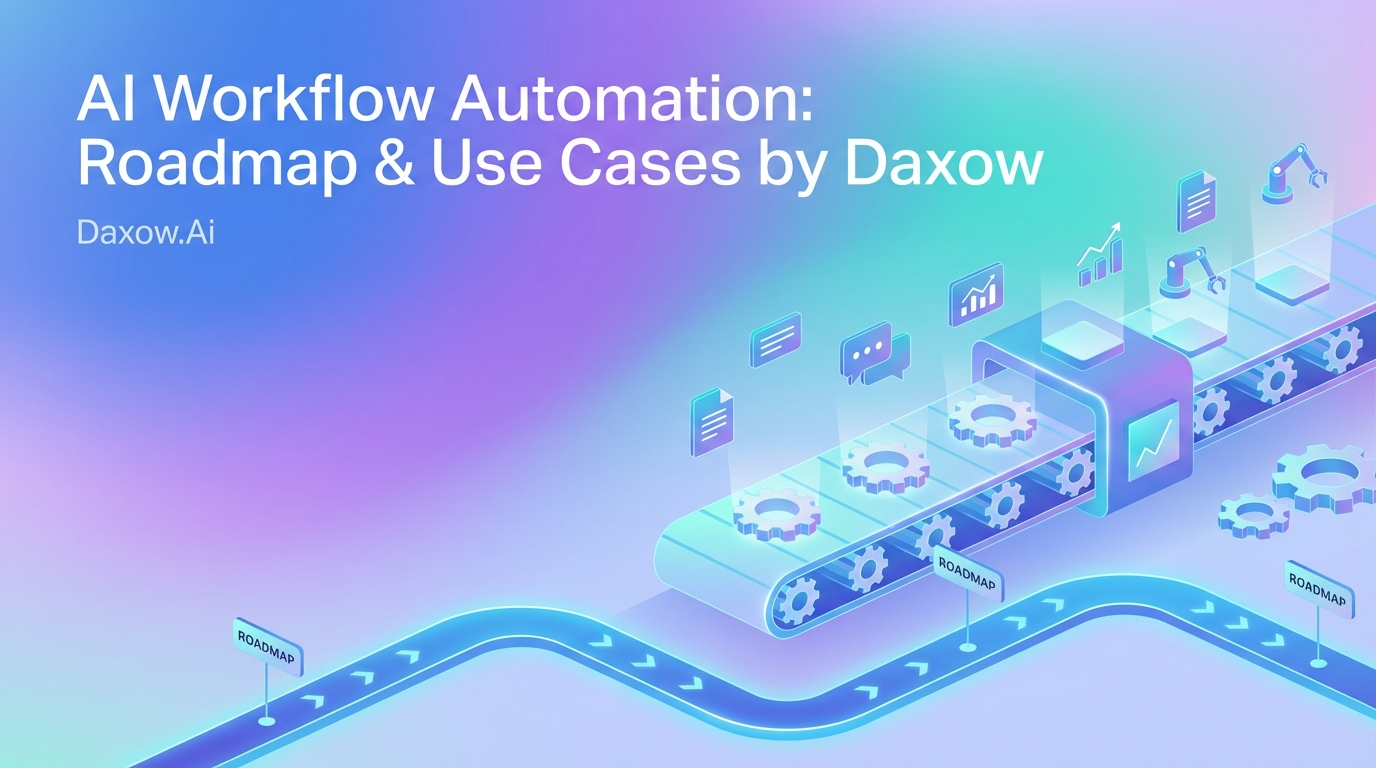
How Daxow.ai builds AI workflow automation to reduce costs, boost productivity, and scale operations, with a practical roadmap, industry use cases, and measurable ROI.
AI Workflow Automation: Transforming Business Operations for the AI Era
Estimated reading time: 15 minutes
Key Takeaways
- AI workflow automation integrates AI agents with rule-based systems to improve productivity and reduce costs up to 40%–50%.
- Industries such as e-commerce, healthcare, finance, real estate, and HR see tangible benefits from tailored AI automations.
- Daxow.ai delivers custom AI solutions linking systems like CRMs and ERPs to automate complex workflows with monitoring and retraining.
- A structured implementation roadmap ensures low-risk deployment, scalability, and continuous ROI measurement.
- Security, compliance, and governance are integral, with strict controls and audit trails embedded in the automation design.
Table of Contents
- AI Workflow Automation: Transforming Business Operations for the AI Era
- Practical Use Cases Across Industries
- How AI Agents and Automation Drive Success
- Implementation Roadmap: From Audit to Scale
- Measuring ROI and Business Value
- Security, Compliance, and Governance
- Getting Started with Daxow.ai
- Frequently Asked Questions
AI Workflow Automation: Transforming Business Operations for the AI Era
AI Workflow Automation: Transforming Business Operations for the AI Era is no longer a theoretical advantage — it is a practical requirement for organizations that want to scale, reduce costs, and improve customer experience. By integrating AI agents and automation into routine processes, companies convert repetitive, error-prone work into reliable, measurable systems that operate 24/7. This article explains what AI workflow automation means for your business, presents actionable implementation steps, provides industry use cases, and shows how Daxow.ai designs and deploys custom AI solutions to reduce manual tasks, improve productivity, and maximize ROI.
What AI workflow automation means for your organization
AI workflow automation combines rule-based automation with intelligent models — machine learning, natural language processing, and decision engines — to autonomously execute multi-step processes. Instead of delegating repetitive tasks to staff, businesses deploy AI agents that handle data entry, document processing, lead qualification, ticket routing, and more. The result is measurable: organizations commonly report up to 40% productivity gains, significant error reductions, and faster decision-making when automation is implemented properly.
Why it matters now
- Scalability: Processes scale without proportional headcount increases.
- Resilience: Automated systems maintain consistent performance during demand spikes.
- Customer experience: Faster response times and personalized interactions increase satisfaction and retention.
- Cost control: AI automation reduces operational costs by 20–50% in targeted workflows.
Key components of AI workflow automation
- AI agents: Autonomous software entities that execute complex tasks end-to-end.
- Workflow automation: Orchestration of triggers, actions, and handoffs across systems.
- Integrations: Connectors to CRMs, ERPs, ticketing systems, and databases to ensure seamless data flow.
- Monitoring and retraining: Ongoing evaluation to prevent model drift and maintain accuracy.
Practical Use Cases Across Industries
AI workflow automation delivers immediate impact when applied to high-volume, repetitive processes. Below are practical, industry-specific examples and the measurable outcomes they deliver.
E-commerce
Use cases:- Automated order-to-cash workflows: inventory updates, fulfillment orchestration, and customer notifications.
- Personalized product recommendations and post-purchase engagement.
- Returns processing and exception handling.
- 30–50% reduction in fulfillment times.
- Lower return handling costs and improved customer lifetime value.
We build AI agents that integrate with your e-commerce platform and logistics partners to automate order routing and exception resolution. We also connect recommendation engines to marketing and CRM systems to automate personalized campaigns.
Healthcare
Use cases:- Patient scheduling and triage using symptom-based intake.
- Claims and billing automation with document extraction and validation.
- Automated patient follow-ups and administrative support via chatbots.
- Reduced wait times, improved compliance, and lower administrative overhead.
Daxow designs secure, HIPAA-aware automation that extracts data from forms, routes tasks to clinicians, and automates repetitive admin tasks — improving throughput while maintaining privacy and auditability.
Finance
Use cases:- Invoice reconciliation and accounts payable automation.
- Fraud detection through anomaly spotting and automated alerts.
- Regulatory and compliance reporting with automated data aggregation.
- Faster close cycles, reduced fraud risk, and cost savings from reduced manual reconciliation.
We deploy document automation and data extraction pipelines integrated with core finance systems, plus predictive models that flag anomalies for human review.
Real Estate
Use cases:- Automated lead qualification and scheduling of viewings.
- Automatic property listing updates and content generation.
- Contract and document automation for transactions.
- Accelerated deal cycles and higher conversion rates from prioritized leads.
Daxow builds AI agents that qualify leads based on intent and behavior, integrate with property management and CRM platforms, and automate scheduling and paperwork to reduce manual outreach.
Human Resources
Use cases:- Resume screening and candidate shortlisting.
- Onboarding automation: document collection, account provisioning, and training assignments.
- Employee support via HR chatbots for policy queries and leave requests.
- Up to 40% shorter hiring cycles and improved new-hire experience, reducing early turnover.
We implement screening models tuned to your hiring criteria, automate repetitive onboarding tasks, and deploy internal chatbots that reduce HR ticket volumes.
How AI Agents and Automation Drive Success
Understanding AI agents
AI agents are the operational core of modern automation. They perform multi-step tasks that previously required human coordination: pulling data from several systems, applying decision logic, taking actions, and escalating exceptions. When paired with workflow automation, these agents enable continuous, context-aware operations.
Capabilities that matter
- Autonomous execution: Agents complete tasks end-to-end, including integrations and data updates.
- Contextual understanding: NLP enables agents to interpret customer messages and take appropriate action.
- Predictive insights: Models forecast outcomes (e.g., churn, payment risk) and trigger proactive workflows.
- Hybrid handoffs: Agents escalate complex cases to humans with a full audit trail and suggested next steps.
Integration is critical
AI agents must connect to core business systems — CRM, ERP, ticketing, and data warehouses — to be effective. Seamless integrations enable automated decisions based on up-to-date data and ensure downstream systems reflect real-time actions.
How Daxow builds AI agents for action
- We design agents with a focus on business objectives rather than technology for technology’s sake.
- Our agents are integrated directly into client systems to execute tasks like lead qualification, ticket triage, invoice reconciliation, and document automation.
- We implement monitoring, logging, and retraining processes to maintain accuracy and compliance.
Implementation Roadmap: From Audit to Scale
Deploying AI workflow automation follows a phased, low-risk approach. Below is a practical roadmap with direct mappings to how Daxow supports each stage.
1. Define clear goals and prioritize workflows
- Focus on measurable objectives: reduce cost per transaction, shorten resolution time, or increase qualified leads.
- Use task mining to identify high-impact, repetitive processes.
Daxow support: We run a process discovery workshop to map workflows, quantify effort, and recommend prioritized automation candidates.
2. Assess and ensure data quality
- Audit data sources for completeness and consistency.
- Build standardized pipelines and data schemas with privacy and compliance in mind.
Daxow support: Our data engineers remediate sources, implement pipelines, and ensure secure access controls to protect sensitive data.
3. Assemble a cross-functional team
- Include domain experts, data scientists, engineers, and operations managers.
- Provide stakeholders with clear KPIs and governance.
Daxow support: We embed our multidisciplinary team with your stakeholders, providing training and a governance framework to accelerate adoption.
4. Select technology and pilot
- Choose models and integration patterns that align with legacy systems.
- Run small pilots on non-critical workflows to validate impact.
Daxow support: We prototype with minimal disruption, using low-code orchestration where appropriate and selecting models that best fit use-case constraints.
5. Test, deploy, and monitor
- Validate models with real-world datasets; deploy with dashboards and alerting.
- Implement feedback loops and automated retraining.
Daxow support: Our deployment includes performance dashboards, automated monitoring, and scheduled retraining workflows to prevent model drift.
6. Scale with continuous improvement
- Expand to adjacent workflows, integrate additional systems, and measure ROI against initial targets.
Daxow support: We provide a scaling plan tied to KPIs and ROI milestones, ensuring expansion delivers incremental business value.
Best practices to follow
- Start small to limit risk.
- Design for security and compliance from day one.
- Measure strictly against predefined KPIs to avoid scope creep.
- Foster a culture of experimentation to iterate quickly on outcomes.
Measuring ROI and Business Value
Quantifying impact is essential for stakeholder buy-in. Typical ROI metrics for AI workflow automation include:
- Operational cost reduction: 20–50% in targeted workflows.
- Process acceleration: 30–70% faster cycle times.
- Productivity gains: Up to 40% improvement in staff utilization.
- Revenue uplift: 15–25% from improved customer interactions and faster sales cycles.
Sample scenario: Finance invoice automation
- Baseline: 10,000 invoices/year, 15 minutes manual processing per invoice = 2,500 staff hours.
- With automation: Processing time reduced by 60% = 1,000 staff hours saved.
- Annual labor savings: If average loaded hourly cost is $30, savings = $45,000.
- Additional savings from fewer late payments, lower error rates, and improved supplier terms amplify ROI.
Key KPIs to track
- Time per transaction
- Error rate
- Cost per case
- Net Promoter Score (NPS)
- First-contact resolution
- Revenue conversion rate
How Daxow ensures measurable returns
We define KPIs during discovery, instrument systems for continuous measurement, and align rollout with financial targets. Our engagements are oriented to deliver a clear 3–5x return within 12–18 months when pilots are selected and executed per best practices.
Security, Compliance, and Governance
Automation should never compromise security or compliance. Critical considerations include:
- Data encryption in transit and at rest.
- Access controls and role-based permissions.
- Audit trails for actions taken by AI agents.
- Privacy-by-design and regulatory compliance (e.g., GDPR, HIPAA where applicable).
Daxow approach: Security is embedded into every project. We provide compliant architectures, logging and auditing capabilities, and documentation required for internal and external audits.
Getting Started with Daxow.ai
Daxow.ai — founded in Estonia in 2024 — specializes in helping businesses convert manual workflows into intelligent, automated systems. We combine domain expertise, engineering discipline, and a pragmatic implementation model to deliver business automation that scales.
What we deliver:
- Custom AI agents that execute real tasks and integrate with your ecosystem.
- Workflow automation that reduces manual tasks and improves throughput.
- Customer support automation including chatbots and ticket routing to improve response and resolution times.
- Sales automation and lead qualification to increase conversion rates.
- Data extraction & document automation to eliminate manual entry and speed up processing.
- System integrations with CRMs, ERPs, and other tools to ensure a single source of truth.
Our typical engagement:
- Discovery and process analysis to identify high-impact opportunities.
- Pilot deployment for rapid validation and measurable outcomes.
- Full-scale implementation with monitoring, retraining, and governance.
- Continuous optimization and expansion across the organization.
Bold, measurable outcomes are achievable with a clear roadmap and the right partner. If your goals are to reduce operational costs, improve productivity, and deliver better customer experiences through AI automation, Daxow is positioned to deliver end-to-end solutions tailored to your business.
Contact Daxow.ai to book a free consultation, request a process analysis for your company, or start building a custom AI system that reduces manual tasks and transforms workflows into reliable, scalable assets. Book a free consultation today and begin your journey toward efficient, intelligent business automation.
Frequently Asked Questions
What is AI workflow automation?
AI workflow automation refers to using artificial intelligence combined with automated processes to handle repetitive, multi-step business tasks without human intervention, increasing efficiency and accuracy.
How does Daxow.ai tailor AI agents for different industries?
Daxow.ai customizes AI agents based on specific industry workflows, regulatory requirements, and integration needs, ensuring relevant, compliant, and impactful automation solutions.
What is the typical timeline for implementing AI automation?
Implementation timelines vary, but a phased approach including discovery, piloting, and scaling typically spans from a few months to under a year depending on complexity and scope.
How is data privacy maintained?
Daxow implements strict encryption, access controls, and compliance measures such as GDPR and HIPAA adherence to ensure data privacy and security throughout automation workflows.