
Mastering AI Workflow Automation: Transform Operations with Daxow
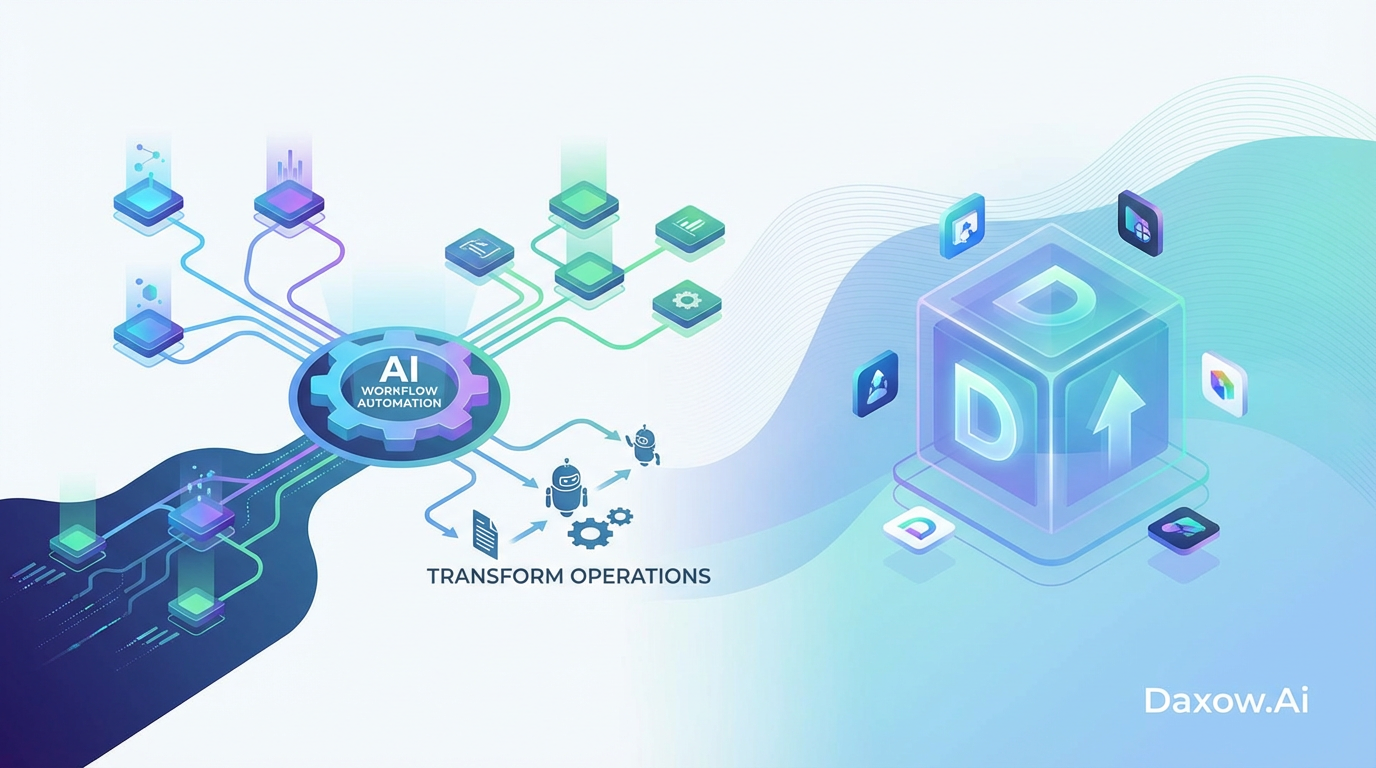
Blueprint for leaders to implement AI workflow automation and agents. Actionable steps, ROI benchmarks, and industry use cases from Daxow.ai.
Mastering AI Workflow Automation: Transforming Business Operations for the AI Era
Estimated reading time: 15 minutes
Key Takeaways
- AI workflow automation delivers operational improvements of 40–50% in targeted workflows and faster processing times.
- AI agents orchestrate complex multi-step workflows, enabling scalable, adaptive business processes.
- Daxow.ai specializes in designing custom AI automation systems that produce measurable ROI across industries.
- Strategic automation reduces costs, accelerates time-to-decision, and enhances customer experiences.
- A structured implementation approach and continuous monitoring are critical for success.
Table of Contents
- Mastering AI Workflow Automation: Transforming Business Operations for the AI Era
- Strategic Implications for Businesses
- Practical Use Cases Across Key Industries
- How AI Agents and Automation Drive Transformation
- Implementation Steps and Best Practices
- Measuring ROI and Business Value
- Getting Started with Daxow.ai
- Frequently Asked Questions
Mastering AI Workflow Automation: Transforming Business Operations for the AI Era
AI workflow automation integrates artificial intelligence into repetitive, rule-based processes to deliver predictable efficiency gains. Industry implementations regularly show operational improvements of 40–50% in targeted workflows, faster ticket resolution (up to 70% faster), and meaningful cost reductions through labor reallocation. For leaders, the result is not only lower costs but faster time-to-decision, higher accuracy, and improved customer experiences.
Why this matters now:
- Economic pressure and talent shortages require teams to do more with less.
- Enterprises need scalable intelligence that adapts to new data and business conditions.
- Early adopters capture market share; laggards face rising operational costs.
Strategic Implications for Businesses
For business owners and operations leaders
- Predictable cost savings: Automating high-volume tasks like data entry and invoice processing frees capital for growth initiatives.
- Faster cycle times: Reduce end-to-end processing (for example, invoice-to-pay) from days to hours.
- Scalable capacity: Smaller teams can handle enterprise workloads, improving resilience during demand spikes.
For CTOs and technology leaders
- Seamless integration: AI layers should complement existing stacks (ERP, CRM, ticketing) to minimize disruption.
- Data-first approach: High-quality pipelines enable reliable models; flawed data is the primary failure mode.
- Operational observability: Real-time dashboards and retraining pipelines keep systems performant and auditable.
For sales, marketing, and customer support
- Improved conversion and retention: Sales automation and better lead qualification improve pipeline velocity.
- Customer support automation: Chatbots and AI agents handle routine inquiries, escalating only complex issues, which boosts NPS.
Practical Use Cases Across Key Industries
E-commerce — Order-to-cash and returns automation
Use case:
- Automate order validation, fraud detection, inventory forecasting, and returns processing.
Outcomes:
- 30% fewer fulfillment errors, faster refunds, and improved customer satisfaction.
How Daxow helps:
- Build AI agents that integrate with e-commerce platforms, ERP, and payment systems to orchestrate returns, reconcile inventory, and trigger communications automatically.
- Implement personalized recommendation logic that increases average order value while preserving performance at scale.
Healthcare — Patient intake and compliance automation
Use case:
- Automate patient triage, appointment scheduling, and EHR updates while maintaining compliance.
Outcomes:
- 40% reduction in administrative burden, prioritized care routing, and improved readmission prediction.
How Daxow helps:
- Connect AI triage agents with EHRs, appointment systems, and secure messaging to automate intake and flag high-risk patients.
- Ensure GDPR/HIPAA-aligned pipelines and audit trails for compliance-sensitive workflows.
Finance — Reconciliation, anomaly detection, and compliance
Use case:
- Automate invoice reconciliation, anomaly detection in transactions, and regulatory reporting.
Outcomes:
- Faster audits, fewer manual errors, and improved fraud detection—with forecasting accuracy supporting cash flow decisions.
How Daxow helps:
- Deploy AI agents that extract data from invoices and transaction logs, reconcile across ledgers, and escalate anomalies to finance teams.
- Integrate with accounting systems and build retrainable models for evolving fraud patterns.
Real estate — Lead qualification and market intelligence
Use case:
- Scrape listings, qualify leads, calculate automated valuations, and schedule viewings.
Outcomes:
- 25% shorter sales cycles and more accurate pricing signals.
How Daxow helps:
- Implement sales automation agents that prioritize inbound leads, schedule virtual tours, and update CRM records automatically.
- Supply analytics dashboards for agents and brokers with predictive price trends.
HR — Recruiting and onboarding automation
Use case:
- Automate resume screening, interview scheduling, and benefits enrollment.
Outcomes:
- 50% reduction in time-to-hire, consistent candidate experience, and faster onboarding.
How Daxow helps:
- Build semantic matching engines and automated workflows that route qualified candidates to hiring managers and automate background checks and enrollment tasks.
How AI Agents and Automation Drive Transformation
AI agents combine reasoning, planning, and execution. They are distinct from simple chatbots because they can orchestrate multi-step workflows across systems and learn from outcomes.
Core capabilities:
- Orchestration: Chain actions like data extraction, analysis, and notifications across apps (CRM, Slack, ERP).
- Adaptation: Retrain on new data to handle seasonal trends and edge cases.
- Unstructured data handling: Use NLP and computer vision to process emails, contracts, invoices, and images.
How Daxow builds agentic systems:
- We design agents that execute real tasks — not just suggest actions. Agents can update records, file tickets, trigger payments, and run exceptions processes autonomously.
- We combine no-code automation platforms for rapid deployment with custom logic and models to handle domain-specific complexity.
- Security and auditability are embedded from day one: role-based access, activity logs, and retraining controls.
Implementation Steps and Best Practices
1. Define precise goals
- Audit processes and prioritize workflows consuming the most manual time.
- Set measurable targets (e.g., "Reduce invoice processing from 5 days to 2 hours").
- Score opportunities using an AI-first impact matrix.
2. Assess and prepare data
- Evaluate data accuracy, completeness, and accessibility.
- Build cleansing pipelines and secure storage; design for regulatory compliance.
- Treat data readiness as a gating factor — 80% of AI failures trace back to data issues.
3. Select and integrate technology
- Choose agent frameworks, workflow engines, and RPA tools that integrate with your stack.
- Prioritize systems that support real-time APIs for interoperability.
- At Daxow, we map integration points with CRMs, ERPs, ticketing systems, and cloud storage to ensure zero-disruption rollout.
4. Build a cross-functional team
- Combine data engineers, ML specialists, domain experts, and operations leads.
- Provide training to users and governance teams to enable adoption and manage change.
5. Prototype and test
- Start with a low-risk workflow (e.g., email triage or billing validation).
- Use validation datasets, track precision and recall, and iterate through A/B testing.
- Capture user feedback to refine prompts, rules, and handover points.
6. Deploy, monitor, and scale
- Roll out in phases with clear KPIs and dashboards.
- Retrain models on schedule and trigger retraining from drift detection.
- Automate monitoring for errors, performance, and compliance exceptions.
Best practices to follow:
- Focus on high-ROI workflows first to build momentum.
- Embed security and ethics from day one, including legal review and logging.
- Drive adoption via training, pilot successes, and change management.
Measuring ROI and Business Value
AI workflow automation delivers rapid, measurable returns when implemented correctly. Typical benchmarks from recent implementations include:
- 200–400% ROI within 12 months for focused automation projects.
- 30–50% reduction in operational expenses on automated processes.
- 40–70% faster processing times, enabling staff redeployment to higher-value work.
- 15–25% revenue uplift from improved customer retention and predictive insights.
- 90% fewer compliance errors in regulated workflows.
How to measure:
- Track time saved, error rate reduction, cost per transaction, and customer satisfaction (NPS).
- Use baseline vs. post-deployment dashboards with clear KPIs: cycle time, throughput, accuracy, and cost per unit.
- Run pilot ROI models: estimate time saved per task × hourly cost × volume to create a 12-month savings projection. Subtract implementation and licensing costs to produce net impact and payback period.
Getting Started with Daxow.ai
Daxow.ai helps organizations move from concept to production with minimal risk and maximum business value. Our end-to-end engagement typically includes:
- Discovery and process analysis: Identify high-impact workflows and create an AI-first scorecard.
- Data readiness and integration planning: Build secure pipelines and map system connections.
- Prototype and pilot development: Deliver a working pilot in weeks, not months.
- Production deployment and monitoring: Scale with observability, retraining schedules, and SLA-backed operations.
- Continuous improvement: Ongoing model tuning, change management, and new workflow rollouts.
Why choose Daxow:
- We combine technical expertise in AI agents and workflow automation with practical operational experience.
- We focus on business outcomes: reduced manual tasks, measurable productivity gains, and lower operational costs.
- We design systems that integrate with CRM and business tools, enabling end-to-end automation that executes real tasks — not just recommendations. Learn more on our Solutions and Approach pages.
Frequently Asked Questions
What types of processes are best suited for AI workflow automation?
Repetitive, rule-based, and high-volume processes with clearly definable inputs and outputs are ideal candidates. Examples include invoicing, order processing, compliance reporting, and lead qualification.
How long does it typically take to implement AI automation solutions with Daxow.ai?
We typically deliver a working pilot within weeks and scale to production in a few months depending on the complexity and scope of workflows selected.
Can AI automation solutions be integrated with existing CRM and ERP systems?
Yes. Our approach prioritizes seamless integration with existing technology stacks to minimize disruption and maximize ROI.
How do you ensure data security and compliance with AI automation?
Security and compliance are embedded from day one, including role-based access, audit logs, encrypted storage, and compliance with standards like GDPR and HIPAA where applicable.