
AI Workflow Automation and Process Optimization by Daxow.ai
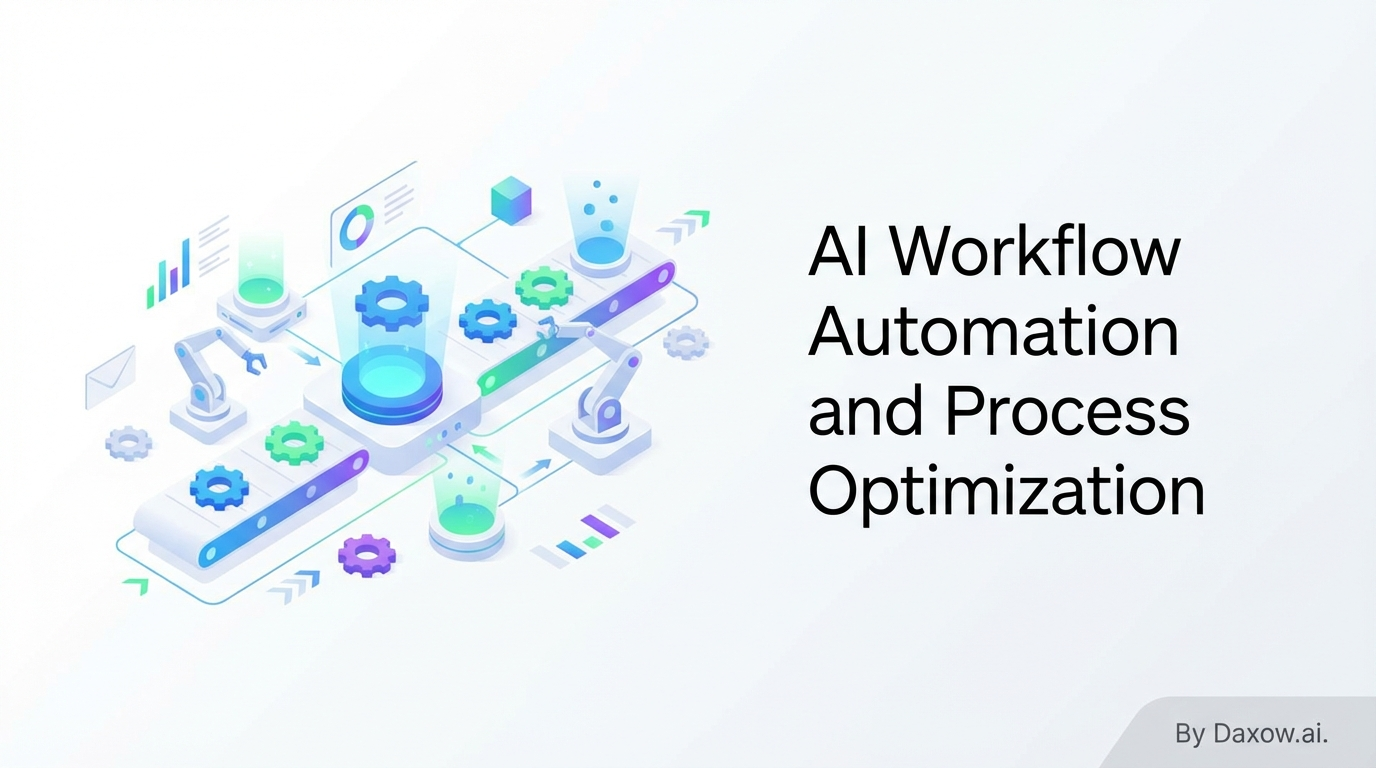
Practical guide to designing, implementing, and scaling AI workflow automation with phased methodology, use cases, KPIs, and Daxow.ai services.
AI Workflow Automation and Process Optimization
Estimated reading time: 15 minutes
Key Takeaways
- AI workflow automation reduces manual tasks and accelerates business processes across industries.
- Implementing AI automation requires a phased approach from discovery to scaling and governance.
- Daxow.ai delivers custom AI agents, integrations, and managed services to ensure measurable ROI.
- Key outcomes include cost reduction, improved productivity, enhanced customer experience, and compliance.
- Ongoing monitoring, human-in-the-loop, and governance ensure sustainable AI-powered automation.
Table of Contents
- Introduction
- Why This Matters Now
- Core Capabilities That Enable Impact
- Key Business Outcomes
- How to Implement AI Workflow Automation and Process Optimization
- Use Cases Across Industries
- How Daxow.ai Delivers AI Workflow Automation and Process Optimization
- Technical Architecture and Best Practices
- Measuring Success and Typical KPIs
- Change Management and Adoption
- Conclusion and Next Steps
- Frequently Asked Questions
Introduction
AI Workflow Automation and Process Optimization is transforming how organizations operate by combining intelligent agents, workflow orchestration, and system integrations to eliminate manual tasks, accelerate decision-making, and deliver measurable business value. For decision-makers, the strategic question is no longer whether to adopt AI, but how to design and implement AI automation that reliably reduces costs, improves productivity, and enhances customer experience. This article explains practical approaches, industry use cases, implementation steps, and how Daxow.ai builds custom systems that turn automation strategy into operational results.
Why This Matters Now
- Rapid improvements in large language models, agents, and API-driven platforms enable automation that previously required bespoke development.
- Enterprises face pressure to reduce operational costs while improving customer response times and compliance.
- AI-driven workflows can reduce repetitive manual work, free skilled staff for higher-value tasks, and accelerate throughput across sales, support, finance, HR, and operations.
Core Capabilities That Enable Impact
- AI agents that understand context, take multi-step actions, and interact with systems.
- Workflow automation engines that orchestrate triggers, decisions, and handoffs.
- Data extraction and document automation for high-volume, error-prone inputs.
- Integrations with CRMs, ERPs, ticketing systems, and cloud platforms to create end-to-end automation.
Key Business Outcomes
- Reduce manual tasks across teams by automating data entry, triage, and routing.
- Increase productivity by shortening cycle times and automating follow-ups.
- Improve customer experience with faster, more accurate responses.
- Lower operational costs through headcount optimization and error reduction.
How to Implement AI Workflow Automation and Process Optimization
Phase 1 — Process discovery and prioritization
- Map existing workflows and quantify manual effort, touchpoints, and error rates.
- Identify high-impact automation candidates by volume, cost, and customer impact.
- Deliverable: prioritized automation backlog with expected benefits and KPIs.
Phase 2 — Solution design
- Define required AI capabilities (NLP, classification, extraction), integrations, and decision logic.
- Design human-in-the-loop boundaries for exceptions and escalation.
- Establish data, security, and compliance requirements.
- Deliverable: technical design, integration map, and roadmap.
Phase 3 — Build and integrate
- Develop AI models, agents, and workflow logic.
- Implement connectors to CRMs, ticketing systems, document stores, and databases.
- Create monitoring and observability for model drift, throughput, and errors.
- Deliverable: working automation with test harness and rollback plan.
Phase 4 — Pilot, measure, iterate
- Run controlled pilots on a subset of transactions or teams.
- Measure KPIs such as cycle time reduction, manual touches reduced, accuracy, and cost savings.
- Iterate on model tuning, decision thresholds, and exception handling.
- Deliverable: updated models and expanded automation scope.
Phase 5 — Scale and govern
- Roll out automation across business units with training and change management.
- Implement governance: versioning, access controls, audit trails, and compliance checks.
- Plan ongoing model maintenance and continuous improvement processes.
- Deliverable: enterprise-grade automation platform with governance.
Use Cases Across Industries
E-commerce — Order processing and returns
- Challenge: High volume of order exceptions, returns, and refund requests; manual triage delays refunds.
- Automation: AI agents extract order details from messages, match to orders in the ERP, approve straightforward refunds, and route exceptions to agents with context.
- Impact: Reduce manual touches by 60%, slash resolution time from days to hours, and improve NPS with faster refunds.
Finance — Invoice processing and reconciliation
- Challenge: Manual invoice data entry, frequent discrepancies, and slow approvals.
- Automation: Document automation extracts invoice data, validates against purchase orders, and routes exceptions. Workflows auto-approve within thresholds.
- Impact: Cut processing costs by 40–70%, reduce errors, and speed up vendor payments.
Healthcare — Patient intake and claims triage
- Challenge: Time-consuming intake forms and documentation, delayed claims processing.
- Automation: AI-powered form extraction, eligibility checks, and pre-authorization workflows. Agents gather missing information via secure messaging.
- Impact: Faster intake, reduced denials, and improved revenue cycle performance.
Real Estate — Lead qualification and scheduling
- Challenge: High volume of inbound inquiries with inconsistent follow-up.
- Automation: AI agents qualify leads via chat and email, match preferences to listings, and automatically schedule viewings with calendar integrations.
- Impact: Increase qualified lead conversion while reducing manual outreach by over 50%.
HR and Administration — Candidate screening and onboarding
- Challenge: Screening resumes, scheduling interviews, and onboarding tasks are manual and time-consuming.
- Automation: Resume parsing, candidate scoring against job criteria, interview scheduling, and automated onboarding checklists.
- Impact: Faster time-to-hire, reduced recruiter workload, and more consistent onboarding.
Customer Support — Ticket triage and resolution
- Challenge: High volumes of repetitive support requests and slow SLA compliance.
- Automation: Auto-triage and response generation for common issues, escalate complex cases with pre-filled context.
- Impact: Reduce first-response time by up to 80%, increase agent productivity, and lower support costs.
Sales — Lead qualification and CRM hygiene
- Challenge: Sales teams spend time on low-value tasks and maintaining CRM data.
- Automation: AI agents qualify leads, enrich CRM records, and create follow-up tasks.
- Impact: Higher sales capacity, improved forecast accuracy, and faster sales cycles.
How Daxow.ai Delivers AI Workflow Automation and Process Optimization
Consultative discovery
- We start by mapping your current workflows and quantifying the manual burden.
- Outcome: A prioritized automation roadmap with clear financial and operational metrics.
Custom AI systems and agents
- Daxow builds AI agents tailored to your processes—these agents perform multi-step tasks, interact with systems, and escalate exceptions.
- Agents can be trained on your data for domain-specific accuracy and connected to enterprise systems via secure APIs.
Workflow orchestration and integrations
- We design orchestration layers that connect agents, trigger rules, and handle retries and exceptions.
- Daxow integrates with CRMs, ERPs, ticketing systems, and document repositories to create seamless end-to-end flows.
End-to-end automation and managed services
- Beyond delivery, Daxow provides monitoring, model maintenance, and continuous improvement.
- Our teams ensure governance, security, and compliance are baked into the solution.
Business-driven ROI
- We align automation objectives with measurable KPIs: manual tasks reduced, cycle time improvements, cost savings, error reduction, and revenue uplift.
- Typical client engagements achieve measurable ROI within months through targeted pilots and incremental expansion.
Technical Architecture and Best Practices
Key components of a robust AI automation architecture
- Data layer: centralized access to transactional data, documents, and model training datasets.
- Model layer: domain-specific models for extraction, classification, and language understanding.
- Orchestration layer: workflow engine to sequence tasks, manage state, and handle exceptions.
- Integration layer: connectors to third-party systems and identity/access management.
- Observability: logging, metrics, and alerting for throughput, accuracy, and drift.
- Security & compliance: encryption, audit trails, role-based access, and privacy controls.
Best practices for success
- Start small and prove value with high-frequency, low-risk processes.
- Use human-in-the-loop for edge cases and continuous model feedback.
- Implement governance to manage model changes, access, and auditability.
- Monitor performance and retrain models on new data to avoid drift.
- Plan for change management: communicate benefits, train users, and update SOPs.
Measuring Success and Typical KPIs
To ensure your AI workflow automation and process optimization drive business value, track the following KPIs:
- Manual touches reduced (absolute count and %).
- Cycle time reduction (average time from request to resolution).
- Cost per transaction (before and after automation).
- Error rate and rework percentage.
- Customer satisfaction / NPS changes.
- Throughput (transactions processed per hour/day).
- Lead-to-conversion rate improvements for sales use cases.
Sample ROI calculation (illustrative)
- Manual processing cost per transaction: $10
- Volume: 10,000 transactions/month = $100,000/month
- Automation reduces manual effort by 60% → savings = $60,000/month
- Implementation cost amortized over 12 months = $20,000/month
- Net monthly benefit = $40,000 → payback within months for most mid-size deployments
Change Management and Adoption
- Engage stakeholders early and demonstrate quick wins.
- Provide training and clear escalation paths.
- Use metrics dashboards to show progress and justify further investment.
Conclusion and Next Steps
AI Workflow Automation and Process Optimization is a practical, high-impact strategy for businesses seeking to reduce manual tasks, increase productivity, and improve customer experience. The right approach combines strategic prioritization, custom AI agents, robust integrations, and ongoing governance.
If you want to move from strategy to results, Daxow.ai helps design, build, and operate AI systems that automate your critical workflows end-to-end. Our process focuses on measurable ROI, secure integrations, and scalable automation.
Book a free consultation with Daxow.ai today to request a process analysis for your company and begin building a custom AI system that reduces manual work and delivers measurable business outcomes.
Frequently Asked Questions
What industries benefit most from AI workflow automation?
Industries such as e-commerce, finance, healthcare, real estate, HR, customer support, and sales experience significant benefits from AI workflow automation by reducing manual tasks and improving process efficiency.
How does human-in-the-loop help in AI automation?
Human-in-the-loop ensures that edge cases and exceptions are managed safely. It allows continuous feedback to improve AI models, maintain accuracy, and manage risks associated with automated decision-making.
What is the typical ROI timeline for AI automation?
Many clients achieve measurable ROI within months by targeting high-impact processes, running pilots, and incrementally expanding automation with robust governance and continuous improvement.
How does Daxow.ai ensure data security and compliance?
Daxow.ai implements encryption, audit trails, role-based access controls, and privacy safeguards as core elements of our AI automation platforms, ensuring compliance with regulatory and enterprise security requirements.