
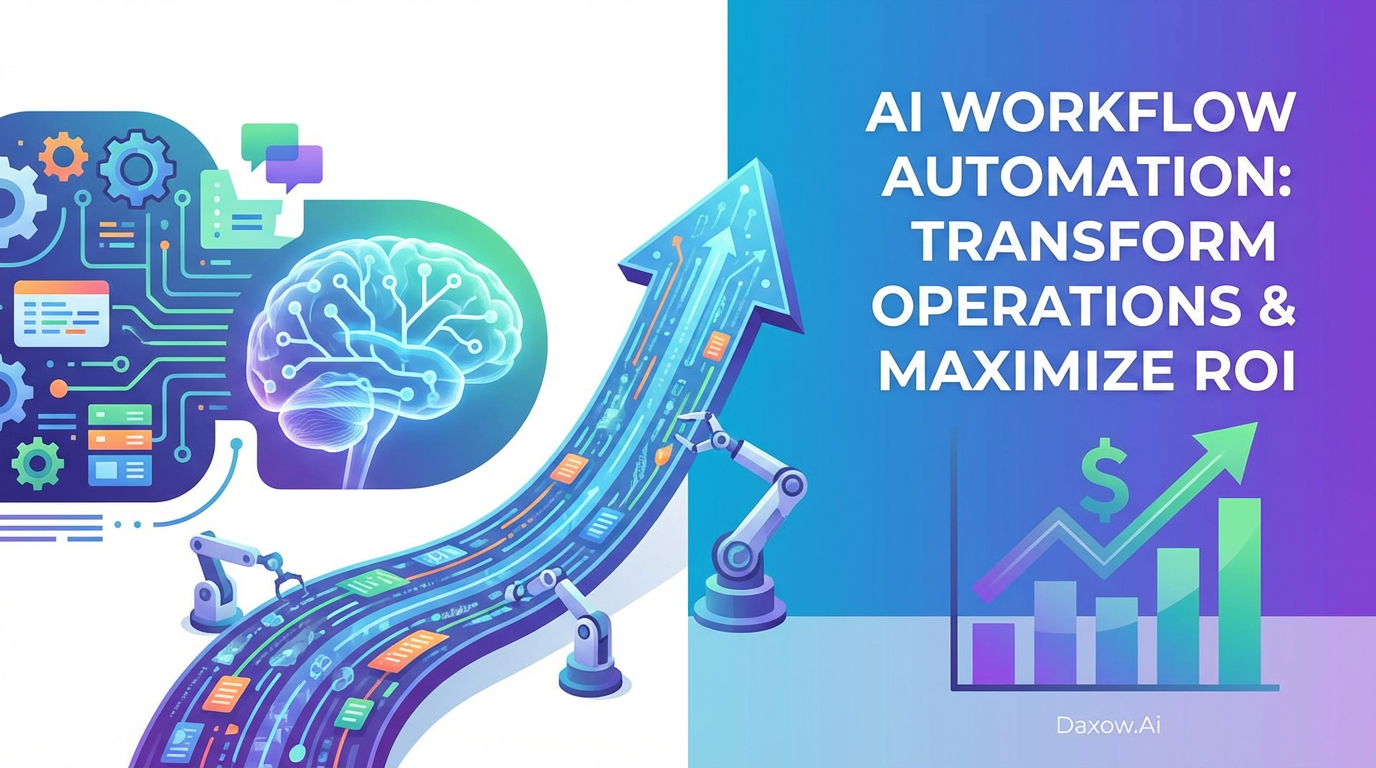
AI Workflow Automation: Transform Operations & Maximize ROI
How AI workflow automation and AI agents streamline operations, cut costs, and deliver 3–5x ROI — practical use cases, roadmap, and Daxow approach.
AI Workflow Automation: Transforming Business Operations for the Modern Enterprise
Estimated reading time: 15 minutes
Key Takeaways
- AI workflow automation turns repetitive, manual tasks into intelligent, scalable processes, increasing efficiency and reducing errors.
- Combining rule-based automation and AI agents delivers superior operational scalability and adaptability.
- Industry-specific use cases highlight rapid ROI and measurable operational improvements.
- A structured implementation roadmap supports successful adoption and scaling.
- Daxow.ai specializes in designing custom AI automations that accelerate digital transformation and business value.
Table of Contents
- AI Workflow Automation: Transforming Business Operations for the Modern Enterprise
- Why AI Workflow Automation Matters for Your Business
- AI Agents vs. Basic Automation — When to Use Which
- Practical Use Cases Across Industries
- Implementation Roadmap: From Audit to Scale
- Measuring ROI and Business Value
- How Daxow.ai Designs and Delivers Custom AI Automation
- Practical Considerations and Risk Management
- Get Started: Next Steps for Decision-Makers
- Frequently Asked Questions
AI Workflow Automation: Transforming Business Operations for the Modern Enterprise
AI workflow automation combines intelligent models, process orchestration, and system integrations to automate repetitive, data-heavy tasks and support complex decision-making. The result is a shift from manual, error-prone operations to intelligent, scalable workflows that free employees to focus on higher-value work.
- What it delivers: faster processing times, reduced error rates, and measurable labor savings.
- Typical outcomes: targeted efficiency gains of 40–50% in automated areas, reductions in manual intervention by up to 70%, and payback periods often within 12–18 months producing 3–5x ROI.
Why AI Workflow Automation Matters for Your Business
Organizations across sectors increasingly treat AI automation as a core operational capability rather than a one-off project.
Strategic benefits
- Operational scalability: Automations scale with transaction volume, avoiding linear headcount increases.
- Improved customer experience: Faster responses and fewer errors increase NPS and retention.
- Data-driven insights: Automated workflows capture structured data for real-time analytics and forecasting.
- Cost control: Labor and error costs fall, and throughput rises.
When to prioritize automation
- High-volume, rule-based processes (invoicing, data entry, scheduling)
- Processes with predictable decision points that can be codified or learned
- Customer-facing workflows where response time and accuracy impact revenue
- Back-office tasks that consume qualified employee time
AI Agents vs. Basic Automation — When to Use Which
Understanding the difference between AI agents and traditional automation is critical to design effective systems.
- Basic automation: Best for repetitive, deterministic tasks. It executes rules reliably but lacks adaptability.
Use cases: data transfers between systems, scheduled reports, rule-based approvals. - AI agents: Autonomous systems that perceive inputs, make decisions using models, and act across systems.
Use cases: dynamic customer support that routes issues and escalates exceptions, predictive lead qualification, intelligent document understanding.
Why combine them:
- Rule-based automation handles stable, high-throughput steps.
- AI agents manage exceptions, learn from data, and adapt to new scenarios.
- Together they reduce manual tasks, maintain 24/7 operations, and surface predictive insights.
Practical Use Cases Across Industries
E-commerce — Order-to-Cash and Returns Processing
Problem: Manual order reconciliation, inventory mismatches, and slow returns handling increase fulfillment times and customer churn.
Solution: Deploy AI agents to validate orders, automate inventory updates, generate personalized recommendations, and triage returns.
Impact: Reduced fulfillment times by up to 30%, fewer stockouts, higher conversion rates from personalized messaging.
Daxow approach: Integrate AI with your ERP and CRM, implement automated order validation, and build a returns automation agent that connects to logistics partners.
Healthcare — Scheduling, Triage, and Records Management
Problem: Administrative overhead slows patient intake and clinicians spend time on paperwork.
Solution: Chatbot-driven triage, automated scheduling that matches clinician availability and compliance rules, and AI-powered document extraction for records.
Impact: Lower administrative burden, faster patient throughput, and improved care timeliness while preserving compliance.
Daxow approach: Design patient-facing AI agents that integrate with EHR systems, ensure HIPAA-ready security controls, and automate claims and billing workflows.
Finance — Invoice Reconciliation and Fraud Detection
Problem: Manual reconciliation is slow and error-prone; suspicious transactions can be missed.
Solution: Use document automation to extract invoice data, reconcile across systems, and deploy ML models to detect anomalies.
Impact: Faster month-end closes, reduced error rates, and proactive fraud alerts.
Daxow approach: Connect to accounting systems, implement intelligent OCR and validation, and create monitoring dashboards with alerting and audit trails.
Real Estate — Lead Qualification and Contract Review
Problem: High volume of low-quality leads and time-consuming contract reviews delay closings.
Solution: AI agents qualify leads by parsing inquiries, ranking by intent and likelihood to transact; NLP models highlight contract clauses and flag risks.
Impact: Accelerated deal cycles, better agent utilization, and reduced legal review time.
Daxow approach: Build lead qualification pipelines that feed CRM lead scoring, automate follow-up outreach, and integrate contract analysis tools.
HR — Recruitment and Onboarding
Problem: Long hiring cycles and repetitive onboarding tasks slow new-hire productivity.
Solution: Automated resume screening, interview scheduling, and onboarding task orchestration using AI-driven workflows.
Impact: Faster time-to-hire, consistent candidate assessment, and reduced administrative cost.
Daxow approach: Implement candidate screening agents, integrate with ATS and payroll systems, and automate onboarding checklists.
Customer Support Automation and Sales Automation
Problem: High volumes of repetitive customer queries and inconsistent lead follow-up reduce satisfaction and revenue.
Solution: Deploy conversational AI agents for first-line support and AI workflows to route qualified leads to sales with recommended next actions.
Impact: Higher first-contact resolution rates, shorter sales cycles, and improved conversion rates.
Daxow approach: Build omnichannel chatbots, connect them to CRM and knowledge bases, and design escalation paths for human agents.
Implementation Roadmap: From Audit to Scale
1. Define clear objectives
- Conduct an automation audit to identify inefficiencies.
- Set measurable KPIs (cost per transaction, turnaround time, error rate).
- Daxow helps define business-first objectives and an AI readiness score.
2. Assess and prepare data
- Audit data for completeness and accuracy.
- Prioritize structured sources and implement cleansing.
- Daxow connects data sources, builds ETL pipelines, and ensures traceability.
3. Identify high-impact processes and pilot
- Use process mining to surface repetitive, high-volume workflows.
- Start with a pilot in a non-critical area to demonstrate value quickly.
- Daxow runs rapid pilots and quantifies gains so stakeholders can see measurable impact.
4. Select tools and design integration
- Choose scalable platforms and APIs for secure integrations.
- Prefer modular designs (no-code/low-code where appropriate) to accelerate iteration.
- Daxow selects technology stacks tailored to your ecosystem and implements enterprise-grade integrations.
5. Build cross-functional teams and governance
- Include IT, operations, legal, and frontline users.
- Establish model governance, monitoring, and human-in-the-loop processes.
- Daxow embeds governance and provides training for adoption.
6. Pilot, monitor, and scale
- Track metrics continuously; iterate on models and rules.
- Scale incrementally to avoid "agentic sprawl."
- Daxow operates and monitors systems, applies retraining, and scales modules across the organization.
7. Continuous improvement and compliance
- Monitor for bias, model drift, and changing business conditions.
- Maintain security, auditing, and compliance documentation.
- Daxow provides ongoing maintenance, updates, and compliance support.
Measuring ROI and Business Value
Key KPIs to track
- Cost per transaction (pre/post automation)
- Throughput and processing time
- Error rate and exception volume
- Employee time reallocated to strategic work
- Customer metrics (NPS, response time, CSAT)
- Revenue impact (lead-to-deal conversion, upsell rates)
Expected returns and timelines
- Typical labor reductions: up to 50% in targeted administrative tasks.
- Efficiency gains: 40–50% in optimized processes.
- Manual intervention reduction: up to 70% in mature workflows.
- ROI: often 3–5x within 12–18 months when pilots target high-impact processes.
- Long-term value: systems become more valuable as data accumulates, enabling better predictive analytics and process optimization.
How Daxow.ai Designs and Delivers Custom AI Automation
Discovery and process analysis
- We map your workflows, identify bottlenecks, and quantify potential impact.
- Deliverable: a prioritized automation roadmap with measurable KPIs.
Custom solution design
- We design AI agents and workflow automation tailored to your systems and compliance needs.
- We recommend technology stacks (ML models, RPA tools, integration platforms) and a modular architecture.
Integration and implementation
- Daxow implements secure integrations with CRMs, ERPs, ticketing systems, and data stores.
- We build pipelines for document automation, lead qualification, and customer support automation.
Pilot, measure, and scale
- We run controlled pilots, measure outcomes against KPIs, and refine models.
- Once validated, we scale automations across teams and geographies.
Ongoing operations and optimization
- Daxow provides monitoring, retraining of models, and governance to ensure sustained performance.
- We deliver dashboards and reporting so decision-makers can see ROI clearly.
Practical Considerations and Risk Management
- Start small and prove impact: Pilot one high-value process before broad rollout.
- Embed governance: Prevent uncontrolled agent proliferation and ensure compliance.
- Human-in-the-loop: Maintain oversight for exceptions, legal decisions, and sensitive interactions.
- Security and privacy by design: Protect data and meet regulatory requirements.
- Change management: Communicate benefits and retrain teams to maximize adoption.
Get Started: Next Steps for Decision-Makers
AI workflow automation is a strategic investment that reduces manual tasks, increases productivity, and transforms customer-facing and back-office operations. Daxow.ai partners with businesses to design, build, and operate custom AI agents and workflow automation that integrate with existing systems and deliver measurable ROI.
- Book a free consultation to assess your highest-impact automation opportunities.
- Request a process analysis for your company and receive a prioritized roadmap with projected savings.
- Contact us to build a custom AI system that automates lead qualification, customer support, document processing, and more.
Contact Daxow.ai today to begin turning manual processes into automated, scalable workflows that drive efficiency and growth.
Frequently Asked Questions
What is AI workflow automation?
AI workflow automation uses advanced AI models combined with system integrations and orchestration to automate repetitive tasks and aid complex decision-making, increasing operational efficiency.
How do AI agents differ from traditional automation?
Traditional automation follows fixed rules for repetitive tasks, while AI agents perceive inputs, make decisions using predictive models, and handle exceptions autonomously.
What industries benefit most from AI workflow automation?
Industries such as e-commerce, healthcare, finance, real estate, HR, and customer support see strong immediate value from AI workflow automation.
How does Daxow.ai support AI workflow automation initiatives?
Daxow.ai offers end-to-end services from workflow analysis and solution design to implementation, pilot management, scaling, and ongoing monitoring to ensure maximum ROI and compliance.