
AI Workflow Automation: Transform Operations with Daxow.ai
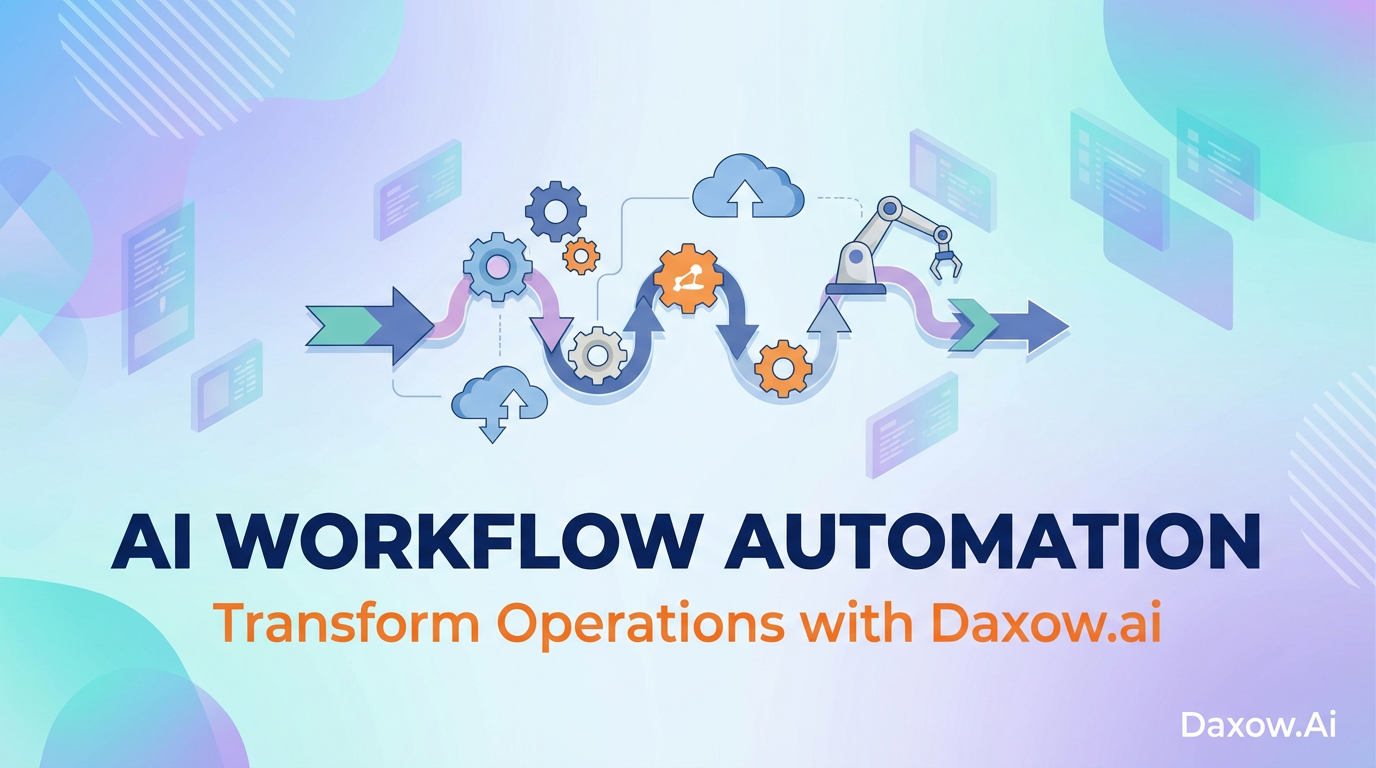
How AI workflow automation and Daxow.ai's custom agents reduce manual work, boost productivity, and deliver measurable ROI across industries.
AI Workflow Automation: Transforming Business Operations for the Modern Enterprise
Estimated reading time: 12 minutes
Key Takeaways
- AI workflow automation reduces manual, repetitive tasks to improve productivity and scalability.
- Real-world use cases span e-commerce, healthcare, finance, real estate, and HR.
- Daxow.ai provides end-to-end AI automation services, from discovery to ongoing optimization.
- Successful implementation requires clear goals, quality data, cross-functional teams, and continuous monitoring.
- Measurable ROI includes cost reductions, faster cycles, improved customer experience, and strategic agility.
Table of Contents
- AI Workflow Automation: What It Means for Your Business
- Practical Use Cases of AI Workflow Automation Across Industries
- How AI Agents and Automation Drive Success
- Implementation Steps and Best Practices for AI Workflow Automation
- Measuring ROI and Business Value
- How Daxow.ai Builds and Deploys Custom AI Workflow Automation
- Next Steps: Implement AI Workflow Automation with Daxow.ai
- Frequently Asked Questions
AI Workflow Automation: What It Means for Your Business
AI workflow automation integrates artificial intelligence into operational processes so that repetitive, rule-based work is handled automatically, decisions are data-driven, and human teams are freed to focus on strategic priorities.
What AI workflow automation delivers
- Reduced manual work: Tasks like data entry, invoice processing, and routine customer inquiries are automated to minimize errors and cycle times.
- Faster decision-making: AI agents analyze patterns and recommend or execute actions in real time.
- Scalability: Processes scale with demand without linear increases in labor costs.
- Operational visibility: Dashboards and alerts provide continuous monitoring and performance metrics.
Why it matters to decision-makers
- Competitive advantage through faster responses and improved accuracy.
- Predictable cost reductions and measurable productivity gains.
- Enhanced customer experience via consistent, 24/7 automation (customer support automation, sales automation).
- Risk reduction from fewer human errors and stronger compliance controls.
Core business problems solved
- Bottlenecks caused by manual handoffs and legacy systems.
- High operational costs from repetitive tasks.
- Slow response times in support and sales channels.
- Poor data quality and disconnected toolchains (CRM, ERP, ticketing systems).
Practical Use Cases of AI Workflow Automation Across Industries
AI workflow automation is not theoretical; it produces immediate, measurable results when applied to the right processes. Below are actionable use cases and what success looks like.
E-commerce
- Use case: Automate order-to-cash — inventory checks, fraud screening, returns processing, and customer follow-up.
- How it works: AI agents read order data, reconcile with inventory, flag anomalies, route tickets to the right team, and trigger refunds or shipping changes.
- Business impact: Faster fulfillment, improved conversion rates, reduced chargebacks, and higher customer satisfaction.
- KPI examples: Reduce fulfillment time by 30–50%; lower returns processing costs by 40%.
Healthcare
- Use case: Patient intake automation and clinical documentation triage.
- How it works: Conversational AI triages symptoms, schedules appointments, pre-fills patient forms, and flags abnormal records for clinician review.
- Business impact: Reduced administrative burden, faster patient throughput, and improved compliance with audit trails.
- KPI examples: Cut scheduling time by 50%; reduce billing errors to <1%.
Finance
- Use case: Invoice reconciliation, fraud detection, and regulatory reporting.
- How it works: AI extracts data from invoices and bank statements, reconciles discrepancies, and uses anomaly detection to flag suspicious transactions.
- Business impact: Faster month-end closes, reduced audit risk, and lower operational costs.
- KPI examples: 20–50% reduction in processing costs; reconciliation accuracy rising from 95% to >99%.
Real Estate
- Use case: Lead qualification, contract review automation, and virtual tour scheduling.
- How it works: AI agents evaluate incoming leads, prioritize by conversion probability, auto-schedule visits, and scan contracts for missing clauses or compliance flags.
- Business impact: Shorter sales cycles, higher lead-to-client conversion, and lower administrative overhead.
- KPI examples: Reduce lead qualification time by 60%; shorten contract turnaround by 40%.
HR and Recruitment
- Use case: Resume screening, interview scheduling, and onboarding automation.
- How it works: NLP models parse resumes, score candidates, coordinate calendars, and deliver pre-boarding tasks automatically.
- Business impact: Faster time-to-hire, improved candidate experience, and lower cost-per-hire.
- KPI examples: Cut hiring time by up to 50%; increase interview-to-hire ratios.
How AI Agents and Automation Drive Success
AI agents are the engines of modern workflow automation. Unlike static scripts, AI agents combine machine learning, natural language processing, and process orchestration to perform complex, multi-step tasks.
AI agents vs. rules-based automation
- Rules-based automation: Best for predictable, fixed processes. Low complexity; simple to implement.
- AI agents: Best for tasks involving unstructured data, decisioning, and variability (e.g., email routing, natural-language customer queries).
- Combined approach: The highest value comes from integrating rules-based workflows with AI agents that handle exceptions, triage, and learning.
Integration and orchestration
- Seamless integration is essential. AI agents must connect to CRMs, ERPs, ticketing systems, and databases to execute end-to-end processes.
- Orchestration layer: Coordinates multi-step processes and escalations (e.g., if a model confidence threshold is low, escalate to human operator).
- Continuous learning: Retraining pipelines update models based on feedback and new data, improving performance over time.
How Daxow helps
- Daxow designs AI agents that execute real tasks—extracting data, qualifying leads, answering customer queries, and reconciling accounts—while integrating with your existing systems.
- We deliver end-to-end automation: discovery, design, integration, deployment, monitoring, and ongoing optimization.
Implementation Steps and Best Practices for AI Workflow Automation
A structured approach minimizes risk and maximizes value. Follow these steps to deploy successful AI workflow automation.
1. Define clear objectives
- Set measurable goals: cost reduction percentages, processing time improvements, or SLA upgrades.
- Use task mining to identify the highest-impact workflows to automate first.
2. Assess and prepare data
- Audit data quality and accessibility.
- Build pipelines that ensure accuracy, completeness, and regulatory compliance (GDPR, HIPAA where applicable).
3. Select and integrate tools
- Choose platforms that fit your stack: low-code/no-code for faster pilots, enterprise-grade solutions for scale.
- Prioritize APIs and robust connectors to CRMs, ERPs, and ticketing systems.
4. Build a cross-functional team
- Include process owners, IT, data engineers, and change managers.
- Invest in training and stakeholder engagement for successful adoption.
5. Prototype and scale
- Start with a focused pilot on a non-critical but high-impact process.
- Validate KPIs, refine models, and expand modularly.
6. Monitor, measure, and optimize
- Track accuracy, cycle time, cost per transaction, and user satisfaction.
- Retrain models and adjust rules based on live data and business feedback.
Best practices to follow
- Focus on high-impact, repeatable tasks first.
- Maintain human oversight and clear escalation paths.
- Implement governance to prevent agent sprawl and ensure ethical AI (bias detection, audit logs).
- Design for modularity so components can be reused across processes.
Measuring ROI and Business Value
Quantifying returns is essential to securing executive sponsorship and scaling successfully.
- Short-term indicators
- Reduction in manual hours.
- Faster response and cycle times.
- Improved data accuracy and fewer exceptions.
- Mid-term indicators
- Lower operational costs (20–50% on repetitive tasks).
- Higher throughput with same headcount.
- Improved customer satisfaction metrics and NPS.
- Long-term indicators
- Revenue uplift from faster sales cycles and improved lead qualification.
- Strategic agility due to data-driven decisioning.
- Employee retention improvements from removing tedious work.
Typical ROI profile
Businesses automating 30–50% of their workflows often report 3–5x returns within 12–18 months, with error rates dropping from around 5% to under 1% in many processes. Use dashboards to visualize KPIs and demonstrate continuous improvement.
How Daxow.ai Builds and Deploys Custom AI Workflow Automation
Daxow specializes in designing tailored AI automation that aligns with business objectives, integrates with enterprise stacks, and delivers measurable outcomes.
- Discovery and process analysis
- We map your existing workflows, identify bottlenecks, and quantify automation potential.
- Deliverable: prioritized automation roadmap with expected ROI.
- Design and prototyping
- Build small, focused pilots using no-code/low-code and custom ML models where needed.
- Engage stakeholders to validate outcomes and refine acceptance criteria.
- Integration and deployment
- Connect AI agents to CRMs, ERPs, support platforms, and internal databases.
- Implement orchestration logic to ensure robust end-to-end execution and fail-safes.
- Monitoring and continuous improvement
- Live dashboards for KPIs, automated alerts for model drift, and scheduled retraining pipelines.
- Ongoing support to optimize processes and expand automation coverage.
- Security and compliance
- Data handling practices aligned to GDPR and industry-specific regulations.
- Audit trails, role-based access, and governance to ensure safe deployment.
Typical project timeline and cost considerations
- Pilot (6–8 weeks): discovery, prototype, and initial integration.
- Scale phase (3–9 months): expand to additional workflows and refine models.
- Investment varies by complexity—simple automations can be low-cost pilots; enterprise-grade integration and custom ML require larger budgets, but deliver proportionally higher ROI.
- Daxow structures engagements to demonstrate early wins and iterate toward broader automation.
Next Steps: Implement AI Workflow Automation with Daxow.ai
Adopting AI workflow automation is a strategic decision that transforms operations, reduces manual tasks, and builds long-term agility. The path to success is methodical: start with high-impact pilots, integrate with existing systems, measure outcomes, and scale across the organization.
Immediate actions for leaders
- Identify 2–3 processes with high volume and repeatability.
- Assign an internal sponsor and gather a cross-functional team.
- Request a process analysis to estimate potential savings and timelines.
Daxow.ai — founded in Estonia in 2024 — partners with enterprises, startups, and functional teams (support, sales, HR, finance) to deliver tailored AI agents and workflow automation strategies that cut costs, boost productivity, and enhance customer experience. Our end-to-end approach ensures systems are integrated, secure, and built to evolve with your business.
Book a free consultation with Daxow.ai to assess your workflows and start building a custom AI system that reduces manual tasks, improves productivity, and delivers measurable ROI.
Frequently Asked Questions
What types of businesses benefit most from AI workflow automation?
Businesses with high volumes of repetitive tasks, complex operational workflows, and data-driven decision requirements across industries like e-commerce, healthcare, finance, real estate, and HR benefit significantly from AI workflow automation.
How quickly can we expect to see ROI after implementation?
Many businesses see 3–5x returns within 12–18 months by automating 30–50% of their workflows, driven by cost savings, productivity improvements, and error reductions.
Does Daxow.ai support integration with existing enterprise systems?
Yes, Daxow.ai specializes in seamless integration with CRMs, ERPs, ticketing systems, and databases to ensure end-to-end automation and orchestrated workflows tailored to your technology stack.
How does Daxow.ai ensure data security and compliance?
Daxow.ai adheres to GDPR and industry-specific regulations with robust data handling practices, audit trails, role-based access, and governance frameworks to ensure ethical and secure AI deployment.