
AI Workflow Automation: Transform Business Operations with Daxow.ai
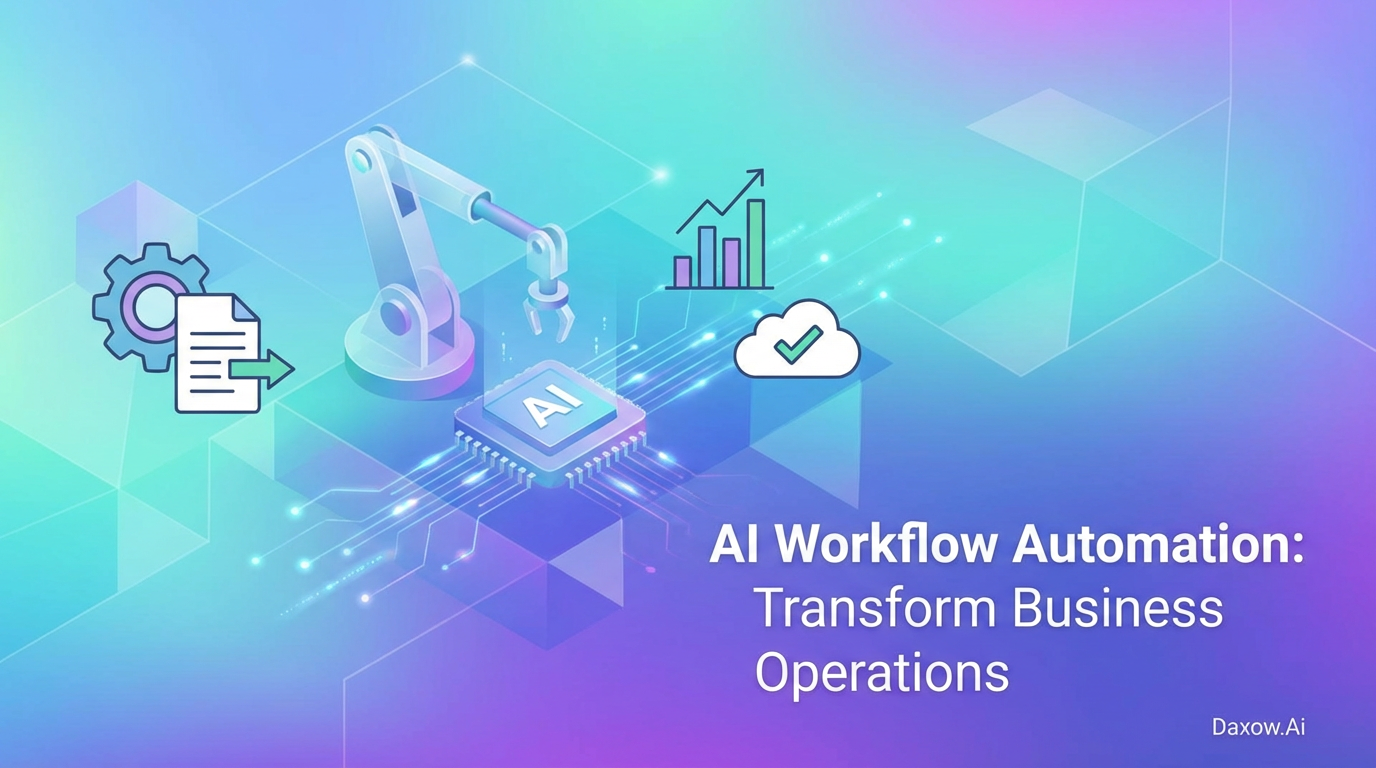
Guide to AI workflow automation: use cases, ROI (6-12 months), steps, and how Daxow.ai builds AI agents to cut manual work and boost productivity.
AI Workflow Automation: Transforming Business Operations for the AI Era
Estimated reading time: 12 minutes
Key Takeaways
- AI workflow automation leverages machine learning, NLP, and rule-based systems to optimize end-to-end business processes.
- Adopting AI agents boosts productivity, reduces costs, improves accuracy, and accelerates outcomes with measurable ROI.
- Industry-specific implementations in e-commerce, healthcare, finance, real estate, HR, and manufacturing deliver tangible benefits.
- Daxow.ai offers tailored AI agents and secure integrations supporting rapid pilots, governance, and enterprise-scale automation.
- A phased roadmap ensures smooth adoption from pilot to continuous optimization with clear metrics and business value.
Table of Contents
- AI Workflow Automation: Transforming Business Operations for the AI Era
- Practical Use Cases of AI Workflow Automation
- How AI Agents and Automation Drive Results
- Implementation Roadmap: From Pilot to Enterprise-Grade Automation
- Measuring ROI and Sustaining Business Value
- Why Partner with Daxow.ai for AI Workflow Automation
- Getting Started — Next Steps for Decision-Makers
- Frequently Asked Questions
AI Workflow Automation: Transforming Business Operations for the AI Era
What it is
AI workflow automation integrates machine learning, natural language processing, and rule-based automation to orchestrate end-to-end business processes. Instead of isolated bots or scripts, modern AI-driven workflows combine decision-making models with connectors to CRMs, ERPs, ticketing systems, and document repositories so processes complete autonomously while remaining auditable.
Why it matters
- Higher productivity: AI agents handle high-volume, repetitive tasks so staff can focus on strategy and customer relationships.
- Lower costs: Workload scales without proportional headcount increases, reducing operational spend.
- Faster outcomes: Automated processes shorten cycle times — from lead qualification to invoice reconciliation.
- Improved accuracy: Machine learning and validation reduce human errors in data entry, compliance, and reporting.
- Competitive differentiation: Data-driven decisions executed at scale create defensible advantages in service, pricing, and speed.
Quantifiable impact
- Targeted AI workflow automation typically delivers 20–50% efficiency gains in prioritized workflows and can reduce errors by 30–70%.
- Mature deployments often cut human intervention by 70–80% in repetitive processes, enabling redeployment of talent to higher-value work.
- Typical ROI is visible within 6–12 months, with payback multiples of 3–10x depending on scope and industry.
Practical Use Cases of AI Workflow Automation
Below are concrete, industry-specific examples showing how AI automation and AI agents create measurable business value.
E-commerce and Retail
- Order-to-cash automation: AI agents reconcile orders, validate payments, update inventory, and trigger fulfillment workflows. Result: 30% faster fulfillment and reduced cart abandonment through quicker confirmations.
- Personalized customer journeys: Automated recommendation engines and dynamic email workflows increase conversion by tailoring marketing to behavior.
- Returns processing: Vision-based triage and automated RMA generation cut manual handling and speed refunds.
Healthcare
- Patient scheduling and triage: NLP-driven intake bots parse symptoms and schedule appointments, reducing administrative load and no-shows.
- Medical record triage: AI extracts structured data from clinical notes and routes cases to appropriate specialists, improving throughput while maintaining compliance.
- Billing and reconciliation: Automated claims validation and exception handling lower denials and administrative overhead by 25–40%.
Finance and Insurance
- Invoice matching and reconciliation: AI normalizes supplier invoices and automates three-way matching, accelerating close cycles.
- Fraud detection: Anomaly-detection agents monitor transactions in real time, reducing losses and false positives.
- Regulatory reporting: Automated data aggregation and validation streamline audits and compliance submissions.
Real Estate and Property Management
- Lead qualification: AI agents score and route leads based on intent, availability, and portfolio fit, reducing time-to-contact and improving conversion rates.
- Document automation: Lease generation, extraction of key clauses, and automated notifications speed closings and reduce legal bottlenecks.
- Maintenance workflows: Predictive maintenance schedules driven by sensor data and automated vendor dispatch reduce downtime and costs.
HR and Administrative Operations
- Resume screening and candidate shortlisting: Automated parsing and scoring reduce time-to-hire by up to 50%.
- Onboarding automation: Integrated workflows trigger IT provisioning, training schedules, and compliance checklists with minimal human coordination.
- Employee self-service: Chatbots resolve common HR queries, freeing HR teams for strategic initiatives.
Manufacturing and Logistics
- Predictive maintenance: AI agents analyze telemetry to schedule repairs before failures, improving equipment uptime.
- Dynamic pricing and inventory optimization: Automated workflows adjust pricing and replenishment based on demand signals and margin targets.
- Supply chain exception handling: Intelligent automation routes exceptions to the right resolver, reducing delay and manual triage.
How AI Agents and Automation Drive Results
What AI agents do
AI agents are software entities that perceive inputs (documents, messages, signals), make decisions using models and rules, and then execute actions across systems. Unlike simple bots, AI agents adapt based on feedback and learn from new data, making them suited for complex, multi-step workflows.
Typical agent capabilities
- Document understanding: Extract structured data from invoices, contracts, forms.
- Conversational interfaces: Handle customer or employee inquiries via chatbots with escalation logic.
- Decision orchestration: Apply business rules and model outputs to route tasks, approve exceptions, or trigger compensating actions.
- System integrations: Connect to CRMs, ERPs, ticketing, and cloud services to complete transactions end-to-end.
Business outcomes
- Consistency and speed: Automation enforces process compliance and reduces cycle times.
- Reduced manual tasks: Agents lower routine work volumes, enabling organizations to redeploy staff.
- Scalability: Processes scale without linear staffing increases, supporting growth and peak demand.
- Improved customer experience: Faster, accurate responses increase satisfaction and retention.
How Daxow.ai implements AI agents
Daxow designs AI agents that not only make decisions but execute them: qualify leads in a CRM, update billing in an ERP, escalate service tickets, and run reconciliations overnight. Our agents are built with enterprise security, auditability, and human-in-the-loop controls so business leaders retain oversight while automation reduces manual workload.
Implementation Roadmap: From Pilot to Enterprise-Grade Automation
A pragmatic, phased approach reduces risk and maximizes value. Daxow follows a proven methodology mapped to business outcomes.
1. Define objectives and prioritize workflows
- Create an AI-first scorecard aligned to revenue, cost, and customer KPIs.
- Prioritize high-volume, repetitive processes with measurable baselines (e.g., ticket response time, invoice cycle).
2. Assess and prepare data
- Audit data quality and accessibility.
- Build ETL and data pipelines for consistent, secure model inputs.
- Establish labeling and feedback loops for continual model improvement.
3. Prototype with a focused pilot
- Implement a non-critical pilot that targets clear KPIs.
- Use no-code/low-code automation components to accelerate delivery.
- Measure results and iterate rapidly.
4. Integrate systems and secure infrastructure
- Connect AI agents to CRMs, ERPs, and collaboration platforms.
- Apply enterprise-grade security, encryption, and role-based access.
- Ensure compliance and audit trails for regulated industries.
5. Build teams and change management
- Form cross-functional squads to bridge technical and business knowledge.
- Provide training and establish operating playbooks.
- Maintain human oversight for exceptions and continuous governance.
6. Scale and continuous optimization
- Expand from pilots to adjacent processes with reusable components.
- Monitor model drift, retrain models, and refine workflows based on performance metrics.
- Embed governance for bias detection, privacy, and regulatory compliance.
How Daxow supports each step
- Strategy workshops and process audits to identify high-impact automation opportunities.
- Data engineering and secure integration to capture clean, auditable input.
- Custom agent development and low-code orchestration for rapid pilots.
- Operations support for deployment, monitoring, and iterative improvement.
- Governance frameworks and compliance guidance tailored to your industry.
Measuring ROI and Sustaining Business Value
Key metrics to track
- Process cycle time: Time from initiation to completion for targeted workflows.
- Cost per transaction: Direct processing cost before and after automation.
- Error rate: Reduction in human errors and exceptions.
- Throughput: Number of cases handled per unit time.
- Customer metrics: NPS, CSAT, and response SLA compliance.
- Employee impact: Hours freed for strategic tasks and time-to-hire improvements.
Modeling ROI
- Build a conservative business case using current volume, cost per task, and projected automation efficiency.
- Factor in implementation costs, integration complexity, and expected maintenance.
- Expect payback within 6–12 months for prioritized workflows, with ongoing gains as automation scales.
Sustaining value
- Continuous monitoring: Track model performance and retrain with new data.
- Governance: Maintain audit logs, bias checks, and legal reviews.
- Change management: Communicate gains, reskill staff, and align incentives to reduce resistance.
- Iterative expansion: Reuse components to accelerate subsequent automations and compound benefits.
Why Partner with Daxow.ai for AI Workflow Automation
Daxow is an AI automation agency founded in Estonia in 2024 focused on delivering measurable business outcomes through end-to-end solutions.
What we deliver
- Custom AI agents that execute real tasks across your systems.
- End-to-end process automation from discovery and data pipelines to production deployment.
- System integrations with CRMs, ERPs, support platforms, and bespoke business tools.
- Security and compliance built into the architecture for regulated industries.
- Ongoing operations and optimization to sustain and grow ROI.
Client value propositions
- Faster time-to-value through targeted pilots and reusable automation blocks.
- Reduced operational costs via significant reductions in manual tasks and error rates.
- Improved productivity as AI agents free staff for higher-value work.
- Scalable architecture that grows with your business without linear staffing increases.
Practical example: end-to-end automation for a finance team
- Daxow identified high-volume invoice exceptions.
- Implemented document extraction and reconciliation agents connected to the ERP.
- Results: 50% fewer manual exceptions, audit-ready records, and a complete month-end close accelerated by several days.
Getting Started — Next Steps for Decision-Makers
If your organization aims to reduce manual tasks, increase productivity, and transform processes with AI automation, the path is clear:
- Start with a focused process analysis to identify quick wins.
- Pilot an AI agent on a non-critical workflow to validate results.
- Scale using repeatable components and strong governance.
Book a free consultation with Daxow.ai to:
- Request a process analysis for your company.
- Explore tailored pilots in customer support automation, sales automation, data extraction, or end-to-end business automation.
- Discuss building AI agents that integrate with your existing systems to reduce costs and improve ROI.
Contact Daxow.ai today to build a custom AI system that transforms your workflows, reduces manual tasks, and unlocks measurable productivity gains. Book a free consultation or request a process analysis to begin.
Frequently Asked Questions
What is AI workflow automation?
AI workflow automation combines machine learning, natural language processing, and rule-based automation to manage and optimize complete business processes autonomously with auditability.
How quickly can a company see ROI from AI automation?
Typical ROI is visible within 6 to 12 months, driven by efficiency gains, error reduction, and redeployment of staff to higher-value work.
What industries benefit most from AI workflow automation?
Industries such as e-commerce, healthcare, finance, real estate, HR, manufacturing, and logistics have demonstrated measurable gains from AI workflow automation.
How does Daxow.ai ensure compliance and security?
Daxow.ai builds AI agents with enterprise-grade security, encryption, auditability, and human-in-the-loop controls to maintain oversight while adhering to regulatory requirements.
Can AI agents integrate with existing ERP and CRM systems?
Yes, Daxow.ai designs AI agents to connect seamlessly with your existing CRMs, ERPs, ticketing, and analytics tools to automate data flow and decision execution end-to-end.