
AI Workflow Automation: Transform Operations with Daxow.ai
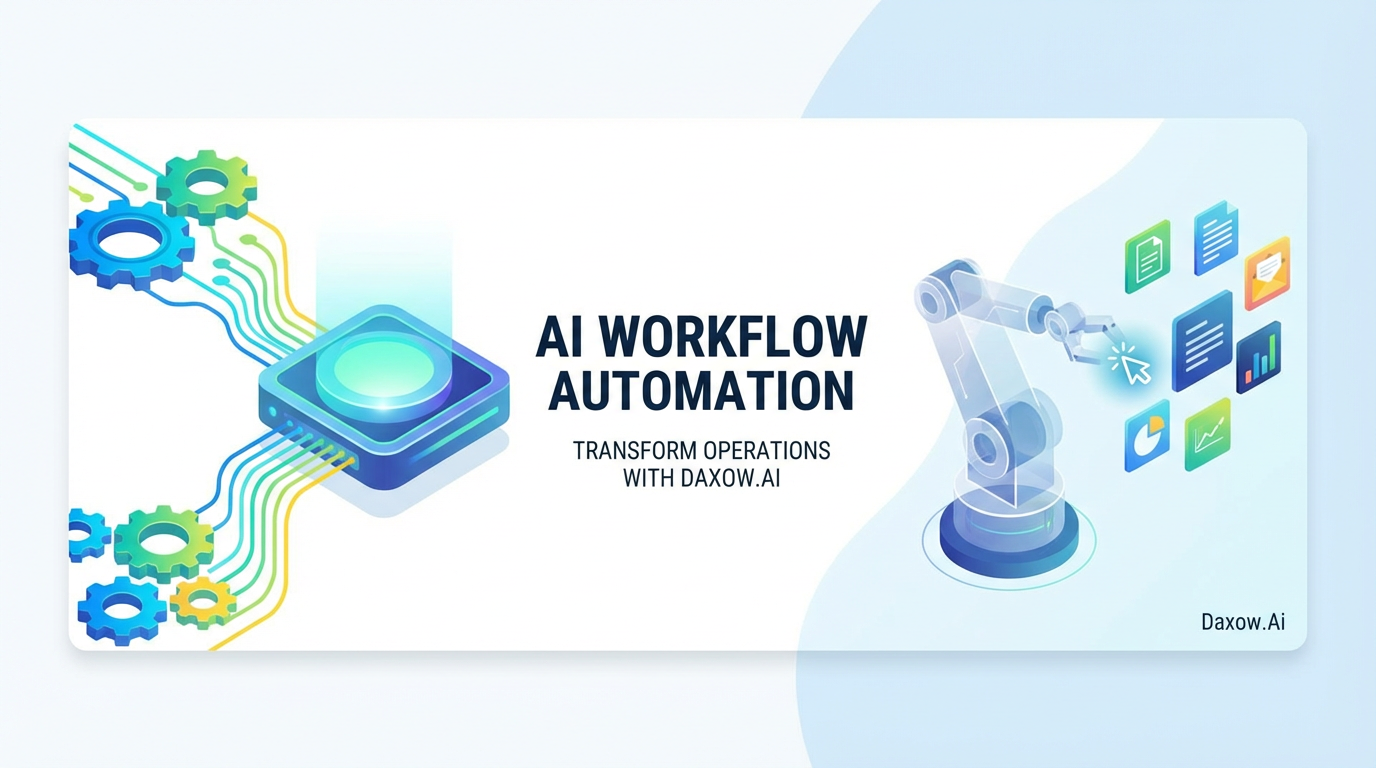
AI workflow automation and AI agents that streamline processes, cut costs, and boost customer experience. Roadmap, industry use cases, and Daxow.ai implementation services.
AI Workflow Automation: Transforming Business Operations for the Modern Enterprise
Estimated reading time: 12 minutes
Key Takeaways
- AI workflow automation automates repetitive, rule-based tasks to increase operational efficiency and reduce errors.
- AI agents enable autonomous, multi-step process execution that scales business without proportional headcount increases.
- Industry-specific use cases demonstrate measurable business value from faster cycles, reduced costs, and improved customer experience.
- A structured roadmap ensures successful AI automation implementation with clear KPIs and continuous optimization.
- Daxow.ai delivers custom AI agents and workflow automation integrating seamlessly with existing enterprise systems.
Table of Contents
- AI Workflow Automation: What it Means for Your Business
- How AI Agents and Automation Drive Business Impact
- Practical Use Cases of AI Workflow Automation Across Industries
- Implementing AI Workflow Automation: A Practical Roadmap
- Estimating ROI and Measuring Success
- Why Partner with Daxow.ai to Build Your AI Workflow Automation
- Frequently Asked Questions
AI Workflow Automation: What it Means for Your Business
AI Workflow Automation integrates artificial intelligence into business processes to automate rule-based, high-volume tasks—such as data entry, invoice processing, ticket triage, and lead qualification—and elevates humans to high-value work. The result is faster execution, fewer errors, and more predictable outcomes.
Key business impacts:
- Reduce manual tasks: Automate repetitive operations so teams can focus on relationship-building, innovation, and exception handling.
- Improve productivity: Organizations report significant time savings—process reductions in the range of 50–70% are commonly achieved for routine tasks—freeing resources for strategic activities.
- Enhance customer experience: Faster response times and personalized interactions lead to higher satisfaction and retention.
- Enable data-driven decisions: Automated workflows generate consistent, high-quality data that feeds analytics and predictive models.
Why this matters now:
- Digital transformation initiatives require automation to scale.
- Regulatory and compliance pressures demand accurate, auditable processes.
- Competitive differentiation increasingly depends on operational agility and customer responsiveness.
Where AI Workflow Automation Delivers Immediate Value
- Order-to-cash cycles: Faster processing and fewer disputes.
- Customer support automation: Quicker resolutions via automated triage and chatbots.
- Accounts payable and reconciliation: Reduced errors and audit time.
- HR onboarding and recruitment: Streamlined screening and faster new-hire activation.
How AI Agents and Automation Drive Business Impact
AI agents—autonomous software that executes tasks, makes decisions, and learns—extend workflow automation beyond single-step rules to multi-step, adaptive processes. When combined with workflow automation, AI agents can operate as virtual team members that monitor data, trigger actions, and integrate across systems.
Core capabilities of AI agents:
- Autonomous execution: Run multi-step processes across systems without manual hand-offs.
- Decision support: Score leads, prioritize escalations, and detect anomalies.
- Learning and adaptation: Improve over time with supervised feedback and new data.
- Integration: Connect CRMs, ERPs, ticketing systems, document repositories, and messaging platforms to orchestrate end-to-end workflows.
Business outcomes:
- Scale without proportional hires: Agents handle volume spikes and repetitive tasks.
- Reduce error rates: Automated validation and reconciliation reduce human mistakes.
- Faster insight cycles: Near-real-time analytics enable proactive decisions.
Examples of AI Agents in Action
- Sales automation: An AI agent monitors incoming leads, enriches profiles, scores leads using predictive models, and routes high-value opportunities to account executives.
- Finance automation: Agents reconcile invoices against purchase orders, flag inconsistencies, and prepare exception reports for human review.
- Support automation: A triage agent classifies incoming tickets, assigns priority, and escalates complex issues to the right specialist.
Practical Use Cases of AI Workflow Automation Across Industries
E-commerce and Retail
- Automated order processing and fulfillment orchestration.
- Inventory forecasting and automated replenishment triggers.
- Personalized product recommendations and post-purchase support automation.
Business value: Faster order-to-fulfillment cycles, reduced stockouts and overstocks, and higher conversion and repeat purchase rates.
Healthcare
- Patient scheduling and automated reminders.
- Medical record data extraction and structuring.
- Triage automation for patient inquiries.
Business value: Lower administrative burden on clinical staff, improved appointment adherence, and better data quality for care coordination and compliance.
Finance and Accounting
- Invoice OCR, validation, and automated posting.
- Fraud detection and anomaly monitoring.
- Automated compliance checks and audit trails.
Business value: Reduced reconciliation time and audit costs, faster month-end closes, and lower risk of financial errors.
Real Estate
- Automated listing syndication and lead qualification.
- Contract review and extraction of key clauses.
- Matchmaking between buyer profiles and listings.
Business value: Shorter sales cycles, prioritized leads and higher close rates, and streamlined contract management.
HR and Operations
- Resume parsing and candidate shortlisting.
- Onboarding workflow orchestration (accounts, equipment, training).
- Employee query automation via internal chatbots.
Business value: Reduced time-to-hire, higher new-hire productivity from day one, and reduced HR service load.
Customer Support and Service
- Multi-channel chatbot for first-line support and knowledge retrieval.
- Automated ticket routing and SLA monitoring.
- Proactive outreach for renewals or at-risk customers.
Business value: Faster response times and reduced backlog, increased CSAT and lower churn, and reduced cost per ticket.
Implementing AI Workflow Automation: A Practical Roadmap
Adopting AI workflow automation is a structured, cross-functional effort. The following phased approach reduces risk and accelerates value realization.
-
Define clear objectives
- Identify measurable goals: reduce processing time by X%, improve NPS by Y points, or cut invoice processing cost by Z%.
- Prioritize processes by impact and complexity—start with high-volume, rule-based tasks.
-
Assess data quality and accessibility
- Audit existing data sources and document formats.
- Standardize and pipeline data to ensure reliable AI inputs and maintain compliance.
- Identify gaps and plan for enrichment where necessary.
-
Select and integrate tools
- Choose platforms that support secure integrations, scalable APIs, and model deployment.
- Prefer modular solutions that can integrate with your CRM, ERP, and ticketing systems.
-
Build a cross-functional team
- Include operations owners, data engineers, ML engineers, security/compliance, and business sponsors.
- Plan for change management and user training to drive adoption.
-
Prototype and test
- Launch small pilots on non-critical processes to validate assumptions.
- Use dashboards and KPIs to measure throughput, error rates, and user feedback.
- Iterate rapidly based on results.
-
Deploy, monitor, and optimize
- Roll out in phases with monitoring and feedback loops.
- Retrain models and update rules as data patterns evolve.
- Maintain governance, auditing, and compliance checks.
Best practices:
- Start small and scale: Prove value with a pilot before enterprise rollout.
- Measure continually: Track KPIs like time saved, error reduction, and revenue impact.
- Keep humans in the loop: Design escalation paths and human review for exceptions.
- Treat automation as iterative: Continuous improvement ensures long-term value.
How Daxow.ai supports each step:
- We conduct process audits to identify automation candidates.
- We design data pipelines and ensure secure integrations with your systems.
- We build custom AI agents and prototypes tailored to your KPIs.
- We provide training, change management, and ongoing optimization to embed automation into operations.
Estimating ROI and Measuring Success
To justify investment and guide scaling, ROI must be quantifiable and tracked against defined KPIs.
Primary ROI drivers:
- Labor cost reduction from replaced manual tasks.
- Time-to-resolution improvements that increase revenue conversion and customer retention.
- Error and compliance cost reductions.
- Increased capacity without adding headcount.
Recommended KPIs:
- Time saved per process (hours/day or % reduction).
- Cost per transaction or ticket.
- Error rate and rework reductions.
- Lead-to-opportunity conversion and sales cycle length.
- Customer satisfaction (CSAT, NPS) and retention metrics.
Example ROI scenario:
An accounts payable automation that reduces invoice processing time by 60% can cut full-time equivalent (FTE) effort by half, reduce late payment penalties, and shorten the financial close. When combined, these effects often justify the automation investment within months.
How Daxow.ai measures success:
- We establish baseline metrics and projected targets.
- We implement real-time dashboards to monitor throughput, accuracy, and economic impact.
- We offer continuous optimization plans to increase ROI over time.
Why Partner with Daxow.ai to Build Your AI Workflow Automation
Daxow.ai is an AI automation agency founded in Estonia in 2024 focused on delivering end-to-end business automation that connects strategy, technology, and operations.
What we deliver:
- Custom AI Agents that execute real tasks and learn from operations.
- Workflow automation design and implementation aligned to your business goals.
- Customer support automation and chatbots that reduce response times and lift CSAT.
- Sales automation and lead qualification to increase conversion and focus sales effort.
- Data extraction and document automation to process invoices, contracts, and records accurately.
- Systems integrations to connect your CRM, ERP, ticketing, and collaboration tools for seamless data flow.
Our approach:
- Process-first: We map current workflows, identify bottlenecks, and target high-impact use cases.
- Integration-first: We prioritize connectivity to your existing systems to maximize ROI and minimize disruption.
- Outcome-driven: We set measurable targets—productivity gains, cost reductions, and revenue impact—and focus on delivering them.
- Governance and security: We implement compliance controls, auditability, and data governance to reduce risk.
Client benefits:
- Reduced operational costs through automation of repetitive tasks.
- Improved productivity across teams by freeing capacity for strategic work.
- Faster time-to-value via pilot-to-scale approach.
- Sustainable ROI through continuous monitoring and optimization.
Typical engagement stages with Daxow.ai
- Discovery and process analysis.
- Prototype development with an AI agent and integration tests.
- Pilot deployment and KPI validation.
- Phased roll-out and team enablement.
- Ongoing support, monitoring, and optimization.
Frequently Asked Questions
What types of business processes are best suited for AI workflow automation?
High-volume, rule-based tasks such as data entry, invoice processing, customer support triage, and lead qualification are ideal for AI workflow automation because they are repetitive and time-consuming, enabling significant efficiency gains.
How do AI agents differ from traditional automation tools?
AI agents are autonomous and capable of multi-step decision-making and learning, whereas traditional automation executes fixed rules. AI agents adapt over time and can integrate data and processes across systems for complex workflows.
What is the expected ROI timeline for AI workflow automation?
ROI timelines vary but many organizations see measurable returns within months after implementation, especially when automating high-volume tasks that reduce manual effort and errors.
How does Daxow.ai ensure compliance and data security in automation projects?
Daxow.ai incorporates governance frameworks, compliance controls, audit trails, and secure data integrations throughout the automation lifecycle to protect sensitive information and meet regulatory requirements.