
AI Workflow Automation: Transform Operations & Drive ROI
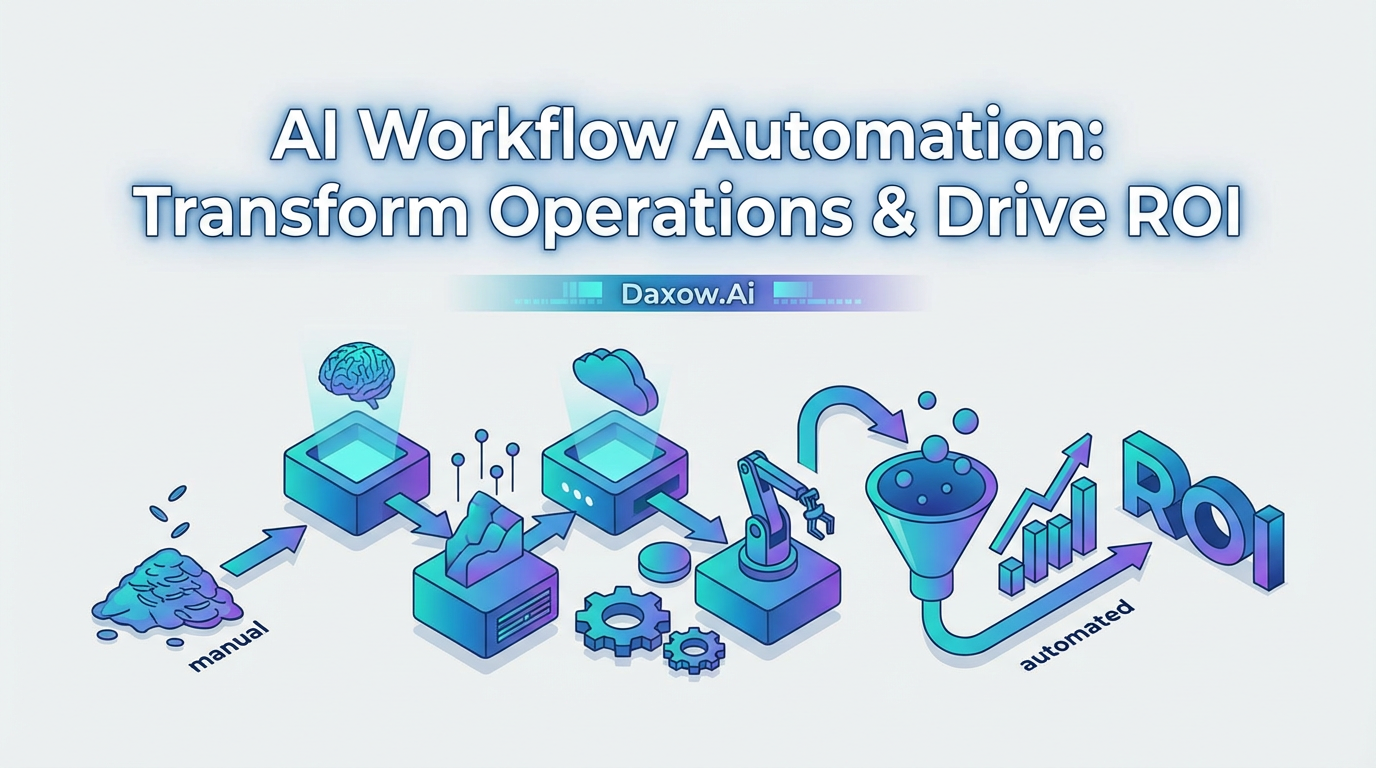
Cut costs and speed operations with AI workflow automation. Read use cases, an 8-step implementation guide, and how Daxow.ai delivers measurable ROI.
AI Workflow Automation: Transforming Business Operations for the AI Era
Estimated reading time: 12 minutes
Key Takeaways
- AI workflow automation integrates intelligent systems into daily business processes, reducing manual efforts and operational risks.
- Organizations can achieve 30–50% operational cost reductions and faster cycle times through AI-driven workflows.
- High-impact areas include customer support, sales, finance, HR, healthcare, real estate, and e-commerce.
- A proven 8-step implementation framework ensures scalable and compliant deployment aligned with business goals.
- Daxow.ai offers tailored AI automation solutions with deep integration, governance, and ongoing support to maximize ROI.
Table of Contents
- AI Workflow Automation: Transforming Business Operations for the AI Era
- What AI Workflow Automation Means for Your Business
- Practical Use Cases Across Industries
- How AI Agents and Automation Drive Transformation
- Implementation Steps and Best Practices
- Measuring ROI and Business Value
- How Daxow.ai Helps You Implement AI Workflow Automation
- Practical Next Steps — A Checklist for Leaders
- Frequently Asked Questions
AI Workflow Automation: Transforming Business Operations for the AI Era
What this phrase captures is the integration of intelligent systems into everyday business processes — from customer support automation and sales automation to document processing and cross-system orchestration. The result: fewer manual tasks, faster cycle times, and automated decision-making that’s auditable and repeatable.
- Definition: AI workflow automation applies machine learning, natural language processing, and rule-based logic to manage and execute end-to-end processes formerly handled by humans.
- Core benefits: reduced manual tasks, improved accuracy, 24/7 operations, and scalable throughput.
- Business impact: targeted areas can see 30–50% operational cost reductions, faster response times, and increased competitiveness.
What AI Workflow Automation Means for Your Business
Strategic advantages for decision-makers
Businesses that adopt AI automation move from reactive, headcount-driven models to proactive, system-driven operations. Key strategic advantages include:
- Capacity without headcount: Automate repeatable tasks so teams focus on strategy and client relationships.
- Improved accuracy: Data-driven agents reduce human error in reconciliation, billing, and reporting.
- Faster time to value: Automated workflows accelerate order-to-cash, support resolution, and onboarding.
- Scalability and agility: Retrainable models and modular integrations adapt as business needs change.
Operational areas with immediate returns
AI workflow automation is most effective in high-volume, repeatable processes:
- Data extraction and document automation (invoices, contracts, medical records)
- Customer support automation (ticket triage, responses, escalation)
- Sales automation (lead qualification, scheduling, CRM updates)
- Finance operations (reconciliation, fraud detection, compliance reporting)
- HR processes (resume screening, onboarding, payroll workflows)
Practical Use Cases Across Industries
E-commerce — Order-to-cash and customer experience
Use case: Automate order validation, inventory updates, shipping notifications, and returns processing using integrated AI agents.
How it works: An AI agent validates orders, checks inventory via ERP integration, triggers fulfillment, and updates the CRM. NLP-powered chatbots handle common support queries; complex issues are routed to humans with context.
Impact: 40% faster fulfillment, reduced cart abandonment through better personalization, and lower support costs via automated ticket triage.
Healthcare — Scheduling, triage, and records management
Use case: Automate patient scheduling, triage intake, and medical record extraction.
How it works: NLP extracts symptoms from intake forms, an AI triage agent prioritizes appointments, and document automation reconciles insurance details.
Impact: Reduced administrative errors, improved compliance, and administrative teams freed to focus on patient care.
Finance — Reconciliation, fraud detection, and compliance
Use case: Automate invoice reconciliation, detect anomalous transactions, and generate audit-ready reports.
How it works: Machine learning models flag suspicious entries, automated reconciliation matches transactions to invoices, and a reporting agent compiles regulatory filings.
Impact: 30% error reduction, faster close cycles, and lower fraud exposure.
Real Estate — Listings, lead qualification, and contract workflows
Use case: Automate property listing ingestion, lead scoring, and contract review.
How it works: Computer vision extracts property features, AI scores leads and schedules viewings, and document automation highlights contract clauses for legal review.
Impact: Faster closings, reduced manual data entry, and better conversion rates.
HR — Recruitment, onboarding, and retention analytics
Use case: Automate resume screening, interview scheduling, and onboarding checklists.
How it works: AI agents parse resumes, match candidates to role profiles, schedule interviews, and track onboarding tasks through HRIS integration.
Impact: Up to 50% reduction in hiring time, improved candidate experience, and early detection of retention risks.
How AI Agents and Automation Drive Transformation
From task bots to autonomous agents
- Autonomy: Agents can qualify leads, schedule meetings, update CRMs, and trigger escalation rules.
- Learning: Continuous retraining ensures agents adapt to new patterns and reduce false positives.
- Orchestration: Agents coordinate across tools (CRM, ERP, support platforms) to complete end-to-end processes.
Integrations, governance, and auditability
- System integrations with Salesforce, HubSpot, ERP platforms, or tools like monday.com enable synchronized workflows.
- Governance ensures model explainability and audit trails for compliance.
- Security and privacy are embedded at design time to meet regulatory requirements.
Implementation Steps and Best Practices
Adopting AI workflow automation requires a structured, business-aligned approach. Below is a proven 8-step framework with practical tips.
1. Define clear objectives
- Set measurable goals: cost reductions, faster SLA adherence, or NPS improvements.
- Use an AI-first scorecard to evaluate readiness.
2. Identify high-impact processes
- Conduct a task audit or process mining to prioritize order-to-cash, ticket triage, or document-heavy workflows.
- Aim for early wins with high-volume, low-risk processes.
3. Assess data quality
- Standardize formats, remove duplicates, and secure PII.
- Create a data pipeline for continuous model training.
4. Select tools and approach
- Choose between off-the-shelf components and custom AI agents based on complexity and integrations.
- Prioritize scalable, secure platforms with API-first architecture.
5. Build a cross-functional team
- Combine domain experts, data engineers, IT, and compliance.
- Start with a small prototype team to speed iteration.
6. Integrate and prototype
- Implement in phases; pilot on non-critical workflows.
- Use feature flags and rollback mechanisms to reduce risk.
7. Monitor, retrain, and optimize
- Deploy dashboards for throughput, error rates, and business KPIs.
- Retrain models with new labeled data and incorporate human feedback loops.
8. Invest in change management
- Provide staff training and communicate benefits.
- Scale modularly to avoid sprawl and preserve governance.
Best practices summary:
- Start small with measurable pilots.
- Embed ethics and bias checks in model development.
- Design for scale with modular integrations and retraining processes.
Measuring ROI and Business Value
Quantifiable outcomes to track
- Cost savings (labor and error correction)
- Throughput increases (tickets closed, invoices processed)
- Processing time reductions (order-to-cash cycle)
- Accuracy improvements (reduction in exceptions)
- Customer metrics (NPS, response time)
- Employee impact (time reallocated to strategic work)
Typical ROI expectations
- Expect 3–5x ROI within 12–18 months when automation is targeted at high-volume workflows.
- Common operational improvements include 20–40% efficiency gains and 30% error reductions.
- Daxow.ai clients typically see sustained 15–30% margin improvements after holistic workflow optimization.
How Daxow.ai Helps You Implement AI Workflow Automation
Daxow.ai designs and delivers end-to-end AI automation tailored to each organization’s needs. Our approach centers on business outcomes and integration discipline.
Discovery and process analysis
- We map current workflows, identify bottlenecks, and prioritize automation candidates.
- Our assessments quantify potential savings and project timelines.
Custom AI system design
- We build AI agents and workflow automation that connect to existing CRMs, ERPs, ticketing systems, and data stores.
- Solutions include document automation (OCR + NLP), chatbots for customer support automation, and sales automation agents that qualify leads and update records.
Integration and deployment
- We implement robust integrations (API-first), secure data pipelines, and audit trails to maintain compliance.
- Deployments follow a prototype-to-scale path with governance controls and rollback options.
Monitoring, retraining, and support
- Daxow provides dashboards, alerts, and retraining workflows so agents improve over time.
- We offer ongoing support to tune models, expand automation scope, and ensure continuity.
Business-aligned outcomes
- Our engagements focus on measurable KPIs: reduced manual tasks, improved productivity, and predictable ROI.
- We balance automation depth with risk management to preserve customer trust and regulatory compliance.
Practical Next Steps — A Checklist for Leaders
- Define 2–3 high-impact processes for a pilot.
- Gather sample data and confirm accessibility.
- Assign a small cross-functional pilot team.
- Choose metrics and a timeline for the pilot (90–180 days).
- Prepare integration endpoints (CRM, ERP, ticketing APIs).
- Plan for monitoring and retraining from day one.
- Communicate changes and train affected teams.
Conclusion and Call to Action
AI Workflow Automation: Transforming Business Operations for the AI Era is an imperative for companies that want to reduce manual tasks, boost productivity, and sustain competitive advantage. By combining AI agents, workflow automation, and disciplined integration, organizations can achieve measurable cost savings, faster processes, and improved customer and employee experiences.
If you want to assess where AI automation will deliver the most value in your business, Daxow.ai can help. Book a free consultation, request a process analysis for your company, or contact us to build a custom AI system that reduces operational costs and scales with your growth.
Frequently Asked Questions
What is AI workflow automation?
AI workflow automation leverages machine learning, natural language processing, and rule-based logic to automate end-to-end business processes that traditionally required human intervention.
Which business areas benefit most from AI workflow automation?
High-volume, repetitive processes such as customer support, sales, finance reconciliation, HR recruitment, healthcare scheduling, and real estate listings experience immediate impact and high ROI.
How long does it take to see ROI from AI automation?
Organizations commonly achieve 3–5x ROI within 12–18 months after deploying AI automation targeted at suitable workflows, with measurable improvements in efficiency and error reduction.
How does Daxow.ai support ongoing AI workflow optimization?
Daxow.ai provides continuous monitoring, model retraining, alerting, and integration support to ensure AI agents evolve with changing business needs while maintaining compliance and governance.