
AI Workflow Automation for Enterprises | Daxow.ai
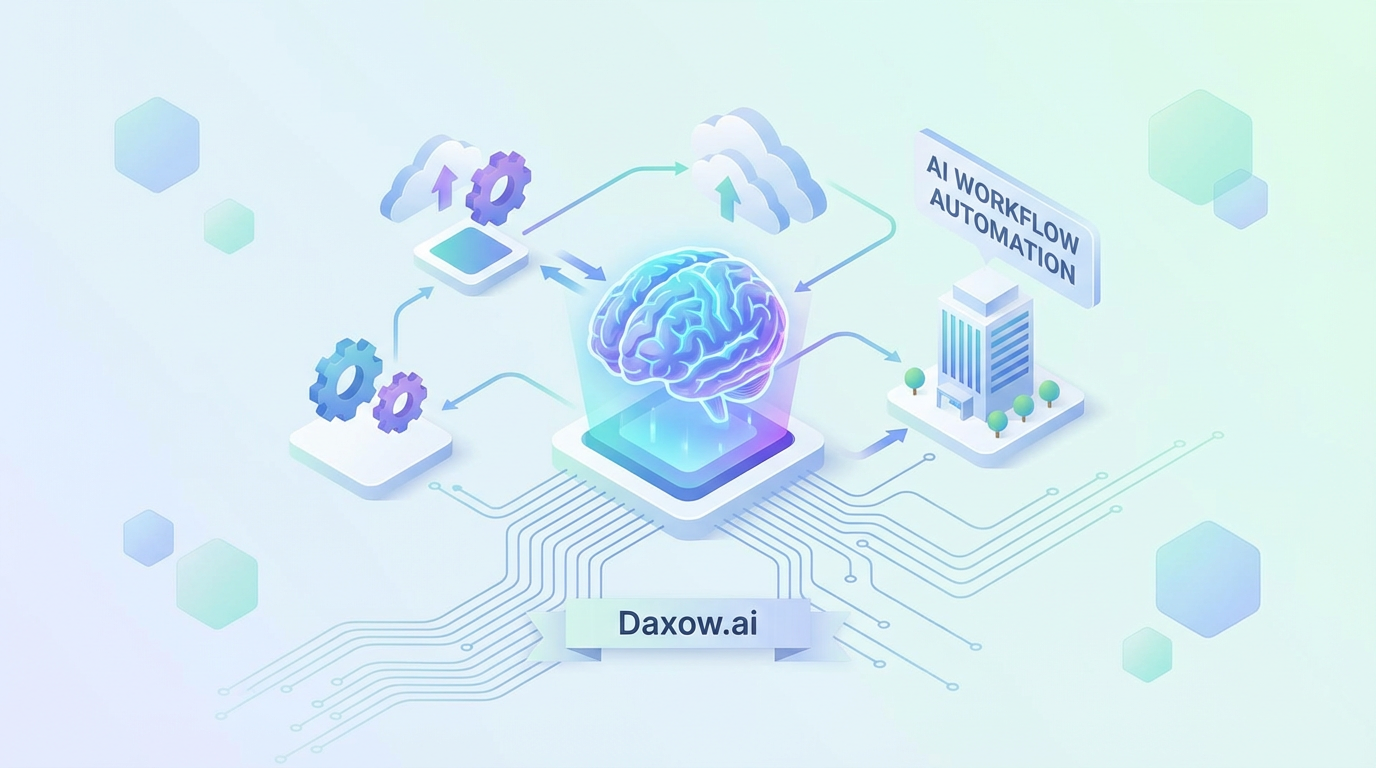
Learn how AI agents and workflow automation help enterprises cut costs, speed operations, and scale. Daxow.ai's roadmap, use cases, and ROI-backed approach.
AI Workflow Automation: Transforming Business Operations for the Modern Enterprise
Estimated reading time: 15 minutes
Key Takeaways
- AI workflow automation integrates AI agents and rule-based systems to reduce manual work and scale operations efficiently.
- Key benefits include reduced operational costs, improved accuracy and compliance, faster cycle times, and enhanced customer experience.
- AI agents perform complex, multi-step tasks and integrate directly with business platforms like CRM and ERP.
- Industry-specific use cases demonstrate measurable improvements in e-commerce, healthcare, finance, real estate, and HR.
- Successful implementation requires a phased, measurable roadmap with emphasis on data quality, compliance, and governance.
- Daxow.ai delivers end-to-end AI workflow automation solutions that drive ROI and operational excellence.
Table of Contents
- What AI Workflow Automation Means for Your Business
- How AI Agents Drive Change
- Practical Use Cases: Industry-by-Industry Examples
- Implementation Roadmap: A Practical, Phased Approach
- Measuring ROI and Business Value
- How Daxow.ai Delivers End-to-End Business Automation
- Governance, Risk, and Ethical Considerations
- Example: A Concrete Daxow Deployment Scenario
- Next Steps: Start Small, Scale Fast
- Frequently Asked Questions
What AI Workflow Automation Means for Your Business
AI workflow automation integrates artificial intelligence into process orchestration so systems—not people—handle repetitive tasks, data extraction, decision routing, and routine customer interactions. This approach combines rule-based automation with predictive models and AI agents—autonomous software entities that perceive data, reason, and act through APIs and platform integrations.
Why this matters now:
- Reduce manual tasks: Rule-based and semi-structured work such as data entry, document processing, and first-line support are prime candidates for automation.
- Scale operations: Systems absorb volume spikes without proportional hiring, improving resilience and response times.
- Improve accuracy and compliance: AI reduces human error and creates audit trails for regulated processes.
- Shift workforce focus: Employees move from repetitive tasks to strategic initiatives, boosting overall productivity.
Research-backed outcomes show automation can cut labor costs by 30–50% in transactional processes and automate 40–60% of routine work in many organizations. These gains translate into faster cycle times, lower error rates, and stronger customer experiences.
AI Workflow Automation: Transforming Business Operations for the Modern Enterprise — How AI Agents Drive Change
AI agents are the practical enablers of this transformation. Unlike simple bots, agents chain multiple tasks, make conditional decisions, and integrate with CRMs, ERPs, and productivity platforms. They can ingest documents, enrich records, trigger downstream processes, and escalate to humans when complex judgment is required.
Key agent capabilities:
- Data ingestion and extraction from documents (invoices, contracts, medical records).
- Natural language understanding to triage customer inquiries and route them.
- Decisioning logic that applies business rules and predictive scores.
- Action execution via APIs: update CRMs, create tickets, submit claims, order inventory.
- Continuous learning and model retraining to adapt to new patterns.
Benefits realized:
- Efficiency gains: Task processing times reduce by an order of magnitude with near-human accuracy.
- Error reduction: Standardized processing eliminates variance across teams.
- Proactive operations: Agents predict issues (e.g., supply chain risks) and take mitigations automatically.
- Human augmentation: Staff handle exceptions and strategy, while agents manage routine flow.
Daxow designs agents that are modular, auditable, and integrated into existing systems—ensuring quick wins and avoiding "agent sprawl."
Practical Use Cases: Industry-by-Industry Examples
E-commerce: Order-to-Cash and Customer Support
Problem: High volume of inquiries, manual returns processing, slow order reconciliation.
Solution:
- AI agents automate order validation, inventory checks, and exception routing.
- Chatbots handle first-line support with escalation to human agents for complex cases.
- Automated returns and refunds processing triggered by scanned receipts and package scans.
Outcomes:
- Conversion uplift via real-time personalization and rapid lead qualification.
- 20–30% lift in conversion rates and 20–40% reduction in support load.
- Faster invoicing and cash collection, improving working capital.
Healthcare: Scheduling, Triage, and Compliance
Problem: Administrative burden, scheduling bottlenecks, and regulatory reporting complexity.
Solution:
- NLP-based triage agents categorize patient inquiries and recommend scheduling windows.
- Document automation extracts data from forms and populates EHR fields.
- Automated compliance reporting pipelines flag anomalies for review.
Outcomes:
- 40% reduction in administrative time, improved appointment utilization, and faster care coordination.
- Reduced compliance risk through consistent, auditable processes.
Finance: Reconciliation, Fraud Detection, and Compliance
Problem: Manual invoice reconciliation, transaction anomalies, regulatory checks.
Solution:
- Intelligent data extraction reconciles invoices to purchase orders.
- Real-time anomaly detection flags suspicious transactions for analyst review.
- Automated compliance workflows generate audit-ready documentation.
Outcomes:
- 30% faster audit cycles, lower error rates, and reduced fraud losses.
- Rapid ROI from reduced manual reconciliations and faster close cycles.
Real Estate: Lead Qualification, Document Review, and Valuations
Problem: Time-consuming lead handling, contract review backlogs, slow valuation cycles.
Solution:
- AI agents pre-qualify leads via chat and automated outreach.
- NLP reviews contracts, highlights risky clauses, and extracts key terms.
- Market trend models generate property valuations and pricing suggestions.
Outcomes:
- Accelerated deal cycles, higher-quality leads, and fewer legal review bottlenecks.
HR and People Operations: Hiring and Onboarding
Problem: Large candidate pools, repetitive onboarding tasks, retention prediction gaps.
Solution:
- Resume screening and candidate shortlisting through ML models.
- Automated onboarding workflows that provision accounts, schedule training, and collect documents.
- Predictive models that analyze engagement signals to forecast turnover risk.
Outcomes:
- 50% reduction in time-to-hire, improved new-hire experience, and proactive retention interventions.
These use cases demonstrate how AI agents and automation start with rule-based tasks and evolve into predictive and prescriptive systems that unlock strategic benefits.
Implementation Roadmap: A Practical, Phased Approach
Successful AI workflow automation follows a disciplined, measurable process. Daxow recommends a phased roadmap:
-
Define clear objectives
- Link automation goals to business KPIs (cost reduction, response time, conversion improvements).
- Set measurable targets—for example, 25% cost savings in invoicing within 9 months.
-
Audit processes and data
- Map end-to-end workflows to identify high-frequency, high-effort tasks.
- Assess data quality and accessibility; ensure compliance readiness.
-
Prioritize use cases
- Choose high-ROI and low-risk pilots to demonstrate value quickly.
- Balance between quick wins and strategic deployments.
-
Architect modular solutions
- Build agents as composable modules that integrate via APIs with CRMs, ERPs, and collaboration tools.
- Design audit logs, role-based access, and monitoring from day one.
-
Prototype and validate
- Develop an MVP agent for a single workflow. Validate with a cross-functional pilot group.
- Measure throughput, accuracy, and user satisfaction.
-
Monitor, iterate, and scale
- Deploy dashboards for performance and error metrics.
- Retrain models, refine rules, and expand automation incrementally.
-
Manage change and governance
- Provide training, documentation, and governance to prevent agent sprawl.
- Maintain ethical standards, privacy safeguards, and security controls.
Best practices across these phases:
- Begin with data quality—garbage in, garbage out still applies.
- Embed compliance from the start to reduce rework.
- Measure impact with business KPIs, not just technical metrics.
- Adopt modular agent design to avoid vendor lock-in and enable reuse.
Measuring ROI and Business Value
AI workflow automation produces measurable returns within 6–12 months, with typical outcomes including:
- Operational cost reductions of 20–50% in targeted areas.
- 3–5x return on investment from faster processing, fewer errors, and higher conversions.
- Improved customer satisfaction with 30–40% faster response times and better first-contact resolution.
- Scalability: handle volume increases without matching headcount growth.
To quantify benefits, Daxow recommends a simple business case template:
- Baseline cost and time per task.
- Expected automation percentage and accuracy improvement.
- Projected dollar savings from reduced labor and faster cycle times.
- Revenue uplifts from improved customer conversion or retention.
Real client outcomes regularly show sustained efficiency gains exceeding 25% annually when automation is executed with governance and continuous improvement.
How Daxow.ai Delivers End-to-End Business Automation
Daxow is structured to move beyond pilots to production-grade business automation. Our approach covers the full lifecycle:
- Discovery and process analysis - We map workflows, quantify losses from manual tasks, and prioritize opportunities with a clear ROI model.
- Custom AI design and development - We build modular AI agents tuned to your data and integrated into your systems—CRM, ERP, ticketing, and cloud storage.
- Integrations and connectivity - We connect disparate systems with secure APIs and create real-time data pipelines so agents act on authoritative information.
- Deployment and change management - We deploy incrementally, provide training, and embed governance to sustain adoption.
- Monitoring and continuous optimization - We deliver dashboards, automated alerts, and retraining schedules so automation adapts as your business changes.
Services we provide:
- AI Agents that execute real tasks end-to-end.
- Workflow automation that orchestrates multi-system processes.
- Customer support automation including chatbots and ticket triage.
- Sales automation and lead qualification to improve funnel efficiency.
- Data extraction and document automation for contracts, invoices, and forms.
- System integrations with CRMs, ERPs, and collaboration tools.
Daxow focuses on measurable business outcomes: reducing manual tasks, boosting productivity, lowering operational cost, and improving customer experience. Learn more about our solutions and services.
Governance, Risk, and Ethical Considerations
Automation introduces new responsibilities. Daxow embeds governance across deployments:
- Security-first design, role-based access, and encrypted data flows.
- Transparent audit logs and explainability for decisions.
- Privacy controls aligned with GDPR and industry regulations.
- Human-in-the-loop escalation for high-risk decisions.
Proactive governance prevents operational disruption and builds stakeholder trust—critical for enterprise adoption.
Example: A Concrete Daxow Deployment Scenario
Problem: A mid-sized e-commerce company faced high returns processing costs, slow refunds, and low cart recovery rates.
Daxow solution:
- Deploy an AI agent to process return requests by extracting purchase data, verifying return eligibility, and issuing shipping labels.
- Integrate with the CRM to notify customers and with the payments gateway to trigger refunds.
- Implement a chatbot to handle common return queries and qualify cases needing human attention.
Results:
- Return processing time reduced from days to hours.
- Customer support tickets related to returns decreased by 40%.
- Faster refunds improved customer satisfaction and repeat purchases, increasing revenue per customer.
This example illustrates how combining AI agents, workflow automation, and systems integration produces measurable operational and commercial gains.
Next Steps: Start Small, Scale Fast
If your organization is evaluating AI automation, begin with a focused pilot that targets a high-frequency, high-cost process. Use clear KPIs, short sprint cycles, and measurable milestones. Daxow’s modular approach means pilots convert quickly into scalable systems.
Ready to transform operations with AI workflow automation? Book a free consultation with Daxow.ai to:
- Request a process analysis for your company.
- Get a pilot proposal aligned with ROI targets.
- Design a roadmap to scale AI agents across your business.
Contact us to build a custom AI system that reduces manual tasks, boosts productivity, and delivers measurable business automation outcomes.
Frequently Asked Questions
What is AI workflow automation?
AI workflow automation integrates AI and rule-based systems to automate repetitive business tasks such as data entry, decision routing, and customer interactions, improving efficiency and accuracy.
How do AI agents differ from traditional bots?
AI agents perform multi-step workflows, make conditional decisions, and integrate deeply with enterprise systems, unlike simple bots which usually execute predefined, isolated tasks.
Which industries benefit most from AI workflow automation?
Industries such as e-commerce, healthcare, finance, real estate, and human resources see significant benefits through improved accuracy, cost reduction, and faster process cycles.
What is the typical ROI timeframe for AI workflow projects?
Most AI workflow automation projects achieve measurable returns within 6 to 12 months, delivering operational cost savings and enhanced customer outcomes.
How does Daxow.ai ensure compliance and governance?
Daxow embeds compliance from the start with security-first designs, audit logging, privacy controls aligned with regulations like GDPR, and human-in-the-loop escalation for sensitive decisions.