
AI Workflow Automation: Transform Operations with Daxow.ai
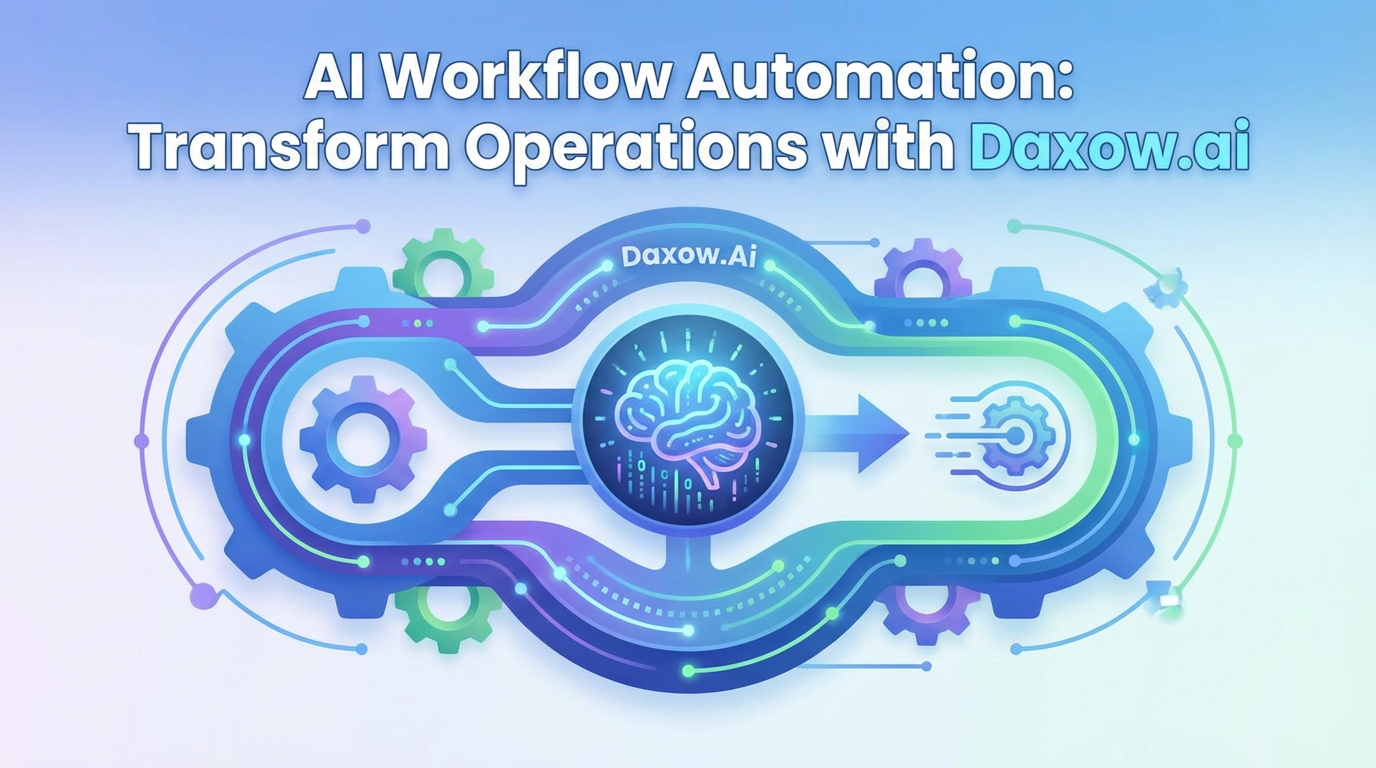
Practical guide to AI workflow automation—use cases, ROI, governance, and implementation steps. See how Daxow.ai designs AI agents and end-to-end automation.
AI Workflow Automation: Transforming Business Operations for the AI Era
Estimated reading time: 15 minutes
Key Takeaways
- AI workflow automation integrates AI and automation tools to optimize business processes and reduce manual effort.
- Industries such as e-commerce, healthcare, finance, real estate, HR, and customer support benefit with faster, more accurate workflows.
- AI agents enable dynamic, autonomous workflows and seamless system integration, driving operational efficiency and scalability.
- Structured implementation including data preparation, tool selection, and governance accelerates successful deployment.
- Measuring ROI involves tracking cycle time, error rates, labor savings, and customer impact with continuous monitoring.
- Daxow.ai partners offer end-to-end AI workflow automation solutions designed to fit specific business needs and maximize value.
Table of Contents
- AI Workflow Automation: Transforming Business Operations for the AI Era
- Practical Use Cases: How AI Workflow Automation Delivers Value
- How AI Agents and Automation Drive Success
- Implementation Steps and Best Practices
- Measuring ROI and Business Impact
- How Daxow.ai Partners with Your Organization
- Frequently Asked Questions
AI Workflow Automation: Transforming Business Operations for the AI Era
AI Workflow Automation: Transforming Business Operations for the AI Era is not a hypothetical future — it is a practical strategy companies are adopting now to reduce manual tasks, increase productivity, and deliver measurable business value. This article explains what AI workflow automation means for organizations, presents structured research-backed guidance, and offers actionable use cases across industries. It also shows how Daxow.ai helps businesses design and deploy custom AI systems — from AI agents to end-to-end workflow automation — to reduce operational costs and improve ROI.
What we mean by AI workflow automation is the integration of AI models and automation tools into business processes to handle repetitive, rule-based, and data-heavy tasks. The result is faster decision-making, fewer errors, scalable throughput, and freed human capacity for strategic work.
Why this matters now
- Businesses gain cost savings by reducing labor-intensive activities and automating high-volume workflows.
- Organizations achieve improved accuracy through AI-driven validation and anomaly detection, lowering error rates.
- Companies obtain enhanced scalability, managing growth without proportional increases in headcount.
- Faster response times and data-driven insights improve customer satisfaction and resource allocation.
Core capabilities delivered by AI workflow automation
- Intelligent data extraction and document automation to remove manual data entry.
- AI agents that autonomously qualify leads, route tickets, and run exception handling.
- Integrations with CRMs and enterprise tools to create closed-loop, end-to-end processes.
- Continuous monitoring and retraining to maintain model accuracy and compliance.
Practical Use Cases: How AI Workflow Automation Delivers Value
E-commerce — Order-to-Cash and Customer Experience
- Process: Order validation, inventory reconciliation, returns processing, personalized recommendations.
- Automation: AI agents monitor incoming orders, verify payment and inventory data, trigger fulfillment, and manage returns workflows. Personalization engines tailor product suggestions and automated emails.
- Impact: Up to 50% faster fulfillment, reduced fulfillment errors, and improved repeat purchase rates. Integrations with inventory systems and CRMs enable single-source customer views.
Healthcare — Scheduling and Administrative Load Reduction
- Process: Patient scheduling, medical record updates, insurance pre-authorization, preliminary triage.
- Automation: Intelligent schedulers coordinate availability, extract and standardize EHR data, and run rule-based triage to prioritize appointments.
- Impact: Reduced administrative burden, faster patient throughput, and better compliance management. AI workflow automation ensures privacy-by-design and audit trails for regulators.
Finance — Reconciliation, Fraud Detection, and Compliance
- Process: Invoice processing, payment reconciliation, fraud monitoring, regulatory reporting.
- Automation: Document automation extracts invoice data, AI models reconcile transactions, anomaly detection flags suspicious activity, and automated reporting compiles audit-ready files.
- Impact: 20–50% reduction in process time, lower error rates (approaching industry targets under 1%), and accelerated audit cycles.
Real Estate — Lead Qualification and Valuation
- Process: Lead intake, property listing updates, valuation and comparables analysis.
- Automation: AI agents qualify leads via email/chat, enrich leads with external data, auto-generate listing descriptions, and produce valuation drafts from market data.
- Impact: Faster deal cycles, higher-quality pipeline, and improved agent productivity through automated administrative tasks.
HR — Recruitment and Employee Support
- Process: Candidate screening, onboarding document collection, employee helpdesk inquiries.
- Automation: Resume parsing, skills-matching algorithms, automated offer and onboarding workflows, and HR chatbots for policy questions.
- Impact: 30–40% shorter hiring time, better candidate experience, and reduced HR admin costs.
Customer Support — Ticket Routing and Self-Service
- Process: Incoming support tickets, triage, escalation, and knowledge-base access.
- Automation: AI classifiers route tickets to the correct team, automated responders handle common queries, and agents surface next-best-actions for complex issues.
- Impact: Faster resolution times, higher first-contact resolution, and reduced manual ticket handling.
Across these industries, common themes are clear: AI agents handle unstructured inputs, automation tools connect systems, and monitoring ensures continuous improvement.
How AI Agents and Automation Drive Success
AI agents are autonomous or semi-autonomous software entities that perform dynamic, context-aware tasks. They are central to advanced workflow automation because they can learn from interactions and improve performance over time.
What AI agents do in practical terms
- Lead qualification agents evaluate inbound prospects against sales criteria and push qualified leads into the CRM.
- Invoice-processing agents extract invoice fields, validate totals, and create reconciliation entries.
- Support-routing agents classify tickets and apply escalation rules.
- Monitoring agents watch for exceptions, generate alerts, and trigger corrective workflows.
Integration and orchestration
AI agents are most powerful when orchestrated into end-to-end workflows. Agents must integrate with CRMs, ERPs, ticketing systems, and cloud storage so that information flows without human handoffs. This integration is where businesses realize operational leverage: process bottlenecks disappear and data is centralized for analytics.
Governance and lifecycle management
- Continuous monitoring: dashboards, performance alerts, error tracking.
- Adaptive retraining: scheduled and event-driven model updates to maintain accuracy.
- Audit trails and compliance: logging every decision for transparency and regulatory review.
- Change control: governance to prevent uncontrolled proliferation of agents and maintain system integrity.
Implementation Steps and Best Practices
Key Implementation Steps
-
Define clear objectives
- Establish measurable goals (e.g., reduce invoice processing time by 30%).
- Use an AI-first scorecard to assess readiness and prioritize workflows.
-
Assess and prepare data
- Audit data quality, completeness, and accessibility.
- Standardize formats and establish secure pipelines.
-
Select and integrate tools
- Choose scalable, secure platforms compatible with your tech stack.
- Favor tools with robust APIs to integrate with CRMs, ERPs, and ticketing systems.
-
Build a cross-functional team
- Combine product owners, data engineers, subject-matter experts, and compliance leads.
- Invest in training and change management.
-
Prototype and test
- Start with a high-impact pilot, measure results, and iterate rapidly.
- Use guarded deployments to validate performance before scaling.
-
Deploy, monitor, and optimize
- Roll out in phases, retrain models, and maintain governance and asset inventories.
Best Practices (Actionable)
- Prioritize high-impact workflows first to secure quick wins and internal buy-in.
- Ensure data quality before model development to avoid downstream failures.
- Foster scalability with modular design and microservices-based orchestration.
- Embed compliance and privacy from day one, not as an afterthought.
- Implement continuous monitoring and retraining to adapt to changing inputs.
- Invest in training and adoption for business users to maximize ROI.
Avoid "agentic sprawl" by enforcing governance: inventory agents, set access controls, and maintain clear SLAs and ownership.
Measuring ROI and Business Impact
AI workflow automation delivers quantifiable returns when measured against the right metrics. Typical gains reported across deployments include process time reductions of 20–50%, error rates dropping below 1% in disciplined systems, and payback periods of 6–12 months.
Key metrics to track
- Cycle time reduction (e.g., order processing, invoice turnaround).
- Error rate and exception volume.
- Labor hours saved and redeployed to strategic tasks.
- Conversion lift from automated lead qualification.
- Customer satisfaction and resolution time for support automation.
- Cost per transaction before and after automation.
Practical ROI example
Scenario: A mid-size company processes 10,000 invoices annually at a manual cost of $8 per invoice = $80,000.
With AI workflow automation reducing time and errors by 40%, effective cost per invoice drops to $4.80 = $48,000.
Annual savings: $32,000. Additional soft benefits (faster payments, fewer disputes) can accelerate the payback further.
Tracking and iterations
Create a dashboard with leading and lagging indicators. Use pilot results to refine forecasts and scale investments where outcomes are strongest.
How Daxow.ai Partners with Your Organization
Daxow.ai helps businesses across industries implement and scale AI workflow automation end-to-end. Our approach focuses on measurable business outcomes and robust integrations.
What Daxow.ai delivers
- Process discovery and readiness assessment: We map workflows, identify automation candidates, and build a prioritized roadmap.
- Custom AI agents and workflow automation: We design and deploy AI agents tailored to your use cases — lead qualification, invoice processing, support automation, and more.
- Data extraction and document automation: We implement pipelines that convert unstructured documents into actionable data.
- CRM and system integrations: We connect AI agents with your existing stack to create seamless end-to-end processes.
- Governance, monitoring, and retraining: We set up compliance frameworks, monitoring dashboards, and retraining pipelines to keep models accurate and auditable.
- Change management and training: We equip teams to adopt automated processes and maximize ROI.
How we work (typical engagement)
- Discovery: Map current processes, set KPIs, and identify quick wins.
- Pilot: Build a focused pilot to validate accuracy and business impact.
- Scale: Expand successful pilots into wider automation programs with modular architecture.
- Operate: Maintain and optimize systems, provide training, and report on business metrics.
Business value delivered
- Reduced operational costs through automated repetitive work.
- Faster response times and better customer experience through automation and AI agents.
- Increased productivity by freeing employees for strategic work.
- Clear ROI within predictable timelines, supported by monitoring and continuous improvement.
Conclusion and Call to Action
AI Workflow Automation: Transforming Business Operations for the AI Era is a practical, high-impact route to operational excellence. Organizations that prioritize high-impact workflows, ensure data quality, and apply disciplined governance achieve rapid ROI and long-term strategic advantage.
If you are ready to reduce manual tasks, increase productivity, and build AI agents that execute real work in your systems, Daxow.ai can help. Book a free consultation or request a process analysis to discover where automation will have the greatest business impact for your company. Contact us to build a custom AI system and start your transformation.
Frequently Asked Questions
What is AI workflow automation?
AI workflow automation is the integration of AI models with automation tools to handle repetitive, data-heavy business tasks, enabling faster and more accurate operations.
Which industries benefit most from AI workflow automation?
Industries such as e-commerce, healthcare, finance, real estate, HR, and customer support see significant benefits through faster processing, enhanced accuracy, and improved scalability.
How does Daxow.ai assist with AI workflow automation?
Daxow.ai partners with organizations to map processes, design custom AI agents, integrate systems, and provide governance, monitoring, and training for sustainable automation success.
How can I measure the ROI of AI workflow automation?
Key metrics include cycle time reduction, error rates, labor savings, conversion rates, customer satisfaction, and cost per transaction. A structured dashboard helps track performance and ROI.