
Transform Business Operations with AI Workflow Automation
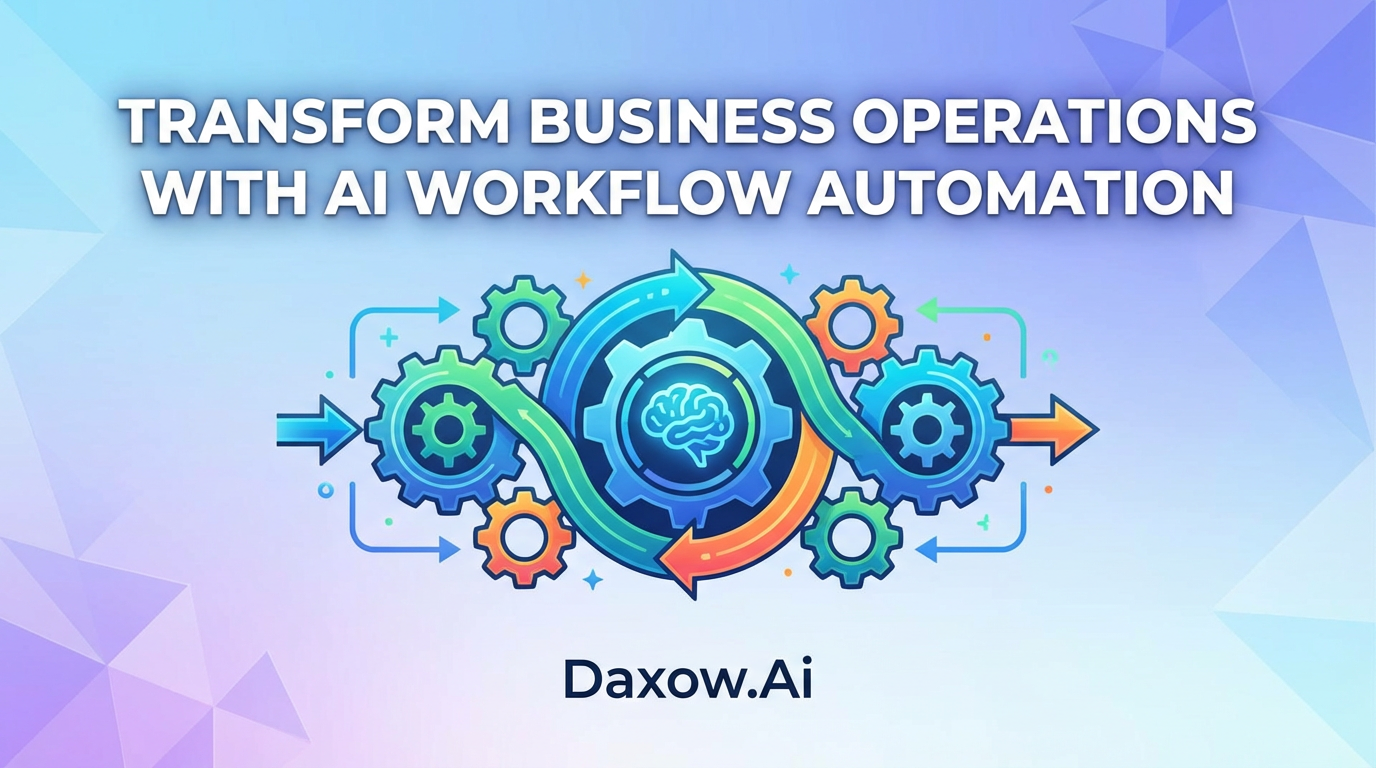
How AI workflow automation and Daxow.ai's AI agents reduce manual work, boost productivity, and deliver measurable ROI across industries in months.
AI Workflow Automation: Transforming Business Operations for the AI Era
Estimated reading time: 15 minutes
Key Takeaways
- AI workflow automation integrates intelligence to create autonomous, adaptive, and scalable processes.
- Industries like e-commerce, healthcare, finance, and real estate benefit from significant efficiency and error reduction.
- Daxow.ai provides tailored AI systems and agents for seamless automation, compliance, and measurable ROI.
- Successful implementation follows clear objectives, data governance, prototyping, modular integration, and continuous optimization.
Table of Contents
- AI Workflow Automation: Transforming Business Operations for the AI Era
- Practical Use Cases and Industry Examples
- How AI Agents and Automation Deliver Tangible Business Value
- Implementation Steps and Best Practices
- Overcoming Common Challenges
- Measuring ROI and Long-Term Value
- How Daxow.ai Helps Organizations Implement AI Workflow Automation
- Practical Roadmap — Example Project Timeline
- Actionable Checklist for Decision-Makers
- Frequently Asked Questions
AI Workflow Automation: Transforming Business Operations for the AI Era
AI workflow automation integrates intelligence into routine processes so systems can execute tasks autonomously, adapt to changing inputs, and generate real-time insights. The transformation is not just replacing manual steps — it is redesigning workflows to be data-driven, auditable, and scalable.
Key outcomes decision-makers care about:
- Reduce manual tasks and human error across high-volume operations.
- Improve productivity by 20–50% on targeted workflows.
- Accelerate throughput and shorten cycle times for customer-facing and back-office processes.
- Achieve ROI within 6–12 months by combining cost reduction and revenue uplift.
What distinguishes AI workflow automation from traditional automation
Traditional automation follows fixed rules. AI workflow automation uses machine learning and natural language processing to handle unstructured inputs (emails, documents, voice), adapt to new patterns, and escalate exceptions. AI agents extend this further by orchestrating multi-step processes across systems — for example, qualifying a lead, updating the CRM, and scheduling a demo without human intervention.
Practical Use Cases and Industry Examples
E-commerce
Use case: Order-to-cash automation
- Automate inventory reconciliation, fraud checks, and returns processing.
- Use AI agents to trigger restock orders when inventory dips and to route exceptions to human agents.
- Business impact: Up to 50% reduction in fulfillment time, faster refunds, and improved customer satisfaction through instant query resolution.
Healthcare
Use case: Patient intake and triage automation
- Extract structured data from intake forms and medical records using NLP.
- Automate scheduling, pre-authorization checks, and triage recommendations for clinicians.
- Business impact: Reduced administrative burden, faster patient routing, and improved compliance with audit trails.
Finance
Use case: Invoice processing and fraud detection
- Use OCR and predictive models to reconcile invoices, flag anomalies, and match payments automatically.
- Automate compliance checks and generate audit-ready logs.
- Business impact: Error reductions up to 90% and accelerated month-end closing cycles.
Real Estate
Use case: Lead qualification and property matching
- AI agents qualify inbound leads from email and chat, match buyer preferences with listings, and schedule viewings.
- Integrate with CRMs to update lead stages and trigger follow-ups.
- Business impact: Shorter sales cycles and higher conversion rates through timely, personalized engagement.
HR and Recruitment
Use case: Resume screening and onboarding automation
- Automate resume parsing, initial candidate screening, interview scheduling, and paperwork.
- Keep candidate data synchronized with HRIS and compliance systems.
- Business impact: Hiring time reduced by 30–40%, recruiters freed for strategic sourcing.
Customer Support
Use case: Ticket handling and escalation
- AI agents classify tickets, draft context-aware responses, and route complex issues to specialists.
- Combine customer support automation with sentiment analysis to prioritize critical cases.
- Business impact: Faster first-response times and improved customer satisfaction scores.
How AI Agents and Automation Deliver Tangible Business Value
AI agents are the operational layer that executes tasks end-to-end. When combined with workflow automation, they provide:
- Autonomy across systems: Agents connect to CRMs, finance systems, and communication platforms to perform actions directly.
- Adaptation and learning: Continuous retraining reduces model drift and keeps performance consistent.
- Compliance and traceability: Audit logs document decisions and actions for regulatory needs.
- Scalability: Modular agents can be expanded across departments without rearchitecting core systems.
Example: A sales automation agent can qualify leads, send tailored outreach, book demos, and update opportunity status. This reduces manual follow-ups and shortens the sales cycle while preserving personalization.
Implementation Steps and Best Practices
1. Define clear objectives and prioritize workflows
- Identify high-volume, high-cost processes where automation will deliver measurable gains (e.g., invoice processing, ticket routing, lead qualification).
- Set KPIs such as time saved, error rate reduction, or revenue impact (e.g., reduce manual invoice processing time by 30%).
2. Assess data quality and infrastructure
- Audit data sources for completeness and consistency.
- Standardize formats and establish secure pipelines to ensure the AI has reliable inputs.
- Address privacy and regulatory requirements before integrating data.
3. Build cross-functional teams
- Combine process owners, data engineers, ML specialists, and compliance officers.
- Establish governance for model testing, bias detection, and monitoring.
4. Prototype, pilot, and iterate
- Start with a narrow pilot for a non-critical workflow.
- Use feedback loops from users to refine models and workflows.
- Expand iteratively to avoid sprawl and ensure stable ROI.
5. Integrate and scale with modular architecture
- Use APIs and connectors to integrate AI agents with CRMs, ERPs, ticketing systems, and communication tools.
- Design agents to be modular so they can be reused across workflows.
6. Monitor, retrain, and govern
- Track accuracy, throughput, and financial metrics continuously.
- Retrain models to prevent drift and maintain performance.
- Implement ethical checks and transparency to build trust.
Overcoming Common Challenges
Common challenges include data silos, integration hurdles, resistance to change, and model drift. Practical mitigations:
- Data silos: Standardize data pipelines and centralize access for AI models.
- Integration hurdles: Prioritize compatible, scalable tools and adopt incremental integrations.
- Resistance to change: Use comprehensive training, clear communication, and early wins from pilots to build adoption.
- Model drift: Set up automated monitoring and retraining schedules.
Measuring ROI and Long-Term Value
AI workflow automation delivers quantifiable returns:
- Reported efficiency gains of 20–50%, with some workflows achieving higher.
- Error reductions up to 90% in high-volume tasks like data entry and invoice reconciliation.
- Payback often within 6–12 months when automation is aligned with strategic objectives.
Beyond near-term savings, long-term value compounds:
- Predictive analytics improves forecasting accuracy and strategic planning.
- Employee productivity multiplies as humans shift from repetitive work to higher-value tasks.
- Modernized operations help retain talent and provide a competitive edge.
How Daxow.ai Helps Organizations Implement AI Workflow Automation
Discovery and process analysis
- We map existing workflows, identify bottlenecks, and quantify opportunities to reduce manual work.
- Deliverable: A prioritized automation roadmap that includes estimated savings and implementation timeline.
Custom AI system design and prototyping
- We design tailored AI agents and automation pipelines that integrate with your CRM, finance systems, ticketing platforms, and data stores.
- Deliverable: A working prototype validated against real data and business KPIs.
Secure integration and deployment
- Daxow.ai implements secure, API-driven integrations and orchestrates automation across tools used by your teams.
- We ensure compliance, audit logging, and role-based access for governance.
Continuous optimization and support
- We monitor agent performance, retrain models, and implement feature improvements.
- Deliverable: Ongoing optimization that sustains ROI and adapts to new business needs.
Measurable outcomes we deliver
- Reduced operational costs through automation of repetitive tasks.
- Improved customer experience via faster, personalized responses.
- Increased conversion and revenue with bespoke sales automation.
- Higher employee productivity by removing routine work and enabling focus on strategic tasks.
Practical Roadmap — Example Project Timeline
A typical Daxow.ai engagement follows a phased timeline to de-risk the initiative and demonstrate value quickly.
- Phase 1 (2–4 weeks): Discovery & process mapping - Identify target workflows and baseline metrics.
- Phase 2 (4–8 weeks): Prototype & pilot - Build an AI agent for a single workflow; run pilot and collect performance data.
- Phase 3 (8–16 weeks): Integrate & deploy - Extend automation across systems, roll out to broader teams, and implement monitoring.
- Phase 4 (Ongoing): Optimize & scale - Retrain models, add new workflows, and expand integrations.
Actionable Checklist for Decision-Makers
- Identify top 3 processes where manual effort is highest.
- Set clear KPIs (time savings, error reduction, revenue impact).
- Ensure data accessibility and privacy compliance.
- Start with a controlled pilot and measure outcomes.
- Partner with a specialist (like Daxow.ai) to accelerate deployment and integration.
Frequently Asked Questions
What is AI workflow automation?
AI workflow automation integrates artificial intelligence into routine business processes, enabling systems to execute tasks autonomously, adapt to changes, and generate real-time insights.
How quickly can I expect a return on investment?
Organizations typically see ROI within 6 to 12 months by combining cost reductions and revenue improvements through AI workflow automation.
What industries benefit most from AI workflow automation?
Industries such as e-commerce, healthcare, finance, real estate, HR, and customer support have demonstrated significant improvements using AI workflow automation.
How does Daxow.ai support the automation journey?
Daxow.ai offers end-to-end services from process analysis and custom AI system design to secure integration, continuous optimization, and measurable business outcomes.