
AI Workflow Automation: Transforming Business Operations
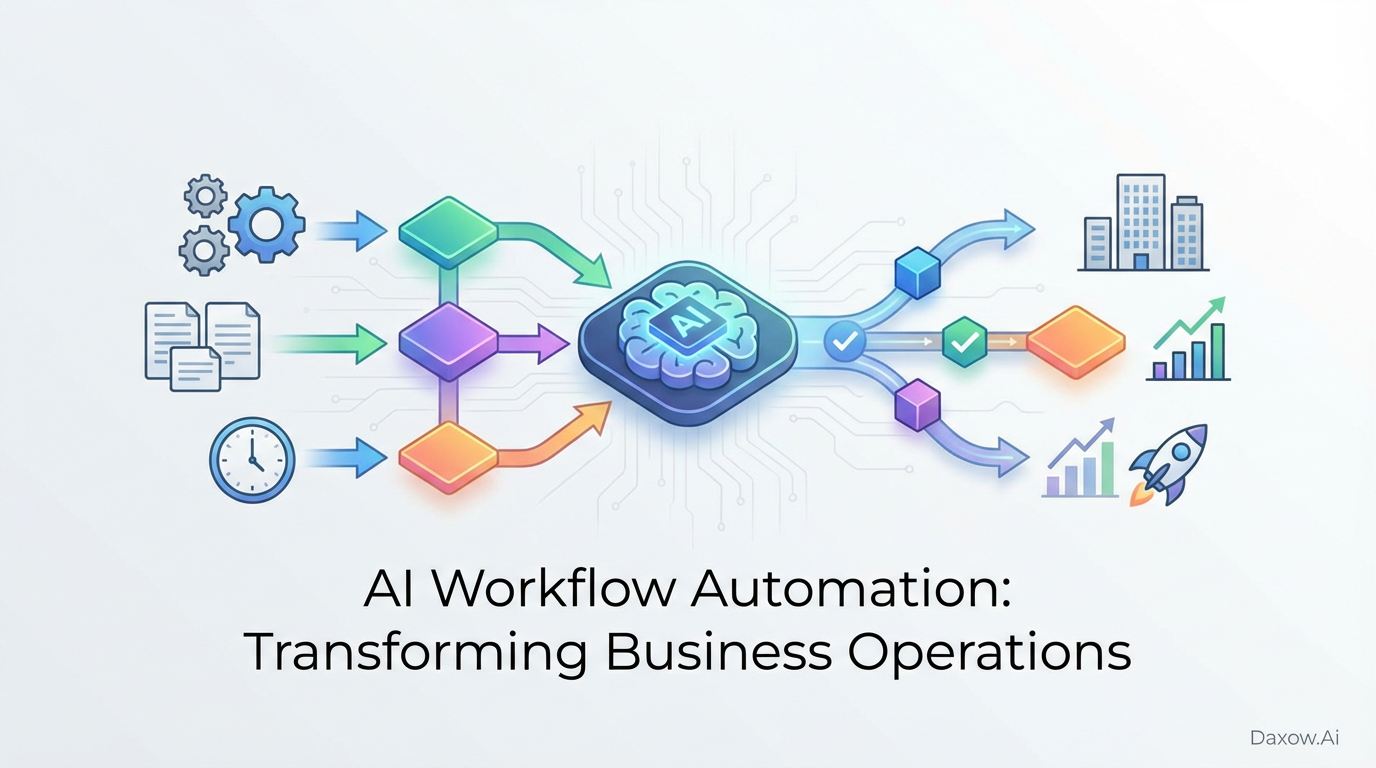
How AI workflow automation and agents reduce manual work, improve accuracy, and scale operations—practical use cases, ROI metrics, and an implementation roadmap.
AI Workflow Automation: Transforming Business Operations for the AI Era
Estimated reading time: 13 minutes
Key Takeaways
- AI workflow automation merges traditional automation with AI technologies like machine learning and NLP to transform business processes.
- Daxow.ai designs custom AI agents and modular workflows to improve efficiency, accuracy, and decision speed across industries.
- Typical business impacts include 20–50% efficiency gains, up to 30% administrative burden reduction, and error reductions exceeding 90% in structured tasks.
- Key use cases include e-commerce order automation, healthcare triage, finance invoice reconciliation, real estate lead qualification, and HR onboarding automation.
- Successful adoption requires a phased approach: discovery, data prep, piloting, scaling, and continuous optimization.
- Daxow.ai addresses challenges like data silos, change management, model drift, and scalability through integrated solutions and governance.
- Quantifying ROI is critical; clients often see 3–5x returns within 6–12 months through labor savings and improved throughput.
Table of Contents
- AI Workflow Automation: Transforming Business Operations for the AI Era — What it means for your business
- How AI agents and automation drive measurable results
- Practical use cases and industry examples
- Implementation roadmap and best practices
- Overcoming common challenges
- Quantifying ROI and business value
- How Daxow.ai partners with you
- Frequently Asked Questions
AI Workflow Automation: Transforming Business Operations for the AI Era — What it means for your business
AI Workflow Automation: Transforming Business Operations for the AI Era is no longer a theoretical advantage—it's a practical imperative for organizations that want to reduce manual work, scale operations, and increase competitive differentiation. By embedding AI automation and AI agents into routine processes, companies can free teams from repetitive tasks, improve accuracy, and accelerate decision-making. At Daxow.ai, we partner with businesses to analyze current workflows and build custom AI systems that deliver measurable productivity gains and lasting ROI.
AI workflow automation combines traditional workflow automation with machine learning, natural language processing, and intelligent decisioning. The result is systems that do more than move data between systems: they interpret, decide, and act.
- What it automates: data entry, invoice processing, lead qualification, customer support triage, compliance reporting, and other rule-based or data-heavy activities.
- Business outcomes: faster decision cycles, fewer errors, lower operating costs, and improved customer experience.
- Typical impact: efficiency improvements of 20–50%, administrative burden reductions up to 30%, and error reductions that can exceed 90% in highly structured tasks.
Daxow.ai helps organizations move from pilots to enterprise-scale automation by designing AI agents and modular workflows that integrate with CRM, ERP, ticketing systems, and document repositories. Our approach balances rapid value capture with robust governance and scalability.
How AI agents and automation drive measurable results
AI agents are autonomous software entities that perceive data, reason, and take actions. They extend the reach of traditional automation by handling unstructured inputs and dynamic decisions.
Core capabilities of AI agents
- NLP and document understanding: read invoices, contracts, emails, and support tickets.
- Predictive analytics: score leads, flag anomalies, and forecast demand.
- Automated orchestration: trigger downstream workflows, update systems of record, and notify stakeholders.
- Continuous learning: adapt to new patterns through retraining and human feedback.
Business improvements enabled
- Reduce manual tasks: agents automate routine touchpoints, freeing staff for strategic work.
- Improve productivity: reclaim employee time and increase throughput.
- Enhance customer support automation: provide faster, consistent responses and escalate complex cases intelligently.
- Enable sales automation: qualify leads and surface prioritized opportunities for human follow-up.
At Daxow, we build AI agents that execute real tasks—extracting data from documents, qualifying leads via email analysis, and autonomously routing tickets—while preserving audit trails and compliance controls.
Practical use cases and industry examples
E-commerce: Order-to-cash and returns automation
Problem: Manual order verification, inventory updates, and returns handling cause delays and high labor cost.
Solution: Deploy an AI agent that validates orders against inventory, triggers fulfillment workflows, auto-creates return labels, and updates the CRM.
Impact: Up to 40% faster fulfillment times and reduced returns processing costs; improved customer satisfaction through faster resolution.
How Daxow helps:
- Design automated order validation pipelines and integrations with ERP and fulfillment systems.
- Build exception handling agents that escalate only high-risk or ambiguous cases to humans.
Healthcare: Patient scheduling and preliminary triage
Problem: Administrative overload from scheduling, insurance verification, and initial triage slows care delivery.
Solution: Use workflow automation coupled with NLP agents to extract intake information, verify insurance, and triage patient inquiries to the correct clinician or department.
Impact: Administrative costs reduced ~30%, faster appointment throughput, and improved compliance with privacy safeguards.
How Daxow helps:
- Configure secure data pipelines and HIPAA-aware automation.
- Implement AI triage agents that prioritize urgent cases and reduce no-shows.
Finance: Invoice reconciliation and fraud detection
Problem: High-volume invoices and transaction records require manual reconciliation and risk review.
Solution: Combine document extraction agents with anomaly detection models to reconcile invoices against purchase orders and flag suspicious patterns for review.
Impact: Faster audits, reduced reconciliation effort, and earlier fraud detection. Error rates drop significantly when human review focuses only on flagged items.
How Daxow helps:
- Integrate agents with accounting systems and design dashboards for exception management.
- Implement retraining regimes to prevent model drift in evolving transaction patterns.
Real estate: Lead qualification and valuations
Problem: Agents waste time on low-quality leads and manual comps slow valuation.
Solution: Deploy lead-scoring AI agents that analyze inquiry sources, communication history, and market data to prioritize leads. Use data extraction to build rapid valuation reports.
Impact: Higher conversion rates and shorter sales cycles; improved agent productivity.
How Daxow helps:
- Build lead qualification pipelines that integrate with CRM and marketing automation.
- Create valuation agents that pull market data and generate investor-ready reports.
HR: Resume screening and onboarding automation
Problem: Screening resumes and coordinating onboarding tasks consume HR bandwidth.
Solution: AI-driven resume parsing and scoring combined with automated onboarding workflows ensures faster candidate shortlisting and a consistent employee welcome experience.
Impact: Time-to-hire reduced by ~50% and better retention through a standardized onboarding process.
How Daxow helps:
- Implement candidate screening agents and orchestrate onboarding tasks across HRIS and IT systems.
- Create feedback loops for recruiters to refine scoring rules and fairness constraints.
Implementation roadmap and best practices
Successful adoption follows a structured, phased approach. Below is a pragmatic implementation roadmap Daxow uses with clients.
Phase 1 — Discover and prioritize
- Audit workflows to identify high-impact automation opportunities.
- Define clear objectives and KPIs (time saved, error reduction, cost per transaction).
- Prioritize pilots with measurable upside and limited risk.
Phase 2 — Prepare data and systems
- Assess data quality, accessibility, and compliance requirements.
- Build connectors to CRMs, ERPs, ticketing systems, and document stores.
- Standardize formats and create training datasets for AI models.
Phase 3 — Prototype and pilot
- Develop a narrow pilot for a single workflow (e.g., invoice processing).
- Deploy an AI agent in a supervised setting with human-in-the-loop review.
- Measure results against defined KPIs and collect feedback.
Phase 4 — Scale and govern
- Gradually expand automation to adjacent processes.
- Implement monitoring for model drift, latency, and error rates.
- Ensure security, privacy, and auditability are embedded.
Phase 5 — Optimize and sustain
- Retrain models based on new data.
- Extend automation to cross-functional orchestration.
- Use analytics to discover further automation opportunities.
Best practices:
- Start small: validate with low-risk pilots before enterprise rollout.
- Cross-functional teams: include IT, process owners, and compliance.
- Iterate quickly: use feedback loops and human oversight to refine agents.
- Design for scalability: choose modular, cloud-native architectures.
Daxow’s role:
- We lead discovery workshops, build prototypes, and deliver full-stack integrations.
- We implement governance frameworks and operational monitoring so automation delivers sustained ROI.
Overcoming common challenges
- Data silos: We integrate data sources early and create standardized pipelines to feed AI systems.
- Resistance to change: We provide role-based training, clear ROI communication, and phased change management.
- Model drift: We establish monitoring and retraining schedules, plus human-in-the-loop gates for high-risk decisions.
- Scalability limits: We design modular automation using cloud-native services and orchestrators to scale with demand.
Quantifying ROI and business value
Measuring the financial impact of automation is critical for decision-makers. Typical ROI metrics include:
- Time saved per transaction and aggregate labor cost reduction.
- Error rate reductions and compliance cost avoidance.
- Throughput increases and customer satisfaction metrics (e.g., NPS).
- Revenue-side benefits from faster lead response and personalized outreach.
Based on industry results:
- Efficiency gains of 20–50% are common for targeted workflows.
- Error reductions can reach up to 90% in structured processes.
- High-impact pilots often pay back within 6–12 months.
At Daxow, we help clients define a measurement framework before implementation and deliver dashboards that track time saved, cost per transaction, and service-level improvements. We model scenarios to show 3–5x returns based on labor savings, reduced rework, and improved conversion rates.
How Daxow.ai partners with you
Daxow provides end-to-end services to move from concept to production-ready automation:
- Process analysis and opportunity mapping to identify automation candidates.
- Custom AI agent development for document automation, lead qualification, support automation, and more.
- Workflow orchestration and integration with legacy systems, CRMs, and ERPs.
- Security, compliance, and audit trails built into every automation.
- Ongoing monitoring, retraining, and support for continuous improvement.
Our focus is delivering practical business value—reducing manual tasks, boosting productivity, and enabling teams to concentrate on strategic work. Learn more about our approach on our services page.
Frequently Asked Questions
What is AI workflow automation?
AI workflow automation integrates AI technologies like machine learning, natural language processing, and intelligent decisioning with traditional automation to improve and extend business processes.
How does Daxow.ai customize AI agents for my business?
We analyze your existing workflows and data to design modular AI agents tailored to your use cases, integrating them with your CRM, ERP, and other systems for seamless automation.
What industries benefit most from AI workflow automation?
E-commerce, healthcare, finance, real estate, and HR are common industries, but AI workflow automation can benefit virtually any sector with repetitive, rules-based, or data-heavy processes.
How do you ensure security and compliance in automation?
Daxow.ai embeds security best practices, privacy safeguards, and audit trails into every solution, adhering to relevant industry standards such as HIPAA for healthcare and GDPR for data protection.