
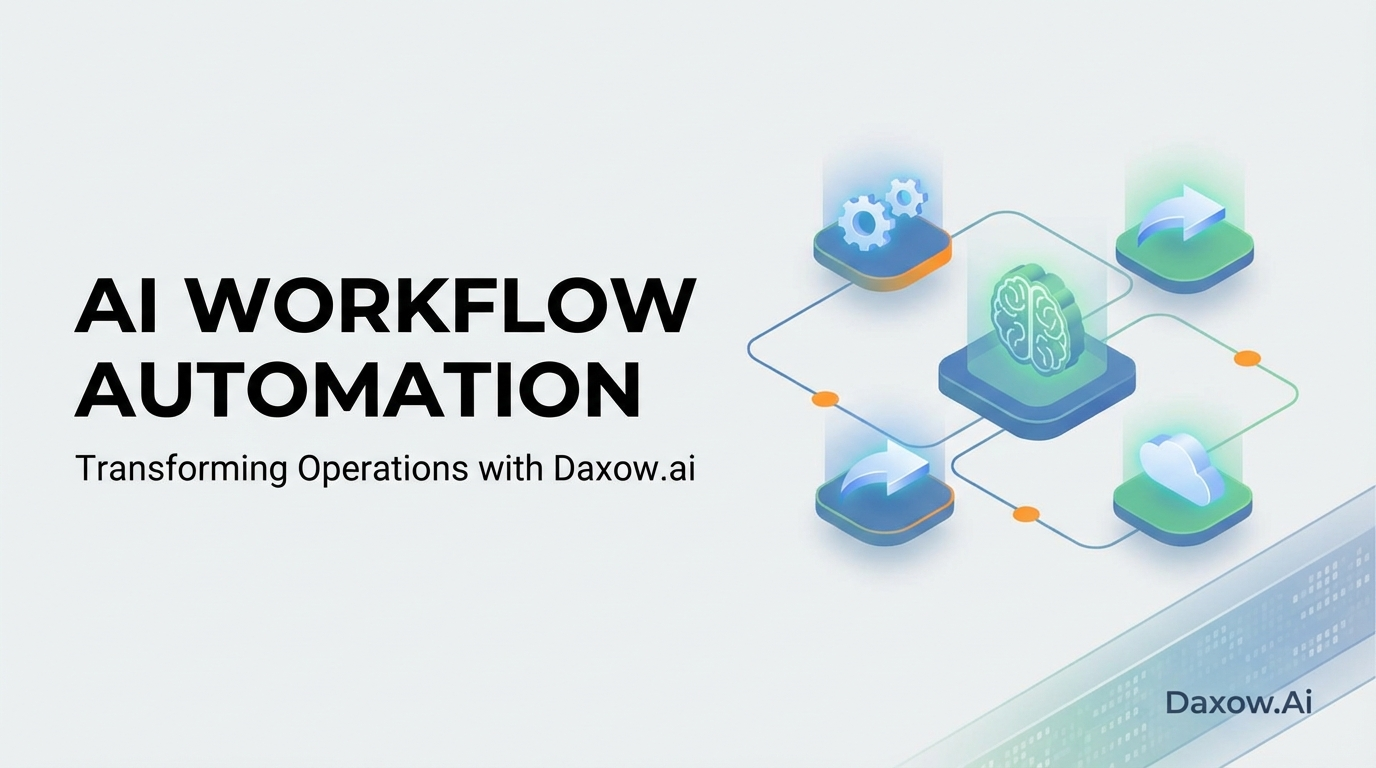
AI Workflow Automation: Transforming Operations with Daxow.ai
How AI workflow automation boosts productivity, cuts errors, and delivers ROI across industries. Implementation steps and Daxow.ai's end-to-end AI agent solutions.
AI Workflow Automation: Transforming Business Operations for the AI Era
Estimated reading time: 15 minutes
Key Takeaways
- AI workflow automation reduces manual tasks, increases productivity, and unlocks predictive capabilities for measurable ROI.
- Industry-specific use cases demonstrate tangible benefits from e-commerce to healthcare, finance, real estate, HR, and customer support.
- Successful implementation requires phased approaches including goal definition, data quality assessment, prototyping, and continuous improvement.
- Integration, governance, and AI agent autonomy are essential to maximize impact and build scalable hyperautomation networks.
- Daxow.ai offers end-to-end design, integration, and monitoring services to help businesses realize AI workflow automation benefits.
Table of Contents
- AI Workflow Automation: Transforming Business Operations for the AI Era
- Practical Use Cases Across Industries
- How AI Agents and Automation Drive Impact
- Implementation Steps and Best Practices
- Measuring ROI and Business Value
- Real-world Example — End-to-end Automation for a Finance Team
- Getting Started with Daxow.ai
- Frequently Asked Questions
AI Workflow Automation: Transforming Business Operations for the AI Era
What AI workflow automation delivers for business leaders
AI workflow automation replaces repetitive, rule-driven work with intelligent processes that can interpret data, make decisions, and execute multi-step tasks. Core business outcomes include:
- Faster operations and fewer errors: Automating invoice processing, data entry, and case routing reduces manual handoffs and error rates.
- Predictive capability: AI can spot patterns across large datasets to forecast supply chain disruptions, detect fraud, and predict customer churn.
- Higher employee productivity: Staff are freed from low-value tasks and can focus on strategy, sales, and customer relationships.
- Improved customer experience: Faster response times and personalized interactions increase satisfaction and loyalty.
- Measurable ROI: Many organizations recoup automation investments within 6–12 months through cost savings and productivity gains.
These benefits require an AI-first strategy that aligns automation with core business goals rather than isolated tool deployments. Decision-makers should use readiness scorecards and prioritize processes where automation yields the most impact.
Practical Use Cases Across Industries
E-commerce — order-to-cash and personalization
- Use case: Automate order validation, payment reconciliation, returns handling, and fraud detection.
- AI components: Document extraction, payment anomaly detection, recommendation engines.
- Business impact: Reduced fulfillment errors, faster invoice-to-cash cycles, higher conversion through personalized offers.
- Example: An AI agent monitors order flows, flags abnormal chargebacks, updates CRM records, and triggers a returns workflow without human intervention.
Healthcare — document automation and clinical support
- Use case: Extract clinical data from patient forms, summarize medical literature for clinicians, and flag anomalies in records.
- AI components: OCR, NLP summarization, anomaly detection.
- Business impact: Faster administrative processing, improved compliance, and more time for clinicians to focus on patient care.
- Example: An AI pipeline extracts structured data from referral letters, populates EHR fields, and alerts care coordinators for missing critical information.
Finance — fraud detection and compliance
- Use case: Automate transaction monitoring, KYC checks, and compliance reporting.
- AI components: Real-time anomaly detection, automated report generation, document validation.
- Business impact: Reduced fraud losses, faster audits, and decreased manual reconciliation.
- Example: An AI agent continuously scores transactions for risk, escalates suspicious cases to analysts, and assembles audit trails automatically.
Real Estate — lead qualification and market intelligence
- Use case: Automate lead qualification, update property listings, and analyze market trends for valuations.
- AI components: Conversational AI, lead-scoring models, data aggregation agents.
- Business impact: Faster lead conversion, reduced time-to-list, and better pricing decisions.
- Example: A chatbot qualifies inbound inquiries, schedules viewings, and routes hot leads to agents with a pre-populated dossier.
HR — talent screening and onboarding
- Use case: Screen resumes, conduct initial candidate interviews, and automate onboarding documentation.
- AI components: Resume parsing, interview bots, document automation.
- Business impact: Shorter time-to-hire, improved candidate experience, and lower administrative overhead.
- Example: An AI agent ranks candidates, runs scripted screening interviews, and initiates background checks for selected profiles.
Customer support and sales automation
- Use case: Automate first-line support, route complex issues to specialists, and qualify sales leads.
- AI components: Support chatbots, triage agents, CRM integrations.
- Business impact: Reduced response times, higher first-contact resolution, and more efficient sales pipelines.
- Example: A customer support bot handles 70% of routine queries, escalates complex tickets, and ensures knowledge base updates based on recurring issues.
How AI Agents and Automation Drive Impact
From bots to autonomous AI agents
Traditional automation follows scripts; modern AI agents are capable of autonomous, multi-step decisioning. They can:
- Orchestrate workflows across tools (CRMs, ERPs, ticketing systems).
- Combine structured and unstructured data to form decisions.
- Learn from outcomes and improve performance over time.
A well-designed AI agent can take a support ticket from receipt to resolution: understanding the issue via NLP, retrieving relevant documentation, applying rules or predictive models, and executing follow-up actions in connected systems.
Integration and data connectivity
Real impact requires seamless integrations. AI agents must access clean, trustworthy data from legacy systems, cloud platforms, and third-party services. Effective strategies include:
- Building secure data pipelines and APIs.
- Implementing data normalization and governance.
- Phased integration to avoid disruptions with legacy systems.
Daxow.ai specializes in building integration layers that connect AI systems to CRMs, ERPs, and other business tools—enabling AI agents to operate as part of existing workflows rather than as isolated silos.
Hyperautomation and continuous improvement
When automation and AI combine across processes, the result is hyperautomation: a network of interconnected agents that learn from each other. This enables continuous operational improvement and adaptability as business conditions change.
Implementation Steps and Best Practices
1. Define clear goals and identify target processes
- Action: Set measurable objectives (e.g., reduce invoice processing time by 40%).
- Daxow approach: We run a discovery workshop to map processes, identify high-volume tasks, and score opportunities by ROI and risk.
- Deliverable: Prioritized backlog of automation candidates.
2. Assess data quality and accessibility
- Action: Audit data sources and workflows for completeness and compliance.
- Daxow approach: We perform data profiling, define transformation rules, and design secure pipelines to feed AI models.
- Deliverable: Data readiness plan and integration strategy.
3. Select tools and assemble teams
- Action: Choose platforms with scalability, security, and integration capabilities. Form cross-functional teams.
- Daxow approach: We recommend architectures tailored to your tech stack, advise on vendor selection, and embed cross-functional teams through the project.
- Deliverable: Architecture blueprint and team roles.
4. Prototype and integrate incrementally
- Action: Build small pilots for non-critical workflows, validate outcomes, then scale.
- Daxow approach: We deliver rapid prototypes—AI agents that automate specific tasks—measure impact, and iterate before full rollout.
- Deliverable: Pilot systems, integration adapters, and rollout plan.
5. Measure, monitor, and iterate
- Action: Track accuracy, cycle time, cost savings, and user adoption metrics.
- Daxow approach: We implement monitoring dashboards, retraining schedules, and governance processes to prevent model drift and ensure ethical AI use.
- Deliverable: Production monitoring, SLAs, and continuous improvement cycles.
Best practices to ensure success
- Prioritize governance: Establish bias checks, security controls, and approval workflows.
- Start small, scale fast: Prove value through pilots and expand based on results.
- Invest in change management: Train teams and communicate outcomes to avoid shadow AI.
- Design for interoperability: Build agents that integrate with existing tools to maximize adoption.
Daxow.ai provides end-to-end delivery: from process analysis and prototype to full integration, training, and monitoring—ensuring automation projects meet business goals.
Measuring ROI and Business Value
What to measure
- Productivity gains (e.g., tasks per employee per day).
- Cycle time reduction (e.g., invoice processing time).
- Error rate and compliance improvements.
- Revenue impact (e.g., uplift from personalized recommendations).
- Total cost of ownership and time to payback.
Typical outcomes
- Organizations often realize 30–50% productivity improvements in automated areas.
- Many projects recoup costs within 6–12 months through labor savings and process efficiency.
- Predictive models can reduce fraud or churn, directly protecting revenue and improving margins.
How Daxow.ai improves ROI
- We focus on high-impact processes first to accelerate payback.
- Our systems combine rules-based automation with AI agents to tackle both structured and unstructured tasks.
- We ensure end-to-end integrations so automation affects the full process (not just point solutions), maximizing cost savings and revenue benefits.
- Ongoing monitoring and retraining preserve model value and adapt to new patterns, protecting long-term ROI.
Real-world Example — End-to-end Automation for a Finance Team
- Problem: Manual invoice processing took days, with high error rates and delayed payments.
- Solution: Daxow.ai built an AI agent that extracts invoice data, validates vendor contracts, routes exceptions, and posts approved entries to the ERP.
- Outcome: Invoice processing time dropped from days to hours, exceptions fell by 60%, and accounts payable headcount was reallocated to strategic vendor management.
Getting Started with Daxow.ai
If your organization is evaluating AI workflow automation, the right partner makes the difference between pilot projects and enterprise transformation. Daxow.ai helps businesses:
- Analyze current workflows and identify high-impact automation candidates.
- Design and build custom AI agents that execute real tasks across systems.
- Implement secure integrations with CRMs, ERPs, support platforms, and data stores.
- Deliver measurable productivity gains while reducing manual tasks and operational costs.
Take the next step toward automation that drives business value. Book a free consultation with Daxow.ai to request a process analysis for your company and explore a tailored roadmap for AI automation and workflow automation. Contact us to build a custom AI system that improves productivity, automates customer support automation and sales automation, and scales with your business.
Frequently Asked Questions
What is AI workflow automation?
AI workflow automation uses intelligent systems and AI agents to automate multi-step business processes, reducing manual tasks, improving accuracy, and enabling predictive analytics.
How does AI improve business productivity?
AI removes repetitive work, allows staff to focus on higher-value tasks, accelerates workflows, reduces errors, and provides insights to make better decisions.
Can AI automation integrate with existing systems?
Yes, successful AI automation requires secure and seamless integration with legacy and cloud systems such as CRMs and ERPs, a specialty offered by Daxow.ai.
What industries benefit most from AI workflow automation?
Industries like e-commerce, healthcare, finance, real estate, HR, and customer support benefit significantly through tailored AI use cases that address their specific challenges.