
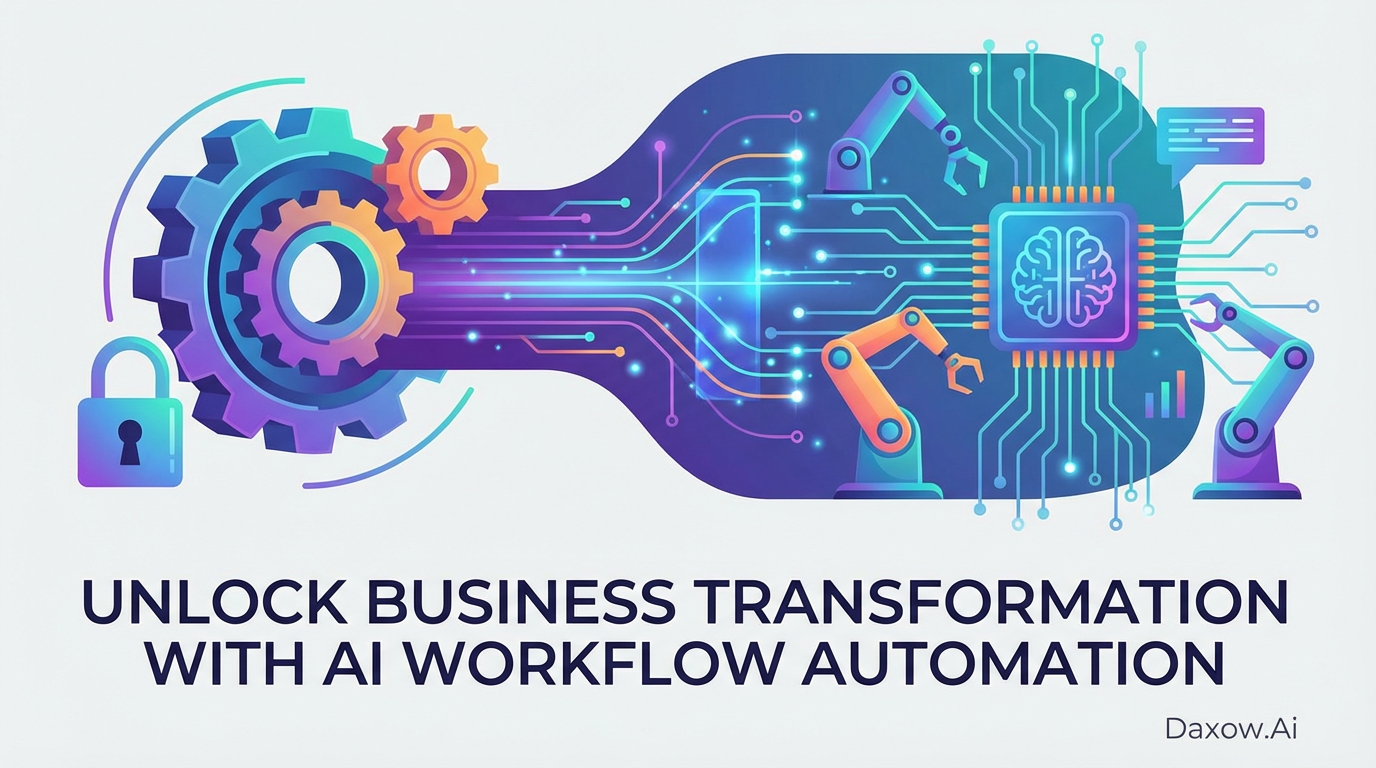
Unlock Business Transformation with AI Workflow Automation
AI workflow automation that reduces costs, speeds processes, and delivers measurable ROI across industries — how Daxow.ai designs pilots and production systems.
Unlocking Business Transformation: The Power of AI Workflow Automation
Estimated reading time: 15 minutes
Key Takeaways
- AI workflow automation enables businesses to scale operations, reduce errors, and convert data into actionable insights.
- Industries such as e-commerce, healthcare, finance, real estate, and HR benefit from tailored AI automation use cases.
- Effective implementation requires phased planning, data readiness, cross-functional teams, and continuous improvement.
- ROI can be significant, often realized within months, through reduced costs and increased productivity.
- Daxow.ai specializes in designing, building, and operating custom AI systems with measurable business impact.
Table of Contents
- Unlocking Business Transformation: The Power of AI Workflow Automation
- Practical Use Cases Across Industries
- How AI Agents and Automation Deliver Value
- Implementation Steps and Best Practices
- Estimating ROI and Building a Business Case
- Common Challenges and How to Avoid Them
- How Daxow.ai Helps You Implement AI Automation
- Real-world Example — From Manual to Autonomous
- Next Steps for Leaders Ready to Transform
- Frequently Asked Questions
Unlocking Business Transformation: The Power of AI Workflow Automation
AI workflow automation integrates artificial intelligence into your core processes so systems can autonomously execute tasks, make decisions, and optimize flows based on real-time outcomes. That combination of automation and intelligence delivers three transformational outcomes:
- Scale without proportional headcount growth by automating repetitive tasks and low-value work.
- Reduce errors and increase speed, turning multi-day processes into near-real-time outcomes.
- Convert data into action, enabling predictive decisions and personalised customer experiences.
Why this matters:
- Targeted processes can achieve cost reductions of 30–50%.
- Teams often see productivity improvements of 40–60% for automated workflows.
- Time-to-value for high-impact automations (for example, invoice processing) can be measured in months rather than years.
Core components of AI workflow automation
- AI agents that autonomously execute multi-step tasks (e.g., extract data, validate, update CRM).
- Workflow orchestration that sequences actions, exceptions, and decision branches.
- Data pipelines and integrations connecting ERPs, CRMs, ticketing, and document stores.
- Monitoring and feedback loops for continuous retraining and compliance.
Practical Use Cases Across Industries
E-commerce — customer support automation and operational resilience
Use case:
- Autonomous support agents answer complex product questions, handle returns, and escalate exceptions.
- AI-driven inventory prediction identifies supply-chain disruption risks and triggers replenishment workflows.
Business impact:
- Faster first response times, improved NPS, and reductions in support headcount required for repetitive inquiries.
- Reduced stockouts and better margin protection through predictive replenishment.
How Daxow.ai helps:
- Build chatbots integrated with order systems and CRM.
- Deploy AI agents that combine customer context with supply-chain signals to automate decisions and notifications.
Healthcare — document automation and patient onboarding
Use case:
- Automatically ingest and classify medical documents, extract structured data, and populate EHRs.
- AI agents guide patient intake, pre-authorizations, and appointment triage.
Business impact:
- Shorter onboarding times, fewer manual transcription errors, and earlier clinical insights for care teams.
- Enhanced compliance via auditable workflows.
How Daxow.ai helps:
- Create secure, HIPAA-aware data pipelines and document-extraction agents.
- Integrate with hospital information systems to close the loop between intake and clinical workflows.
Finance — fraud detection, invoice automation, and faster approvals
Use case:
- Real-time transaction monitoring with anomaly detection and automated case creation.
- AI-based invoice OCR, validation, and routing to approvers, reducing cycle time from days to minutes.
Business impact:
- Reduced fraud losses and faster working capital cycles.
- Immediate labor savings and faster vendor payments.
How Daxow.ai helps:
- Implement fraud surveillance agents that integrate with payment processors and alert workflows.
- Build invoice-processing systems that connect to ERPs and deliver auditable approval trails.
Real Estate — market intelligence and deal acceleration
Use case:
- Analyze property data sources to generate investment signals, auto-populate listings, and produce client-ready reports.
- AI agents coordinate document collection and due-diligence checklists.
Business impact:
- Faster deal cycles, improved lead conversion, and fewer manual hours preparing standard documents.
How Daxow.ai helps:
- Deliver connectors to MLS, internal databases, and CRM systems to automate listing updates and reporting.
HR — recruitment automation and retention analytics
Use case:
- Resume screening, candidate shortlisting, initial interview scheduling via chat, and churn-risk modeling for at-risk employees.
Business impact:
- Faster hiring, better candidate fit, and proactive interventions that reduce turnover.
How Daxow.ai helps:
- Design recruitment pipelines with integrated chat-driven screening and HRIS synchronization.
How AI Agents and Automation Deliver Value
AI agents are autonomous process executors that bridge intelligence and action. Unlike static scripts, they adapt to context, handle exceptions, and coordinate across systems.
Typical agent capabilities
- Natural language understanding to parse emails and tickets.
- Document understanding to extract tables, invoices, and forms.
- Decision-making using rules and models (fraud scores, credit eligibility).
- System-level actions (update records, trigger payments, schedule calls).
Value levers
- Reduce manual tasks by shifting routine work to agents.
- Improve accuracy through consistent rule enforcement and model validation.
- Boost productivity by freeing skilled staff for strategic activities.
- Improve customer satisfaction via faster and more consistent responses.
Implementation Steps and Best Practices
Phase 1 — Define goals and select pilot processes
- Identify high-impact, repetitive processes with clear metrics (e.g., invoice processing time, first-response SLAs).
- Set measurable targets: time saved, error reduction, cost reduction.
Phase 2 — Assess data and integrations
- Audit data quality, accessibility, and compliance requirements.
- Standardize formats and establish secure pipelines.
Phase 3 — Build a cross-functional team and choose tools
- Assemble domain experts, data engineers, ML specialists, and product owners.
- Prefer platforms with strong integration capabilities and scalable APIs. Use no-code/low-code options for rapid pilots.
Phase 4 — Pilot, measure, and scale
- Run controlled pilots, validate performance with real datasets, and monitor KPIs.
- Use dashboards and automated alerts. Retrain models and refine rules regularly.
Best practices
- Prioritize processes with clear ROI and low ambiguity.
- Invest in change management to drive adoption.
- Implement governance for bias monitoring and compliance.
- Pilot small, then scale to avoid complex rollouts.
Metrics to track
- Process cycle time reduction (e.g., 25% time savings).
- Model accuracy and data quality scores.
- Integration success rate and incident counts.
- ROI timeline: months for high-impact workflows.
Estimating ROI and Building a Business Case
Steps to quantify ROI
- Map current process time and cost per transaction.
- Estimate agent-handled volume and time saved per transaction.
- Calculate incremental savings (labor, error reduction, expedited cash flow).
- Factor in implementation and ongoing costs (platform, maintenance, monitoring).
Typical financial outcomes
- Quick ROI for high-volume tasks such as invoice processing and support triage, often realized within a few months.
- 40–60% productivity gains and sustained 20–30% annual efficiency improvements with continuous monitoring and expansion.
How Daxow.ai supports ROI modeling
We run a process analysis to baseline time and cost, model expected savings, and deliver a pilot that validates assumptions. This approach minimizes risk and proves value before scaling.
Common Challenges and How to Avoid Them
- Data quality gaps — mitigate with upfront auditing and pipelines.
- Overly complex pilots — start with narrow, high-impact processes.
- Shadow AI and fragmented tools — centralize governance and standard integrations.
- Lack of adoption — pair automation with training and stakeholder engagement.
Daxow.ai mitigations:
- We deliver standardized integration templates, provide staff training, and run governance workshops to ensure sustainable adoption.
How Daxow.ai Helps You Implement AI Automation
Daxow.ai builds custom AI systems that turn strategy into live, measurable automation. Our end-to-end approach includes:
Discovery and process analysis
- We map workflows, quantify manual tasks, and identify automation candidates.
- Deliverable: a prioritized roadmap with KPI targets and ROI estimates.
Solution design and prototyping
- Design AI agents, data flows, and integration points.
- Build secure prototypes to validate functionality against real use cases.
Build, integrate, and deploy
- Implement production-grade agents that connect to CRMs, ERPs, ticketing systems, and document stores.
- Deliver end-to-end automation including exception handling and audit logs.
Monitoring, continuous improvement, and support
- Set up monitoring dashboards, automated alerts, and retraining schedules.
- Provide managed services to scale agents, add features, and optimize ROI.
How this delivers value:
- Reduced operational costs through automation of repetitive tasks.
- Improved productivity by enabling staff to focus on high-value work.
- Seamless system integration to maximize existing investments.
- Faster time-to-value via iterative pilots and rapid deployments.
Real-world Example — From Manual to Autonomous
Problem: A mid-size finance team spent days resolving invoice exceptions and routing approvals manually.
Daxow.ai approach:
- Discovery: quantified average cycle times and exception rates.
- Pilot: deployed an AI agent that extracts invoice data, validates vendors against ERP, and routes standard approvals.
- Outcome: approval time reduced from 72 hours to under 2 hours, 60% fewer manual touches, and ROI realized within three months.
Next Steps for Leaders Ready to Transform
AI workflow automation is strategic — it improves margins, accelerates operations, and enhances customer experience. The right partner turns ambition into predictable outcomes.
- Start with a targeted process analysis.
- Prove value with a pilot that includes KPIs and ROI tracking.
- Scale with governance, training, and continuous monitoring.
Unlocking Business Transformation: The Power of AI Workflow Automation is available to organizations willing to pair strategy with disciplined execution. Daxow.ai specializes in designing, building, and operating custom AI agents and workflow automation that reduce manual tasks, increase productivity, and deliver measurable ROI.
Book a free consultation with Daxow.ai to discuss a tailored process analysis for your company. Request a process analysis or contact us to build a custom AI system that automates critical workflows and accelerates your digital transformation.
Frequently Asked Questions
What is AI workflow automation?
AI workflow automation is the integration of artificial intelligence into business processes to enable autonomous task execution, decision-making, and flow optimization without manual intervention.
How long does it take to see ROI from AI automation?
ROI can often be realized within months, especially for high-volume, repetitive workflows such as invoice processing and customer support triage.
Which industries benefit most from AI workflow automation?
Key industries include e-commerce, healthcare, finance, real estate, and human resources, each with specific use cases that yield measurable business value.
How does Daxow.ai support businesses in AI automation?
Daxow.ai offers end-to-end AI automation services including discovery, solution design, prototyping, integration, deployment, and ongoing monitoring to ensure sustained ROI and seamless system integration.