
Transform Enterprise Operations with AI Workflow Automation
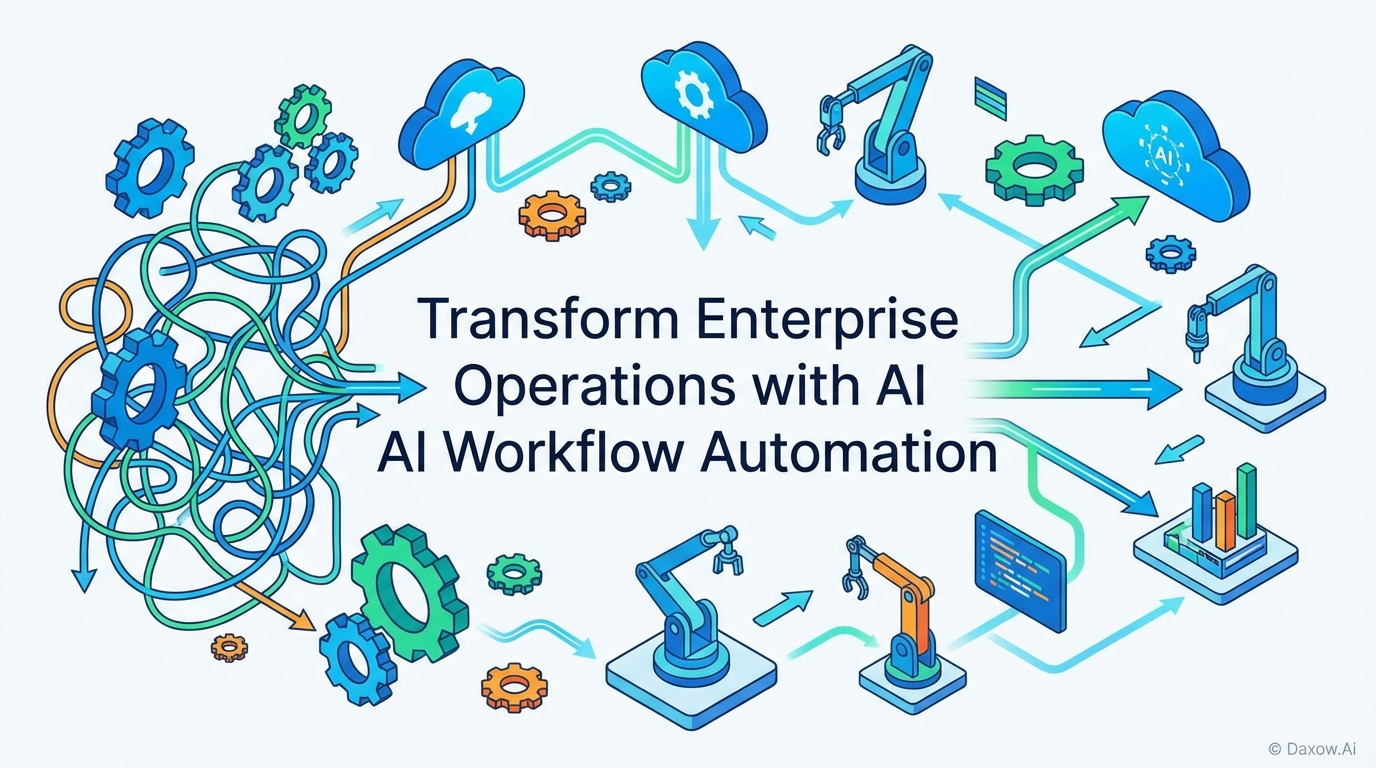
How AI workflow automation cuts costs, boosts productivity, and scales operations — use cases, implementation steps, and Daxow.ai solutions.
AI Workflow Automation: Transforming Business Operations for the Modern Enterprise
Estimated reading time: 12 minutes
Key Takeaways
- AI workflow automation boosts productivity, reduces operational costs, and scales business processes without proportional headcount growth.
- Industry-specific use cases demonstrate tangible benefits across e-commerce, customer support, finance, healthcare, real estate, and HR.
- AI agents enable adaptive decision-making, seamless system integrations, and continuous improvement for reliable automation.
- Successful AI automation requires clear objectives, data readiness, the right tools, cross-functional teams, and iterative pilots.
- Daxow.ai offers tailored AI solutions, from process analysis to managed services, helping enterprises unlock measurable ROI.
Table of Contents
- AI Workflow Automation: Transforming Business Operations for the Modern Enterprise — Why it matters
- Practical use cases and industry examples
- How AI agents and automation deliver value in practice
- Implementation steps and best practices for successful deployments
- Measuring ROI and business value
- How Daxow.ai helps you implement AI Workflow Automation
- Realistic examples of Daxow.ai engagements
- Getting started — a practical checklist
- Frequently Asked Questions
AI Workflow Automation: Transforming Business Operations for the Modern Enterprise — Why it matters
AI workflow automation integrates artificial intelligence into core business processes to automate repetitive tasks, improve decision-making, and enable faster, more reliable operations. For leaders focused on growth and efficiency, this translates to:
- Reduced operational costs: Targeted automation can cut costs in specific areas by up to 30–50% through fewer manual interventions and faster throughput.
- Improved productivity: Teams reclaim time from routine work, enabling higher-value activity and innovation.
- Scalability without linear headcount increases: Automated workflows allow volume growth without proportional hiring.
- Better customer and employee experience: Faster response times and fewer errors improve satisfaction metrics and retention.
- Stronger compliance and auditability: Embedded logging and governance simplify reporting and risk control.
These benefits are realized by focusing AI automation on high-volume, rule-based tasks — invoice processing, ticket triage, lead qualification — where human time is often wasted on repeatable work. AI agents then layer adaptive decision-making on top, handling exceptions, escalating appropriately, and learning from new data.
Practical use cases and industry examples
E-commerce — Order-to-cash, personalization, and fraud prevention
- Automate order validation, payment reconciliation, and fulfillment triggers to shorten order-to-cash cycles.
- Use NLP-driven product recommendations to increase average order value and conversion rates.
- Apply anomaly detection AI agents to flag potential fraud in real time, reducing chargebacks and false positives.
Impact: Faster fulfillment, fewer fulfillment errors, and measurable revenue uplift from personalization and reduced fraud costs.
Customer support automation — Ticket handling and escalation
- Implement customer support automation that classifies and routes incoming tickets using intent detection.
- Deploy AI agents that draft responses for common inquiries, automatically escalate critical issues, and surface knowledge-base articles to customers.
- Integrate with CRM to update customer records and close tickets automatically after verification.
Impact: Reduced average handle time, higher first-contact resolution, and improved CSAT scores with lower staffing overhead.
Finance — Invoice processing and compliance
- Automate invoice ingestion from PDFs and emails using document extraction.
- Match invoices to purchase orders and trigger approvals automatically; escalate mismatches to human reviewers.
- Monitor transactions with anomaly detection to improve audit accuracy and detect compliance risks.
Impact: Reconciliation time reduced by up to 70%, error rates under 5%, faster month-end close cycles, and improved auditability.
Healthcare — Scheduling, triage, and claims
- Use conversational AI to handle appointment scheduling and pre-visit symptom triage, freeing clinical staff from administrative calls.
- Automate insurance claim assembly and validation with secure data handling and audit trails for compliance (e.g., HIPAA-ready design considerations).
- Route exceptions to staff with contextual patient history and suggested next steps.
Impact: Shorter patient wait times, reduced administrative burden, and faster claims processing.
Real estate — Lead qualification and property operations
- Automate lead capture, initial qualification, and follow-up scheduling using AI agents that analyze inquiry content and match leads to available listings.
- Schedule viewings, trigger virtual tours, and update CRM records automatically.
- Use market trend analysis to suggest price adjustments and marketing strategies.
Impact: Higher-quality leads, faster deal cycles, and better matching between buyers and properties.
HR — Recruitment and onboarding
- Automate resume screening with models trained on role-specific success criteria.
- Conduct initial conversational screenings with candidates and schedule interviews based on calibrated scoring.
- Run onboarding workflows that provision accounts, collect documentation, and guide new hires through compliance tasks.
Impact: Reduced time-to-hire, lower recruitment costs, and more consistent candidate experiences.
How AI agents and automation deliver value in practice
AI agents are autonomous or semi-autonomous systems that execute multi-step workflows across tools and data sources. When implemented correctly, they provide:
- Adaptive decision-making: Machine learning models classify, score, and predict outcomes rather than relying on brittle rule sets.
- Seamless integrations: Agents connect to CRMs, ERPs, help desks, and data warehouses to provide end-to-end automation without manual handoffs.
- Exception handling and human-in-the-loop: Agents escalate complex cases, present recommended actions, and learn from human feedback.
- Continuous improvement: Built-in monitoring and retraining pipelines prevent model drift and maintain performance.
- Governance and auditability: Detailed logs and versioned models enable compliance reviews and ethical oversight.
Example workflow: An AI agent ingests a customer email, classifies intent, extracts relevant entities, updates the CRM, executes a transaction or triggers a return, and records the outcome for feedback and model retraining. The result is dramatic reduction in manual tasks and consistent service quality.
Implementation steps and best practices for successful deployments
1. Define clear, measurable objectives
- Start with pain points that are high volume and high impact.
- Set KPIs such as time saved, error rate reduction, cost per transaction, and customer satisfaction improvement.
- Use scorecards to prioritize initiatives and avoid scope creep.
2. Assess and prepare data
- Audit data quality, completeness, and accessibility.
- Standardize formats and create pipelines for clean inputs.
- Address compliance requirements early (data residency, encryption, access controls).
3. Select tools and architecture
- Prioritize platforms that support integrations with existing CRMs, ERPs, and collaboration tools.
- Choose modular, scalable components (document extraction, NLP, ML ops) to avoid vendor lock-in.
- Ensure enterprise-grade security and role-based access.
4. Build cross-functional teams
- Form small, focused teams combining business, IT, and data science.
- Assign process owners and create feedback loops for continuous improvement.
- Invest in training and change management to gain user adoption.
5. Pilot, iterate, and scale
- Begin with a small, low-risk pilot that can be delivered in weeks.
- Measure outcomes, collect user feedback, and refine models and workflows.
- Expand modularly, prioritizing adjacent processes and integrations.
6. Monitor, secure, and optimize
- Embed monitoring for performance, bias, and drift.
- Establish governance policies for model updates, logging, and incident response.
- Track ROI using consistent KPIs and reinvest gains into new automation opportunities.
Measuring ROI and business value
Quantifying the impact of AI workflow automation secures executive buy-in and sustains investment. Typical measurable outcomes include:
- Process time reduction: Many workflows see 40–60% faster cycle times.
- Error reduction: Target error rates under 5% with automated validation and exception handling.
- Productivity gains: Staff redeployed from repetitive tasks to strategic work.
- Cost savings: Operational cost reduction of 30–50% in automated areas.
- Faster decision-making and scaling: Businesses can process larger volumes without proportional headcount increases.
To track ROI, tie KPIs to financial metrics (cost-per-transaction, time-to-value) and customer metrics (NPS, CSAT). Early wins from high-impact pilots create case studies that accelerate adoption across the organization.
How Daxow.ai helps you implement AI Workflow Automation
Workflow discovery and process analysis
- We conduct process audits to identify automation candidates and quantify expected impact.
- Our team maps existing workflows, data sources, and integrations to prioritize quick wins.
Custom AI agents and solution design
- Daxow.ai builds AI agents tailored to your use cases — from customer support automation to sales automation and finance reconciliation.
- We design agents that execute real tasks across your systems, handle exceptions, and learn from feedback.
End-to-end implementation and integrations
- We integrate AI systems with your CRMs, ERPs, ticketing systems, and data stores to enable seamless business automation.
- Our engineers implement secure data pipelines and monitoring to ensure compliance and performance.
Pilot-to-scale delivery and change management
- Daxow.ai runs rapid pilots to demonstrate value quickly, iterates based on real metrics, and scales successful workflows across teams.
- We provide training and change management to ensure adoption and maintain long-term ROI.
Ongoing monitoring and optimization
- Our managed services include monitoring, model retraining, and governance to prevent drift and maintain accuracy.
- We help you measure ROI and identify the next automation opportunities.
Realistic examples of Daxow.ai engagements
Example A — Mid-sized e-commerce retailer
- Challenge: Slow order reconciliation and rising chargeback rates.
- Solution: AI agents automated invoice extraction, payment matching, and fraud scoring integrated with the fulfillment system.
- Outcome: Reconciliation time cut by 60%, chargeback rates reduced, and customer support time decreased by 35%.
Example B — Healthcare provider network
- Challenge: High administrative load on scheduling and claims processing.
- Solution: A HIPAA-ready conversational assistant for scheduling plus a claims automation pipeline with secure document extraction.
- Outcome: Appointment booking handled 24/7, claims turnaround shortened by 40%, and administrative staff redirected to patient-facing tasks.
Example C — B2B SaaS company
- Challenge: Sales team spending excessive time on lead qualification.
- Solution: Sales automation with an AI agent that scores leads, schedules demos, and enriches CRM records.
- Outcome: Sales qualified leads increased by 25%, time-to-demo shortened by 50%, and conversion rates improved.
Getting started — a practical checklist
- Identify one high-volume, low-risk process for a pilot.
- Define 2–3 KPIs and baseline measurements.
- Gather sample data and confirm accessibility.
- Assemble a small cross-functional team and assign a process owner.
- Partner with a vendor or build internal capability for integrations and model operations.
- Run the pilot, measure outcomes, iterate, and plan for scale.
AI Workflow Automation: Transforming Business Operations for the Modern Enterprise is achievable and measurable when approached with clear objectives, disciplined implementation, and the right partners. Daxow.ai combines strategic process analysis, custom AI agents, secure integrations, and operational support to reduce manual tasks, boost productivity, and deliver measurable ROI.
Book a free consultation with Daxow.ai to request a process analysis for your company and begin building a custom AI system that automates key workflows, reduces operational costs, and positions your business to scale. Contact us today to get started.
Frequently Asked Questions
What types of business processes are best suited for AI workflow automation?
Processes that are high-volume, repetitive, rule-based, and involve structured data are the best candidates. Examples include invoice processing, customer support ticket triage, lead qualification, and scheduling.
How does Daxow.ai ensure compliance and security in automated workflows?
We design workflows with enterprise-grade security, data encryption, access controls, and auditability in mind. Our solutions are HIPAA-ready where applicable and include detailed logs and governance policies to meet regulatory requirements.
What kind of ROI can businesses expect from AI workflow automation?
Most businesses see operational cost reductions of 30–50%, process time reductions between 40–60%, error rates under 5%, and improved customer satisfaction and productivity metrics. ROI depends on the use case and implementation quality.
How long does it take to implement AI workflow automation solutions?
Initial pilot deployments can typically be delivered within a few weeks. Full-scale implementation depends on scope and integrations but benefits can often be realized quickly through a phased, iterative approach.