

AI Workflow Automation: Transforming Enterprise Operations
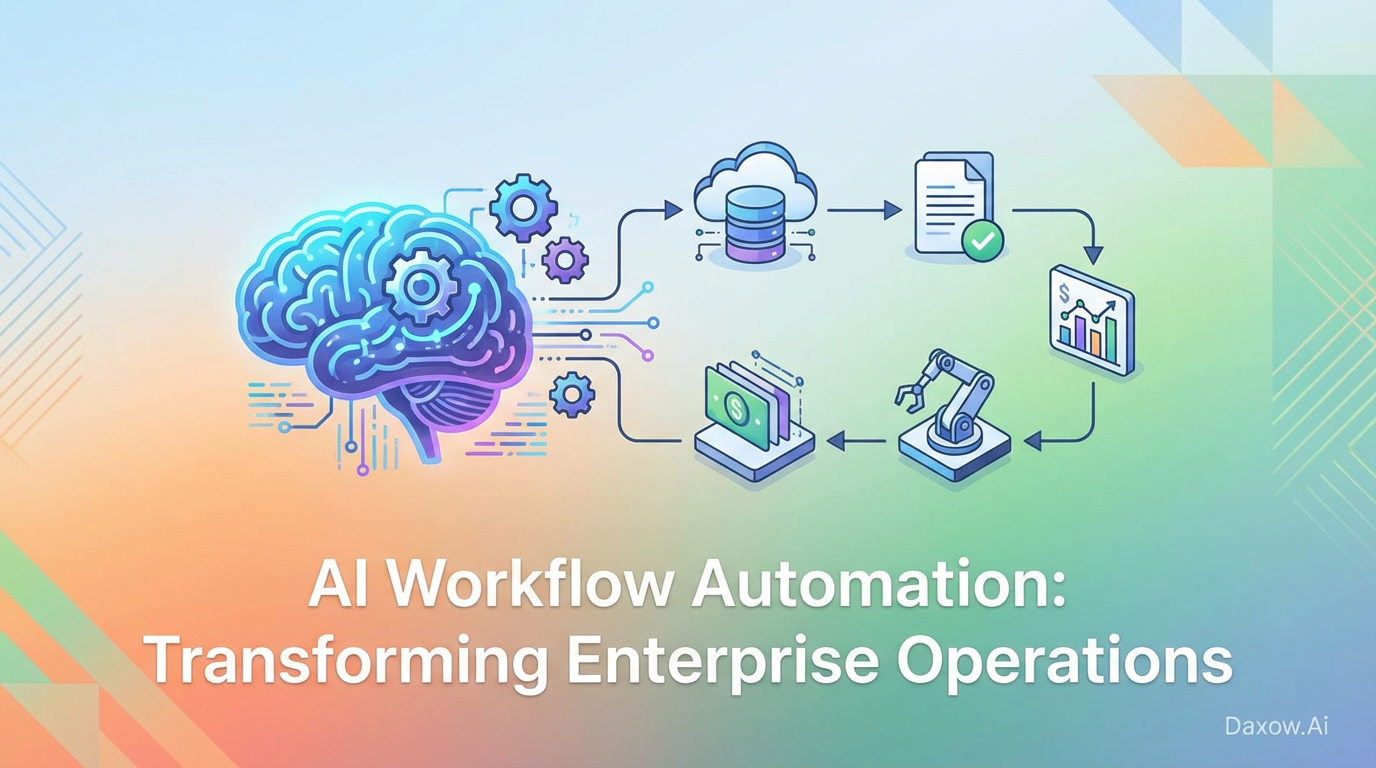
Learn how AI workflow automation and AI agents streamline enterprise processes, delivering 20-60% efficiency and cost gains with Daxow.ai's roadmap.
AI Workflow Automation: Transforming Business Operations for the Modern Enterprise
Estimated reading time: 15 minutes
Key Takeaways
- AI workflow automation combines machine learning, NLP, and rule-based systems to improve accuracy and speed in business processes.
- Organizations can achieve 20–50% efficiency gains and 30–60% cost reductions with effective AI automation.
- Implementation requires clear objectives, data quality assurance, proper tool integration, and a skilled cross-functional team.
- Industry-specific use cases demonstrate measurable improvements in e-commerce, healthcare, finance, real estate, and HR.
- Daxow.ai delivers end-to-end AI automation solutions with a focus on business value, integration, and continuous optimization.
Table of Contents
- AI Workflow Automation: Transforming Business Operations for the Modern Enterprise
- What AI Workflow Automation Means for Businesses
- Practical Use Cases Across Industries
- How AI Agents and Automation Drive Results
- Implementation Steps and Best Practices
- Common Pitfalls and How to Avoid Them
- Measuring ROI and Business Value
- How Daxow.ai Delivers End-to-End AI Automation
- Getting Started: A Daxow.ai Roadmap for Your Business
- Conclusion and Next Steps
- Frequently Asked Questions
AI Workflow Automation: Transforming Business Operations for the Modern Enterprise
AI workflow automation integrates machine learning, natural language processing, and rule-based automation to streamline repetitive, high-volume tasks and enable faster, more accurate decision-making. The technology shifts operational models from human-intensive, error-prone processes toward systems that execute tasks autonomously, surface insights, and allow staff to focus on strategic and customer-facing work.
- Core benefits: faster execution, higher accuracy, and real-time data-driven insights.
- Typical targets: invoice processing, customer inquiries, document extraction, lead qualification, and ticket routing.
- Impact: organizations commonly see 20–50% efficiency gains in targeted processes and can achieve 30–60% cost reductions on automated tasks when implemented correctly.
What AI Workflow Automation Means for Businesses
Strategic outcomes and operational shifts
AI workflow automation delivers more than speed improvements. It creates resilient operational capacity that scales with demand, improves compliance through audit trails, and reduces human error in structured and unstructured data tasks.
- Scalability: Systems scale without linear increases in staffing.
- Compliance & traceability: Automated logs and governance enable easier audits.
- Quality & speed: Routine tasks can reach 95%+ accuracy, with workflows running up to 70% faster in many cases.
KPIs that matter
When evaluating automation, measure the right things:
- Process cycle time and throughput
- Error rate and rework cost
- Customer satisfaction (NPS) and response SLAs
- Cost per transaction and total cost of ownership
- Time-to-resolution for support and sales leads
Practical Use Cases Across Industries
E-commerce — order-to-cash and customer experience
Problem: Slow order processing, frequent returns, and reactive customer support increase churn.
Automated solution:
- AI agents handle order validation, inventory updates, and payment reconciliation.
- Chatbots provide 24/7 customer support and automated returns processing.
Outcomes:
- Up to 40% reduction in fulfillment time.
- Higher conversion and reduced churn through real-time query handling and personalized recommendations.
Healthcare — administrative efficiency and patient triage
Problem: Administrative burden on clinicians and delays in claims processing.
Automated solution:
- Automated patient scheduling and eligibility checks.
- AI triage that prioritizes urgent cases and flags anomalies in claims.
Outcomes:
- Reduced administrative errors and faster care delivery.
- Improved revenue cycle performance through faster claims reconciliation.
Finance — compliance, reconciliation, and fraud detection
Problem: Manual invoice matching and slow audit cycles create risk and cost.
Automated solution:
- AI-powered invoice matching, exception handling, and anomaly detection for fraud.
- Automated compliance checks and audit-ready logs.
Outcomes:
- Faster reconciliation, fewer manual interventions, and lowered fraud exposure.
- Clear audit trails and measurable cost savings.
Real Estate — lead nurturing and contract automation
Problem: Slow lead follow-up and manual contract reviews delay transactions.
Automated solution:
- AI agents score leads, trigger personalized outreach, and auto-generate contract summaries.
- Document automation extracts key clauses and populates CRMs.
Outcomes:
- Shorter sales cycles and improved conversion rates.
- Faster due diligence and reduced legal review time.
HR — hiring and employee engagement
Problem: High volume of applications and repetitive onboarding tasks.
Automated solution:
- Resume screening with intelligent ranking and bias-aware filters.
- Onboarding workflows and HR chatbots for employee queries.
Outcomes:
- Faster hiring and reduced time-to-productivity.
- Higher employee satisfaction through consistent and personalized onboarding.
How AI Agents and Automation Drive Results
AI agents are autonomous software entities that execute multi-step tasks by integrating with business systems (CRMs, ERPs, ticketing platforms). They combine intelligence and automation to not only handle rule-based work but also predict outcomes and self-optimize.
- Integration-first approach: Agents connect to existing systems and trigger actions across tools.
- Intelligent orchestration: Agents route tickets, generate reports, and take corrective actions based on model predictions.
- Continuous improvement: Feedback loops enable retraining and process optimization.
Business outcomes from combining AI agents with workflow automation:
- Faster end-to-end cycle times (often up to 70% faster).
- Higher routine task accuracy (95%+ in well-implemented flows).
- Reallocation of human labor to higher-value tasks, improving overall productivity and job satisfaction.
Implementation Steps and Best Practices
1. Define clear objectives
- Identify high-impact, repetitive workflows through process audits.
- Set measurable goals (e.g., “reduce invoice processing time by 30%”).
- Prioritize high-ROI use cases to establish early wins.
2. Assess data quality and accessibility
- Audit data for accuracy, completeness, and compliance needs.
- Standardize formats and establish pipelines for ongoing access.
- Ensure data governance is embedded from day one.
3. Select and integrate tools
- Choose scalable platforms that integrate with CRMs, ERPs, and other systems.
- Use off-the-shelf components for speed, with custom layers where differentiation is required.
- Prioritize security, API compatibility, and observability.
4. Build a cross-functional team
- Include process owners, data engineers, ML specialists, and compliance leads.
- Invest in change management and upskilling to minimize resistance.
- Establish clear ownership for ongoing maintenance.
5. Prototype and test
- Launch pilots on non-critical processes.
- Monitor performance via dashboards and KPIs.
- Iterate quickly using collected feedback.
6. Deploy, monitor, and optimize
- Roll out in phases with continuous retraining and drift detection.
- Use alerts for model degradation and governance checkpoints.
- Treat automation as an ongoing program, not a one-time project.
Common Pitfalls and How to Avoid Them
- Vague goals: Define measurable KPIs up front to maintain alignment.
- Poor data quality: Invest in data cleansing and pipelines before model training.
- Rigid systems: Choose modular architectures that can evolve with business needs.
- Lack of adoption: Invest in training and stakeholder engagement to ensure uptake.
- “Set and forget”: Implement continuous monitoring and optimization to guard against drift.
Measuring ROI and Business Value
AI workflow automation yields quantifiable benefits when tracked properly.
Key metrics to track:
- Cycle time reduction and throughput.
- Error and exception rates.
- Cost per transaction and total cost savings.
- Customer NPS and first-contact resolution.
- Time-to-hire and employee retention in HR processes.
Typical outcomes:
- Payback in 6–12 months for well-scoped pilots.
- 30–60% cost reduction on automated tasks.
- Ongoing revenue growth from faster sales cycles and improved customer experiences.
How Daxow.ai Delivers End-to-End AI Automation
Discovery and process analysis
- We map existing workflows and identify automation opportunities using AI-driven discovery.
- We quantify potential gains and help prioritize initiatives based on ROI.
Custom solution design
- We design AI agents and automation pipelines tailored to your stack—CRMs, ERPs, ticketing systems, and database systems.
- Solutions combine pre-built components and custom models where needed for competitive advantage.
Integration and deployment
- Daxow.ai implements secure, scalable integrations with your systems.
- We deliver phased rollouts and pilot programs to validate performance and adoption.
Monitoring, governance, and optimization
- We set up observability, drift detection, and KPIs for continuous improvement.
- Our governance frameworks embed compliance and ethical considerations into operations.
Outcome-focused support
- Daxow.ai supports change management and training to embed automation in daily workflows.
- We provide ongoing maintenance and retraining so AI agents continue to drive value.
Getting Started: A Daxow.ai Roadmap for Your Business
- Weeks 1–2: Discovery workshop and process mapping.
- Weeks 3–4: Data assessment and quick-win prioritization.
- Weeks 5–8: Pilot design and rapid prototype (one workflow).
- Weeks 9–12: Pilot rollout, performance tracking, and iteration.
- Months 4–6: Phased expansion across prioritized processes and enterprise rollout plan.
This pragmatic cadence delivers early ROI and builds the foundation for scalable business automation. Learn more about our approach on the Daxow.ai Solutions page.
Conclusion and Next Steps
AI workflow automation transforms how enterprises operate by reducing manual tasks, improving productivity, and enabling smarter operations. When combined with AI agents that execute real-world tasks and integrate with business systems, automation becomes a strategic capability that drives sustainable cost savings and better customer experiences.
Daxow.ai combines deep process understanding with technical expertise to design, build, and operate custom AI systems that deliver measurable business outcomes. Whether your priority is customer support automation, sales automation, document processing, or full value-chain automation, we create solutions that connect to your tools, ensure governance, and focus on ROI.
Bold next step: Book a free consultation with Daxow.ai to request a process analysis for your company and discover which workflows can be automated to deliver rapid value. Visit our Contact page to build a custom AI system that reduces manual tasks, increases productivity, and transforms operations.
Frequently Asked Questions
What is AI workflow automation?
AI workflow automation uses artificial intelligence techniques such as machine learning and natural language processing combined with rule-based systems to automate repetitive and high-volume business tasks, improving speed and accuracy.
How does AI improve business operations?
By automating manual tasks and enhancing decision-making through data-driven insights, AI reduces errors, accelerates process cycles, ensures compliance, and enables staff to focus on strategic priorities and customer interactions.
What industries benefit most from AI workflow automation?
Sectors such as e-commerce, healthcare, finance, real estate, and human resources see significant gains by automating processes like order management, patient triage, compliance auditing, lead nurturing, and hiring workflows.
How does Daxow.ai support AI automation initiatives?
Daxow.ai offers end-to-end AI automation services, including workflow discovery, custom AI solution design, secure system integration, phased deployment, ongoing governance, and continuous optimization to ensure measurable ROI.