
AI Workflow Automation for Enterprises: Roadmap & ROI
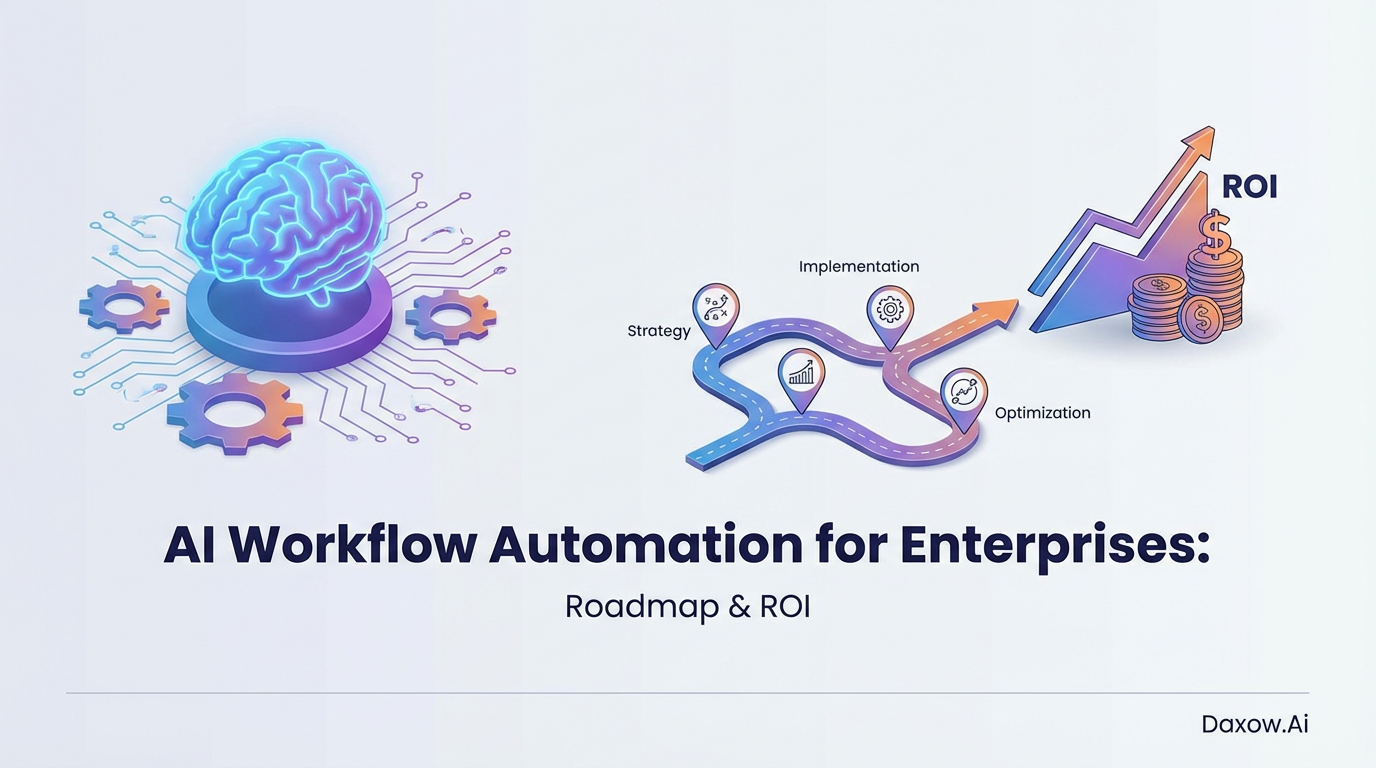
Practical guide to AI workflow automation: roadmap, industry use cases, ROI metrics, and Daxow.ai's approach to deploying AI agents across enterprise systems.
AI Workflow Automation: Transforming Business Operations for the Modern Enterprise
Estimated reading time: 15 minutes
Key Takeaways
- AI workflow automation enhances scalability, reduces costs, and improves customer outcomes by integrating AI with business processes.
- AI agents enable end-to-end automation by interacting across systems, improving resolution times, compliance, and operational efficiency.
- Industry-specific use cases demonstrate measurable ROI in e-commerce, healthcare, finance, real estate, and HR.
- A structured roadmap and best practices help mitigate risks and ensure successful AI automation deployment.
- Partnering with Daxow.ai delivers custom AI systems tailored to business needs, ensuring measurable impact through continuous monitoring and integration.
Table of Contents
- AI Workflow Automation: What it Is and Why It Matters
- How AI Agents and Automation Deliver Business Outcomes
- Daxow.ai’s Approach to AI Agents and Business Automation
- Practical Use Cases: Industry Examples and Actionable Playbooks
- Implementation Roadmap: From Discovery to Continuous Improvement
- Measuring ROI and Business Value
- Technology and Integration Considerations
- Why Partner with Daxow.ai for AI Workflow Automation
- Frequently Asked Questions
AI Workflow Automation: What it Is and Why It Matters
AI workflow automation integrates machine learning, natural language processing, and rule-based automation into business processes so tasks are executed autonomously, adaptively, and at scale. Rather than simply replacing manual steps, the best automation programs reframe work so people focus on high-value activities while AI handles repetitive, high-volume, or pattern-driven tasks.
Key business benefits
- Reduce manual tasks and human error across high-volume processes.
- Improve productivity by reallocating staff to strategic work.
- Lower operational costs through faster cycle times and fewer exceptions.
- Enhance customer experience with faster responses and personalized service.
- Increase resilience by detecting anomalies and enabling proactive responses.
Where AI workflow automation delivers the most value
- Processes that are high-volume, rule-driven, and data-rich (e.g., invoice processing, lead qualification, customer support).
- Workflows that require real-time decisioning, contextual understanding, or document extraction.
- Cross-system flows where integrations create manual handoffs today.
How AI Agents and Automation Deliver Business Outcomes
AI agents extend workflow automation beyond rigid scripts. They can reason across data, take multi-step actions, and interact with systems and people to complete tasks end-to-end.
What AI agents do
- Automate customer-facing conversations and escalate when needed.
- Extract structured data from unstructured documents and route it automatically.
- Monitor transactions for anomalies and trigger follow-up workflows.
- Orchestrate multi-system processes (CRM, ERP, ticketing, cloud storage).
Business outcomes from agent-driven automation
- Faster resolution times and higher customer satisfaction via customer support automation.
- Higher conversion rates through automated lead qualification and sales automation.
- Regulatory compliance at scale by standardizing document review and audit trails.
- Reduced cost-per-task by eliminating repetitive manual intervention.
Daxow.ai’s approach to AI agents and business automation
Daxow.ai designs AI agents that execute real tasks — not prototypes. Our process includes:
- Mapping existing workflows and KPIs to identify high-impact automation candidates.
- Building connectors to CRMs, ERPs, and third-party services for secure data flow.
- Training and validating models on your own data to ensure accuracy and compliance.
- Deploying agents with monitoring, retraining schedules, and human-in-the-loop controls.
- Measuring outcomes against business metrics and iterating to expand value.
Practical Use Cases: Industry Examples and Actionable Playbooks
E-commerce: Faster service, smarter operations
Use cases
- Customer support automation: AI agents handle order status, returns, and complaints. Escalations route to agents with context and suggested resolutions.
- Inventory and supply chain predictions: Models flag likely disruptions and trigger replenishment workflows.
- Content and feedback automation: Auto-generate personalized product descriptions and summarize customer reviews for product teams.
Actionable playbook
- Start with the top 3 customer-support ticket types and measure average handle time.
- Train an intent-classification model on historical tickets.
- Deploy a support agent that handles 50–70% of routine tickets and hands off complex cases.
- Integrate agent responses with CRM so customer context persists.
Business impact
Reduced support costs, faster resolution, and improved conversion when product pages and responses are personalized.
Healthcare: Secure document automation and early detection
Use cases
- Patient onboarding and triage: Automated intake reduces waiting times and ensures coding accuracy.
- Document extraction: Extract clinical data from referrals, lab reports, and insurance forms.
- Anomaly detection: Monitor patterns across claims or patient data for early warning signals.
Actionable playbook
- Identify high-volume intake documents and prioritize OCR + extraction models.
- Validate extraction accuracy against clinician review and iterate.
- Configure alerts for anomalies tied to clinical or compliance thresholds.
- Implement role-based access and audit logs to meet regulatory requirements.
Business impact
Lower administrative burden, faster patient processing, and improved compliance posture.
Finance: Faster close, stronger controls
Use cases
- Invoice and reconciliation automation: Extract line items, match to purchase orders, and route for approval.
- Fraud detection: Real-time scoring of transactions and automated workflows for investigation.
- Regulatory reporting: Aggregate and normalize disparate datasets for audits.
Actionable playbook
- Automate the invoice-to-pay workflow for the highest-volume vendor categories.
- Use anomaly detection models to flag suspicious patterns for human review.
- Create dashboards with exception metrics and savings realized.
Business impact
Reduced cycle times, fewer payment errors, and lower fraud losses.
Real Estate and Property Management: Lead-to-lease automation
Use cases
- Lead qualification: Parse inquiries, score leads based on tenant criteria, and automatically schedule viewings.
- Listing automation: Pull listing data, enrich with neighborhood insights, and publish across channels.
- Tenant onboarding: Automate document collection and lease execution workflows.
Actionable playbook
- Identify the lead sources generating the most unqualified traffic.
- Deploy an AI agent to score leads and assign high-potential prospects to sales.
- Integrate with calendar systems and digital signature platforms.
Business impact
Improved lease conversion, faster onboarding, and reduced administrative overhead.
HR and People Ops: Smarter hiring and onboarding
Use cases
- Resume screening: Extract skills and experiences, score candidates, and surface matches.
- Onboarding automation: Automate paperwork, IT provisioning, and training assignments.
- Attrition prediction: Identify early indicators of flight risk and trigger retention workflows.
Actionable playbook
- Pilot automated resume screening for a single role category.
- Measure time-to-hire and candidate quality against manual screening.
- Expand automation to onboarding documents and routine HR inquiries.
Business impact
Faster hiring, consistent candidate evaluation, and reduced HR administrative load.
Implementation Roadmap: From Discovery to Continuous Improvement
Step 1 — Discover and prioritize
- Map processes end-to-end and quantify time spent, error rates, and cost per transaction.
- Prioritize processes with high volume, repeatability, and measurable KPIs.
- Define targets: cost reduction, response time improvement, or error rate reduction.
Step 2 — Data readiness and tool selection
- Audit data quality and build secure data pipelines.
- Choose platforms supporting required integrations and security standards.
- Leverage pre-built connectors to minimize engineering lift.
Step 3 — Build, train, and test
- Assemble a cross-functional team: business owners, data engineers, ML engineers, legal/compliance, and change managers.
- Train models on representative datasets and validate with holdout samples.
- Run pilot deployments with clear success criteria.
Step 4 — Deploy and integrate
- Implement agents and automation with rollbacks, monitoring, and human-in-the-loop processes.
- Integrate with CRM, ERP, ticketing, and document storage to preserve context and auditability.
- Provide staff training and documentation to ensure adoption.
Step 5 — Monitor, iterate, scale
- Track metrics: throughput, cost-per-case, SLA attainment, and customer satisfaction.
- Retrain models periodically and incorporate user feedback.
- Expand to adjacent processes once targets are met.
Best practices and risk mitigation
- Focus on high-impact processes first for quick wins.
- Ensure clear human escalation paths and transparency in agent decisions.
- Standardize data formats and enforce secure pipelines to address data quality issues.
- Embed compliance and ethics oversight from the start.
- Use phased rollouts to manage infrastructure demands and change resistance.
Measuring ROI and Business Value
Quantifying benefits is critical to sustained investment and scale.
Key metrics to track
- Cost savings: reduced full-time equivalent (FTE) hours and error remediation costs.
- Productivity: cases handled per agent, time to resolution.
- Revenue impact: lead conversion lift, faster quote-to-cash cycles.
- Customer metrics: NPS, first-response times, churn reduction.
ROI expectations
Benchmarks indicate 20–50% efficiency gains in targeted processes when automation is thoughtfully applied. Realized ROI typically emerges from a combination of labor reduction, faster cycle times, and improved sales outcomes.
How Daxow.ai ensures measurable ROI
- We tie automation outcomes directly to business KPIs during discovery.
- We provide dashboards and reporting for real-time visibility and financial modeling of automation benefits.
- Our phased approach delivers early wins and scales value while minimizing upfront risks.
Technology and Integration Considerations
Integration priorities
- Secure connectors to core systems (CRM, ERP, HRIS, ticketing).
- Ability to ingest unstructured data (emails, PDFs, images) and transform it into structured records.
- Monitoring and logging for traceability and compliance.
Scalability and governance
- Select infrastructure that supports model retraining, versioning, and multi-tenant operations if necessary.
- Establish governance for model changes, data access, and ethical use of AI.
Daxow.ai’s technical capabilities
- End-to-end integration experience across common enterprise systems.
- Secure data handling and compliance-first deployment patterns.
- Continuous monitoring, retraining, and incident management as standard.
Why Partner with Daxow.ai for AI Workflow Automation
Implementing AI automation is as much about people and process as it is about technology. Daxow.ai combines business-first consulting with hands-on engineering to deliver production-grade automation that produces measurable results.
How Daxow.ai helps
- Process discovery and prioritization: We map workflows, quantify ROI, and recommend automation roadmaps.
- Custom AI solution design: We build AI agents and workflow automations tailored to your data, systems, and risk profile.
- End-to-end implementation: From connectors and model training to deployment and monitoring.
- Operational support: Ongoing model management, retraining, and governance to maintain performance.
- Integration expertise: Seamless data connectivity with CRMs, ERPs, and other enterprise systems to eliminate manual handoffs.
Client outcomes we focus on
- Reduced operational costs through automation of repetitive work.
- Improved customer experience with faster responses and fewer errors.
- Higher productivity by freeing employees for strategic work.
- Clear, measurable ROI and growing automation scope as value is proven.
Conclusion — Start transforming your operations today
AI workflow automation is a strategic lever for modern enterprises that want to scale efficiently, reduce manual tasks, and improve customer outcomes. By combining AI agents with robust workflow automation and enterprise integrations, organizations can realize significant productivity gains and cost savings while maintaining control and compliance.
If you’re ready to reduce manual work, improve productivity, and build automation that drives measurable ROI, contact Daxow.ai. Book a free consultation or request a process analysis for your company to discover where AI workflow automation can deliver the most value and how a custom AI system can be implemented end-to-end.
Frequently Asked Questions
What is AI workflow automation?
AI workflow automation uses artificial intelligence technologies, such as machine learning and natural language processing, integrated with business processes to autonomously execute repetitive or data-rich tasks at scale, improving efficiency and accuracy.
How do AI agents differ from traditional automation?
AI agents can reason across multiple systems, handle multi-step tasks, and engage with both people and technology dynamically, rather than following rigid scripted rules, enabling more intelligent and flexible automation.
How can Daxow.ai help my business implement AI automation?
Daxow.ai offers end-to-end services including process discovery, custom AI agent design, system integrations, deployment, and ongoing operational support to deliver measurable ROI and expand automation value within your enterprise.
What industries benefit most from AI workflow automation?
Industries with high volume, data-rich, and rule-driven processes benefit significantly, including e-commerce, healthcare, finance, real estate, and HR among others.