
Mastering AI Workflow Automation: A Strategic Business Guide
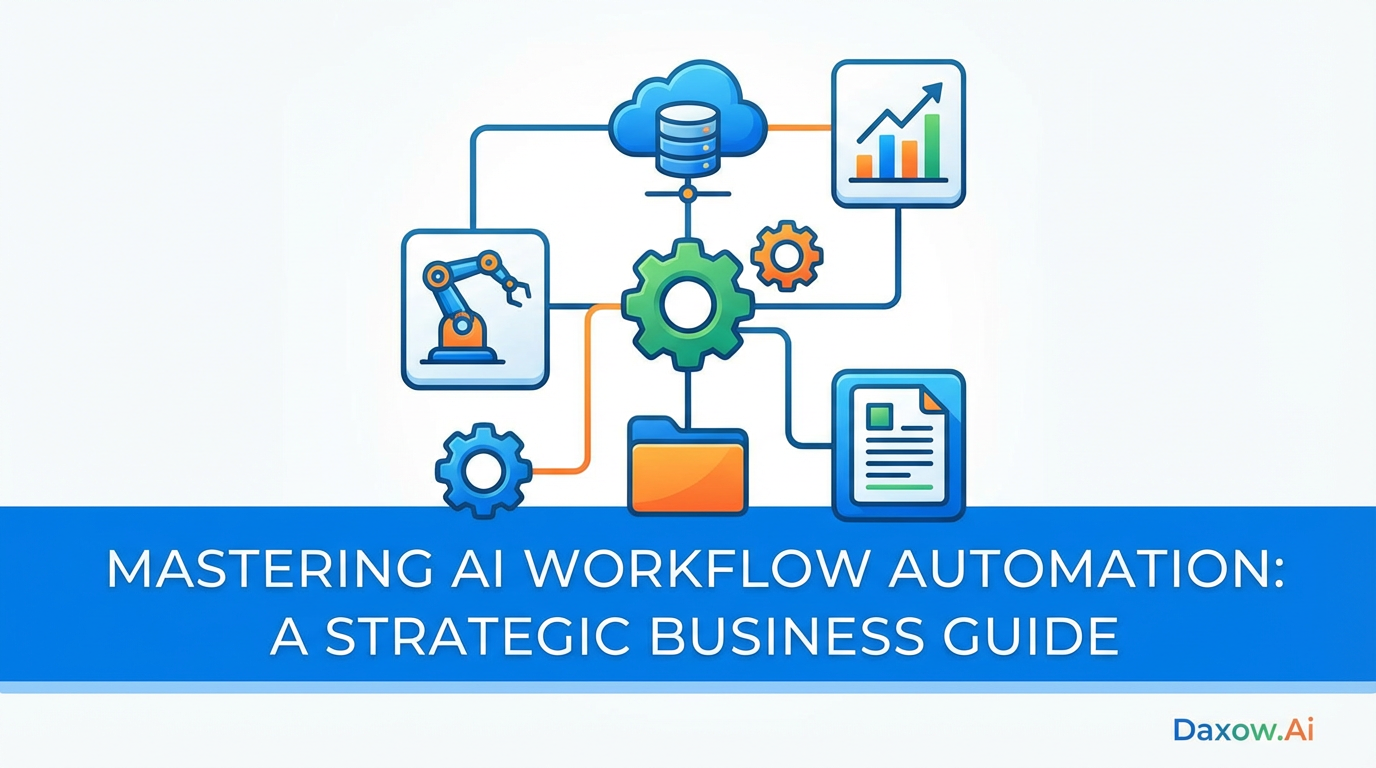
Strategic guide to AI workflow automation and AI agents — use cases, implementation roadmap, ROI metrics, and how Daxow.ai builds scalable, compliant automation.
Mastering AI Workflow Automation: A Strategic Guide for Business Transformation
Estimated reading time: 14 minutes
Key Takeaways
- AI workflow automation transforms manual processes into scalable, high-value systems driving measurable ROI.
- Automation reduces errors, boosts productivity, and improves customer satisfaction across industries.
- Strategic implementation follows a phased roadmap from assessment to continuous optimization.
- Daxow.ai provides expert end-to-end AI automation solutions integrating with existing business systems.
- Prioritizing quick wins, data readiness, and human-in-the-loop safeguards are critical to success.
Table of Contents
- Mastering AI Workflow Automation: A Strategic Guide for Business Transformation
- Why AI Workflow Automation Matters Now
- Practical Use Cases Across Industries
- How AI Agents and Automation Deliver Business Value
- Implementation Roadmap — From Pilot to Scale
- Best Practices and Risk Mitigation
- Measuring ROI and Business Impact
- How Daxow.ai Helps You Master AI Workflow Automation
- Realistic Example — From Invoice Chaos to Automated Reconciliation
- A Practical First Project for Most Organizations
- Next Steps — How to Get Started with Daxow.ai
- Frequently Asked Questions
Mastering AI Workflow Automation: A Strategic Guide for Business Transformation
AI workflow automation embeds intelligence into processes so systems—not people—handle repetitive, high-volume work. The result: faster processing, fewer errors, and real-time decision support. Organizations that adopt structured approaches to automation and AI agents typically achieve results 3–5x faster on targeted objectives and see efficiency gains of 30–50% in prioritized workflows. These outcomes translate to lower operational costs, improved customer experience, and capacity to scale without commensurate headcount increases.
Why AI Workflow Automation Matters Now
- Reduce manual tasks and human error: Routine data entry, ticket triage, and document processing consume valuable time and introduce mistakes.
- Boost productivity: AI agents can operate 24/7, handing off only complex exceptions to humans, which raises throughput and service levels.
- Improve customer satisfaction: Faster resolutions, proactive notifications, and consistent responses create superior experiences.
- Protect compliance and governance: Automated audit trails and rule-based checks reduce risk and make regulatory reporting repeatable.
- Scale business automation: As volume grows, AI systems scale without linear increases in operational cost.
The core capabilities that deliver impact
- Natural language processing (NLP) for chat, email, and document understanding.
- Machine learning models for classification, scoring, and anomaly detection.
- Orchestration layers to integrate CRMs, ERPs, ticketing, and knowledge bases.
- Feedback loops to retrain models and improve accuracy over time.
Practical Use Cases Across Industries
AI workflow automation proves most effective when applied to high-volume, rule-based, or predictable processes. Below are concrete examples and the business outcomes you can expect.
E-commerce
- Use cases: Order processing, returns triage, inventory prediction, dynamic pricing, customer inquiry triage.
- How it works: AI agents parse incoming emails and chats, classify intent, and execute actions—update orders, trigger shipments, or forward complex cases to agents.
- Business value: Faster fulfillment, reduced cart abandonment, and improved customer support efficiency. Typical outcomes: faster response times and reduced manual ticket handling by up to 50%.
Healthcare
- Use cases: Patient scheduling, claims pre-screening, intake form extraction, compliance checks.
- How it works: Automated workflows validate eligibility, create appointments, and send reminders while preserving HIPAA compliance through secure integrations.
- Business value: Reduced administrative burden on clinicians, faster billing cycles, and fewer scheduling errors.
Finance
- Use cases: Invoice reconciliation, fraud detection, compliance reporting, transaction monitoring.
- How it works: AI models reconcile invoices to purchase orders, flag anomalies, and generate structured audit logs for compliance teams.
- Business value: Shorter close cycles, lower fraud losses, and fewer manual reconciliations.
Real Estate
- Use cases: Lead qualification, property matching, contract review, rent collection reminders.
- How it works: AI agents qualify leads by intent and budget, match buyers to listings, and extract key clauses during contract reviews.
- Business value: Faster deal cycles, higher lead conversion, and streamlined legal reviews.
HR and Administrative Teams
- Use cases: Resume screening, interview scheduling, onboarding workflows, performance monitoring.
- How it works: Automated screening reduces the candidate pool to top matches; integrated scheduling removes calendar friction; onboarding checklists run in sequence with notifications.
- Business value: Faster hires, improved candidate experience, and consistent onboarding compliance.
How AI Agents and Automation Deliver Business Value
AI agents are autonomous software entities that perceive, reason, and act on data across systems. Unlike simple chatbots, they can execute transactions, update records, and coordinate multi-step processes.
- Orchestration: Agents integrate with CRMs, ERPs, and knowledge bases to complete end-to-end processes.
- Adaptation: Continuous learning and feedback loops improve accuracy and reduce manual escalation rates.
- Visibility: Dashboards and alerts provide real-time monitoring of KPIs and exception patterns.
- Resilience: Early detection of process bottlenecks and automated fallback behaviors reduce downtime.
These capabilities translate directly into business outcomes: lower operational costs, improved throughput, and measurable improvements in customer and employee satisfaction.
Implementation Roadmap — From Pilot to Scale
1. Assess and Plan (4–8 weeks)
- Define measurable goals tied to business KPIs (e.g., 20% cost reduction, 50% faster response time).
- Perform a data readiness audit: availability, quality, access, and compliance requirements (HIPAA, GDPR).
- Map target workflows and identify owners.
2. Select Technology and Team (6–12 weeks)
- Choose platforms compatible with your tech stack and integration needs.
- Build a cross-functional team: IT, data engineers, subject matter experts, and change managers.
- Evaluate vendors and models based on scalability, explainability, and support.
3. Prepare Data and Systems (4–8 weeks)
- Clean and label sample datasets.
- Build knowledge bases and decision trees for rule-driven steps.
- Document escalation paths and risk communication plans.
4. Pilot and Deploy (4–20 weeks)
- Start small with high-ROI, low-complexity processes (e.g., invoice processing, lead qualification).
- Monitor defined metrics: resolution rate, accuracy, time to handle, and user satisfaction.
- Iterate quickly on model tuning and workflow refinements.
5. Optimize Continuously (Ongoing)
- Retrain models with new data, capture user feedback, and update knowledge bases.
- Use dashboards to track performance and business impact.
- Expand automation scope based on validated outcomes.
Best Practices and Risk Mitigation
- Prioritize quick wins: Focus initial efforts on processes with clear ROI and straightforward data.
- Invest in data readiness: Clean, accessible data is foundational to successful AI automation.
- Maintain human-in-the-loop: For exceptions and critical decisions, ensure clear escalation processes.
- Plan for scalability: Design architectures that support growth for the next 3–5 years.
- Ensure ethical compliance: Monitor for bias, maintain explainability, and observe regulatory constraints.
Measuring ROI and Business Impact
Proving ROI requires clear metrics and baseline measurements. Common KPIs:
- Cost reduction in labor-hours and transaction processing.
- Speed improvements: average handle time, time to resolution.
- Quality and accuracy: error rates, rework frequency.
- Revenue outcomes: conversion rate changes and faster deal cycles.
- Employee and customer satisfaction scores.
Model expected savings up front and track actual performance against goals. Many organizations realize payback within 6–12 months on targeted automations, with cumulative benefits compounding over time as systems improve.
How Daxow.ai Helps You Master AI Workflow Automation
Daxow.ai is an AI automation agency founded in Estonia in 2024. We specialize in designing and delivering custom AI systems that automate end-to-end workflows, integrate with existing business tools, and run AI agents that execute real tasks.
Our end-to-end approach
- Discovery & Process Analysis: We map your workflows, identify bottlenecks, and prioritize automation opportunities that maximize ROI.
- Custom Solution Design: We architect AI agents and orchestrated workflows tailored to your tech stack and compliance needs.
- System Integrations: We connect CRMs, ERPs, ticketing systems, and data sources to enable reliable data flow and single-source truth.
- Implementation & Pilot: We run rapid pilots, validate outcomes, and scale successful automations across teams and channels.
- Continuous Optimization: We provide monitoring, retraining, and iterative enhancements to sustain performance.
Examples of what we build
- AI agents for customer support automation that triage and resolve 70–80% of incoming queries, escalating complex issues to humans.
- Sales automation systems that qualify leads, create opportunities in CRMs, and schedule follow-ups automatically.
- Document automation and data extraction solutions for finance and legal teams to accelerate reconciliations and contract review.
- HR automation for resume parsing, interview scheduling, and onboarding sequences.
Why partner with Daxow.ai
- Practical, results-driven focus: We prioritize high-impact use cases to deliver measurable ROI quickly.
- Integration expertise: We ensure your AI systems connect seamlessly with business tools for reliable execution.
- Security & compliance by design: We implement safeguards and audit trails for regulated industries.
- Operational ownership: We don’t just deliver models; we build production systems, dashboards, and support processes so automation drives sustained value.
Realistic Example — From Invoice Chaos to Automated Reconciliation
Problem: A mid-sized company spends hundreds of hours monthly reconciling vendor invoices, with frequent mismatches and late payments.
Solution:
- Data extraction: An AI agent extracts line-item data from invoices and validates entries against purchase orders.
- Matching logic: A rules engine and ML classifier match invoices to orders and flag anomalies.
- Orchestration: Approved invoices trigger payments in the ERP; exceptions create task tickets routed to finance specialists.
- Monitoring: Dashboards track reconciliation times, exception rates, and cost savings.
Outcome:
- 50% reduction in manual reconciliation time.
- Faster vendor payments and improved supplier relationships.
- Clear audit trail and compliance documentation.
A Practical First Project for Most Organizations
If you are starting, pick a single, high-volume process with clear metrics—customer support ticket triage, invoice processing, or lead qualification. Run a 6–12 week pilot focused on:
- Defining success metrics.
- Integrating with one or two core systems.
- Deploying an AI agent for the defined scope.
- Monitoring results and planning scale.
Next Steps — How to Get Started with Daxow.ai
Transforming operations with AI workflow automation requires the right strategy and execution partner. Daxow.ai offers a proven path from process analysis to full production systems.
- Book a free consultation to review your current workflows.
- Request a process analysis for your company to identify high-ROI automation targets.
- Contact us to build a custom AI system that reduces manual tasks, improves productivity, and delivers measurable business automation outcomes.
Frequently Asked Questions
What is AI workflow automation?
AI workflow automation leverages artificial intelligence to automate repetitive, high-volume business processes, improving speed, accuracy, and scalability.
How quickly can we see ROI from automation?
Many organizations achieve payback within 6–12 months after deploying targeted automation solutions, with benefits compounding over time.
Does automation eliminate the need for human workers?
Automation handles routine tasks, freeing humans to focus on complex, creative, and strategic work, with human-in-the-loop mechanisms for exceptions and oversight.
How does Daxow.ai ensure integration with existing systems?
Daxow.ai specializes in seamless integration with CRMs, ERPs, ticketing systems, and other platforms to ensure reliable data flow and single-source truth across workflows.