
AI Workflow Automation: Strategic Roadmap for Growth
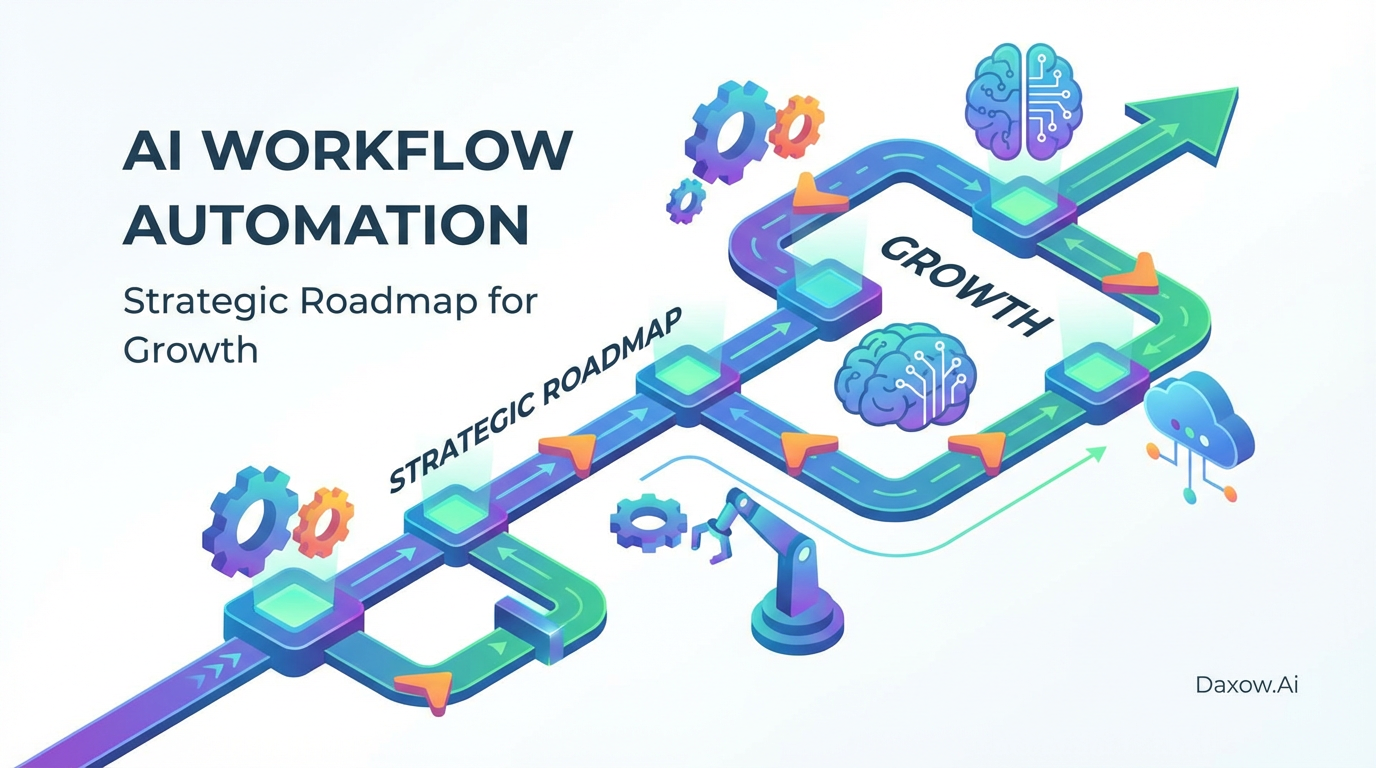
Practical guide to AI workflow automation — ROI, industry use cases, implementation phases, and how Daxow.ai builds AI agents to scale operations.
Unlocking Business Growth: AI Workflow Automation as a Strategic Imperative
Estimated reading time: 15 minutes
Key Takeaways
- AI workflow automation reduces routine work, accelerates processing, and cuts costs while boosting productivity.
- AI agents enable contextual decision-making and handle unstructured data across complex business workflows.
- Industry-specific implementations demonstrate measurable ROI, with common benefits including faster throughput and higher accuracy.
- A phased implementation roadmap emphasizes assessment, technology selection, pilot deployment, and continuous optimization.
- Daxow.ai delivers end-to-end AI automation solutions with strong integration, compliance, and managed services.
Table of Contents
- Unlocking Business Growth: AI Workflow Automation as a Strategic Imperative
- Business Value and ROI of AI Workflow Automation
- Practical Use Cases: Industry Examples of AI Automation
- Implementation Roadmap — From Strategy to Scale
- Best Practices and Common Pitfalls
- How Daxow.ai Delivers End-to-End Business Automation
- Getting Started — Practical Checklist for Decision-Makers
- Frequently Asked Questions
Unlocking Business Growth: AI Workflow Automation as a Strategic Imperative
Unlocking Business Growth: AI Workflow Automation as a Strategic Imperative is no longer a theoretical advantage — it is a practical necessity for organizations that need to scale, reduce costs, and improve customer experience. Businesses face rising operational costs, talent shortages, and growing customer expectations. AI automation and workflow automation transform repetitive, rule-based processes into intelligent, scalable systems that free teams to focus on strategic work and innovation.
This article explains why AI workflow automation matters, provides a structured implementation roadmap, gives industry-specific use cases, and shows how Daxow.ai designs and deploys custom AI agents and business automation to deliver measurable ROI.
Why this is strategic
- Eliminates routine work: Automates high-volume tasks such as data entry, approvals, and ticket triage to reduce manual effort and errors.
- Delivers measurable performance: Typical outcomes include faster processing (2–5x), cost reductions (30–50% on automated tasks), and productivity gains (20–40%).
- Scales operations without commensurate headcount increases: Companies can manage projected volume growth for several years without proportional hiring.
- Enables better decisions: AI agents extract and structure data, generating insights that drive faster, data-driven decisions.
How AI agents accelerate transformation
AI agents are autonomous software entities that execute tasks, integrate with systems, and learn from interactions. Unlike rule-based RPA alone, AI agents handle unstructured data, manage escalations, and make contextual decisions across multi-step workflows. At Daxow, we build AI agents that connect to CRMs, ERPs, knowledge bases, and messaging channels to automate complete customer journeys or internal processes.
Business Value and ROI of AI Workflow Automation
Quantifying impact
- Faster throughput: 2–5x faster processing on automated workflows.
- Lower costs: 30–50% reduction in labor and processing costs for automated tasks.
- Higher accuracy: Error reductions of up to 90% in routine data tasks.
- Rapid payback: High-impact pilots frequently show ROI within 6–12 months.
Metrics to measure
Trackable KPIs align automation to business objectives:
- Cost per transaction
- Average handling / processing time
- First-contact resolution and resolution rate (for support automation)
- Sales lead-to-opportunity conversion (for sales automation)
- Employee hours reclaimed (productivity)
- NPS and customer satisfaction scores
Daxow approach to ROI
At Daxow.ai, we begin engagements with a KPI-focused assessment. We define target improvements (for example, a 30% reduction in manual processing costs), identify pilot use cases that deliver quick wins, and apply iterative scaling to maximize value. Our projects emphasize integration fidelity and retraining pipelines so gains are sustainable.
Practical Use Cases: Industry Examples of AI Automation
E-commerce — Order to fulfillment automation
Use case:
- Automate order validation, invoice matching, inventory reconciliation, and customer inquiry responses.
- AI agents detect shipping exceptions, re-route orders, and generate personalized recommendations.
Business impact: Reduced fulfillment times, fewer returns, and improved conversion through faster, accurate responses.
Daxow role: Build integrations with e-commerce platforms and ERPs. Deploy AI agents for invoice extraction, inventory forecasting, and customer support automation.
Healthcare — Scheduling, claims, and compliance
Use case:
- Automate patient scheduling, pre-authorization, claims adjudication, and compliance checks.
- NLP-based extraction transforms unstructured clinical notes into structured records.
Business impact: Reduced administrative burden on clinicians, faster claims processing, and tighter compliance.
Daxow role: Design HIPAA-compliant AI systems, integrate with medical record systems, and implement secure data pipelines.
Finance — Fraud detection and reconciliation
Use case:
- Automate transaction monitoring, predictive fraud scoring, loan application screening, and reconciliations.
- AI agents cross-reference multiple data sources to flag anomalies and recommend actions.
Business impact: Faster approvals, reduced losses, and improved regulatory reporting.
Daxow role: Integrate predictive models into existing processes and automate exception workflows that route high-risk items to human review.
Real Estate — Lead qualification and contract review
Use case:
- Automate lead capture, qualification through AI scoring, scheduling viewings, and contract analysis using NLP.
- Chatbots provide instant property information and virtual tour scheduling.
Business impact: Higher-qualified pipeline, faster turnaround on proposals, and fewer missed opportunities.
Daxow role: Implement sales automation and AI agents that qualify leads and generate contract summaries for legal teams.
HR — Recruitment and onboarding
Use case:
- Screen resumes, automate interview scheduling, and manage onboarding checklists.
- Predictive analytics identify flight risk and suggest retention actions.
Business impact: Shorter time-to-hire, consistent onboarding, and improved retention.
Daxow role: Build data extraction and decision support agents that integrate with HRIS systems and applicant tracking tools.
Customer Support — Chatbots and escalations
Use case:
- Combine chatbots for first-line support, AI-driven ticket routing, and knowledge-base automation.
- Agents resolve routine inquiries and escalate complex issues with context and suggested resolutions.
Business impact: Higher resolution rates, reduced mean time to resolution, and reclaimed agent time for higher-value interactions.
Daxow role: Implement customer support automation that integrates with CRMs and support platforms and trains models on company knowledge.
Implementation Roadmap — From Strategy to Scale
Phase 1 — Assess and plan (4–8 weeks)
- Conduct a process audit to identify high-volume, rule-based tasks suitable for automation.
- Define measurable goals (e.g., 30% cost reduction, 80% automated resolution rate).
- Evaluate data readiness and current system landscape.
Daxow contribution: We deliver a process analysis and prioritize use cases by ROI, complexity, and risk.
Phase 2 — Select technology and assemble team (6–12 weeks)
- Choose scalable platforms with strong integration capabilities.
- Assemble cross-functional teams: IT, data engineers, business SMEs, and change leaders.
Daxow contribution: Daxow recommends and configures the tech stack, from LLMs and ML models to orchestration tools, and embeds a delivery team for implementation.
Phase 3 — Prepare data and systems (4–8 weeks)
- Clean and label data, build knowledge bases, and design API integrations.
- Document escalation paths and governance rules.
Daxow contribution: We construct secure connectors to CRMs, ERPs, and document stores, and prepare training datasets for AI agents.
Phase 4 — Pilot and deploy (4–20 weeks)
- Launch controlled pilots focusing on single use cases.
- Measure results, gather feedback, and iterate.
- Scale gradually across channels and business units.
Daxow contribution: Daxow runs pilots end-to-end, from model training to user acceptance testing, ensuring integration and compliance.
Phase 5 — Optimize continuously (ongoing)
- Monitor performance, retrain models, and refine workflows to prevent drift.
- Maintain clear communication and training to drive adoption.
Daxow contribution: Our managed services provide monitoring, retraining, and change management to sustain gains over time.
Best Practices and Common Pitfalls
Best practices
- Start with high-impact, rule-based workflows for fast ROI.
- Ensure data readiness and governance to avoid biased or inaccurate outcomes.
- Build cross-functional teams that include business owners and IT.
- Design for integration to leverage existing CRMs and tools with minimal disruption.
- Plan for adoption through training, documentation, and stakeholder engagement.
Common pitfalls to avoid
- Skipping pilots and scaling too quickly.
- Neglecting data quality or training sets.
- Treating AI as a point solution rather than an end-to-end change.
- Underestimating compliance and privacy requirements.
How Daxow.ai Delivers End-to-End Business Automation
From discovery to production
- Discovery & process analysis: We map workflows and quantify opportunity.
- Custom AI design: We build AI agents tailored to business logic and integrate them with your systems.
- Secure integrations: We connect CRMs, ERPs, ticketing systems, and document stores to ensure data consistency.
- Pilot execution: We run pilots, gather metrics, and iterate quickly to validate business value.
- Scale & managed services: We deploy across the organization and provide ongoing optimization and model retraining.
Systems and integrations
- We design API-based integrations, event-driven pipelines, and secure data lakes.
- Our agents operate across channels—email, chat, phone transcripts, and backend systems—providing seamless orchestration.
- Emphasis on compliance: We implement role-based access, encryption, and auditing for regulated industries.
Practical example: End-to-end customer journey automation
- Rely on AI agents to qualify leads, create CRM records, schedule demos, and escalate to sales when needed.
- Integrate with marketing automation for personalized outreach.
- Result: shorter sales cycles, higher lead-to-opportunity conversion, and measurable increases in revenue-per-rep.
Getting Started — Practical Checklist for Decision-Makers
- Identify 2–3 high-volume processes that are rule-based and measure baseline KPIs.
- Appoint an executive sponsor and cross-functional implementation lead.
- Reserve a pilot budget and timeline (3–6 months) for the initial deployment.
- Prepare data access and compliance documentation.
- Choose a partner with integration and AI agent experience.
Daxow can perform a focused process analysis to identify priority opportunities and deliver a pilot that proves value within months.
Frequently Asked Questions
What types of business processes benefit most from AI workflow automation?
High-volume, repetitive, and rule-based processes such as data entry, customer support ticket triage, claims processing, and order fulfillment see the greatest impact.
How quickly can I expect ROI from an AI automation pilot?
Many pilots show measurable ROI within 6–12 months by focusing on high-impact use cases and leveraging rapid iteration.
How does Daxow.ai ensure data privacy and compliance?
We design systems with secure data access, encryption, role-based permissions, and compliance-specific frameworks such as HIPAA for healthcare or GDPR for European markets.
What industries does Daxow.ai specialize in?
Our expertise spans e-commerce, healthcare, finance, real estate, HR, and customer support sectors, among others, tailoring AI automation to each industry's unique needs.