
Autonomous AI Agents for Business Process Automation
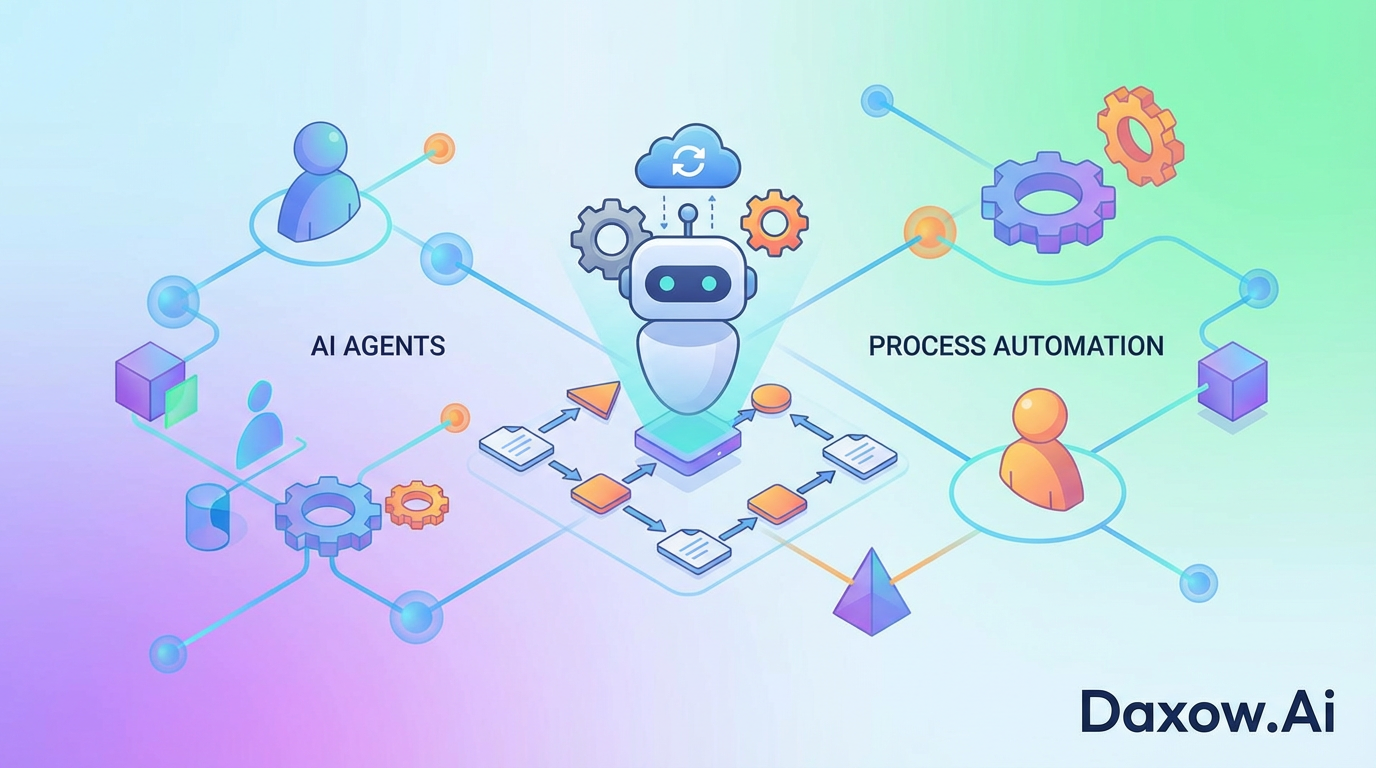
Practical guide to autonomous AI agents for automating business processes, use cases, 90-day roadmap, KPIs and how Daxow.ai builds ROI-driven, secure automation.
Autonomous AI Agents for Business Process Automation
Estimated reading time: 15 minutes
Key Takeaways
- Autonomous AI agents combine language models, automation, and integrations to perform end-to-end business tasks with minimal human intervention.
- They provide measurable benefits like reduced manual tasks, boosted productivity, improved customer support, and decreased operational costs.
- Use cases span industries including customer support, sales, finance, HR, healthcare, e-commerce, and real estate.
- Daxow.ai offers tailored design, integration, and deployment services for AI automation systems focused on delivering clear ROI.
- A phased implementation approach ensures risk reduction, scalability, and continuous improvement of autonomous agents.
Table of Contents
- Introduction
- Autonomous AI Agents for Business Process Automation
- Why This Matters Now
- Key Capabilities of Autonomous AI Agents
- Business Benefits at a Glance
- Practical Use Cases Across Industries
- Designing and Implementing Autonomous AI Agents
- Technical Considerations (What to Plan For)
- Measuring ROI and Success Metrics
- Common Pitfalls and How to Avoid Them
- Actionable 90-Day Roadmap for Decision-Makers
- How Daxow.ai Connects to Your Automation Journey
- Why Partner with Daxow.ai
- Conclusion
- Frequently Asked Questions
Introduction
Autonomous AI Agents for Business Process Automation are changing how companies eliminate repetitive work, scale operations, and improve customer experience. In this article we explain what autonomous AI agents do, show actionable use cases across industries, and provide a practical implementation path for decision-makers who want to reduce manual tasks and unlock measurable productivity gains. Throughout, we describe how Daxow.ai helps design, build, and deploy custom AI automation systems that connect to your tools and deliver ROI.
Autonomous AI Agents for Business Process Automation
What are autonomous AI agents? At a high level, they are software systems that combine language models, automation frameworks, and integrations to perform end-to-end tasks with minimal human intervention. Unlike point tools, these agents can interpret inputs, make decisions based on rules or learned behavior, act across multiple systems, and adapt over time.
Why This Matters Now
- Increased expectations: Customers expect fast, accurate responses across channels. Businesses need solutions that operate 24/7.
- Operational scale: Teams scale faster with automation that can handle volume without linear headcount increases.
- Mature enabling tech: Large language models, task orchestration platforms, and robust APIs make autonomous agents viable for real business processes.
- Tangible impact: Organizations implementing AI automation report meaningful reductions in response times, operational costs, and manual workloads.
Key Capabilities of Autonomous AI Agents
- Natural language understanding and generation: Interpreting unstructured inputs from email, chat, documents, and voice.
- Task orchestration: Executing multi-step workflows across CRMs, ERPs, and ticketing systems.
- Decision automation: Applying business rules and confidence thresholds to decide when to act or escalate.
- Data extraction and validation: Pulling structured data from documents and verifying against authoritative sources.
- Learning and improvement: Using feedback loops to refine responses and reduce errors.
Business Benefits at a Glance
- Reduce manual tasks by automating routine, rule-based work.
- Boost productivity by freeing knowledge workers to focus on high-value activities.
- Improve customer support automation with faster, consistent responses.
- Accelerate sales automation with real-time lead qualification and follow-up.
- Cut operational costs through fewer human touchpoints and higher throughput.
Practical Use Cases Across Industries
Customer Support Automation
Use case: An autonomous agent handles tier-1 support across email and chat, triages issues, updates the CRM, and resolves common problems by applying knowledge-base content.
- Outcome: Faster resolution, fewer transfers to human agents, higher self-service rates.
- KPIs: First response time, resolution rate without escalation, average cost per ticket.
- How Daxow helps: We map support workflows, integrate the agent with your helpdesk and knowledge base, and build escalation policies that preserve SLA and compliance.
Sales Automation and Lead Qualification
Use case: Agents qualify inbound leads by analyzing form inputs, company data, and intent signals, then schedule demos or route leads to reps.
- Outcome: Higher conversion rates, better rep productivity, shorter sales cycles.
- KPIs: Lead-to-opportunity conversion, time-to-contact, meeting no-show rate.
- How Daxow helps: We connect CRMs, enrich data with third-party sources, and deploy intelligent routing that respects sales territories and quotas.
Finance and Accounting
Use case: Automated invoice processing—agents extract line items, match to purchase orders, flag exceptions, and push approvals into ERP workflows.
- Outcome: Faster invoice throughput, fewer manual interventions, reduced late payments.
- KPIs: Invoice processing time, exceptions rate, days payable outstanding (DPO).
- How Daxow helps: We design document extraction pipelines, implement validation rules, and integrate with accounting systems for end-to-end automation.
Human Resources and Onboarding
Use case: Candidate screening and onboarding automation—agents pre-screen applicants, schedule interviews, and gather required documents.
- Outcome: Shorter time-to-hire, consistent candidate experience, lower administrative workload.
- KPIs: Time-to-fill, candidate drop-off rate, HR admin hours saved.
- How Daxow helps: We build screening logic aligned to job profiles and integrate with ATS and calendar systems.
Healthcare Administration
Use case: Patient scheduling and pre-visit intake—agents collect symptoms, schedule appointments, verify insurance coverage, and prepare visit summaries.
- Outcome: Reduced call center load, improved appointment utilization, better data accuracy.
- KPIs: No-show rate, intake completion rate, average scheduling time.
- How Daxow helps: We ensure HIPAA-aware design, secure integrations with EHR systems, and robust audit trails.
E-commerce and Order Management
Use case: Order exception handling—agents detect payment failures, contact customers, retry payments, or route high-value exceptions to human agents.
- Outcome: Fewer abandoned orders, improved revenue recovery, fewer manual interventions.
- KPIs: Recovery rate of failed payments, time to resolution, customer satisfaction.
- How Daxow helps: We integrate agents with payment gateways, CRM, and fulfillment systems to automate common order flows.
Real Estate and Property Management
Use case: Lease intake and maintenance triage—agents process tenant requests, schedule inspections, and initiate vendor work orders.
- Outcome: Faster response for maintenance issues, better tenant satisfaction, optimized vendor utilization.
- KPIs: Request-to-resolution time, vendor utilization rate, tenant NPS.
- How Daxow helps: We connect property management platforms, build vendor workflows, and automate recurring maintenance schedules.
Designing and Implementing Autonomous AI Agents
A practical, phased approach reduces risk and accelerates value. Daxow follows a proven methodology to design custom agents that integrate with your tech stack and execute real tasks.
Phase 1 — Discovery and Process Mapping
- Conduct stakeholder interviews.
- Identify high-volume, high-value processes suitable for automation.
- Create a process inventory and quantify baseline metrics.
Deliverable: Prioritized automation backlog with ROI estimates.
Phase 2 — Proof of Value (PoV)
- Build a constrained agent prototype for one workflow.
- Test within a controlled environment and measure outcomes.
- Validate integration points and data quality.
Deliverable: PoV report with real performance data and scaling recommendations.
Phase 3 — Production Deployment
- Harden the agent for production: monitoring, error handling, and security.
- Integrate with CRMs, ERPs, ticketing systems, and identity platforms.
- Implement governance, logging, and auditability.
Deliverable: Live agent with SLAs and runbook.
Phase 4 — Scale and Optimize
- Expand to adjacent workflows.
- Add automation of decision logic and learning loops.
- Measure continuous improvement and ROI.
Deliverable: Enterprise-wide automation program and performance dashboard.
Technical Considerations (What to Plan For)
- Data access and connectivity: Secure API access and reliable data pipelines are essential.
- Security and compliance: Encryption, role-based access, and audit logs must meet regulatory requirements.
- Error handling and escalation: Define confidence thresholds where the agent escalates to humans.
- Observability: Implement metrics, tracing, and alerts to detect regressions quickly.
- Model governance: Track model versions, prompt changes, and safety filters.
- Integration complexity: Expect work to map fields, normalize data, and handle inconsistent formats.
Measuring ROI and Success Metrics
Quantify outcomes using a mix of operational and business KPIs:
- Operational: Reduction in manual hours, tickets handled per hour, processing time per task.
- Financial: Cost per transaction, cost savings, revenue uplift from faster sales cycles.
- Customer-facing: Response time, first contact resolution, Net Promoter Score (NPS).
- Risk & compliance: Error rates, audit pass rates, issue escalation frequency.
Example ROI Calculation (Illustrative)
Baseline: 10 agents spend 2,000 hours/month on repetitive tasks at $40/hr = $80,000/month.
Post-automation: Autonomous agents handle 70% of tasks; human hours drop to 600 hours/month = $24,000/month.
Monthly savings: $56,000 → annualized savings of $672,000, excluding implementation costs and new revenue from faster processing.
Common Pitfalls and How to Avoid Them
- Over-automating before stabilizing processes: Standardize workflows first.
- Ignoring data quality: Garbage in leads to poor automation outcomes. Invest in data validation.
- Missing integration complexity: Plan for API limitations and legacy systems.
- Lack of governance: Without review and monitoring, agents can drift and introduce risks.
- Unrealistic expectations for accuracy: Start with narrow scopes and expand as confidence grows.
Actionable 90-Day Roadmap for Decision-Makers
Day 0–30: Discovery and Pilot Selection
- Map top 3 processes by volume and manual effort.
- Choose one PoV with clear KPIs.
- Get leadership alignment and necessary data access.
Day 31–60: Build and Test the Pilot
- Implement integrations and the agent prototype.
- Run test cases and collect performance data.
- Tune decision rules and escalation thresholds.
Day 61–90: Deploy and Measure
- Move pilot to limited production.
- Track KPIs daily and report weekly.
- Prepare scaling plan for adjacent processes.
How Daxow.ai Connects to Your Automation Journey
- End-to-end process analysis: We map your workflows and quantify opportunities to reduce manual tasks.
- Custom AI systems: We design AI agents tailored to your rules, compliance needs, and business goals.
- Integrations and data connectivity: We connect agents to CRMs, ERPs, ticketing systems, and data stores.
- Operationalization and governance: We provide monitoring, model governance, and runbooks for production operations.
- Measurable ROI: We focus on KPIs that matter—cost reduction, productivity uplift, and improved customer outcomes.
Why Partner with Daxow.ai
- Practical focus: We prioritize automations with clear ROI and user acceptance.
- Technical depth: We build reliable integrations and robust agent orchestration.
- Industry experience: We deliver use cases across sales automation, customer support automation, finance, HR, healthcare, and more.
- End-to-end delivery: From discovery to scale, we handle implementation, governance, and optimization.
Conclusion
Autonomous AI Agents for Business Process Automation are a strategic lever for organizations that want to reduce manual tasks, increase productivity, and deliver better customer experiences. The right approach combines careful process selection, secure integrations, clear governance, and iterative scaling. Daxow.ai helps businesses design and deploy custom AI agents that execute real tasks, integrate with existing systems, and deliver measurable ROI.
Book a free consultation with Daxow.ai to request a process analysis for your company and start building a custom AI system that reduces manual work and accelerates growth. Contact us to build your first autonomous AI agent and unlock scalable business automation.
Frequently Asked Questions
What industries benefit most from autonomous AI agents?
Autonomous AI agents deliver value across many industries including customer support, sales, finance, human resources, healthcare, e-commerce, and property management by automating repetitive tasks and optimizing workflows.
How does Daxow.ai ensure compliance and security?
Daxow.ai integrates best practices such as encryption, role-based access control, audit logs, and HIPAA-aware designs tailored for healthcare to meet regulatory requirements and protect sensitive data.
What’s the typical timeline for implementing an autonomous AI agent?
A typical phased approach covers discovery, prototype development, production deployment, and scaling over a 90-day roadmap, allowing for validation, tuning, and progressive expansion.
Can autonomous agents integrate with legacy systems?
Yes, Daxow.ai specializes in integrating AI agents with a variety of tech stacks, including legacy CRMs, ERPs, and ticketing systems, managing data normalization and API limitations carefully.