

Autonomous AI Agents: Reshaping Operations Across Industries
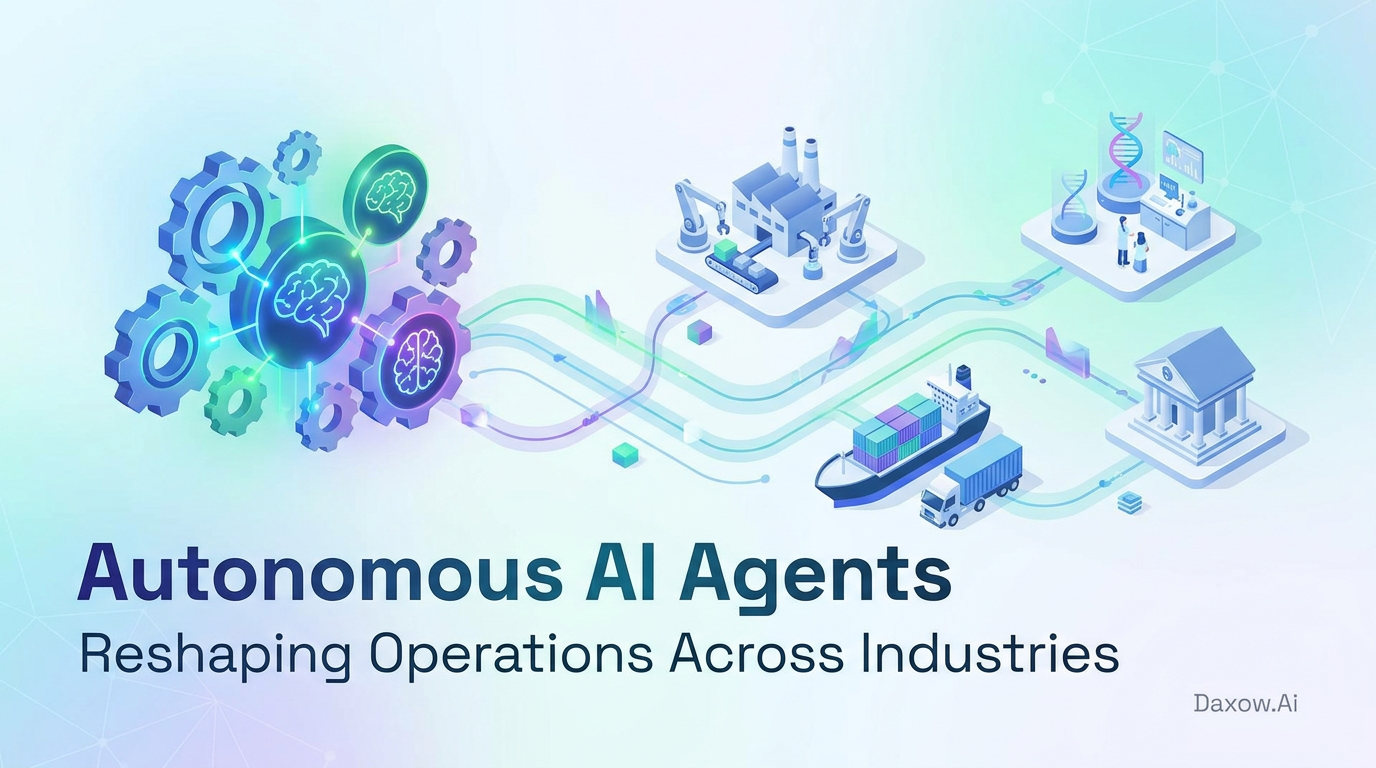
Discover how autonomous AI agents reduce manual work, boost productivity, and deliver measurable ROI across e-commerce, healthcare, finance, real estate, HR and more.
AI Agents and Business Automation: How Autonomous AI Will Reshape Operations Across Industries
Estimated reading time: 15 minutes
Key Takeaways
- AI agents transform repeatable human work into scalable digital labor capable of reasoning and adapting across systems.
- Autonomous AI improves productivity, responsiveness, and lowers operational costs across industries like e-commerce, healthcare, finance, real estate, and HR.
- Successful AI automation requires layered workflows, rigorous governance, iterative measurement, and strategic operational embedding.
- Daxow.ai offers end-to-end AI agent solutions integrating CRM, ERP, ticketing, and data warehouses to deliver measurable business outcomes.
Table of Contents
- Introduction
- AI Agents and Business Automation
- What AI Agents and Automation Mean for Business Value
- Practical Use Cases Across Industries
- From Tools to an Operating Model: What AI Agents Add
- Implementation Steps and Best Practices
- Measuring ROI and Business Value
- How Daxow.ai Builds and Scales AI Automation
- Next Steps — A Practical Starting Plan
- Frequently Asked Questions
Introduction
The rise of AI agents and business automation is revolutionizing how organizations operate. This revolution is more than a technology trend; it represents a strategic shift that converts repeatable human work into scalable, goal-oriented digital labor. For business owners, CTOs, and operations leaders, understanding where to apply autonomous AI and how to operationalize it is critical to reduce manual tasks, enhance productivity, and capture measurable return on investment.
AI Agents and Business Automation: How Autonomous AI Will Reshape Operations Across Industries
What are AI agents and why do they matter today? At Daxow.ai — an AI automation agency founded in Estonia in 2024 — AI agents are defined as advanced software entities connected to your data and systems, capable of reasoning, planning, and executing tasks toward specified goals. Unlike one-off automations, these agents function as reliable digital team members operating across CRM, ERP, ticketing systems, document repositories, and messaging platforms.
Key distinctions from traditional automation:
- From task-centric to outcome-centric: Agents pursue goals (e.g., "qualify all new leads within 2 hours") rather than simply running scripts.
- From brittle to adaptive: Agents manage unstructured inputs and navigate alternate paths when exceptions arise.
- From tools to collaborators: Agents act as virtual employees — such as billing assistants, support triage agents, or revenue operations analysts.
Why it matters
- Reduce manual tasks and repetitive labor across functions.
- Improve productivity by enabling teams to focus on high-value work.
- Increase responsiveness to customers and partners with near-real-time actions.
- Lower operational costs by scaling capacity without linear headcount increases.
What AI Agents and Automation Mean for Business Value
AI agents deliver value across four interlinked dimensions:
- Cost transformation: Routine knowledge work becomes cheaper and faster, enabling organizations to scale workflows without equivalent hiring.
- Speed & responsiveness: Lead response and support resolution accelerate from hours to seconds.
- Operational resilience: Codified processes within agents reduce dependency on tribal knowledge.
- Strategic redeployment of human effort: Employees shift focus to supervising, optimizing, and designing work rather than executing every step.
Below are practical, industry-specific use cases demonstrating tangible outcomes and illustrating how Daxow.ai integrates, builds, and scales these solutions.
Practical Use Cases Across Industries
E-commerce
Core opportunities: revenue uplift, personalization, and operational efficiency.
- Intelligent customer support & product guidance: Agents access order history, inventory, and policies to resolve common queries, escalating only complex cases while maintaining a consistent tone.
- Dynamic merchandising and pricing: Agents monitor trends and sales velocity to recommend price changes, bundles, or personalized promotions.
- Order exception handling: Agents detect shipping delays, interface with carrier APIs, and proactively communicate with customers.
- Lifecycle & retention automation: Agents orchestrate tailored email and SMS flows, logging results into CRM systems.
Business outcomes: Higher conversion rates, increased average order value, lower support costs, and improved campaign efficiency.
Healthcare
Core opportunities: administrative relief, improved patient experience, compliance-aware automation.
- Patient intake & triage assistance: Agents collect structured symptom and insurance data, routing cases appropriately.
- Scheduling & coordination: Agents manage appointments and reminders across multiple channels, reducing no-shows.
- Clinical documentation support: Agents transform visit transcripts into structured notes for clinician review.
- Revenue cycle support: Agents assist in eligibility checks, claims follow-ups, and billing inquiries.
Business outcomes: Reduced administrative burden, better clinician focus, faster billing cycles, and enhanced patient journeys.
Finance (Banking, FinTech, Accounting, Insurance)
Core opportunities: risk control, regulatory alignment, and decision support.
- KYC/AML onboarding assistance: Agents guide customers through document submissions and perform pre-validation.
- Credit underwriting support: Agents aggregate financial inputs and draft risk summaries for human review.
- Insurance claims automation: Agents triage claims, extract data from documents, and prepopulate claims systems.
- Internal compliance monitoring: Agents continuously scan for patterns requiring compliance review.
Business outcomes: Faster onboarding, improved risk consistency, and reduced back-office costs.
Real Estate
Core opportunities: lead handling, transaction coordination, and marketing efficiency.
- Lead qualification & nurturing: Agents qualify leads across channels, scheduling viewings or passing leads to agents.
- Listing preparation & marketing: Agents generate listing copy and campaign assets from property details.
- Transaction coordination: Agents track deadlines, collect necessary documents, and maintain audit trails.
- Investor reporting: Agents aggregate portfolio data and create investor updates.
Business outcomes: Higher lead conversion rates, reduced manual transaction tasks, and clearer portfolio visibility.
HR and People Operations
Core opportunities: recruiting speed, onboarding consistency, and employee self-service.
- Candidate sourcing & screening: Agents shortlist candidates and summarize fit for recruiters.
- Onboarding orchestration: Agents sequence paperwork, training, and IT provisioning.
- Employee self-service: Agents answer routine HR queries and escalate complex issues.
- Performance insights: Agents summarize 1:1s and survey feedback while respecting privacy.
Business outcomes: Faster hiring cycles, improved onboarding quality, and reduced HR administrative load.
From Tools to an Operating Model: What AI Agents Add
To fully capture strategic value, AI automation should be considered across three layers:
- Task automation: Rule-based single steps such as RPA or simple scripts.
- Workflow orchestration: Multi-step flows with fixed logic, often managed by BPM tools.
- AI agents (agentic systems): Goal-oriented systems that reason, plan, and act across multiple systems.
AI agents provide capabilities including:
- Reasoning & planning: Convert high-level goals into actionable plans adapting dynamically to input changes.
- Context & memory: Maintain conversational history and organizational knowledge for sustained workflows.
- Multi-system action: Execute simultaneous operations across CRM, ERP, ticketing, cloud storage, and custom APIs.
- Human collaboration: Designed for human-in-the-loop governance and approval processes.
Examples of agent roles include:
- Sales operations agent: Maintains CRM data integrity, enforces standards, and nudges sales representatives.
- Finance agent: Prepares monthly reports and commentary for CFO review.
- Support triage agent: Classifies tickets, suggests responses, and routes issues appropriately.
Implementation Steps and Best Practices
Step 1: Identify high-value, feasible use cases
Focus on repetitive, high-volume processes that rely on information retrieval or decision support. Prioritize use cases based on impact, complexity, and risk, starting with low-to-medium risk, high-impact opportunities like support triage, lead qualification, and invoice processing.
Step 2: Map the current workflow in detail
Document roles, tools, inputs, decision points, outputs, and exceptions. This detailed mapping helps to expose unnecessary steps to eliminate before automating.
Step 3: Redesign the workflow around an agent
Define the business objective and decide which tasks are fully automated, agent-assisted, or human-owned. Design triggers, agent responsibilities, human checkpoints, and fallback mechanisms accordingly.
Step 4: Select the right technical stack
Prioritize integration with CRM, ERP, data warehouses, and custom APIs; ensure security and governance with role-based access and audit logging; include observability for tracing and debugging; and allow configurability for non-technical users to adjust prompts and rules. Use a hybrid approach: Quick wins with SaaS AI features plus custom agents for cross-system workflows.
Step 5: Implement governance and guardrails
Treat AI agents as employees with least-privilege access. Encode policies in prompts and configurations; require human approval for high-risk actions; and log all agent activities for auditability.
Step 6: Pilot, measure, iterate
Run focused pilots and collect baseline metrics to measure time savings, throughput, quality, and business impact. Refine prompts, logic, and escalation rules based on pilot results.
Step 7: Scale and embed into the operating model
After proving ROI, standardize design patterns, create playbooks, train teams to work with agents, and develop roadmaps for further automation expansion.
Measuring ROI and Business Value
Direct ROI levers
- Labor efficiency: Reduction of 30–70% for repetitive tasks.
- Throughput: Handling more tickets, leads, and reports without increasing headcount.
- Error reduction & data quality: Consistent rules improve system integrity.
- Revenue impact: Faster responses and personalized experiences increase conversion and retention.
Indirect & strategic value
- Employee experience: Reduced monotony enhances retention.
- Process standardization: Agents enforce explicit processes that can scale.
- Experimentation velocity: Teams test ideas with greater speed.
- Data flywheel: Automated logs generate insights improving AI models and decisions.
Building the ROI case
Define baseline metrics and scenario improvements; track implementation costs including tools, integrations, and services; and include ongoing maintenance. Well-chosen pilots often pay back within 6–12 months, with increased returns as agent libraries expand.
How Daxow.ai Builds and Scales AI Automation
Daxow.ai helps organizations transform opportunity into value with a comprehensive approach:
- Discovery & process analysis: Mapping workflows, identifying automation candidates, and quantifying ROI potential.
- Design & governance: Defining agent responsibilities, guardrails, escalation paths, embedding compliance and security requirements.
- Custom development & integration: Building AI agents connecting CRM, ERP, ticketing, data warehouses, and custom APIs to execute real tasks instead of just recommending.
- Pilot & measurement: Running controlled pilots, instrumenting outcomes, refining agents based on usage metrics.
- Scale & operations: Providing monitoring, observability, and governance frameworks to ensure reliable agent operation at scale.
- Continuous improvement: Agents learn from feedback loops and enhanced data, with ongoing maintenance to extend value across functions.
Examples of Daxow.ai capabilities include:
- Lead qualification agents that update CRM records and schedule follow-ups.
- Support automation agents that reduce first response time and improve customer satisfaction (CSAT).
- Document automation pipelines extracting invoices, matching PO lines, and prefilling accounting systems.
Our approach prioritizes secure integrations, auditable actions, and measurable business outcomes, making automation a durable asset for your organization. Visit our Services and About pages to learn more.
Next Steps — A Practical Starting Plan
If your organization is ready to move from experimentation to production, begin with a small, high-value pilot. Daxow.ai can help you:
- Book a free consultation to identify your most impactful automation opportunities.
- Request a process analysis to map workflows and estimate potential ROI.
- Contact us to build a custom AI system that integrates seamlessly with your existing tools and scales across teams.
Take action now: a focused pilot typically proves its value within months and lays the foundation for enterprise-wide automation that cuts manual work, boosts productivity, and drives measurable business results. Reach out to Daxow.ai to start your automation journey today.
Frequently Asked Questions
What distinguishes AI agents from traditional automation tools?
AI agents are goal-oriented, adaptive, and collaborative, capable of reasoning and operating across multiple systems, unlike traditional task-centric automations that execute predefined scripts without flexibility.
How can AI agents improve operational costs?
By automating repetitive knowledge work and scaling workflows without corresponding headcount increases, AI agents reduce manual labor costs and improve efficiency.
What industries benefit most from AI agent automation?
Key industries include e-commerce, healthcare, finance, real estate, and HR, where AI agents enhance customer support, administrative workflows, compliance, lead management, and recruiting processes.
How does Daxow.ai ensure AI agent governance and security?
Daxow.ai treats agents as employees with least-privilege access, implements human-in-the-loop controls, encodes policies into configurations, and logs activities for full auditability.