
Autonomous AI Agents: Workflow Automation Guide
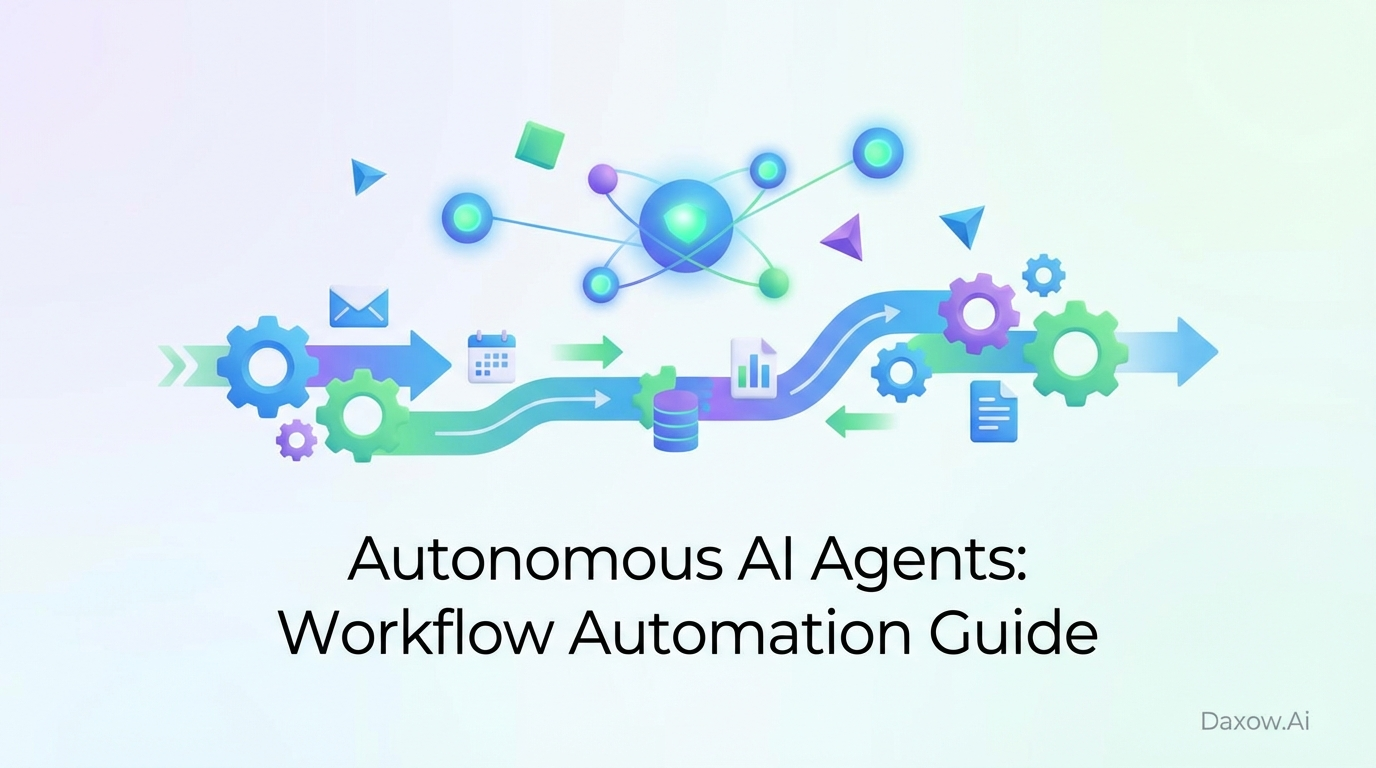
Practical guide to using autonomous AI agents to automate business workflows. Includes use cases, implementation roadmap, KPIs, governance, and Daxow.ai.
Autonomous AI Agents for Business Workflow Automation: A Practical Guide
Estimated reading time: 15 minutes
Key Takeaways
- Autonomous AI agents automate repetitive and multi-step business workflows, increasing efficiency.
- Successful deployments require careful integration, governance, and monitoring aligned with corporate policies.
- AI agents bring measurable business value: reducing manual tasks, boosting productivity, and improving customer experience.
- Industry use cases span e-commerce, finance, healthcare, real estate, HR, and tech support.
- Daxow.ai offers end-to-end AI automation services from process analysis to custom agent deployment.
Table of Contents
- Autonomous AI Agents for Business Workflow Automation — What the Research Shows
- How Autonomous AI Agents Work in Workflow Automation
- Business Benefits — Why Invest in AI Automation
- Use Cases — Practical Examples Across Industries
- Implementation Roadmap — From Discovery to Production
- Measuring ROI and Key Performance Indicators
- Governance, Security, and Compliance
- Common Challenges and How to Overcome Them
- How Daxow.ai Helps Build Autonomous AI Agents and End-to-End Automation
- Getting Started — Practical Next Steps
- Frequently Asked Questions
Autonomous AI Agents for Business Workflow Automation — What the Research Shows
Research and industry trends indicate the following practical realities:
- Growing adoption: Organizations of all sizes are piloting AI agents to handle repetitive, knowledge-based, and multi-step tasks that previously required human coordination.
- Clear business value: Early deployments deliver value through reduced manual tasks, faster cycle times, and improved consistency in customer-facing processes.
- Integration is critical: Successful systems combine AI agents with existing CRMs, ERPs, ticketing systems, document stores, and business applications.
- Risk and governance: Data privacy, model drift, and auditability are top concerns; responsible deployments include monitoring, human-in-the-loop controls, and access governance.
These findings point to a pragmatic approach: treat AI agents as software components that must be integrated, tested, monitored, and governed like any business system. Below we translate those insights into actionable steps and industry-specific use cases.
How Autonomous AI Agents Work in Workflow Automation
Types of AI Agents
- Task Agents: Execute specific tasks (e.g., extract invoice data, update customer records).
- Conversational Agents: Handle customer interactions through chat, voice, or email and escalate when needed.
- Orchestration Agents: Coordinate multiple systems and agents to complete multi-step workflows.
- Data Agents: Continuously ingest, clean, enrich, and sync data across systems.
Core Capabilities Required
- Natural language understanding for conversations and document processing.
- Structured data extraction for invoices, contracts, and forms.
- Integration connectors for CRMs, ticketing, payment gateways, ERPs, and databases.
- Workflow engines and triggers to orchestrate multi-step processes.
- Monitoring, logging, and human-in-the-loop escalation mechanisms.
Business Benefits — Why Invest in AI Automation
- Reduce manual tasks: Automate repetitive data entry, routing, and routine decision-making.
- Boost productivity: Free human workers to focus on high-value, creative, and relationship-driven tasks.
- Improve customer experience: Faster responses and consistent service through customer support automation.
- Lower operational costs: Lower processing times and fewer errors reduce overhead and rework.
- Scale with demand: AI agents can handle spikes in volume without proportional increases in staff.
Use Cases — Practical Examples Across Industries
E-commerce — Order Management and Customer Support
Problem: High volume of order inquiries, returns, and status checks overwhelm support teams.
AI Agent Solution:
- Conversational agents handle order status queries via chat and email.
- Orchestration agents trigger refunds, create RMA labels, and update inventory in the ERP.
- Data agents analyze return reasons and flag product issues for the operations team.
Expected Outcomes: Faster response times, reduced support headcount burden, and improved customer satisfaction.
Finance — Invoice Processing and Reconciliation
Problem: Manual invoice capture and approvals cause delays and payment errors.
AI Agent Solution:
- Document AI extracts invoice fields and validates line items.
- Workflow agents route invoices to approvers based on rules and historical behavior.
- Integration with accounting systems posts transactions and reconciles payments automatically.
Expected Outcomes: Reduced manual tasks, fewer late payments, and faster month-end close.
Healthcare — Patient Intake and Billing
Problem: Manual form processing and eligibility checks delay care and billing.
AI Agent Solution:
- Conversational agents pre-fill intake forms and collect missing data.
- Data agents verify insurance eligibility and pre-authorizations.
- Orchestration agents create claims and submit them to payers with audit logs.
Expected Outcomes: Improved throughput, reduced denials, and better patient experience.
Real Estate — Lead Qualification and Listing Management
Problem: Agents spend substantial time qualifying leads and managing listings across platforms.
AI Agent Solution:
- Lead qualification agents score inbound leads, enrich profiles, and schedule viewing appointments.
- Integration agents push listings to marketplaces, track performance, and adjust syndication rules.
Expected Outcomes: Higher conversion rates, reduced manual scheduling, and consistent listings.
HR and Administration — Candidate Screening and Onboarding
Problem: HR teams sift through many applicants and manage repetitive onboarding tasks.
AI Agent Solution:
- Screening agents parse resumes, score candidates against job requirements, and schedule interviews.
- Onboarding agents orchestrate account creation, compliance training, and document collection.
Expected Outcomes: Faster time-to-hire, improved candidate experience, and reduced administrative burden.
SaaS and Tech Support — Incident Triage and Resolution
Problem: Support teams are tied up with low-complexity tickets.
AI Agent Solution:
- AI agents categorize tickets, run diagnostic checks, apply known fixes, and escalate complex cases.
- Agents update the knowledge base with new resolutions.
Expected Outcomes: Lower mean time to resolution (MTTR) and higher customer satisfaction.
Implementation Roadmap — From Discovery to Production
1. Discovery & Process Analysis
- Identify high-volume, high-cost processes prone to manual tasks.
- Map workflows, handoffs, and data sources.
- Prioritize use cases by ROI, feasibility, and compliance.
2. Design & Proof of Value
- Define agent responsibilities, success metrics, and acceptance criteria.
- Build a rapid prototype for one end-to-end flow.
- Validate with stakeholders and measure early KPIs (time saved, error reduction).
3. Build & Integrate
- Develop AI models, extraction pipelines, and connectors for business systems (CRM, ERP, ticketing).
- Implement orchestration logic and human-in-the-loop points.
- Harden data pipelines with logging, versioning, and security controls.
4. Test & Deploy
- Run staged rollouts with shadow mode to compare agent decisions against human outcomes.
- Conduct compliance reviews and security testing.
- Deploy with monitoring dashboards and rollback capabilities.
5. Operate & Iterate
- Monitor performance and model drift.
- Gather feedback and update decision logic or models.
- Scale to other workflows and continuously optimize for ROI.
Measuring ROI and Key Performance Indicators
To quantify business value, track metrics aligned to your goals:
- Reduction in manual tasks: Percentage decrease in human-handled steps per process.
- Productivity: Time saved per task and reallocation of staff hours to strategic activities.
- Cost savings: Operational cost reduction from automation and reduced error rates.
- Customer metrics: NPS, CSAT, first response time, and resolution time improvements.
- Conversion metrics: Lead-to-opportunity and opportunity-to-deal conversion lift when automating sales functions.
Set baseline measurements before deployment, then run controlled pilots to measure incremental gains. Use these results to build a business case for broader rollouts.
Governance, Security, and Compliance
AI agents introduce unique governance considerations. Implement the following best practices:
- Access controls: Ensure least-privilege access for agents to business systems.
- Audit trails: Log all agent actions for forensic review and compliance reporting.
- Human-in-the-loop: Maintain escalation points for decisions that require human judgment.
- Data privacy: Apply anonymization and retention policies to meet regulatory requirements.
- Model governance: Monitor for bias, performance degradation, and unintended behavior.
Daxow.ai embeds governance and security into each solution design to align automation with corporate risk policies and regulatory standards.
Common Challenges and How to Overcome Them
- Integration complexity: Use a modular connector strategy to reduce coupling to legacy systems.
- Change management: Train staff, communicate benefits, and create new operating procedures.
- Data quality: Invest in data cleaning and validation before automation.
- Over-automation: Identify edge cases and preserve human oversight where necessary.
Daxow.ai mitigates these challenges through phased rollouts, robust integrations, and collaborative training programs.
How Daxow.ai Helps Build Autonomous AI Agents and End-to-End Automation
Daxow.ai provides tailored services to move your organization from manual workflows to full business automation:
- Process analysis: We map workflows and identify high-impact automation opportunities.
- Custom AI systems: We design and build AI agents that execute real tasks — from document extraction to multi-step orchestration.
- Workflow automation: We implement workflow engines and connectors that link agents to CRMs, ERPs, ticketing systems, and databases.
- Customer support automation: We deploy conversational agents and escalation logic that improve response times and reduce support costs.
- Sales automation: We create lead qualification agents and automated follow-up workflows to increase conversions.
- Data extraction and document automation: We transform unstructured documents into structured data usable across your systems.
- Integration & monitoring: We ensure secure integrations, logging, monitoring, and continuous improvement.
Daxow.ai delivers measurable outcomes: reduced operational costs, improved productivity, faster processing times, and demonstrable ROI. Learn more about our services and solutions.
Getting Started — Practical Next Steps
- Conduct a process analysis to identify automation candidates.
- Run a pilot for a single end-to-end use case with clear KPIs.
- Integrate agents with core business systems and implement governance.
- Scale successful pilots across lines of business.
Daxow.ai can support each step, from initial discovery to ongoing operations, ensuring your automation program delivers sustainable business value.
Frequently Asked Questions
What are autonomous AI agents?
Autonomous AI agents are software systems capable of independently performing complex, multi-step business tasks by integrating with various applications and using artificial intelligence techniques.
How do AI agents improve workflow automation?
They reduce manual, repetitive, and error-prone tasks by automating data extraction, decision-making, orchestration, and customer interactions, leading to faster and more consistent business processes.
What industries benefit most from autonomous AI agents?
E-commerce, finance, healthcare, real estate, HR, SaaS, and tech support industries have demonstrated significant gains with AI agents in this guide, though many other sectors can benefit as well.
How does Daxow.ai support AI automation projects?
Daxow.ai offers end-to-end services including process analysis, custom AI system design, integration, workflow automation, monitoring, and ongoing optimization to ensure successful deployment and ROI.