
How Autonomous AI Agents Transform Business Workflows
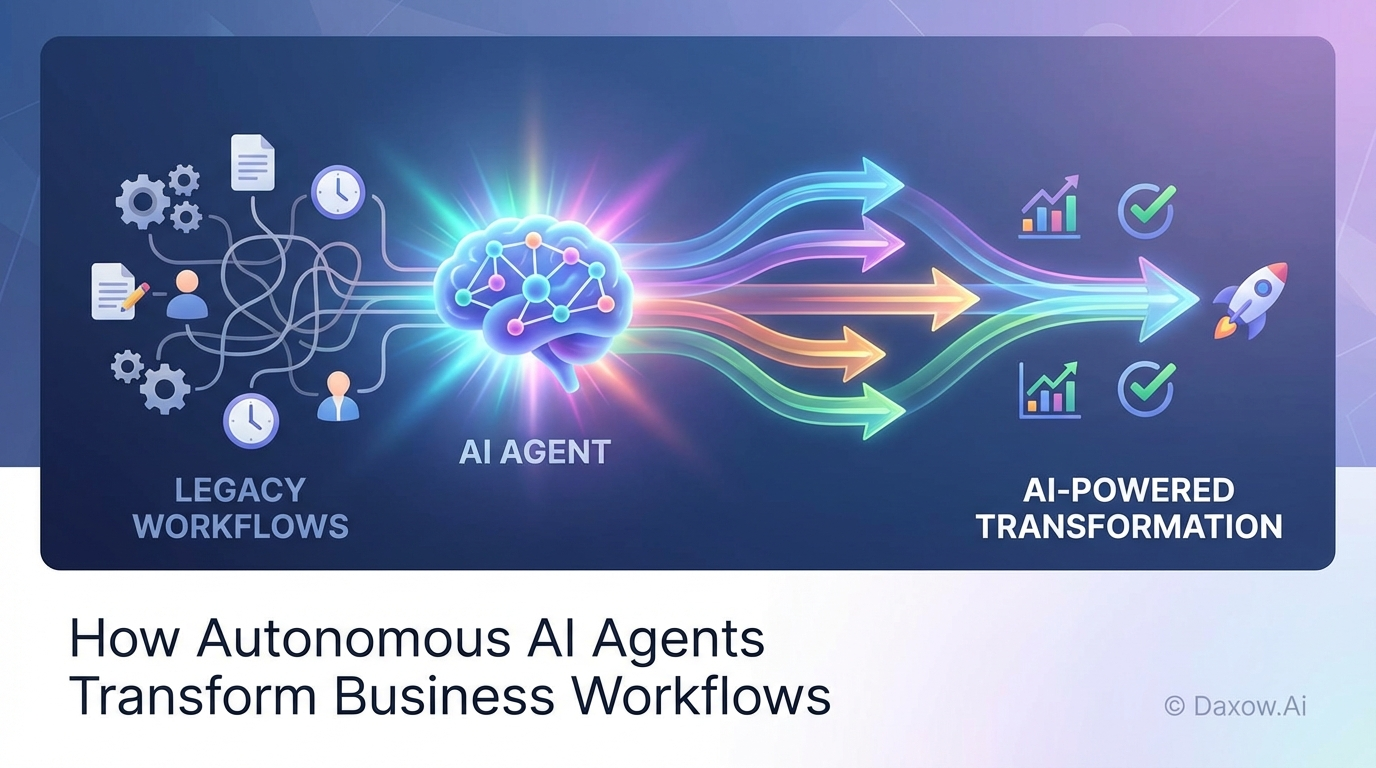
How autonomous AI agents automate workflows, boost productivity, cut costs, and scale operations - with practical guidance, use cases, and deployment steps.
AI agents and agentic AI: How Autonomous AI Agents Transform Business Workflows
Estimated reading time: 15 minutes
Key Takeaways
- AI agents autonomously perform tasks to automate workflows, scale operations, and improve decision-making.
- Agentic AI enables systems to operate without continuous human input, coordinating multiple tools and adapting dynamically.
- Businesses benefit from productivity gains, cost reductions, improved customer experience, and smarter workflows.
- Identifying high-impact workflows and prioritizing based on volume, repetitiveness, and customer impact is critical for success.
- Daxow.ai offers end-to-end support for designing, integrating, and managing AI agents tailored to organizational needs.
Table of Contents
- Introduction
- Why AI agents and agentic AI matter for business
- Recent research and trends
- Identifying high-impact areas for AI agents and agentic AI
- Practical architecture for AI agents
- Use Cases — How AI agents and agentic AI deliver value in multiple sectors
- Designing and implementing AI agents
- Operational considerations and governance
- Measuring ROI and business impact
- How Daxow.ai helps you adopt AI agents and agentic AI
- Getting started: practical next steps
- Conclusion and call to action
- Frequently Asked Questions
Introduction
The rise of AI agents and agentic AI is rapidly reshaping how businesses approach operational efficiency, customer service, and decision-making. In this article we explore the practical implications of adopting autonomous AI agents across organizations, outline research-backed benefits, and provide actionable guidance and industry use cases. Decision-makers reading this will come away with a clear understanding of how to evaluate, design, and deploy AI systems that deliver measurable business value — and how Daxow.ai can help you build and integrate those systems to achieve lasting productivity gains and cost reductions.
Why AI agents and agentic AI matter for business
AI agents are autonomous or semi-autonomous systems that can act on behalf of users or organizations to complete tasks, coordinate workflows, and make data-driven decisions. Agentic AI refers to the broader paradigm in which these agents work without continuous human direction, orchestrating multiple systems, invoking tools, and adapting to new information.
Key business benefits:
- Reduce manual tasks across departments by automating repetitive work.
- Increase productivity by enabling employees to focus on higher-value activities.
- Improve customer experience through faster, consistent, and contextual responses.
- Scale operations without linear increases in headcount.
- Enable smarter workflows by integrating data across systems and automating decisions.
Recent research and trends
Industry research and reports consistently indicate growing adoption of AI automation and agent-based systems. Organizations that implement workflow automation and AI agents report improvements in process cycle times, reduction in manual error rates, and higher customer satisfaction. Leading trends include:
- Growing appetite for AI automation that connects across CRMs, ERP systems, and bespoke databases.
- Shift from point solutions (single-task bots) to multi-capability AI agents that can execute end-to-end processes.
- Rising focus on observability, governance, and safety for agentic systems to ensure compliance and reliability.
- Strong ROI when AI agents are targeted at high-volume, repetitive workflows (e.g., invoice processing, lead qualification, support triage).
Identifying high-impact areas for AI agents and agentic AI
Start with a structured assessment that focuses on business value, operational risk, and implementation complexity.
Criteria for prioritization
- Volume: Tasks performed frequently where automation yields outsized time savings.
- Repetitiveness: Rules-based or semi-structured tasks that can be codified.
- Variability: Tasks with manageable variability that agents can learn from historical data.
- Integration needs: Tasks that require connecting multiple tools or data sources (CRMs, email, databases).
- Customer impact: Processes that affect response times, satisfaction, or conversion rates.
Common high-value candidates
- Customer support automation: Triage, resolution of routine queries, and escalation workflows.
- Sales automation: Lead qualification, meeting scheduling, opportunity scoring, and follow-up sequencing.
- Finance and accounting: Invoice extraction, matching, approvals, and reconciliation.
- HR and admin: Onboarding, document processing, and policy compliance checks.
- Operations and logistics: Inventory alerts, supplier coordination, and exception handling.
Practical architecture for AI agents
A robust agent architecture balances autonomy with control, integrates cleanly with existing systems, and provides monitoring, logging, and governance.
Core components
- Orchestration layer: Coordinates workflows and sequences of actions across tools.
- NLP/LLM capabilities: Understands language, extracts intent, and generates contextual responses.
- Tooling connectors: Prebuilt integrations with CRMs, ERPs, ticketing systems, email, and document storage.
- Decision logic: Rules, business logic, and learned models that guide agent behavior.
- Observability and safety: Logging, audit trails, human-in-the-loop controls, and rollback mechanisms.
- Security and compliance: Role-based access, data encryption, and policy enforcement.
Example workflow: Automated customer support agent
- Input: Incoming customer email/ticket.
- NLP analysis: Classify intent, extract entities, and identify sentiment.
- Knowledge retrieval: Query knowledge base and past tickets.
- Action plan: Generate response or execute an action (issue refund, open service ticket).
- Orchestration: Update CRM, notify relevant teams, and log the interaction.
- Escalation: Route to human agent if confidence threshold is low.
Use Cases — How AI agents and agentic AI deliver value in multiple sectors
E-commerce and retail
- Order exception handling: Agents detect failed payments, coordinate with payment gateways, update orders in ERP, and notify customers with next steps.
- Personalized upsell automation: Agents analyze browsing and purchase history, generate targeted offers, and automate email or chat outreach tied to CRM segments.
- Business impact: Shorter resolution times, higher average order value, and reduced manual intervention in returns processing.
Finance and accounting
- Invoice processing and reconciliation: Agents extract data from invoices using document automation, match against purchase orders, route discrepancies for approval, and post transactions to accounting systems.
- Compliance monitoring: Agents continuously scan transactions for anomalies and flag suspicious items to compliance teams.
- Business impact: Faster close cycles, lower processing costs, and reduced error rates.
Healthcare
- Patient intake automation: Agents pre-fill forms, extract insurance details from uploaded documents, and schedule follow-ups.
- Clinical documentation support: Agents summarize notes, suggest coding, and ensure records are complete before billing.
- Business impact: Reduced administrative burden on clinicians and faster billing cycles.
Real estate and property management
- Tenant onboarding: Agents verify documents, automate lease generation, schedule inspections, and set up billing.
- Maintenance coordination: Agents triage requests, assign vendors, and update tenants and property managers.
- Business impact: Faster turnaround on service requests and improved tenant satisfaction.
Logistics and supply chain
- Shipment exception management: Agents detect delays or discrepancies, re-route shipments, and notify customers and carriers.
- Procurement automation: Agents monitor inventory thresholds, generate purchase orders, and negotiate supplier terms when needed.
- Business impact: Fewer stockouts, optimized procurement cycles, and lower freight costs.
Sales and marketing
- Lead qualification: Agents engage inbound leads, ask qualifying questions, score leads, and schedule meetings with sales reps.
- Campaign orchestration: Agents coordinate multichannel campaigns, adapt messaging based on engagement, and report performance to marketers.
- Business impact: Higher lead-to-opportunity conversion and more efficient use of sales resources.
Designing and implementing AI agents
Implementing AI agents is a multi-step process. Use a phased approach to mitigate risk and maximize learning.
Phase 1 — Discovery and process mapping
- Map existing workflows and identify data sources.
- Quantify current costs, time spent, and error rates.
- Prioritize processes with the highest ROI potential.
Phase 2 — Proof of concept (PoC)
- Build a narrowly scoped agent for a single use case.
- Integrate with minimal systems to validate the model and orchestration.
- Measure KPIs: time saved, reduction in manual touches, accuracy, and user satisfaction.
Phase 3 — Scale and integrate
- Expand agent capabilities and integrate with enterprise systems.
- Implement robust connectors for CRMs, ERPs, ticketing, and cloud storage.
- Add governance, access controls, and monitoring dashboards.
Phase 4 — Continuous improvement
- Monitor agent performance and retrain models as needed.
- Collect user feedback and adjust decision logic.
- Measure long-term ROI and re-prioritize additional automation opportunities.
Operational considerations and governance
AI agents introduce new operational and regulatory considerations. Address these proactively.
Key governance practices
- Human-in-the-loop controls for approval of high-risk actions.
- Auditability: Maintain logs of agent decisions, inputs, and outputs.
- Access control: Limit what agents can read and act on within systems.
- Bias and fairness checks: Regularly evaluate decision models for unintended bias.
- Data privacy: Ensure compliance with data protection regulations and secure data handling.
Performance and monitoring
- Define service-level objectives (SLOs) for task completion and accuracy.
- Use dashboards to track agent throughput, error rates, and escalation frequency.
- Automate alerts for behavior that deviates from expected patterns.
Measuring ROI and business impact
Decision-makers need tangible metrics to assess investments. Use these KPIs:
- Time savings: Hours/month saved per role and across teams.
- Cost reduction: Full-time equivalent (FTE) reduction or reallocation.
- Error rate reduction: Decrease in processing or compliance errors.
- Customer metrics: Response time, resolution time, NPS, and retention.
- Revenue impact: Increased conversion rates, upsell rates, and lead-to-opportunity conversion.
Case example (illustrative)
- A mid-sized SaaS company automates lead qualification and customer onboarding with AI agents. Outcome after 6 months:
- 40% faster lead response times.
- 25% increase in qualified meetings booked.
- 30% reduction in onboarding time per customer.
- Net effect: Sales team focuses on higher-value deals and customer churn decreases.
How Daxow.ai helps you adopt AI agents and agentic AI
Daxow.ai partners with organizations to design, build, and operate AI agents that integrate with existing systems and deliver measurable outcomes.
Our approach
- Discovery & process analysis: We map your workflows, identify automation potential, and quantify ROI.
- Custom solution design: We design agent architectures tailored to your tech stack and compliance needs.
- End-to-end implementation: We build connectors, train models, and deploy orchestration layers.
- Integration with business tools: CRM, ERP, ticketing systems, document stores, and custom APIs.
- Operational support: Monitoring, retraining, governance, and continuous improvement.
What you get
- Faster time-to-value with targeted PoCs and scalable architectures.
- Reduced operational costs through automation that eliminates repetitive tasks.
- Improved productivity by allowing teams to focus on strategy and customer relationships.
- Reliable integrations that ensure data consistency across systems.
- Agents that execute real tasks, not just provide recommendations.
Getting started: practical next steps
- Conduct a process inventory and identify 3-5 candidate workflows.
- Estimate current cost and potential savings for each candidate.
- Select a low-risk, high-volume use case for a PoC.
- Prepare data sources and access for integration.
- Define success metrics and monitoring plan.
- Engage a partner (like Daxow.ai) to accelerate design, implementation, and governance.
Conclusion and call to action
AI agents and agentic AI are no longer theoretical — they are practical tools that deliver measurable improvements in productivity, cost efficiency, and customer experience. By prioritizing high-impact workflows, building secure and observable systems, and partnering with experienced implementers, businesses can realize substantial gains while maintaining control and compliance.
Book a free consultation with Daxow.ai to request a process analysis for your company and learn how custom AI automation and workflow automation can reduce manual tasks, improve customer support automation and sales automation, and drive measurable ROI. Contact us today to build a custom AI system tailored to your needs.
Frequently Asked Questions
What is the difference between AI agents and traditional automation?
AI agents operate autonomously and can adapt to changing conditions, while traditional automation typically follows fixed, pre-programmed rules without learning capabilities.
How can businesses ensure AI agents comply with regulations?
Implementing robust governance measures, including audit trails, human-in-the-loop approvals, access controls, and regular bias and fairness evaluations, helps maintain compliance.
What industries benefit most from AI agents?
Industries such as e-commerce, finance, healthcare, real estate, logistics, and sales & marketing see significant value through workflow automation and operational efficiencies enabled by AI agents.
How does Daxow.ai support AI agent implementation?
Daxow.ai offers end-to-end services from process analysis, custom agent design, integration, and deployment, to ongoing monitoring and continuous improvement to ensure successful adoption and ROI.