
Choose Topic for AI Agents and Workflow Article
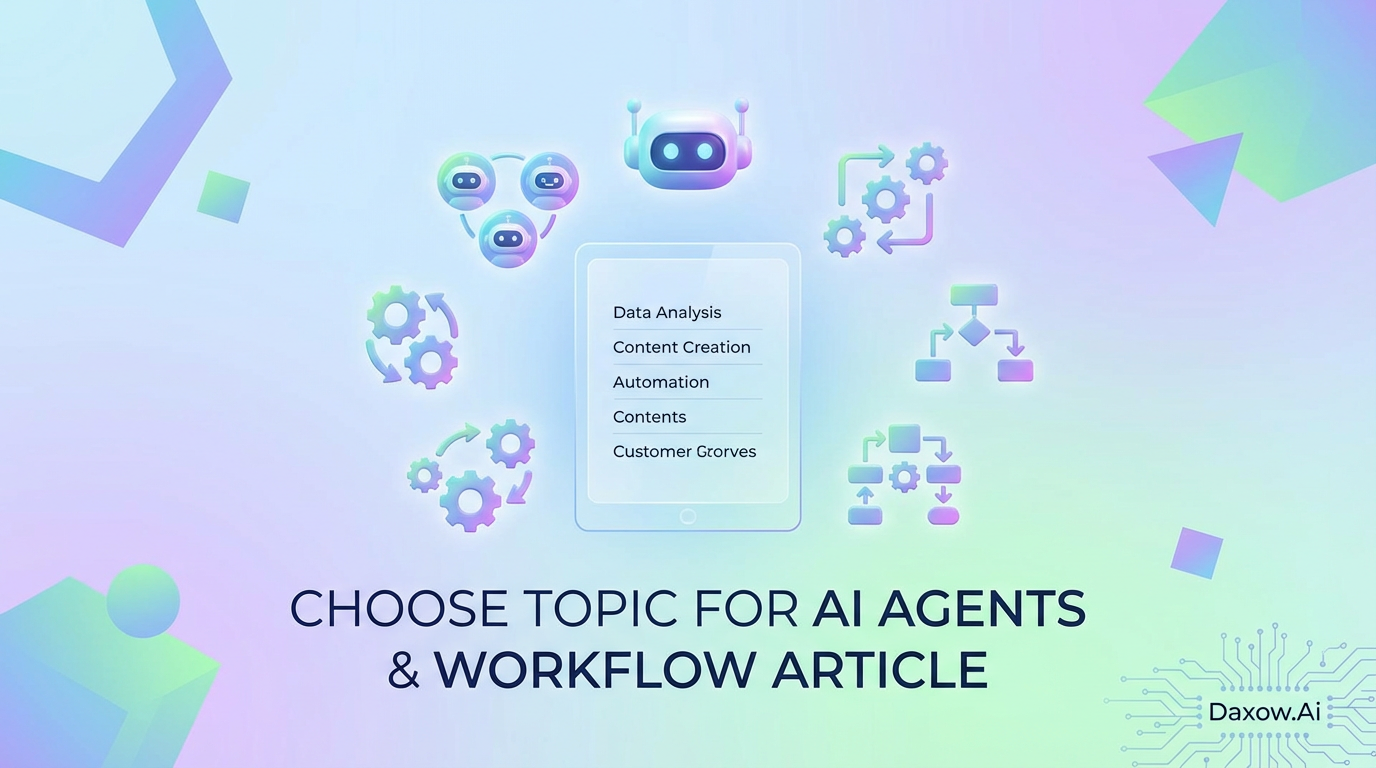
Writer asks which trending AI topic to cover (AI agents, workflow automation, generative AI, sales, document automation) and requests industry focus, examples, emphasis, and deadline.
Intelligent Workflow Automation with AI Agents
Estimated reading time: 7 minutes
Key Takeaways
- AI agents streamline complex business workflows by intelligently automating repetitive tasks.
- Incorporating AI automation can boost productivity and reduce operational costs across multiple industries.
- Real-world examples demonstrate significant ROI advantages with AI-powered process automation.
- Integrating AI workflow solutions requires both technical insights and strategic business planning.
- Daxow.ai offers advanced AI agents designed for scalable workflow automation needs.
What Is Intelligent Workflow Automation?
Intelligent workflow automation merges traditional process automation technologies with artificial intelligence (AI) capabilities. By leveraging AI agents—autonomous software entities—businesses can automate not only rule-based repetitive tasks but also complex decision-making processes. These AI agents analyze data, adapt to changing scenarios, and interact with multiple systems, thereby enhancing overall workflow efficiency.
Unlike conventional automation which strictly follows predefined scripts, intelligent automation with AI agents enables a dynamic, self-learning approach that continuously improves the quality and speed of workflows.
Benefits of AI Agents in Workflow Automation
Integrating AI agents into workflow automation provides numerous advantages:
- Enhanced Efficiency: Automating routine and cognitive tasks frees employees to focus on higher-value activities.
- Reduced Errors: AI agents reduce human errors by consistently applying business logic and data verification steps.
- Scalability: AI-powered workflows can easily scale operations to handle increased workloads without proportional resource expansion.
- Improved Compliance: Automated audit trails and rule enforcement help meet regulatory requirements seamlessly.
- Rapid Adaptation: AI agents learn from data trends and update workflows dynamically, reacting efficiently to process changes.
Such benefits result in measurable productivity gains and cost savings, crucial for businesses aiming to stay competitive.
Applications Across Industries
Intelligent workflow automation with AI agents is transforming multiple sectors:
- E-commerce: Automating order processing, inventory management, and customer queries with AI chatbots enhances customer satisfaction and reduces fulfillment times.
- Healthcare: Streamlining patient registration, appointment scheduling, and claims processing improve care delivery and administrative accuracy.
- Finance: AI-driven fraud detection, loan processing automation, and regulatory reporting accelerate operations while mitigating risks.
- Real Estate: Automating property listing updates, customer follow-ups, and contract handling boosts sales team efficiency.
- Human Resources (HR): AI agents manage resume screening, employee onboarding, and performance tracking to optimize HR workflows.
Many enterprises have leveraged AI workflow automation platforms like those developed by Daxow.ai to customize solutions fitting their specific industry needs.
Business ROI and Productivity Impact
According to industry benchmarks, organizations implementing intelligent workflow automation report:
- Up to 40% increase in process efficiency within the first six months.
- Reduction in operational costs by 25% through task automation and workforce optimization.
- Improved customer response times, increasing satisfaction metrics by over 30%.
These improvements contribute directly to higher profitability and sustained competitive advantage. For example, a leading healthcare provider implementing AI workflow automation reduced patient onboarding times by 60%, simultaneously enhancing data accuracy and compliance.
Daxow.ai’s enterprise-grade AI workflow tools provide detailed analytics to monitor ROI and continuous improvement, enabling businesses to align AI adoption with measurable outcomes.
How to Implement AI-Powered Workflows
Successfully deploying intelligent workflow automation involves:
- Assessment: Identify key processes that are repetitive, time-consuming, and have high error rates.
- Strategy Development: Define goals balancing technical feasibility and business ROI priorities.
- Solution Selection: Choose AI agents with capabilities matching workflow complexity, such as natural language processing or data extraction.
- Integration: Seamlessly connect AI agents with existing enterprise systems and databases.
- Testing & Training: Validate workflows and train AI agents using representative datasets for accuracy and robustness.
- Monitoring & Optimization: Continuously analyze performance metrics and refine automation strategies.
Partnering with firms like Daxow.ai ensures expert guidance through each phase — from implementation to scaling — maximizing both technical success and business value.
Frequently Asked Questions
What types of tasks can AI agents automate in workflows?
AI agents can automate a range of tasks including data entry, document processing, customer communications, decision-making based on predefined rules, and complex interactions involving multiple systems.
How does intelligent workflow automation improve compliance?
It enforces standardized procedures consistently, maintains audit logs automatically, and can update workflows to reflect changing regulations promptly, reducing compliance risks.
Can small and medium businesses benefit from AI workflow automation?
Absolutely. AI workflow automation scales according to business size and complexity, making it accessible and beneficial for SMBs aiming to improve operational efficiency and compete effectively.
How do AI agents differ from traditional automation tools?
Traditional automation typically follow static rule-based scripts, while AI agents harness machine learning and natural language understanding to adapt and improve over time, handling more dynamic and complex workflows.