
Choose an AI Blog Topic (Options & Default)
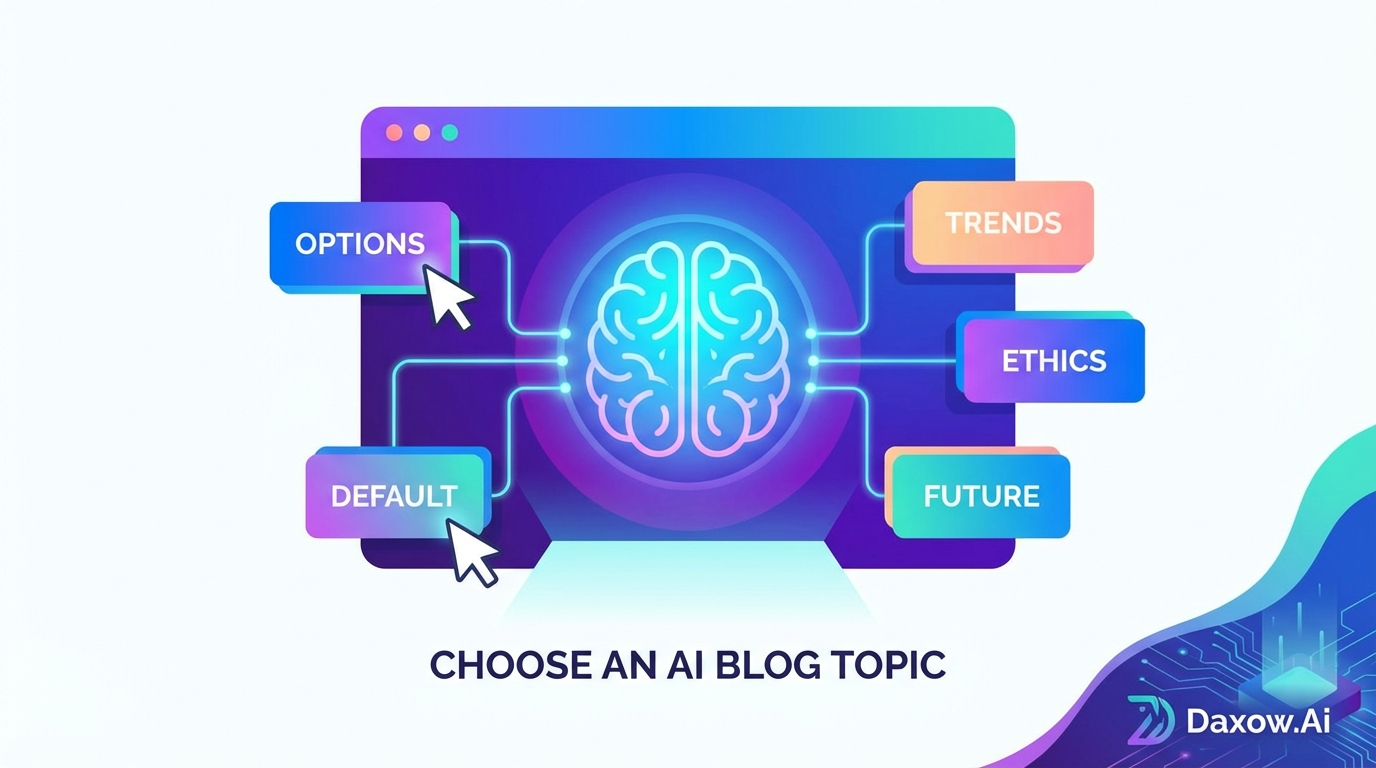
Prompt asking the user to select one of several AI blog topics or provide their own, plus any research, keywords, industry, or audience details.
AI Workflow Automation for Business Processes: Transforming Efficiency and Productivity
Estimated reading time: 7 minutes
Key Takeaways
- AI workflow automation streamlines repetitive tasks, reducing errors and operational costs.
- Integration with existing business systems accelerates digital transformation across industries.
- Enhanced decision-making through AI-driven process insights and predictive analytics.
- Scalable automation solutions support startups and enterprises alike.
- Daxow.ai provides versatile AI automation tools designed for complex business workflows.
Understanding AI Workflow Automation
AI workflow automation combines artificial intelligence with process automation technologies to streamline and optimize business workflows. Unlike traditional automation, which relies on pre-defined rules, AI-driven workflows adapt through machine learning, natural language processing, and predictive analytics to handle complex decision-making tasks autonomously.
This innovation enables businesses to automate routine activities such as data entry, approval routing, customer interactions, and reporting with greater accuracy and speed. By integrating AI into business processes, organizations can reduce manual interventions, accelerate timelines, and improve overall operational agility.
Benefits of AI in Business Processes
AI workflow automation brings numerous advantages, including:
- Increased Efficiency: Automating repetitive tasks frees employees to focus on higher-value work.
- Error Reduction: AI systems reduce human errors by processing tasks consistently and accurately.
- Cost Savings: Lower operational costs result from decreased manual labor and reduced process delays.
- Improved Compliance: Automated workflows ensure adherence to regulations and audit trails.
- Enhanced Decision-Making: AI provides real-time insights and predictive analytics to guide business strategies.
These benefits make AI workflow automation a critical component for businesses competing in fast-paced markets today.
Key Industries Adopting AI Workflow Automation
Several industries are leveraging AI workflow automation to transform their operations:
- Finance: Automating invoice processing, fraud detection, and KYC compliance using AI-driven workflows.
- Healthcare: Streamlining patient data management, appointment scheduling, and claims processing.
- E-commerce: Optimizing order fulfillment, inventory tracking, and customer support automation.
- Manufacturing: Enhancing supply chain coordination and predictive maintenance with AI insights.
- Real Estate: Automating contract management, lead qualification, and customer interactions.
Solutions offered by platforms like Daxow.ai’s AI Workflow Automation cater to these industries, providing customized integration to existing systems and scalable deployment.
Best Practices for Implementing AI Automation
Successful AI workflow automation requires careful planning and execution. Key best practices include:
- Identify Suitable Processes: Start with repetitive, rule-based tasks that can benefit most from automation.
- Ensure Data Quality: Clean, structured data is essential for effective AI model performance and reliable outcomes.
- Integrate Seamlessly: Leverage APIs and connectors to integrate AI automation with existing enterprise software.
- Monitor and Optimize: Continuously assess automation results to refine workflows and AI models.
- Address Change Management: Engage employees early to facilitate adoption and reskilling initiatives.
Partnering with technology providers such as Daxow.ai ensures access to expertise and support during implementation.
Future Trends in AI Workflow Automation
AI workflow automation will evolve dramatically, driven by advancements such as:
- Increased Use of Generative AI: Automating content creation, customer communication, and report generation.
- Hyperautomation: Combining RPA, AI, and analytics to fully automate end-to-end business processes.
- Enhanced Personalization: AI workflows adapting dynamically to user preferences and behaviors.
- Edge AI: Deploying AI automation closer to data sources for faster processing in IoT scenarios.
Organizations embracing these trends will gain a competitive edge by enabling smarter, faster, and more scalable operations with tools like those offered by Daxow.ai’s advanced AI automation platform.
Frequently Asked Questions
What is the difference between AI workflow automation and traditional automation?
Traditional automation follows fixed rules and scripts, while AI workflow automation uses machine learning and AI to adapt, learn, and make decisions autonomously within workflows.
Which business processes are best suited for AI workflow automation?
Processes that are repetitive, rule-based, data-intensive, or require decision-making based on patterns—such as invoicing, customer service, compliance checks, and data entry—are ideal candidates.
Can startups benefit from AI workflow automation?
Yes, startups can leverage AI automation to scale efficiently, reduce operational costs, and accelerate time-to-market, gaining agility that supports rapid growth.
How does Daxow.ai support AI workflow automation?
Daxow.ai offers an advanced AI automation platform that integrates seamlessly with enterprise systems, providing customizable solutions for automating complex business workflows with AI-driven intelligence.