
Choose a topic for your AI automation article
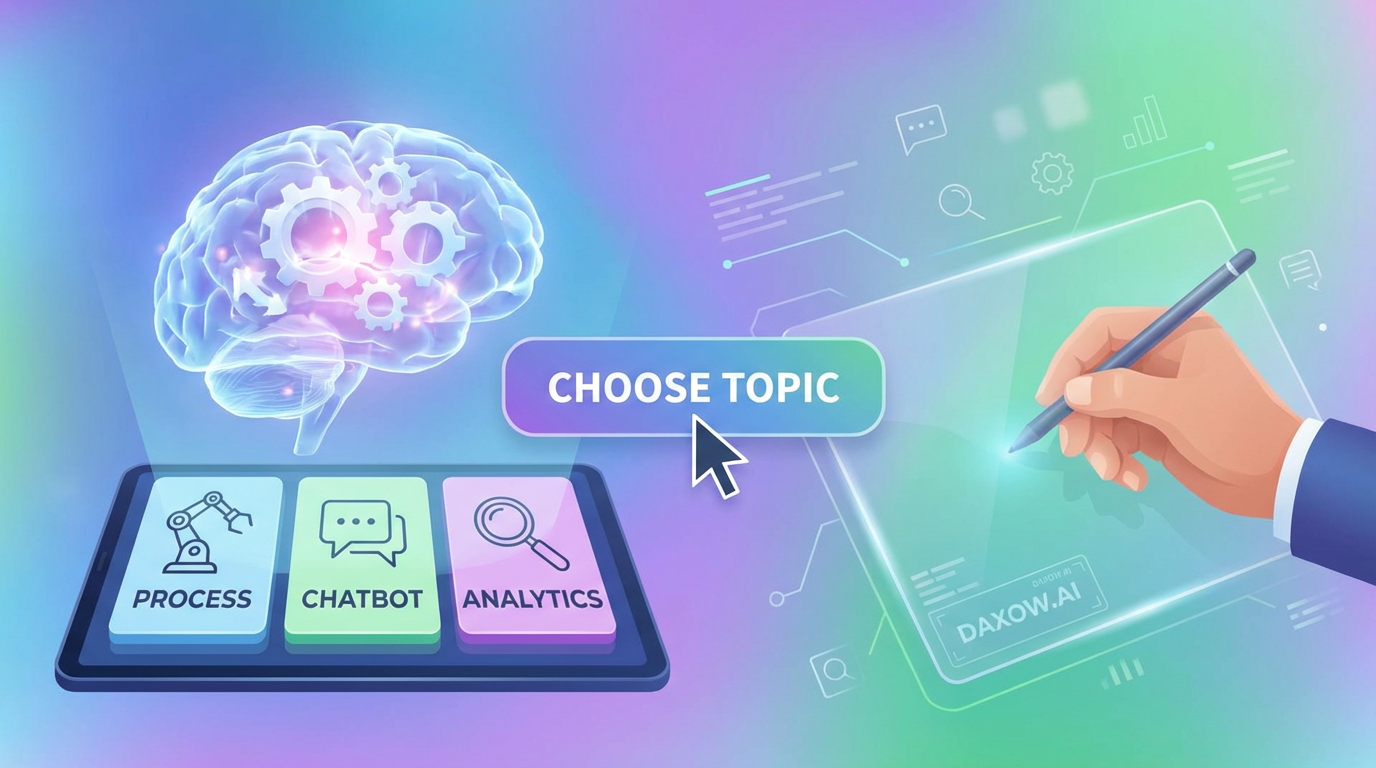
Select one of the AI automation topics (or provide your own) and share preferences for a 1500–2000 word SEO article with specific use cases.
AI Agents for Business Workflows: Revolutionizing Efficiency Across Industries
Estimated reading time: 8 minutes
Key Takeaways
- AI agents enhance business workflows by automating repetitive and complex tasks.
- Industries like finance, healthcare, and e-commerce benefit greatly from AI-driven efficiency.
- Implementing AI agents can reduce operating costs and improve decision-making speed.
- Daxow.ai offers tailored AI solutions to streamline business processes and maximize ROI.
Introduction to AI Agents for Business Workflows
Artificial Intelligence (AI) agents are transforming the way businesses operate by automating workflows that were once manual, time-consuming, and prone to error. These intelligent agents use machine learning, natural language processing, and process automation to handle complex tasks, interact with various systems, and make data-driven decisions. Particularly for startups, SMBs, and enterprises in industries like finance, healthcare, and e-commerce, AI agents represent a vital step toward increased efficiency, agility, and competitive advantage.
From scheduling and customer service to compliance management and data processing, AI agents are integrated in various workflows, boosting productivity and allowing human employees to focus on higher-level strategic activities. This article explores how AI agents reshape business workflows across sectors and offers insights on successful implementation.
Benefits of AI Agents in Business
The adoption of AI agents revolutionizes business workflows by delivering multiple compelling benefits:
- Increased Operational Efficiency: AI agents automate routine tasks like data entry, verification, and report generation, reducing turnaround times and minimizing human error.
- Cost Reduction: By automating labor-intensive processes, companies can lower operational costs and reallocate resources toward innovation and growth.
- Enhanced Decision-Making: Leveraging predictive analytics, AI agents provide actionable insights, enabling informed decisions and proactive risk management.
- Scalability: AI agents scale easily to meet fluctuating demand across departments, supporting business expansion without proportional increases in workforce size.
- Improved Customer Experience: Intelligent automation of customer inquiries, personalization, and service workflows leads to higher satisfaction and retention rates.
Industry Use Cases
AI agents have made significant impacts across diverse industries by customizing workflow automation to industry-specific challenges.
- Finance: AI agents streamline fraud detection, automate transaction processing, monitor compliance requirements, and assist in customer onboarding with natural language chatbots.
- Healthcare: Intelligent automation supports patient scheduling, medical record management, claims processing, and clinical decision support, improving care delivery and reducing administrative burdens.
- E-Commerce: AI agents optimize inventory management, personalize marketing campaigns, handle customer service chat interactions, and forecast demand using advanced analytics.
- Real Estate: Automated agents manage property listings, qualify leads, schedule showings, and assist with contract management, enhancing the sales cycle's efficiency.
These examples illustrate how AI agents can be tailored to address unique workflow requirements, driving value and operational excellence.
Effective Implementation Strategies
Successful deployment of AI agents within business workflows requires a thoughtful approach. Key strategies include:
- Assessment of Workflow Bottlenecks: Identify processes where AI agents can deliver the most immediate efficiency gains.
- Data Readiness: Ensure quality and accessibility of data, as AI agents rely heavily on data inputs for learning and decision-making.
- Incremental Integration: Start with pilot programs on specific workflows to validate ROI before scaling AI agent deployments enterprise-wide.
- Cross-Functional Collaboration: Involve stakeholders from IT, operations, and business units to align AI agent objectives with business goals.
- Continuous Monitoring and Optimization: Use performance metrics to refine AI agent algorithms and workflows for sustained improvement.
Following these strategies maximizes the benefits of AI agents while minimizing disruption and risk during transformation.
How Daxow.ai Supports AI Agent Deployment
Daxow.ai specializes in designing and implementing AI agents that integrate seamlessly with existing business workflows. Whether you operate a startup, an SMB, or a large enterprise, Daxow.ai’s tailored solutions help you automate complex processes while ensuring compliance and security.
By partnering with Daxow.ai, businesses in finance, healthcare, and e-commerce can leverage:
- Custom AI agent development for niche workflows and use cases.
- Intelligent document processing to automate data extraction and verification.
- Integration with enterprise systems for end-to-end workflow automation.
- Ongoing support and optimization services to maximize AI impact.
Explore our solutions page to learn how Daxow.ai can elevate your business with AI agents. For a detailed consultation, visit our contact page to connect with an expert today.
Frequently Asked Questions
What are AI agents, and how do they differ from traditional automation tools?
AI agents go beyond simple rule-based automation by using machine learning, natural language processing, and adaptive algorithms to handle complex, dynamic tasks that require decision-making and contextual understanding.
Which industries benefit most from AI agents?
While AI agents provide value across all industries, finance, healthcare, e-commerce, and real estate have demonstrated significant benefits in workflow automation, compliance, customer engagement, and predictive analytics.
How does Daxow.ai assist in AI agent implementation?
Daxow.ai offers end-to-end AI agent development, integration with existing systems, custom workflow design, and ongoing optimization to ensure AI agents deliver maximum efficiency and business impact.