
Choose Topic for AI Automation Article
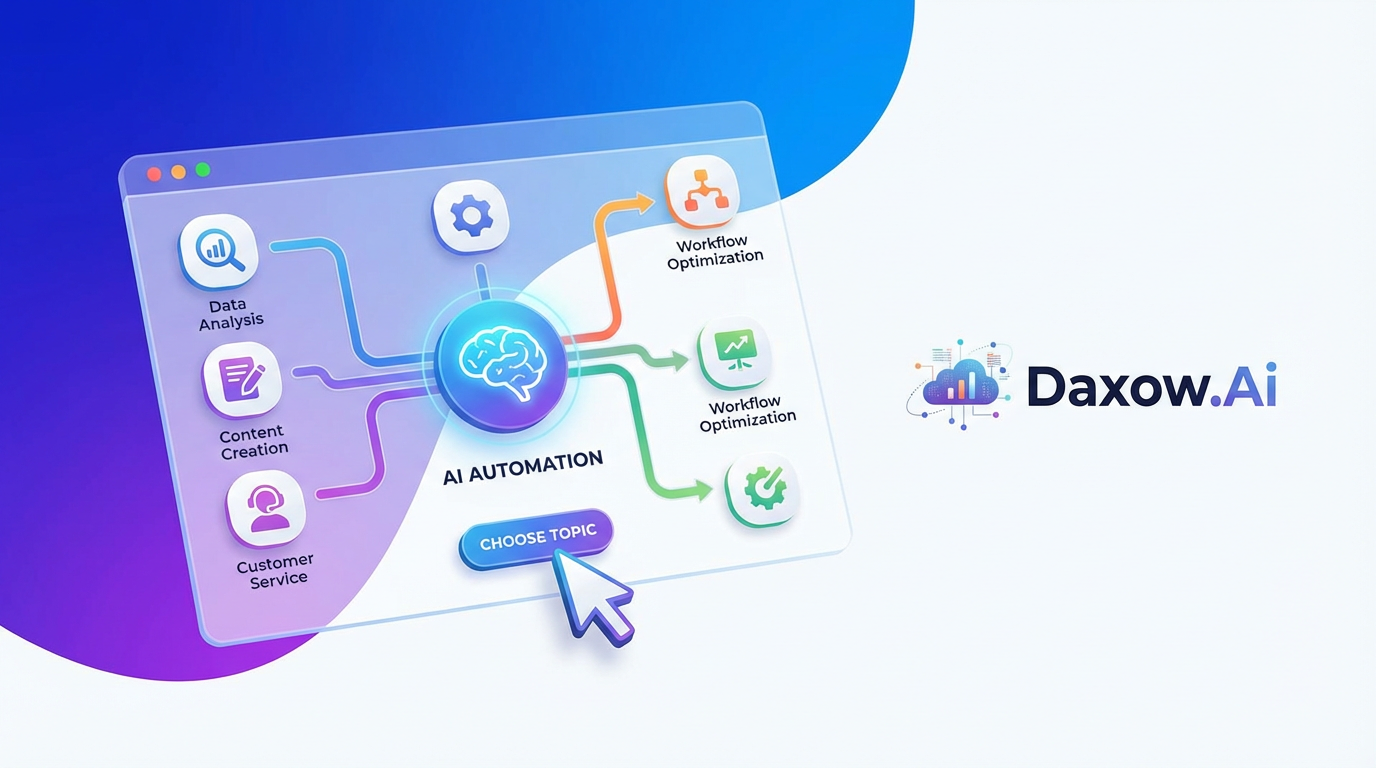
Pick one of the suggested AI automation topics (or provide your own), supply research, industries, links, and a deadline for a 1,500–2,000 word article.
How AI Agents Are Transforming Workflow Automation in 2026
Estimated reading time: 9 minutes
Key Takeaways
- AI agents accelerate workflow automation by intelligently managing repetitive tasks.
- Integrating AI automation drives significant productivity gains across finance, healthcare, and e-commerce.
- Workflow automation powered by AI reduces manual errors and frees employees to focus on strategic initiatives.
- Customer support and sales automation are among the fastest-growing use cases for AI agents in 2026.
- Implementing AI agents requires a clear strategy, quality data inputs, and scalable integration platforms like Daxow.ai.
Introduction to AI Agents
In 2026, AI agents have emerged as groundbreaking tools reshaping how businesses approach workflow automation. Unlike traditional automation workflows that follow rigid, pre-defined rules, AI agents use advanced machine learning, natural language processing, and decision-making algorithms to autonomously perform and adapt complex tasks. These intelligent agents simulate human-like initiatives to analyze data, make decisions, and act on behalf of users or organizations.
The rise of AI automation powered by AI agents is drastically reducing manual tasks and enabling enterprises to achieve unprecedented productivity. Business automation is no longer limited to simple task scheduling — it now encompasses dynamic, context-aware action orchestration that transforms entire operational workflows.
Impact on Workflow Automation
Workflow automation is evolving beyond static process management toward intelligent orchestration. AI agents continuously monitor workflows, identify bottlenecks, predict potential failures, and trigger automatic corrective measures. This dynamic responsiveness drastically reduces downtime and manual intervention requirements.
By leveraging AI agents, organizations reduce manual tasks that were traditionally time-consuming and error-prone, resulting in accelerated turnaround times and cost savings. These agents enable scalable automation that can learn and optimize over time, ensuring workflows remain efficient as business conditions change.
Moreover, AI agents play a crucial role in customer support automation and sales automation by autonomously handling routine inquiries, qualifying leads, and scheduling follow-ups, freeing human teams to focus on high-value interactions.
Industry Use Cases
Finance: AI agents automate transaction processing, fraud detection, and regulatory compliance workflows. By reducing manual oversight and errors, finance teams improve accuracy while accelerating reporting and customer onboarding.
Healthcare: AI automation supports patient data extraction, appointment scheduling, and billing workflows. Intelligent agents improve patient experiences by streamlining administrative tasks and enabling faster decision-making for care coordination.
E-Commerce: Businesses implement AI agents for inventory management, customer support automation, and personalized marketing workflows. This integration boosts sales productivity and enhances the customer journey by delivering timely responses and offers.
Daxow.ai offers industry-tailored platforms that facilitate building and deploying AI agents to transform such workflows seamlessly. Explore our solutions page for detailed capabilities.
Implementation Strategies
To harness the full potential of AI agents in workflow automation, organizations should adopt a thoughtful approach:
- Assess Current Processes: Identify repetitive manual tasks most suitable for automation and evaluate existing workflow inefficiencies.
- Define Clear Objectives: Set measurable goals such as reduced processing time, increased task accuracy, or improved customer satisfaction.
- Data Quality and Integration: Ensure systems provide clean, accessible data feeds to power AI agent decisions effectively.
- Choose Scalable Platforms: Adopt flexible AI automation platforms like Daxow.ai that integrate with existing enterprise systems and support continuous optimization.
- Train and Monitor AI Agents: Gradually roll out automation with human oversight, refining agent behaviors based on performance insights.
Implementing a structured AI automation strategy enables enterprises to maximize ROI and unlock sustainable productivity gains.
Overcoming Challenges
While AI agents present tremendous opportunities, businesses must navigate challenges such as:
- Data Privacy and Security: Protecting sensitive information requires robust governance when AI agents access workflows.
- Change Management: Training staff and managing cultural shifts towards trust in AI automation is critical.
- Complex Workflows: Some processes may require hybrid human-AI collaboration rather than full automation.
- Technical Integration: Ensuring compatibility with legacy systems demands careful planning and iterative testing.
Effective partnerships and platforms that provide comprehensive support, like Daxow.ai’s consulting services, facilitate smoother adoption.
Future Trends in AI Agents
Looking ahead, AI agents will become more autonomous and context-aware, enabling end-to-end business automation from data extraction to decision execution. Advances in natural language understanding will expand AI agents’ abilities to collaborate directly with employees in natural workflow environments.
Additionally, the integration of AI automation with IoT and edge computing promises faster real-time responses in industries like manufacturing and logistics. As these technologies mature, workflow automation will evolve into a seamless, intelligent backbone of enterprise operations.
Companies that invest early in AI automation positioned around adaptable agents will lead the marketplace by maximizing efficiency, reducing cost, and improving overall customer experience.
Frequently Asked Questions
What are AI agents in the context of workflow automation?
AI agents are autonomous software entities that perform tasks within workflows by using machine learning and decision-making algorithms, enabling dynamic and intelligent automation beyond static rule-based systems.
How do AI agents increase productivity?
AI agents reduce manual tasks, minimize errors, and optimize processes by continuously learning and adapting workflows, allowing employees to focus on more strategic and creative work.
Which industries benefit most from AI-powered workflow automation?
Industries like finance, healthcare, and e-commerce have seen significant benefits due to the high volume of repetitive tasks and regulatory requirements that AI agents can efficiently manage.
How can businesses start implementing AI automation?
Start by evaluating existing workflows to identify automation opportunities, set clear goals, ensure data readiness, select scalable platforms such as Daxow.ai, and execute a phased deployment with ongoing monitoring.