
Automate Customer Service with AI Agents
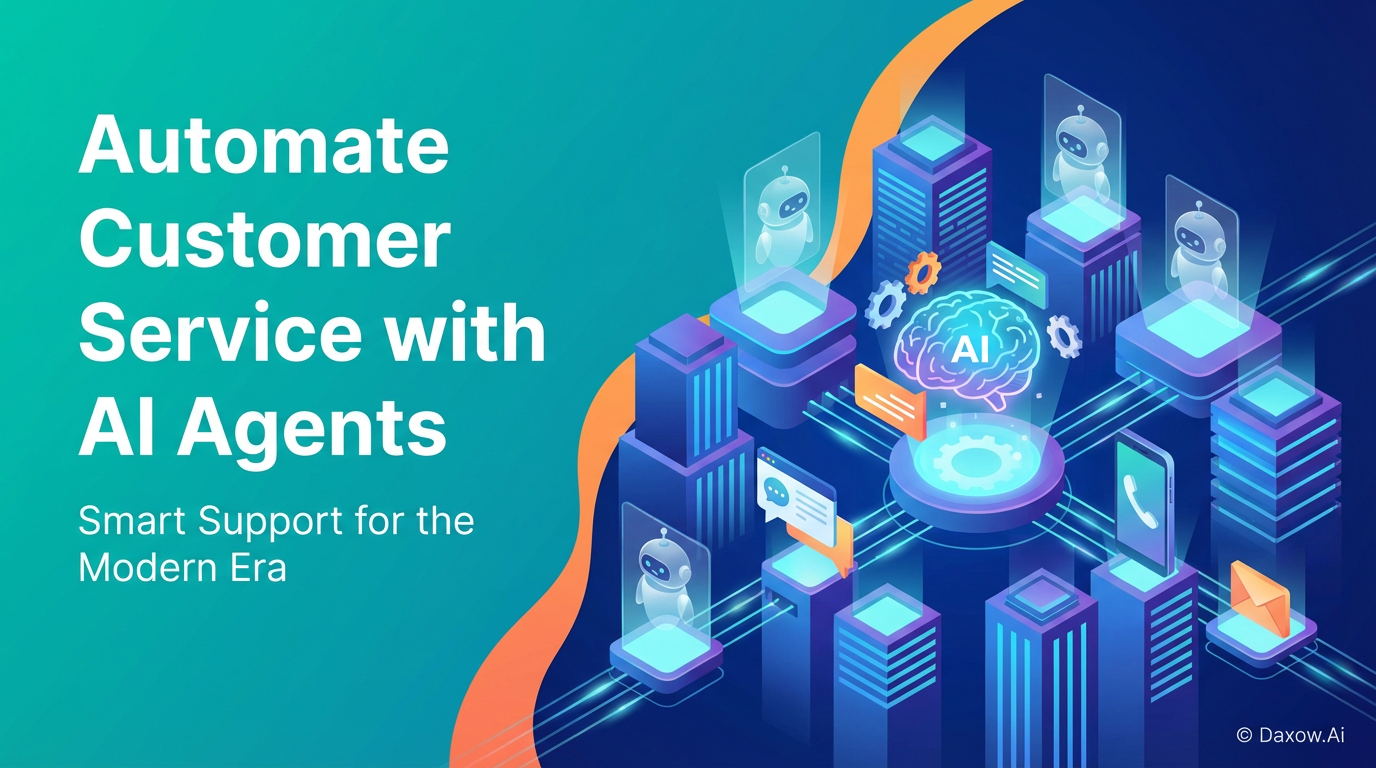
AI agents and workflow automation reduce manual customer service tasks, cut costs, and boost CSAT—includes use cases, KPIs, ROI examples, and a Daxow.ai roadmap.
Customer Service Automation with AI Agents: How Businesses Can Reduce Manual Tasks and Boost Productivity
Estimated reading time: 15 minutes
Key Takeaways
- AI agents reduce repetitive manual work, improving efficiency and lowering costs.
- Automation enhances customer experience through faster response times and 24/7 availability.
- Industry-specific use cases demonstrate significant productivity gains and operational savings.
- A practical 5-phase implementation roadmap ensures successful AI service automation deployment.
- Daxow.ai offers custom AI agent design, workflow automation, and system integration with ROI focus.
Table of Contents
- Introduction
- Customer Service Automation with AI Agents: Research Highlights
- Key Metrics to Watch
- How Customer Service Automation with AI Agents Works
- Use Cases Across Industries
- Implementation Roadmap: From Discovery to Scale
- Measuring ROI and KPIs
- Risks, Compliance, and Best Practices
- Why Daxow.ai for Customer Service Automation with AI Agents
- Conclusion and Call to Action
- Frequently Asked Questions
Introduction
Customer service automation with AI agents is transforming how organizations manage support, sales inquiries, and post-sale engagement. For decision-makers focused on business automation, AI automation delivers measurable reductions in manual tasks, faster response times, and improved customer experience. This article explains the research-backed case for automating customer service, illustrates actionable use cases across industries, and provides a practical implementation roadmap — all framed around how Daxow.ai designs, builds, and deploys custom AI agents and workflow automation to deliver results.
Customer Service Automation with AI Agents: Research Highlights
Recent industry research and operational case studies show consistent business value from AI-driven customer support. The most reliable findings fall into three categories: efficiency gains, cost reduction, and experience improvement.
- Efficiency gains: Organizations that implement AI agents and workflow automation see substantial reductions in repetitive manual work. AI agents can autonomously handle routine queries, freeing human agents to focus on higher-value, complex issues.
- Cost reduction: Companies report meaningful declines in cost per contact when combining AI agents with integrated workflows and ticket routing. Automation of repetitive tasks and self-service options lowers operational expenses and reduces agent staffing pressure.
- Experience improvement: Faster first response times and 24/7 availability improve customer satisfaction and retention. AI-driven triage and context-aware responses reduce resolution times and increase SLA adherence.
Key Metrics to Watch
- Average handle time (AHT) — expected to decrease with automation.
- First response time — typically improves with AI-powered routing.
- Contact deflection rate — percentage of issues resolved without human intervention.
- Cost per contact — direct operational savings after automation.
- Customer satisfaction (CSAT) and Net Promoter Score (NPS) — indicators of experience impact.
How Customer Service Automation with AI Agents Works
Core components
- AI agents: Conversational models and task-oriented agents that understand intent, extract data, and take actions.
- Workflow automation: Triggered processes that move tasks between systems, update records, and execute business logic.
- Integrations: Connectors to CRMs, ticketing systems, billing, inventory, and databases ensure context and actionability.
- Data layer: Clean, centralized customer data and logging for auditability and continuous improvement.
- Monitoring and escalation: Human-in-the-loop flows and dashboards to handle exceptions and measure performance.
Typical agent behaviors
- Triage & routing: Determine issue type and route to the correct team or workflow.
- Self-service resolution: Provide knowledge-based answers, account info, and basic transactions.
- Assisted automation: Perform tasks (e.g., refunds, password resets) after verification.
- Proactive outreach: Notify customers about renewals, delays, or policy changes.
Use Cases Across Industries
E-commerce — Order support and returns
Problem: High volume of order status and return requests inundating agents.
Solution: AI agents handle order tracking queries, initiate returns, generate labels, and update the CRM. Workflow automation processes refunds or exchanges, triggers inventory adjustments, and notifies logistics.
Business impact:
- Reduced manual handling of routine inquiries.
- Faster refunds and higher CSAT.
- Lower cost per return processed.
Finance — Account support and fraud triage
Problem: Financial institutions need secure, compliant, and fast support for account queries and potential fraud.
Solution: AI agents authenticate users, answer balance and transaction questions, flag suspicious activity, and open fraud investigations. Automated workflows enforce compliance checks and create secure case files.
Business impact:
- Faster fraud response and reduced manual triage time.
- Reduced risk via standardized workflows.
- Efficiency gains for relationship managers.
Healthcare — Patient triage and administrative tasks
Problem: Clinics and hospitals face heavy administrative load on scheduling and patient inquiries.
Solution: AI agents provide appointment scheduling, pre-visit instructions, insurance verification, and basic triage for symptoms. Integration with EHR systems updates records and routes clinical concerns to nurses or physicians.
Business impact:
- Reduced administrative burden and patient wait times.
- Better resource utilization and fewer missed appointments.
- Improved patient experience and adherence.
Real estate — Lead qualification and property inquiries
Problem: Agents spend time qualifying low-intent leads and answering repetitive property questions.
Solution: AI agents qualify leads, schedule viewings, answer property-specific queries, and update CRM lead stages. Automation triggers follow-up sequences for high-intent leads.
Business impact:
- Higher conversion from lead-to-visit.
- Improved agent productivity and faster response to hot leads.
- Reduced manual follow-up tasks.
SaaS — Technical support and onboarding
Problem: High-volume onboarding and common technical issues consume support engineers.
Solution: AI agents guide new users through onboarding steps, troubleshoot common issues, escalate complex problems with contextual logs, and automate license changes.
Business impact:
- Faster onboarding and fewer support tickets.
- Engineers spend time on complex bugs and product improvements.
- Increased product adoption and retention.
HR and internal support — Employee service desk
Problem: HR teams handle repetitive requests for policy information, leave requests, and onboarding.
Solution: AI agents answer policy FAQs, automate leave approvals through workflows, and gather new-hire documents. Integrations update HR systems automatically.
Business impact:
- Lower HR administrative overhead.
- Faster employee responses and improved internal satisfaction.
- More consistent policy enforcement.
Implementation Roadmap: From Discovery to Scale
Phase 1 — Discovery and process analysis
- Map current workflows and identify high-frequency, high-effort tasks.
- Measure baseline KPIs: volume, AHT, resolution times, and cost per contact.
- Daxow.ai role: Conduct process analysis and quantify automation opportunities.
Phase 2 — Design and solution architecture
- Define agent personas, decision trees, and escalation points.
- Design integrations: CRM, ticketing, billing, EHR, or ERP systems.
- Establish data requirements and privacy controls.
- Daxow.ai role: Design custom AI agents and workflow blueprints tailored to your systems.
Phase 3 — Build and integrate
- Develop conversational models, retrieval systems (knowledge base), and automation scripts.
- Implement connectors to business systems and ensure secure authentication.
- Create monitoring, logging, and metrics pipelines.
- Daxow.ai role: Build, test, and deploy agents; implement end-to-end automation.
Phase 4 — Pilot and iterate
- Run a controlled pilot with a segment of traffic.
- Monitor performance, collect human feedback, and refine responses.
- Add fallback and human-in-the-loop handling for edge cases.
- Daxow.ai role: Optimize models, refine workflows, and implement continuous improvement.
Phase 5 — Scale, govern, and measure
- Roll out across channels and regions.
- Establish governance: model validation, compliance checks, and access controls.
- Track KPIs and map savings to ROI.
- Daxow.ai role: Provide ongoing maintenance, model retraining, and performance reporting.
Measuring ROI and KPIs
Quantifying value is essential for executive buy-in. Use these practical metrics and formulas:
- Contact deflection rate = (Self-service resolved contacts) / (Total contacts)
- Cost savings = (Average cost per contact * Number of deflected contacts) - Implementation & ongoing costs
- Productivity improvement = (Time saved per agent per week * #agents) / Total labor hours
- Customer impact = Change in CSAT and first response time
Example: If your average cost per contact is $5 and automation deflects 2,000 contacts per month, monthly savings are $10,000 before implementation costs. Measuring these figures over time provides a clear ROI trajectory.
Risks, Compliance, and Best Practices
- Data privacy and security: Enforce encryption, role-based access, and compliance with relevant regulations.
- Human oversight: Always include escalation paths and human-in-the-loop review for sensitive or complex cases.
- Transparency: Maintain audit logs and clear explanations for automated decisions when required by policy.
- Continuous monitoring: Track model drift, error rates, and customer feedback to ensure quality.
- Change management: Train staff on new workflows and define handoff processes.
Why Daxow.ai for Customer Service Automation with AI Agents
Daxow.ai helps organizations move from concept to production with a pragmatic, ROI-driven approach.
- End-to-end service design: From discovery and process analysis to deployment and optimization.
- Custom AI agents: Built to execute real tasks — not just chat — with connectors to your CRM, ticketing, and core systems.
- Workflow automation: Automation that orchestrates multi-step processes and enforces business rules.
- Systems integration: Secure connectors and APIs to ensure data consistency and actionability.
- Cost and ROI focus: We measure automation benefits and align deliverables to reduce operational costs and improve productivity.
- Industry experience: Solutions tailored for finance, healthcare, e-commerce, real estate, SaaS, and internal enterprise services.
Learn more about our custom AI agents and automation solutions on the Daxow.ai Services page.
Conclusion and Call to Action
Customer service automation with AI agents is no longer optional for organizations that want to reduce manual tasks and improve productivity. When implemented correctly, AI agents and workflow automation reduce operational costs, improve customer experience, and free human teams to work on high-value activities.
If you want to understand how AI automation can help your organization, book a free consultation with Daxow.ai. Request a process analysis for your company or contact us to build a custom AI system that automates customer service, integrates with your stack, and delivers measurable ROI.
Frequently Asked Questions
What are AI agents in customer service automation?
AI agents are conversational or task-oriented models that understand customer intent, extract data, and perform support actions autonomously or with minimal human intervention.
How does automation reduce costs in customer service?
Automation reduces costs by deflecting routine queries through AI self-service, lowering average handle times, and minimizing the need for staffing high volumes of manual tasks.
Can AI handle complex customer issues?
AI agents typically handle routine and structured tasks, while assisted automation and human-in-the-loop processes take over complex or sensitive issues to ensure quality and compliance.
How does Daxow.ai ensure data privacy and compliance?
Daxow.ai enforces encryption, role-based access controls, and compliance with regulations relevant to each industry, along with maintaining audit logs and transparent automation processes.