
Unlock Business Transformation with AI Agents & Automation
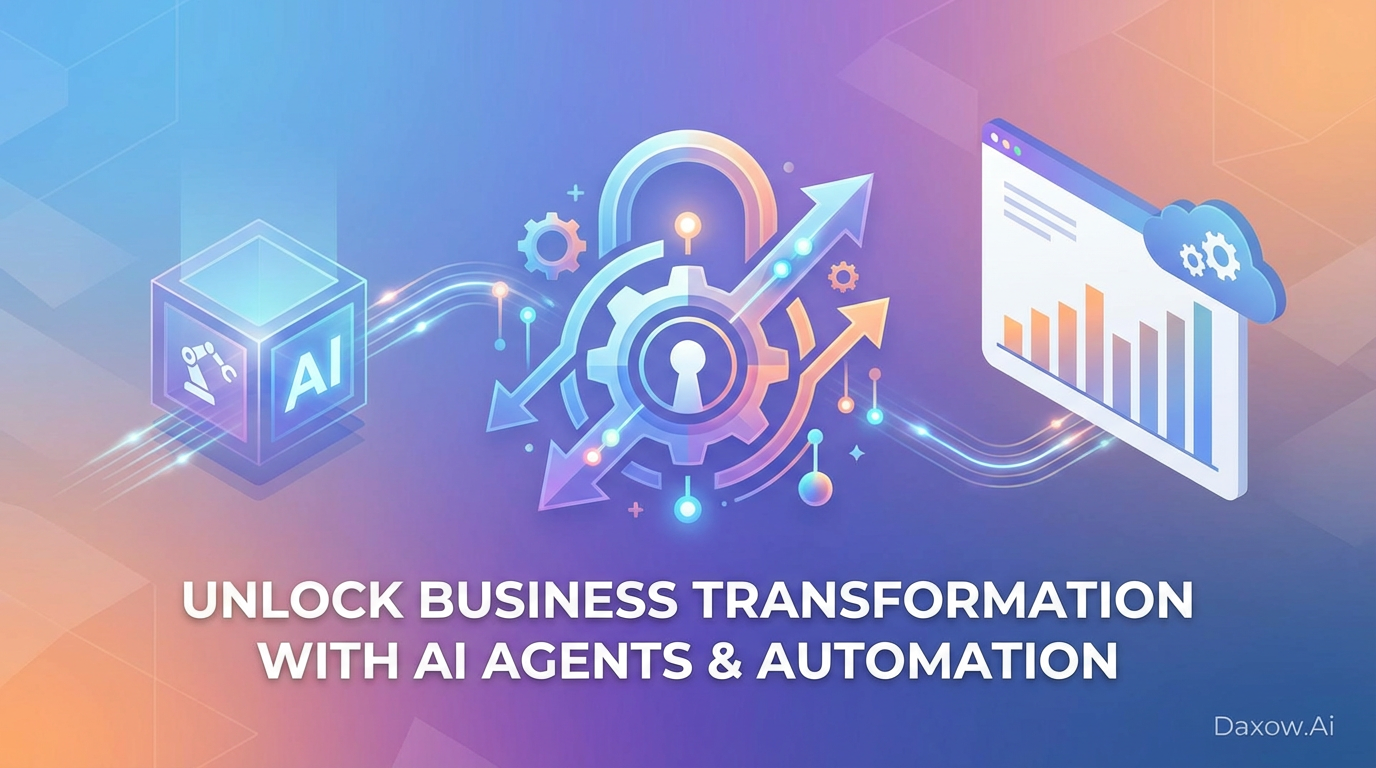
How Daxow.ai implements AI agents and workflow automation to reduce costs, speed processes, and deliver measurable ROI across industries.
Unlocking Business Transformation: Implementing AI Agents and Automation for Competitive Advantage
Estimated reading time: 12 minutes
Key Takeaways
- Implementing AI agents and automation shifts businesses to proactive, data-driven operations, improving speed, accuracy, and customer experience.
- Significant productivity gains include reducing manual tasks by up to 70% and cutting recruitment time by up to 40% across industries.
- AI agents apply natural language processing, predictive models, and orchestration for end-to-end autonomous execution combined with human oversight.
- Successful deployment requires clear goals, quality data, cross-functional teams, compliance focus, and iterative testing and optimization.
- Daxow.ai offers tailored AI agent design, workflow automation, integrations, and monitoring to deliver measurable ROI and business growth.
Table of Contents
- Unlocking Business Transformation: Implementing AI Agents and Automation for Competitive Advantage
- What AI Agents and Automation Mean for Businesses
- Practical Use Cases Across Industries
- How AI Agents and Automation Drive Business Success
- Implementation Steps and Best Practices
- Measuring ROI and Business Value
- How Daxow.ai Delivers End-to-End AI Automation
- Practical Next Steps for Decision-Makers
- Frequently Asked Questions
Unlocking Business Transformation: Implementing AI Agents and Automation for Competitive Advantage
Businesses integrating AI agents and automation see improvements in speed, accuracy, and customer experience. AI agents are autonomous systems that execute tasks, make decisions, and optimize workflows using machine learning, natural language processing, and generative AI. When combined with workflow automation, these systems free teams from repetitive work and enable them to focus on strategic, revenue-driving activities.
Key outcomes organizations can expect:
- Reduced manual tasks across departments by automating routine workflows.
- Increased productivity with 2–3x improvements in certain processes.
- Faster decision-making through automated insights and predictive analytics.
- Improved customer experience via 24/7 support and faster resolution times.
- Tangible cost savings, often with 30–50% reductions in targeted processes.
What AI Agents and Automation Mean for Businesses
Defining the capabilities
AI agents and automation combine multiple technologies to perform work traditionally done by humans:
- Natural language understanding to read and respond to customers and documents.
- Document and data extraction to pull structured data from invoices, contracts, and forms.
- Predictive models to forecast demand, detect fraud, or prioritize leads.
- Orchestration engines to route tasks between systems and people.
Business value at a glance
- Scale without linear headcount growth: Automation handles volume, enabling teams to manage larger workloads without proportional increases in staff.
- Higher accuracy and fewer errors: Machine-based processing reduces human mistakes in data entry and reconciliation.
- Faster throughput: Automated approval paths and instant data processing accelerates cycle times.
- Actionable insights: Automatically generated summaries and alerts allow managers to act earlier.
Practical Use Cases Across Industries
E-commerce
Use case:
An AI agent triages incoming customer messages, answers routine questions, and drafts personalized responses for complex cases. Integrated with the CRM and order system, it updates order status and triggers returns or refunds automatically.
Impact:
- Automates up to 70% of support tickets, reducing response times and improving conversion rates through faster issue resolution.
- Personalized product recommendations and review summary insights increase AOV and reduce churn.
Healthcare
Use case:
Automated extraction of patient data from referral letters, lab reports, and insurance forms. An AI agent triages patient inquiries and flags high-priority cases for clinicians.
Impact:
- Reduces administrative burden, accelerates diagnostics, and helps ensure supply chains for critical medical supplies are pre-emptively restocked through predictive alerts.
Finance
Use case:
AI-powered reconciliation of invoices, automated detection of anomalous transactions for fraud surveillance, and automated lead qualification for wealth-management prospects.
Impact:
- Lower error rates in reconciliation, quicker detection of suspicious activity, and a streamlined sales funnel that increases qualified leads per month.
Real Estate
Use case:
Agents analyze listing data and local market indicators to identify undervalued properties, generate listing descriptions, and qualify buyers from web leads.
Impact:
- Faster deal cycles, improved lead-to-close ratios, and better market positioning through data-driven pricing and targeted outreach.
HR and Recruitment
Use case:
Automated resume screening, candidate shortlisting, and onboarding task orchestration. AI agents summarize candidate feedback from interviews for hiring managers.
Impact:
- Cuts recruitment time by up to 40%, reduces bias through standardized screening, and speeds new-hire productivity with automated onboarding workflows.
Customer Support and Sales Automation
Use case:
Conversational AI handles tier-1 support while escalation rules route complex issues to human agents. Sales automation scores leads and schedules follow-ups automatically.
Impact:
- Improves NPS and conversion rates, reduces average handle time, and increases sales productivity through better lead prioritization.
How AI Agents and Automation Drive Business Success
Autonomous execution and human-AI collaboration
AI agents can execute end-to-end processes — for example, from invoice ingestion to payment reconciliation — without continuous human intervention. For complex or exception cases, automated handoffs to humans maintain oversight while minimizing intervention. This hybrid model maximizes efficiency while maintaining control.
Integration and orchestration
Real business value comes from connecting AI agents to the systems that hold and move data: CRMs, ERPs, ticketing systems, and productivity platforms. Integrations enable:
- Automated record updates in CRM after a support interaction.
- Triggered downstream processes once an AI agent completes a task.
- Centralized dashboards that monitor SLAs and agent performance.
Predictive and prescriptive insights
AI agents not only act on current data but also predict future states (supply shortages, churn risk, fraud likelihood) and recommend actions — allowing leaders to make proactive decisions.
Implementation Steps and Best Practices
1. Define clear goals and identify high-impact processes
- Start with measurable objectives (e.g., 20% reduction in processing costs, decrease in ticket backlog by 40%).
- Prioritize processes that are high-volume, rule-based, or manually repetitive for quick wins.
2. Assess data quality and select appropriate tools
- Audit data for completeness and cleanliness.
- Choose platforms with strong API support and scalable architectures.
- Ensure compliance with privacy and industry regulations.
3. Build a cross-functional implementation team
- Include domain experts, data scientists, ML engineers, product managers, and operational stakeholders.
- Establish governance to prevent shadow AI and to ensure consistent standards.
4. Test, deploy, and iterate
- Use validation datasets and define KPIs (precision, recall, processing time).
- Deploy pilot projects with tight monitoring and feedback loops.
- Plan for automated retraining and continuous improvement.
5. Prioritize scalability, compliance, and change management
- Design integrations with legacy systems in mind.
- Implement audit trails and logging from day one.
- Train staff and communicate benefits to ensure adoption.
Best-practice mitigations for common challenges
- Data issues: Standardize formats and implement ETL pipelines early.
- Integration hurdles: Select tools known for flexible connectors.
- Team resistance: Provide training and clear performance metrics.
- Model drift: Automate monitoring and retraining schedules.
Measuring ROI and Business Value
Quantifying impact
- Short-term pilots often yield ROI within 6–12 months for high-impact workflows.
- Typical improvements:
- 30–60% reductions in process time
- Error rates under 5% in automated tasks
- Cost reductions of 30–50% in targeted processes
KPIs to track
- Process cycle time and throughput.
- Accuracy and error rates.
- Cost per transaction or ticket.
- Lead conversion rates and sales cycle lengths.
- Employee satisfaction and time reclaimed from manual tasks.
Long-term strategic value
- Scalable capacity to support growth.
- Competitive advantages such as real-time fraud detection or supply chain foresight.
- Better customer retention via consistent, fast service.
How Daxow.ai Delivers End-to-End AI Automation
Discovery and process analysis
- We map current workflows, identify bottlenecks, and quantify opportunity in line with your KPIs.
- Outcome: A prioritized roadmap of automation opportunities with projected ROI.
Custom AI agents and workflow automation
- We build AI agents tailored to your use cases: customer support automation, sales automation, document automation, and more.
- We design the orchestration layer that integrates agents with CRMs, ERPs, and other business systems to ensure seamless end-to-end automation.
Integrations and data connectivity
- We connect AI solutions to your existing tech stack, including CRMs and project management tools, ensuring data integrity and real-time updates across systems.
Implementation, monitoring, and optimization
- We deploy pilots, measure outcomes, and scale successful automations.
- We implement monitoring dashboards, automated retraining pipelines, and governance for compliance and performance.
Business outcomes we deliver
- Reduced operational costs and lower error rates.
- Increased productivity through the elimination of repetitive tasks.
- Improved customer experience via faster response times and consistent support.
- Measurable ROI with clear KPIs and timelines for scaling.
Practical Next Steps for Decision-Makers
- Identify 2–3 high-volume processes for a pilot.
- Define success metrics and ownership.
- Allocate a cross-functional team for a 6–12 week pilot.
- Use pilot results to build a scalable automation roadmap.
Unlocking business transformation through AI agents and automation is achievable with a clear strategy, the right data practices, and experienced implementation partners. Daxow.ai specializes in turning process inefficiencies into automated, scalable systems that reduce manual tasks, increase productivity, and deliver measurable ROI.
Frequently Asked Questions
What are AI agents and how do they differ from traditional automation?
AI agents are autonomous systems that leverage machine learning and natural language processing to perform complex tasks and make decisions, unlike traditional automation which typically follows fixed rules without learning or adapting.
How can businesses ensure data quality before implementing AI automation?
Businesses should audit their data for completeness, accuracy, and consistency, standardize formats, implement ETL pipelines, and ensure compliance with privacy and industry regulations before deploying AI automation.
What industries benefit most from AI agents and automation?
Industries like e-commerce, healthcare, finance, real estate, HR, and customer support see significant productivity gains and cost savings by implementing AI agents and automation.
How does Daxow.ai support AI automation deployment?
Daxow.ai offers end-to-end services including discovery, custom AI agent design, workflow automation, system integration, monitoring, and ongoing optimization to help clients realize measurable ROI.