
Reduce Manual Tasks with AI Agents & Workflow Automation
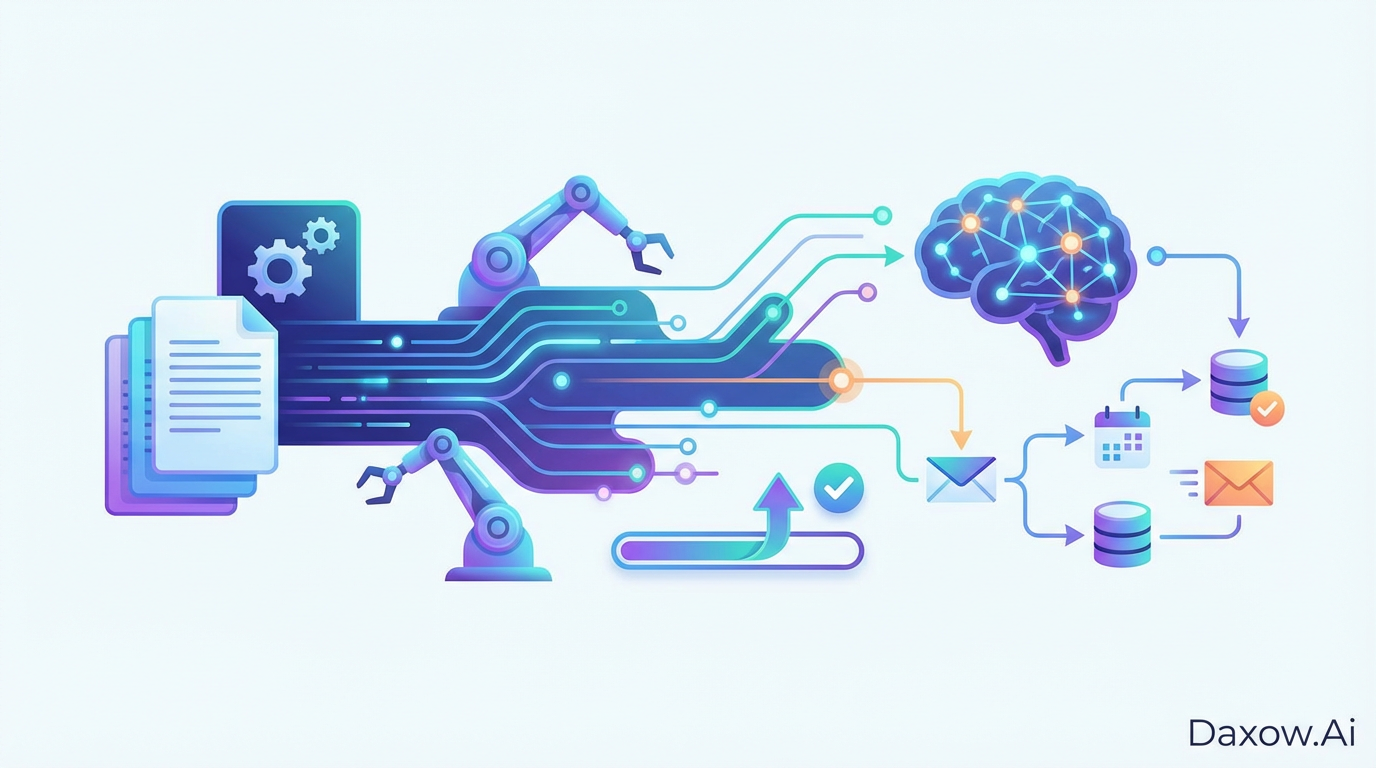
Learn how AI agents and workflow automation reduce manual tasks, boost productivity, and deliver measurable ROI with practical use cases and a Daxow.ai playbook.
AI Agents and Workflow Automation: How to Reduce Manual Tasks and Boost Productivity
Estimated reading time: 15 minutes
Key Takeaways
- AI agents combined with workflow automation can automate 20–40% of routine administrative tasks.
- Integrating AI agents boosts productivity, reduces errors, and improves customer satisfaction.
- Daxow.ai offers end-to-end custom AI automation solutions including data pipelines, integrations, and orchestration.
- Industries such as e-commerce, finance, healthcare, real estate, HR, and sales benefit significantly from AI automation.
- Successful implementation requires process prioritization, prototype validation, integration, scaling, and governance.
- Measuring ROI involves tracking saved hours, cost reductions, and customer and business metrics.
Table of Contents
- AI Agents and Workflow Automation: Business Case and Research Insights
- Key Components of Effective AI Automation Systems
- Use Cases and Practical Examples Across Industries
- Implementation Roadmap: From Process Discovery to Production
- Measuring ROI and Operational Impact
- Common Challenges and Mitigation Strategies
- How Daxow.ai Delivers End-to-End AI Automation
- Conclusion and Next Steps
- Frequently Asked Questions
AI Agents and Workflow Automation: Business Case and Research Insights
What the market shows
- Industry research and practitioner reports consistently find that organizations can automate a significant portion of routine work. Conservative estimates suggest 20–40% of administrative and transactional tasks are highly automatable today with combined AI and automation technologies.
- Companies that integrate AI agents into workflows report improvements in key operational metrics: faster response times, higher throughput, fewer errors, and improved customer satisfaction.
- Early adopters accelerate time-to-value by combining workflow automation platforms with task-specific AI agents rather than attempting to replace entire legacy systems in one jump.
Why AI agents are different from traditional automation
- Traditional RPA follows rigid, rule-based scripts. AI agents combine language understanding, decision-making, and integration capabilities to handle unstructured data, ambiguous inputs, and multi-step processes.
- AI agents enable dynamic orchestration: they can gather context, call APIs, extract data from documents, trigger follow-up tasks, and escalate to humans when needed.
- This shift extends automation from repetitive tasks to complex, end-to-end processes (for example, onboarding new customers, processing claims, or qualifying leads).
Business benefits (what decision-makers care about)
- Reduce manual tasks: reallocate staff from repetitive entry to exception handling and strategy.
- Boost productivity: automate case routing, document processing, and triage to shorten cycle times.
- Lower operational costs: reduce average cost per transaction and scale without linear headcount growth.
- Improve customer experience: faster answers, 24/7 availability, and consistent interactions.
- Increase accuracy and compliance: standardized workflows with audit trails and model governance.
Key Components of Effective AI Automation Systems
Data and document layer
Clean, accessible data is foundational. AI agents rely on structured inputs plus robust document extraction (OCR, NLP) for invoices, claims, contracts, and emails. Daxow.ai helps standardize data pipelines, set up secure storage, and implement extraction models tuned to your document types.
Integration and connectivity
Real business value comes from connecting AI to ERPs, CRMs, databases, ticketing systems, and communication channels. Business automation requires reliable connectors and middleware to execute actions (e.g., update a CRM record, create a support ticket). Daxow.ai builds custom integrations and uses enterprise-grade connectors to ensure data flows seamlessly between systems.
Orchestration and workflow engine
Orchestration coordinates multi-step processes, branching logic, retries, and human handoffs. A workflow engine enforces SLAs and maintains audit logs for compliance. Daxow.ai designs orchestration layers tailored to client SLAs and KPIs, enabling agents to execute tasks end-to-end.
AI agents and models
Agents combine specialized models: NLU for intent detection, RAG (retrieval-augmented generation) for knowledge work, classification models for triage, and decision models for next-step actions. Agents should be designed with human-in-the-loop capabilities for validation and continuous learning. Daxow.ai develops, fine-tunes, and deploys agents that execute real tasks — not just prototypes.
Monitoring, governance, and security
Production monitoring tracks performance, drift, and error rates. Governance enforces access control and model explainability. Build guardrails to prevent hallucinations and to maintain compliance with industry regulations. Daxow.ai implements monitoring dashboards, alerting, and governance frameworks.
Use Cases and Practical Examples Across Industries
E-commerce: Order exceptions and customer support automation
Use case: AI agent continuously monitors orders, identifies exceptions (inventory mismatch, failed payments), and resolves them by updating systems or routing to human agents.
Benefits:
- Reduce manual tasks for operations teams.
- Faster resolution reduces churn and increases conversion.
How Daxow.ai helps: Integrates e-commerce platforms, payment processors, and ERPs. Trains agents for customer intent detection and automated resolution steps.
Finance: Intelligent document processing and KYC automation
Use case: End-to-end automation of onboarding and KYC workflows: extract data from IDs, proofs of address, and financial documents; perform risk checks; create audit-ready records.
Benefits:
- Significant reduction in onboarding time and manual review hours.
- Improved compliance with consistent, auditable processes.
How Daxow.ai helps: Builds document extraction pipelines and secure integrations to compliance systems. Implements human-in-the-loop review for high-risk cases.
Healthcare: Prior authorizations and claims processing
Use case: AI agents extract clinical and billing data from referrals and claims, validate information, submit pre-authorizations, and follow up on denials.
Benefits:
- Reduced administrative burden on clinicians and billing staff.
- Faster approval cycles and improved revenue capture.
How Daxow.ai helps: Creates HIPAA-compliant automation pipelines and integrates with EHRs. Automates common denial reasons with predictive triage to reduce rework.
Real estate: Lead qualification and property onboarding
Use case: Agents handle inbound leads, qualify prospects with custom questionnaires, schedule viewings, and populate listing details from uploaded documents and photos.
Benefits:
- Faster lead response increases show-up rates and conversions.
- Reduced manual listing data entry frees up agents to sell.
How Daxow.ai helps: Deploys conversational AI for lead triage and integrates scheduling and CRM systems.
HR and administration: Candidate screening and onboarding
Use case: AI agents screen resumes, run pre-screen questionnaires, schedule interviews, and populate HRIS fields during onboarding.
Benefits:
- Shorter time-to-hire and less administrative overhead.
- More consistent evaluation across candidates.
How Daxow.ai helps: Aligns automation with company hiring policies and HR systems. Ensures candidate data privacy and auditability.
Sales automation: Lead enrichment and opportunity routing
Use case: Agents enrich inbound leads with firmographic and intent data, prioritize by fit, and route high-value leads to sales reps with suggested next steps.
Benefits:
- Higher qualified lead flow and better rep productivity.
- Increased win rates through timely engagement.
How Daxow.ai helps: Builds lead qualification logic and integrates with CRMs for automated work assignment.
Implementation Roadmap: From Process Discovery to Production
Phase 1 — Process discovery and prioritization
- Map current processes and quantify pain points: manual hours, error rates, cycle times.
- Identify high-impact, low-complexity processes as quick wins.
- Daxow.ai conducts a process analysis to identify automation candidates and expected ROI.
Phase 2 — Prototype and validation
- Build a minimal viable agent for a single use case.
- Validate accuracy, user acceptance, and integration behavior with live data.
- Use pilot feedback to refine scope and models.
Phase 3 — Integration and orchestration
- Connect the agent to production systems, implement orchestration, and define escalation paths.
- Harden security, logging, and compliance controls.
- Daxow.ai implements connectors and orchestrators to ensure reliable production behavior.
Phase 4 — Rollout and scaling
- Gradually expand automation breadth across teams and processes.
- Monitor KPIs and implement continuous improvement cycles.
- Daxow.ai supports scaling, model retraining, and adding new agents as needs evolve.
Phase 5 — Governance and continuous improvement
- Establish governance for model updates, access, and performance thresholds.
- Maintain retraining and feedback loops to adapt to changing data and requirements.
- Daxow.ai provides managed services for monitoring, maintenance, and iterative improvements.
Measuring ROI and Operational Impact
Key metrics to track
- Hours saved per month and reduction in full-time equivalents (FTEs) for manual tasks.
- Average cost per transaction before and after automation.
- Customer metrics: response time, First Contact Resolution (FCR), CSAT.
- Business metrics: lead-to-opportunity conversion, time-to-onboard, claim processing cycle time.
Sample ROI calculation (illustrative)
A team spends 1,000 manual hours monthly on claims triage at $30/hour = $30,000/month. Automation reduces manual hours by 60%, saving 600 hours = $18,000/month or $216,000/year. Factor in implementation and operations costs — payback period often under 12–18 months for high-volume processes.
Daxow.ai helps quantify expected savings during the process analysis stage and sets up dashboards to ensure transparent measurement after deployment.
Common Challenges and Mitigation Strategies
- Challenge: Data quality and fragmented systems
Mitigation: Establish data pipelines, master data management, and connectors to unify sources. - Challenge: Integration complexity with legacy systems
Mitigation: Use API gateways, middleware, and incremental integration strategies to reduce risk. - Challenge: Model drift and accuracy over time
Mitigation: Implement continuous monitoring and retraining pipelines; use human-in-the-loop for edge cases. - Challenge: Regulatory, security, and privacy concerns
Mitigation: Design for compliance, encryption, role-based access, logging, and auditability from day one. - Challenge: Change management and workforce impact
Mitigation: Re-skill staff for higher-value work, involve stakeholders early, and provide clear communication about role changes.
Daxow.ai addresses each challenge through a pragmatic combination of engineering, governance, and organizational change guidance.
How Daxow.ai Delivers End-to-End AI Automation
- Process analysis and discovery: We identify high-impact processes and quantify expected benefits.
- Custom AI agent design: We build agents that understand your domain, extract relevant data, and execute tasks.
- Workflow automation and orchestration: We connect agents to your systems, design exception handling, and implement SLAs.
- Integrations and system connectivity: We integrate with CRMs, ERPs, EHRs, ticketing systems, and more.
- Security, compliance, and governance: We embed enterprise-grade controls and monitoring.
- Managed scaling and support: We provide ongoing monitoring, retraining, and iterative enhancements to sustain value.
By combining technical depth with practical business focus, Daxow.ai helps organizations not only deploy automation but embed it into day-to-day operations for measurable, sustainable outcomes.
Conclusion and Next Steps
AI Agents and Workflow Automation deliver tangible business value by enabling organizations to reduce manual tasks, improve productivity, and realize cost savings while enhancing customer experience. The path to success requires careful process selection, reliable integrations, robust governance, and continuous measurement — all areas where specialized partners accelerate outcomes.
If you want to see how AI automation can transform your operations, book a free consultation with Daxow.ai to request a process analysis for your company and start building a custom AI system tailored to your needs. Contact us to build a custom AI system and begin your journey to efficient, scalable automation.
Frequently Asked Questions
What types of tasks can AI agents automate?
AI agents can automate a wide range of tasks, including administrative work, document processing, customer support, lead qualification, KYC compliance, and multi-step workflows involving decision-making and human handoffs.
How does Daxow.ai ensure data security and compliance?
Daxow.ai implements enterprise-grade security features including encryption, role-based access control, audit logging, and compliance with industry regulations such as HIPAA for healthcare and GDPR for data privacy.
Can AI agents handle unstructured data?
Yes. AI agents leverage technologies such as natural language processing (NLP) and optical character recognition (OCR) to extract and understand unstructured data from documents, emails, and other sources.
What industries benefit most from AI automation?
Industries such as e-commerce, finance, healthcare, real estate, human resources, and sales have seen significant improvements through AI-driven automation of routine and complex workflows.