
Unlock Business Transformation with AI Agents and Automation
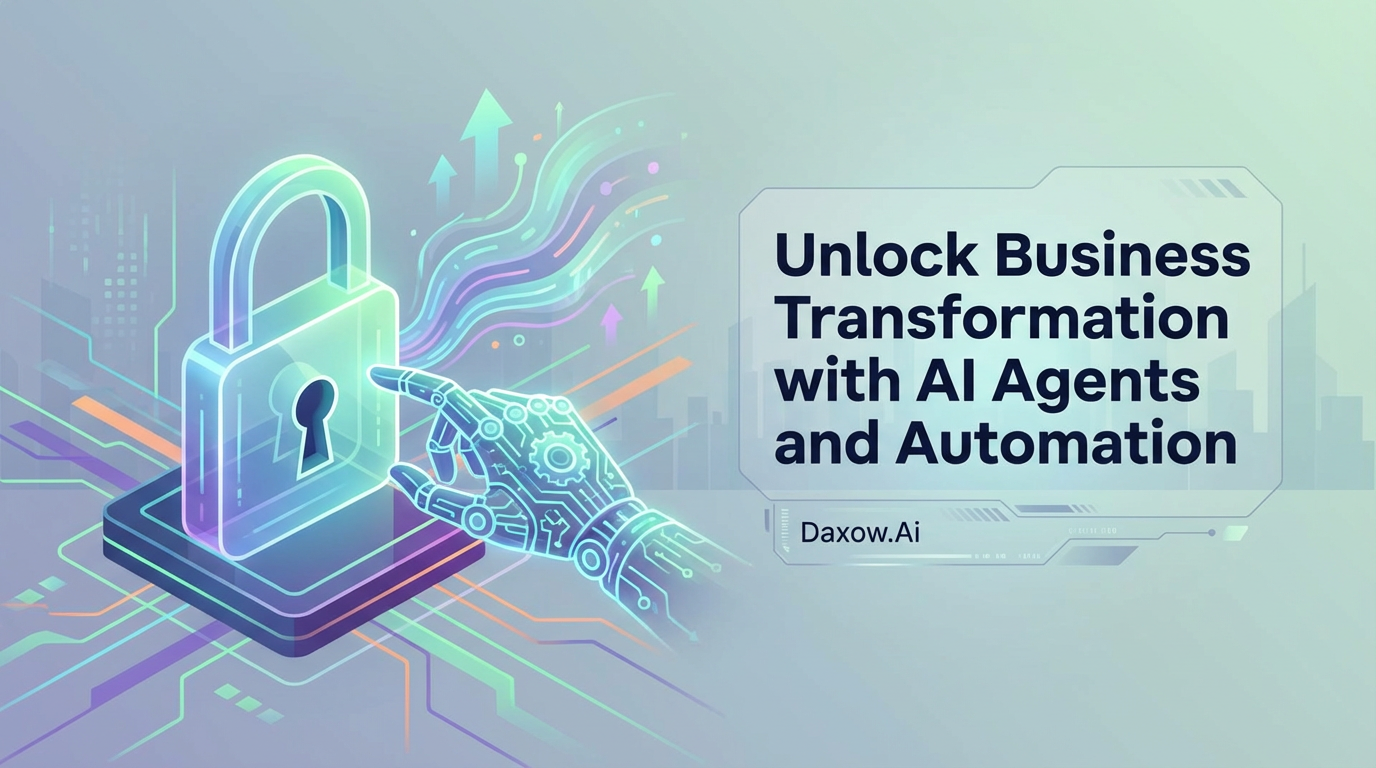
Discover how Daxow.ai designs AI agents and workflow automation to reduce costs, speed processes, ensure compliance, and deliver measurable ROI across industries.
Unlocking Business Transformation with AI Agents and Automation
Estimated reading time: 15 minutes
Key Takeaways
- AI agents combined with workflow automation significantly reduce manual workload and accelerate task completion.
- Industries like e-commerce, healthcare, finance, real estate, and HR benefit from AI-driven use cases offering measurable ROI.
- Daxow.ai delivers custom AI systems integrating with enterprise platforms for end-to-end automation and compliance.
- A phased implementation roadmap ensures structured deployment and risk mitigation.
- Security, compliance, and responsible AI practices are critical for successful automation at scale.
Table of Contents
- Unlocking Business Transformation with AI Agents and Automation — What it Means for Your Company
- High-Impact Use Cases and Real-World Examples
- How AI Agents and Automation Drive Results — Technical and Operational Mechanics
- Implementation Roadmap — A Practical, Phased Approach
- Best Practices and Pitfalls to Avoid
- Measuring ROI and Business Value
- Security, Compliance, and Responsible AI
- How Daxow.ai Delivers End-to-End Business Automation
- Next Steps — Building Your Automation Roadmap
- Frequently Asked Questions
Unlocking Business Transformation with AI Agents and Automation — What it Means for Your Company
AI agents are autonomous software entities that use machine learning, natural language processing, and business logic to perform complex workflows with minimal human intervention. When combined with workflow automation, these agents enable organisations to automate repetitive, high-volume tasks while handling variability and ambiguity through learning and adaptive decision making.
- Business outcomes you can expect: 20–50% cost reductions in automated processes, 30–70% faster task completion, and 15–25% improvements in customer satisfaction.
- Operational advantages: 24/7 availability, built-in audit trails for compliance, and the ability to scale without proportional headcount increases.
- Strategic impact: Freeing human talent to focus on high-value activities, accelerating decision cycles, and enabling data-driven products or services.
Daxow.ai’s role: We help you map processes, design AI agents, and implement business automation across CRMs, ERPs, support platforms, and custom toolchains — delivering measurable ROI while ensuring integration, security, and compliance.
High-Impact Use Cases and Real-World Examples
E-commerce
Use cases:
- Automated order processing and exception handling.
- Inventory forecasting and automated replenishment workflows.
- Personalised recommendations driven by customer behaviour and browsing signals.
- 24/7 conversational chatbots for customer inquiries and returns.
Business impact:
- Reduce fulfillment time by up to 50%, cut manual order errors, and increase conversion rates with real-time personalisation.
- Daxow.ai builds AI agents that integrate with ecommerce platforms and warehouse management systems to automate order routing, notify customers, and trigger replenishment workflows.
Healthcare
Use cases:
- Appointment scheduling and automated reminders.
- Patient triage using symptom-checking agents that escalate to clinicians when needed.
- Billing automation and claims processing with compliance controls.
Business impact:
- Reduce administrative burden by ~30%, improve access to care, and maintain HIPAA-compliant handling of patient data.
- Daxow.ai implements secure integrations with EHRs, designs patient-facing conversational AI, and automates billing paths with auditable workflows.
Finance and Banking
Use cases:
- Automated fraud detection and real-time anomaly alerts.
- Loan pre-qualification and automated KYC/compliance checks.
- Invoice processing with intelligent data extraction and approvals.
Business impact:
- From days to minutes for routine approvals, improved anomaly detection accuracy, and reduced compliance overhead.
- Daxow.ai connects AI agents to your core ledger, transaction monitoring systems, and CRM to automate approvals and flag exceptions.
Real Estate
Use cases:
- Property matching by analysing listings and buyer preferences.
- Automated lead qualification and scheduling of virtual tours.
- Contract review and extraction of key clauses.
Business impact:
- Accelerated lead qualification, reduced vacancy through predictive pricing models, and faster legal review cycles.
- Daxow.ai builds workflow automation that connects MLS data, CRM, and calendar systems to convert leads faster.
HR and People Operations
Use cases:
- Resume screening, candidate scoring, and interview scheduling.
- New hire onboarding automation, policy distribution, and task tracking.
- Employee support agents for routine HR questions.
Business impact:
- Shorten hiring cycles by 30–40%, reduce manual screening work, and improve retention via proactive engagement.
- Daxow.ai develops candidate pipelines, automates onboarding checklists, and integrates with HRIS systems for seamless execution.
How AI Agents and Automation Drive Results — Technical and Operational Mechanics
The synergy between rule-based automation and AI agents delivers more than incremental efficiency — it transforms workflows.
- Rule-based automation: reliable, deterministic execution for repeatable tasks (e.g., invoice matching, approvals).
- AI agents: handle ambiguity with NLP, predictive models, and decision logic (e.g., customer intent understanding, exception triage).
Key capabilities:
- System integration: connectors to CRMs, ERPs, databases, and third-party APIs.
- Adaptive learning: agents improve decisions over time using feedback loops.
- Auditability: traceable actions, logs, and versioned decision policies for compliance.
- Escalation and orchestration: agents can escalate complex cases to humans while managing handoffs.
Daxow.ai’s role: We design AI agents that not only understand context and intent but also execute tasks — updating records, triggering configurations, and interacting with downstream systems — enabling true business automation rather than mere recommendations.
Implementation Roadmap — A Practical, Phased Approach
Phase 1 — Assessment and Planning (4–8 weeks)
- Define measurable goals tied to KPIs: cost per interaction, average handle time, NPS, time-to-fulfillment.
- Process audit: map workflows and identify high-volume, low-complexity tasks suitable for quick wins.
- Data assessment: evaluate sources, quality, and privacy requirements.
- Integration inventory: identify CRMs, ERPs, and tools that will be connected.
Deliverable: A prioritized automation backlog and an implementation business case.
Phase 2 — Technology Selection and Architecture (6–12 weeks)
- Select platforms and models compatible with your stack and regulatory constraints.
- Design architecture for data flow, security, and scalability (on-premises, cloud, or hybrid).
- Develop an API and integration plan for CRMs, ticketing systems, and databases.
Deliverable: Technical design, vendor shortlist, and proof-of-concept criteria.
Phase 3 — Team Assembly and Preparation (4–8 weeks)
- Form a cross-functional team: IT, data engineers, process owners, compliance, and change managers.
- Prepare data pipelines and knowledge bases.
- Define monitoring and escalation protocols.
Deliverable: Ready-to-deploy environment and trained stakeholders.
Phase 4 — Pilot Deployment and Iteration (4–20 weeks)
- Launch a pilot on a single use case or customer segment.
- Track KPIs, capture feedback, and refine models and workflows.
- Expand channels, languages, and complexity progressively.
Deliverable: Validated pilot with measured ROI and a roadmap for scale.
Phase 5 — Scale and Continuous Improvement
- Automate additional use cases based on pilot results.
- Implement governance: model retraining schedules, audit processes, and performance SLAs.
- Maintain a roadmap for upgrades and new capabilities.
Deliverable: Organisation-wide automation programme with monitored outcomes.
Best Practices and Pitfalls to Avoid
Adopting AI automation successfully requires careful planning and organisational alignment.
Best practices:
- Start small: pick high-volume, low-complexity processes for rapid wins.
- Prioritise data quality: clean, consistent data is foundational for accurate AI behaviour.
- Define clear escalation paths: ensure agents hand off to humans gracefully for complex or ambiguous cases.
- Measure and iterate: implement continuous monitoring and retraining loops.
- Engage stakeholders early: involve IT, compliance, and business owners from the outset.
- Plan for change management: training and communication are critical to achieving 80%+ adoption.
Common pitfalls:
- Over-automating complex processes without adequate training data.
- Ignoring integration complexity with legacy systems.
- Underinvesting in governance and auditability, leading to compliance risk.
- Treating AI as a one-off project instead of an ongoing capability.
Daxow.ai’s approach: We mitigate these pitfalls through rigorous process audits, secure integration patterns, phased deployment, and long-term support to manage models and workflows.
Measuring ROI and Business Value
To validate impact, establish KPIs before deployment and monitor them continuously. Typical metrics include:
- Cost per transaction or interaction.
- Average response or resolution time.
- Volume of automated cases vs. human-handled cases.
- Customer satisfaction (CSAT / NPS).
- Error rates and compliance checkpoints.
- Time-to-hire and candidate throughput (for HR use cases).
Examples of expected outcomes:
- E-commerce support automation can deliver ROI within 6–12 months by reducing support tickets and improving conversion rates.
- Finance automation (fraud detection and invoice processing) can shorten approval times from days to minutes and reduce loss from fraud.
- HR automation can decrease time-to-hire by 30–40% and reduce onboarding administrative time substantially.
Daxow.ai’s role: We build dashboards and KPIs into every deployment to ensure you can quantify ROI, model savings, and make informed decisions about scaling.
Security, Compliance, and Responsible AI
Automating business processes requires attention to security and regulatory constraints.
- Ensure data residency and access controls for sensitive data (e.g., HIPAA in healthcare, GDPR in the EU).
- Implement audit logs, role-based access, and explainable decisioning where required.
- Validate models for bias, fairness, and transparency.
- Maintain versioned policies and incident response plans.
Daxow.ai provides secure architectures, compliance-by-design practices, and governance frameworks to ensure your automation is auditable, reliable, and aligned with regulatory requirements.
How Daxow.ai Delivers End-to-End Business Automation
From process analysis to production-grade AI agents, Daxow.ai offers full-cycle services tailored to your organisation.
- Process discovery: we map your workflows, identify automation candidates, and quantify potential savings.
- Custom AI agents: we design agents capable of understanding intent, extracting information, and executing tasks across systems.
- System integrations: we connect CRMs, ERPs, ticketing systems, and data repositories to enable end-to-end automation.
- Workflow automation: we orchestrate multi-step processes, including approvals, escalations, and notifications.
- Monitoring and optimisation: post-deployment service includes model retraining, performance monitoring, and continuous improvement.
- Security and compliance: we implement governance frameworks and secure integrations to protect sensitive data.
Practical example: For a mid-sized e-commerce client, Daxow.ai implemented customer support automation integrated with their CRM and warehouse management system. Outcome: a 45% reduction in manual ticket handling, 35% faster resolution times, and measurable increases in repeat purchase rates due to faster issue resolution.
Next Steps — Building Your Automation Roadmap
If you are evaluating AI automation and AI agents for your organisation, use the following checklist to start:
- Identify 3–5 high-volume processes that are rule-based today.
- Gather current KPIs and baseline metrics for those processes.
- List systems that must integrate with automation (CRM, ERP, ticketing).
- Define success criteria: cost savings, throughput, customer satisfaction.
- Assign an internal sponsor and cross-functional team.
Daxow.ai can accelerate this discovery phase with a structured process analysis and pilot design that shows expected ROI and a clear path to scale.
Frequently Asked Questions
What are AI agents and how do they differ from traditional automation?
AI agents are autonomous and use machine learning, natural language processing, and adaptive decision logic to handle complex, variable tasks with minimal human intervention, unlike traditional rule-based automation which follows fixed instructions.
How secure is AI-driven business automation?
Security is a top priority. Solutions incorporate data residency controls, role-based access, audit logs, and compliance with relevant regulations such as HIPAA and GDPR. Daxow.ai implements these as standard in all deployments.
Can AI automation integrate with existing business systems?
Yes. AI agents and workflow automation are designed to seamlessly integrate with CRMs, ERPs, ticketing systems, databases, and custom toolchains to enable end-to-end business process automation.
What industries benefit most from AI agents and automation?
Industries with high-volume, rule-based processes gain the most, including e-commerce, healthcare, finance, real estate, and HR, among others. Custom AI agents enable these sectors to enhance efficiency, compliance, and customer engagement.