
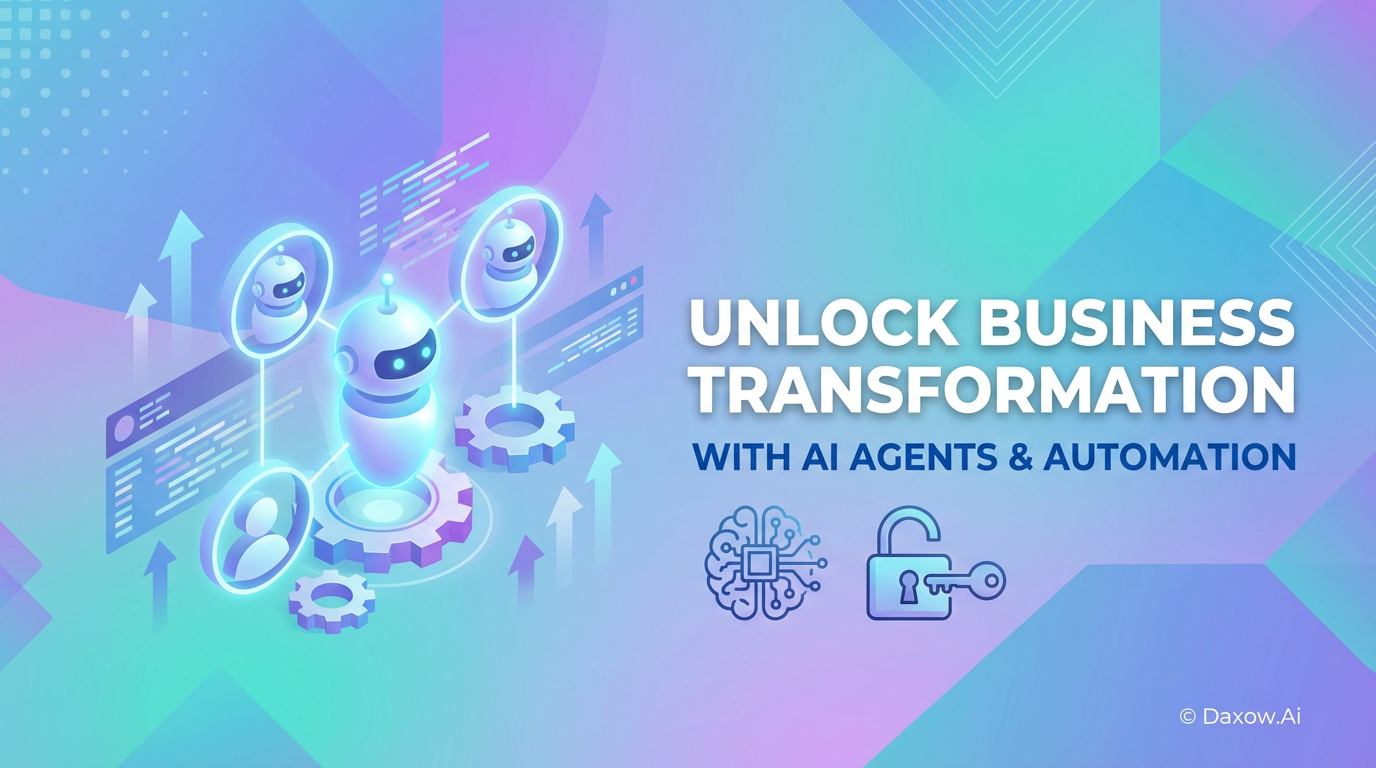
Unlock Business Transformation with AI Agents & Automation
How Daxow.ai uses AI agents and workflow automation to cut costs, speed processes, and deliver measurable ROI across industries.
Unlocking Business Transformation: AI Agents and Workflow Automation
Estimated reading time: 15 minutes
Key Takeaways
- AI agents and workflow automation enable businesses to reduce manual tasks and increase productivity through adaptive, data-driven automation.
- Significant operational benefits include cost reductions of 20–50%, faster process completion by up to 40%, and improved accuracy and scalability.
- Industry use cases span e-commerce, healthcare, finance, real estate, HR, and customer support—delivering measurable ROI and improved customer outcomes.
- Successful implementation requires a phased, business-first approach, focusing on data quality, integration, and governance from the start.
- Daxow.ai offers end-to-end custom AI automation services to design, pilot, and scale workflows that transform operational costs into strategic advantages.
Table of Contents
- Unlocking Business Transformation: AI Agents and Workflow Automation
- Strategic Implications for Businesses
- Practical Use Cases Across Industries
- How AI Agents and Automation Drive Results
- Implementation Steps and Best Practices
- ROI and Tangible Business Value
- Governance, Security, and Ethical Considerations
- How Daxow.ai Can Help
- Frequently Asked Questions
Unlocking Business Transformation: AI Agents and Workflow Automation
What we mean by AI agents and workflow automation
AI agents are autonomous software systems that perceive context, make decisions, and execute tasks across systems. Workflow automation is the orchestration of processes that replace manual, repetitive work with automated sequences. Together, they move organizations from scripted Robotic Process Automation (RPA) to adaptive, data-driven automation that can handle exceptions, learn from interactions, and collaborate across tools.
Key distinctions:
- RPA automates repetitive, rule-based tasks. AI agents add learning, reasoning, and natural language capabilities.
- Workflow automation standardizes process flow. AI agents adapt workflows dynamically based on context and outcomes.
- Combined, they enable business automation that reduces manual tasks while improving accuracy and scalability.
Why this matters now
Modern enterprises face demands for faster decision cycles, lower operational cost, and better customer experiences. AI agents and workflow automation:
- Drive cost reductions and efficiency improvements at scale.
- Free human talent to focus on strategy and high-value work.
- Improve service quality through consistent, measurable automation.
Strategic Implications for Businesses
Measurable operational benefits
Adopting AI agents and workflow automation yields tangible outcomes:
- Reduced operational costs: Targeted workflows often see cost reductions of 20–50%, with some focused automations delivering even higher savings.
- Improved accuracy: Automated data processing minimizes human error in reconciliation, reporting, and record-keeping.
- Scalability: Processes scale without proportional headcount increases, enabling growth with predictable cost structures.
- Faster cycle times: Many organizations report 40% faster process completion for automated workflows.
- Better customer outcomes: Faster and more consistent responses lead to higher satisfaction and increased revenue.
Competitive and strategic impact
AI-driven automation becomes a strategic differentiator:
- It converts operational excellence into improved time-to-market.
- It creates a data-rich foundation for advanced analytics and generative AI.
- It shifts teams from executing tasks to designing higher-impact initiatives.
Practical Use Cases Across Industries
AI agents integrate with existing systems—CRMs, ERPs, support platforms—to automate end-to-end workflows. Below are industry-specific examples and expected business impacts.
E-commerce
Use case:
- AI agents manage the order-to-cash cycle: inventory forecasting, order routing, fulfillment scheduling, and post-purchase support.
Impact:
- 50% reduction in order processing time.
- Decreased cart abandonment via real-time chat-based support and personalized recommendations.
How Daxow helps:
- Design agent workflows that connect storefronts, warehouses, and logistics partners.
- Implement predictive inventory models and automated fulfillment routing.
Healthcare
Use case:
- Automated patient scheduling, symptom triage, and prioritization using EHR integrations.
Impact:
- Faster triage for urgent cases, reduced no-shows, and improved compliance reporting.
How Daxow helps:
- Build secure, HIPAA-aware agents that integrate with clinical systems and automate administrative tasks, freeing clinicians for care delivery.
Finance and Accounting
Use case:
- Invoice capture, reconciliation, anomaly detection for fraud, and compliance checks.
Impact:
- Significant cut in reconciliation errors and near real-time risk assessment.
How Daxow helps:
- Deploy agents that extract data from documents, match transactions, and route exceptions to humans with context and evidence.
Real Estate
Use case:
- Automated lead qualification, listing management, virtual tour analysis, and contract generation.
Impact:
- Faster deal cycles and improved lead-to-close conversion by matching buyers to listings automatically.
How Daxow helps:
- Integrate MLS data, CRM systems, and document generation tools to automate the end-to-end sales workflow.
HR and Talent
Use case:
- Resume screening, interview scheduling, onboarding workflows, and employee sentiment analysis.
Impact:
- 30% reduction in hiring cycle time and improved retention through proactive engagement.
How Daxow helps:
- Build conversational agents and process pipelines that standardize hiring and onboarding while preserving candidate experience.
Customer Support and Sales Automation
Use case:
- Conversational AI for first-line support, automated ticket triage, and lead qualification agents that route opportunities to sales reps.
Impact:
- Faster response times, higher first-contact resolution, and increased sales pipeline quality.
How Daxow helps:
- Create agents that integrate with support platforms, knowledge bases, and CRMs to automate customer journeys and sales workflows.
How AI Agents and Automation Drive Results
Technical capabilities that deliver business value
AI agents combine several AI technologies to elevate automation:
- Machine learning for pattern recognition and predictive decisioning.
- Natural language processing for human-like interactions and context extraction.
- Multi-agent orchestration for complex workflows spanning systems and teams.
Core outcomes:
- Autonomous task execution: Agents handle exceptions and learn from outcomes.
- Scalable intelligence: A single platform can manage many workflows with centralized governance.
- Human-AI synergy: Agents escalate ambiguous cases to humans and provide decision support, improving overall throughput.
Integration and data connectivity
Value is unlocked when agents connect to enterprise systems:
- CRMs, ERPs, support desks, document stores, and business intelligence platforms.
Daxow focuses on secure, maintainable integrations that ensure data flows cleanly between agents and core systems. This reduces friction, avoids data silos, and preserves auditability.
Implementation Steps and Best Practices
A phased, business-first approach
Successful deployment follows these structured steps:
- Define clear objectives
Set measurable KPIs (e.g., 30% cost reduction, 50% faster response). Prioritize high-impact, repetitive processes where automation delivers quick wins. - Audit data and processes
Map workflows, identify bottlenecks, and validate data quality. Prepare datasets to avoid model failures caused by incomplete or inconsistent inputs. - Select and integrate tools
Choose secure, scalable platforms compatible with existing systems. Prefer modular architectures that allow incremental rollouts. - Build a cross-functional team
Include business stakeholders, IT, data scientists, and process owners. Invest in change management to reduce resistance and accelerate adoption. - Pilot and scale
Start with a small, non-critical pilot to validate assumptions. Use KPIs to measure impact, then expand in modular phases. - Monitor, secure, and iterate
Embed compliance and security from the start. Implement retraining loops and continuous monitoring to maintain performance.
Common pitfalls and how to avoid them
- Vague objectives leading to scope creep: Define KPIs up front.
- Poor data quality causing model failures: Invest in data hygiene and governance.
- Incompatible systems: Prioritize integration compatibility.
- Organizational resistance: Involve stakeholders early and communicate wins.
- Over-scaling without validation: Expand only after validated pilots.
ROI and Tangible Business Value
What to expect
AI agents deliver rapid, measurable ROI when applied to the right processes:
- 20–50% labor cost reductions in targeted workflows.
- 40% faster process completion in many automated tasks.
- 15–30% revenue uplift from optimized customer experiences and better sales forecasting.
- Clients commonly see payback in 6–12 months and sustained efficiency multipliers of 2–4x as automations mature.
Example ROI calculation: Invoice automation (illustrative)
- Current cost per invoice: $10 manual processing.
- Volume: 100,000 invoices/year → $1,000,000 processing cost.
- Expected reduction: 40% efficiency gain → $400,000 saved annually.
- Implementation cost: $200,000 one-time + $50,000/year maintenance.
- First-year net benefit: $150,000.
This simplified example shows how targeted automation moves quickly from expense to value.
Prioritize for maximum ROI
- Focus on high-volume, rule-based tasks with measurable outcomes.
- Target workflows that remove manual bottlenecks and improve customer touchpoints.
- Use pilot projects to prove business value and build internal momentum.
Governance, Security, and Ethical Considerations
Embed controls from day one
Automation must be secure, auditable, and compliant:
- Data protection: Ensure data encryption, access controls, and secure integrations.
- Audit trails: Maintain logs for decisions and escalations.
- Explainability: Provide human-readable rationales for agent decisions where required.
- Ethics and bias: Monitor models for biased outcomes and institute remediation processes.
Daxow implements governance frameworks and continuous monitoring to ensure automation is reliable, compliant, and aligned with corporate policies.
How Daxow.ai Can Help
End-to-end services tailored to your organization
At Daxow.ai, we specialize in designing and deploying custom AI automation solutions that meet industry-specific needs. Our services include:
- Process discovery and mapping to identify high-impact automation opportunities.
- Custom AI agent development that integrates with your CRM, ERP, and support systems.
- Workflow automation implementation and orchestration across teams and tools.
- Pilot delivery, performance measurement, and phased scaling.
- Ongoing monitoring, retraining, and governance to sustain value.
Typical engagement and outcomes
- Phase 1: Process analysis and AI readiness assessment (2–4 weeks).
- Phase 2: Pilot development and deployment of an AI agent for a prioritized workflow (6–12 weeks).
- Phase 3: Scale and integrate additional workflows, with continuous optimization (3–12 months).
Outcomes often include faster cycle times, lower error rates, and measurable cost savings with payback commonly achieved within 6–12 months.
Example client scenario (illustrative)
An online retailer engaged Daxow to automate order processing and customer support routing. Daxow:
- Implemented an AI agent to manage order validation, fulfillment routing, and returns handling.
- Integrated the agent with the retailer’s ERP and support desk.
- Delivered a 50% reduction in processing time and a marked improvement in customer satisfaction.
- The client reached payback within 9 months and scaled automation to additional channels.
Frequently Asked Questions
What are AI agents, and how are they different from traditional automation?
AI agents are autonomous systems that make decisions, learn from interactions, and adapt dynamically, unlike traditional automation tools like RPA that follow fixed rules.
Which industries benefit the most from AI-driven workflow automation?
Industries such as e-commerce, healthcare, finance, real estate, HR, and customer support have demonstrated significant gains in efficiency, accuracy, and customer experience through AI-driven automation.
How does Daxow.ai ensure data security in AI automation projects?
Daxow.ai embeds security practices including data encryption, access controls, secure integrations, comprehensive audit trails, and continuous governance to maintain compliance and protect sensitive information.
What is the typical timeline for realizing ROI from AI automation?
Clients typically achieve payback within 6–12 months after deployment, with efficiency gains and cost savings compounding as automations mature and scale.