
AI Automation: AI Agents & Workflow Automation for Business
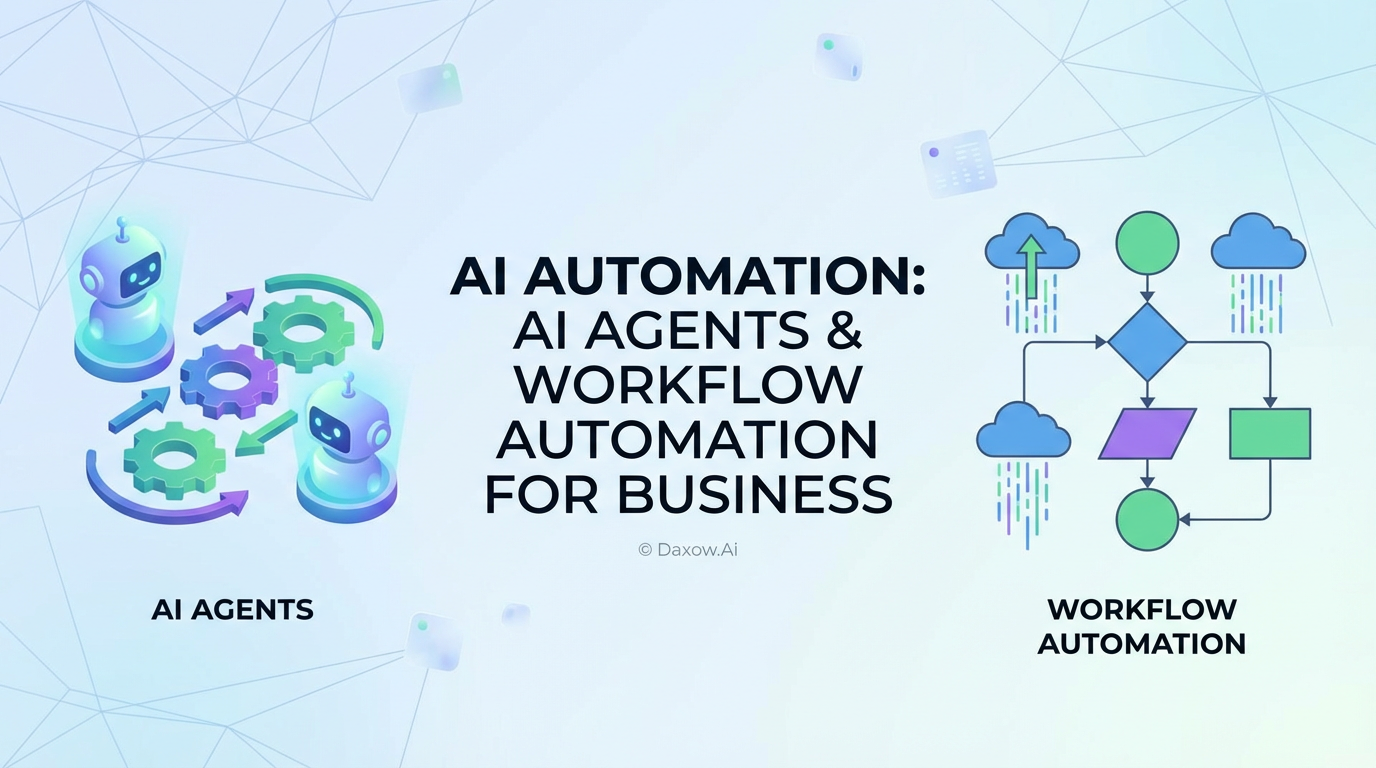
Learn how AI agents and workflow automation streamline operations, cut costs, and boost productivity with Daxow.ai's measurable ROI.
AI Automation: Transforming Business Operations — How AI Agents and Workflow Automation Drive Productivity
Estimated reading time: 20 minutes
Key Takeaways
- AI automation is essential for reducing manual tasks, boosting productivity, and maintaining competitiveness.
- Combining AI agents with workflow automation enables scalable, accurate, and proactive business processes.
- Daxow.ai partners with enterprises to deliver custom AI-driven automation solutions with measurable ROI.
- Practical use cases span e-commerce, healthcare, finance, real estate, HR, customer support, and sales.
- Implementing AI automation requires a phased approach, governance, ethical oversight, and continuous optimization.
Table of Contents
- AI Automation: Transforming Business Operations — Strategic Importance
- How AI Agents and Workflow Automation Deliver Results
- Practical Use Cases: Industry Examples and Actionable Playbooks
- Implementation Steps and Best Practices for Successful AI Automation
- Realizing ROI and Long-term Value
- How Daxow.ai Helps: From Process Analysis to Autonomous AI Agents
- Frequently Asked Questions
AI Automation: Transforming Business Operations — Strategic Importance
AI Automation: Transforming Business Operations is no longer an experimental initiative — it is a strategic imperative for organizations that want to reduce manual tasks, increase productivity, and remain competitive in a data-driven economy. For business owners, operations leaders, and technology decision-makers, intelligent automation combines AI agents, workflow automation, and systems integration to eliminate repetitive work, accelerate processes, and surface insights that inform better decisions. This article presents a structured, actionable roadmap based on proven research and practical use cases across industries, and shows how Daxow.ai partners with enterprises to design and deploy custom AI systems that deliver measurable ROI.
Why now
- Scale and complexity of data have made manual processing untenable for many organizations. AI automation processes large datasets, identifies patterns, and executes repeatable tasks faster and more reliably than humans.
- Cost and productivity gains are measurable. Research shows potential reductions in operational costs by 20–50% and time savings of 30–40% on automated tasks.
- Customer expectations demand faster, personalized service. AI-enabled automation improves response times and consistency, driving customer satisfaction and retention.
Key strategic benefits
- Reduce manual tasks such as data entry, invoice processing, and routine customer inquiries.
- Increase productivity by allowing staff to focus on high-value activities such as strategy, innovation, and relationship-building.
- Improve accuracy and compliance by standardizing processes and reducing human error.
- Enable agility through predictive analytics that prevent disruptions in supply chains or detect fraud proactively.
How AI Agents and Workflow Automation Deliver Results
What differentiates AI agents from traditional automation
- Traditional RPA executes rule-based tasks. AI agents extend this by reasoning over unstructured data, adapting to exceptions, and orchestrating multi-step workflows across systems.
- AI agents can summarize documents, classify claims, draft communications, and integrate with CRMs and ERPs to execute end-to-end processes.
Core outcomes of combining AI agents with workflow automation
- Error reduction through consistent rules and AI-driven anomaly detection.
- 24/7 scalability without proportional headcount increases.
- Insight generation from pattern recognition and predictive models that inform operations, sales, and product strategy.
- Seamless system integration to overcome legacy constraints and enable end-to-end automation.
Daxow.ai’s role
- We design AI agents that not only recommend actions but also execute them across tools and databases.
- We build workflow automation tied to business outcomes, ensuring improvements in productivity and reductions in operational cost.
AI Agents in action — technical capabilities
- Handle unstructured data: extract entities from invoices, medical records, or contracts.
- Multi-step workflows: trigger follow-up tasks, update CRM records, and notify stakeholders automatically.
- Integrate securely with internal systems: API connectors to ERPs, CRMs, ticketing systems, and data warehouses.
- Continuous learning: monitor performance, gather feedback, and retrain models to improve accuracy and relevance.
Practical Use Cases: Industry Examples and Actionable Playbooks
E-commerce
Problem: Increasing volume of orders, inventory mismatches, slow customer responses.
AI automation solution:
- Automate order-to-cash: order validation, inventory allocation, and billing.
- Predict demand and adjust procurement using AI forecasting.
- Deploy chatbots and AI agents to handle returns, FAQs, and lead qualification.
Expected impact: Reduced manual order handling, faster fulfillment, and fewer stockouts. Higher conversion through personalized recommendations.
Daxow.ai contribution: Implement AI agents that update inventory and trigger purchase orders, integrate with e-commerce platforms and CRMs, and automate marketing content generation.
Healthcare
Problem: High volume of patient documents and scheduling complexity.
AI automation solution:
- Automate document processing (intake forms, referrals) via data extraction and classification.
- Use AI agents to flag anomalies in patient records for clinician review.
- Automate appointment scheduling and follow-ups with patient-specific rules.
Expected impact: Faster diagnostics support, reduced administrative backlog, improved compliance.
Daxow.ai contribution: Build secure, HIPAA-aligned pipelines for document automation and integrate clinical systems for reliable workflow execution.
Finance
Problem: Time-consuming reconciliation, fraud monitoring, and compliance reporting.
AI automation solution:
- Automate invoice reconciliation and exceptions handling.
- Use AI to identify anomalous transactions and escalate suspected fraud.
- Generate compliance reports by aggregating data across systems and normalizing formats.
Expected impact: Lower reconciliation time, faster fraud detection, and reduced regulatory risk.
Daxow.ai contribution: Deploy AI agents that continuously reconcile transactions, wire suspicious activity alerts to human analysts, and create audit-ready reports.
Real Estate
Problem: Repetitive listing updates, lead qualification, and market analysis demands.
AI automation solution:
- Automate lead qualification with chatbots that capture buyer preferences and score leads.
- Auto-update listings and syndicate across platforms.
- Analyze market data to identify price trends and investment opportunities.
Expected impact: Higher-quality leads, quicker response times, and better-informed pricing strategies.
Daxow.ai contribution: Integrate lead flows with CRMs, build AI scoring models, and automate content generation for property listings.
Human Resources
Problem: High volume of candidate screening and time-consuming onboarding.
AI automation solution:
- Screen resumes and rank candidates based on role-specific criteria.
- Automate onboarding checklists, document collection, and training reminders.
- Monitor performance and trigger adaptive learning pathways.
Expected impact: Faster hires, reduced administrative load on HR teams, better compliance tracking.
Daxow.ai contribution: Create resume parsing pipelines, candidate-screening AI agents, and onboarding workflows integrated with HRIS systems.
Customer Support and Sales Automation
Problem: Slow first response times, inconsistent lead qualification, and manual ticket routing.
AI automation solution:
- Customer support automation with chatbots for tier-1 queries and automated ticket triage.
- Sales automation to qualify leads, schedule demos, and update opportunity stages.
Expected impact: Improved NPS, shorter sales cycles, and increased conversion rates.
Daxow.ai contribution: Implement conversational AI and ticket automation connected to support platforms and CRMs for end-to-end lead-to-cash automation.
Implementation Steps and Best Practices for Successful AI Automation
A phased, risk-managed approach
- Define clear objectives
- Align automation goals to KPIs (cost reduction, response time, NPS).
- Conduct a process audit to identify repetitive, high-volume tasks suitable for automation.
- Tip: Prioritize processes with measurable outputs and clear owners.
- Assess data quality and accessibility
- Inventory data sources, evaluate completeness, and standardize formats.
- Ensure compliance requirements are met (privacy, retention).
- Tip: Treat data cleanup as an essential project milestone, not an optional step.
- Select tools and architecture
- Choose platforms that support integrations, security, and scalability.
- Balance quick wins with off-the-shelf tools and custom solutions where unique logic is required.
- Tip: Modular designs reduce vendor lock-in and enable iterative builds.
- Build a cross-functional team
- Include developers, operations, business stakeholders, and compliance representatives.
- Provide training and clear documentation to prevent shadow automation.
- Prototype and integrate
- Start with a small pilot on non-critical workflows, measure impact, iterate.
- Integrate with existing CRMs, ERPs, and communication platforms to ensure end-to-end execution.
- Monitor, measure, and optimize
- Track KPIs, retrain models, and update workflows as business rules evolve.
- Establish governance for model updates and change control.
Best practices and governance
- Start small and govern tightly. Early wins build momentum while governance prevents drift.
- Ensure ethical AI and bias checks. Regularly audit models for fairness and compliance.
- Invest in change management. Communicate benefits and provide training to users for adoption.
KPIs and metrics to monitor
- Time saved per task (hours/week).
- Error and exception rates before vs. after automation.
- Cost savings and ROI timeline.
- First response time and customer satisfaction scores.
- Lead-to-opportunity conversion and sales cycle duration.
Realizing ROI and Long-term Value
Short-term returns
- Many organizations recover implementation costs within 6–12 months through labor reduction and error savings.
- Targeted process automation can deliver 30–40% time savings in administrative functions.
Long-term value
- Predictive analytics prevent supply chain or customer churn losses.
- Data-driven decision-making becomes embedded, enabling continued performance improvements and faster scaling.
- Early automation adopters gain a sustainable competitive edge by freeing staff to focus on growth initiatives.
How Daxow.ai Helps: From Process Analysis to Autonomous AI Agents
End-to-end service model
- Discovery and process mapping
- We map workflows, identify automation candidates, and quantify expected impact.
- Deliverable: prioritized automation roadmap with estimated ROI.
- Prototype and pilot
- Rapid prototyping of AI agents and workflow automation on a controlled scope.
- Deliverable: working pilot integrated with key systems.
- Design and build
- Custom model development, document automation, and chatbot design.
- Deliverable: scalable automation platform with secure integrations.
- Integrations and deployment
- Connectors for CRMs, ERPs, ticketing systems, and data warehouses to enable end-to-end automation.
- Deliverable: production-ready automation with monitoring dashboards.
- Monitoring, governance, and optimization
- Continuous performance tracking, retraining, and governance procedures.
- Deliverable: ongoing maintenance plan and improvement roadmap.
Services aligned to business needs
- AI Agents that execute tasks, make decisions, and interact with systems.
- Workflow automation to orchestrate multi-step processes and reduce manual handoffs.
- Chatbots & customer support automation to improve first response and deflect repetitive queries.
- Sales automation and lead qualification to speed pipeline throughput.
- Data extraction & document automation to handle unstructured inputs at scale.
- System integrations to ensure data connectivity and real-time process execution.
Measuring and proving value
- We provide measurable KPIs tied to process outcomes, cost savings, and productivity.
- Typical client engagements include a business-case model showing payback period and long-term gains.
Frequently Asked Questions
What is AI automation?
AI automation uses artificial intelligence technologies to automate complex business processes, combining AI agents with workflow automation to improve efficiency and accuracy.
How do AI agents differ from traditional robotic process automation (RPA)?
Unlike rule-based RPA, AI agents can interpret unstructured data, adapt to exceptions, and perform multi-step tasks that require reasoning and integration across systems.
What industries benefit most from AI automation?
Industries including e-commerce, healthcare, finance, real estate, human resources, and customer support greatly benefit from AI-driven automation solutions.
How does Daxow.ai assist with AI automation?
Daxow.ai offers end-to-end services from process analysis, prototype development, custom AI agent design, to full integration and governance, delivering measurable ROI with scalable AI automation platforms.