
AI Automation: Transforming Enterprise Operations with Daxow.ai
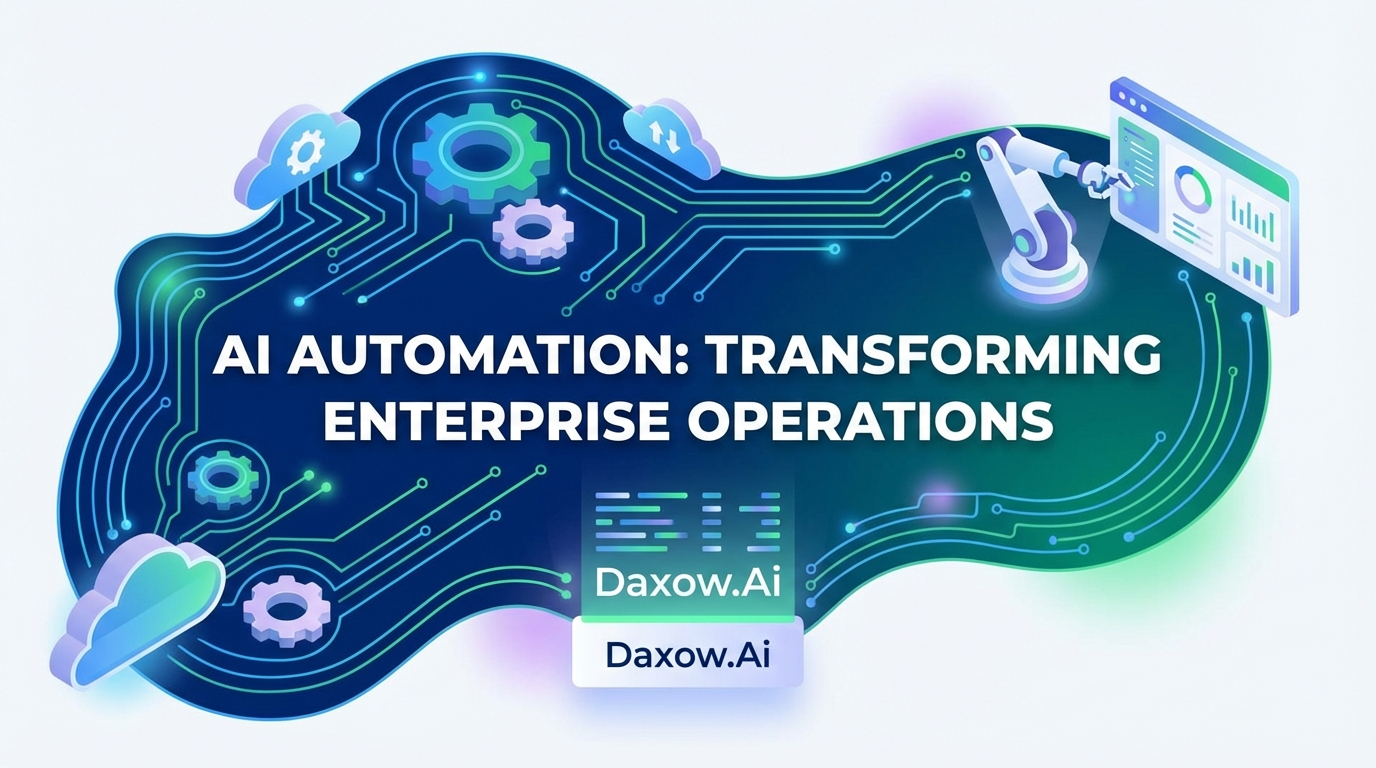
Learn how AI automation cuts manual work, boosts productivity, and delivers fast ROI—use cases, phased roadmap, and Daxow.ai's end-to-end enterprise solutions.
AI Automation: Transforming Business Operations for the Modern Enterprise
Estimated reading time: 12 minutes
Key Takeaways
- AI automation turns repetitive manual tasks into scalable, reliable, and auditable processes, boosting productivity by 20–40%.
- Industry-specific AI applications streamline operations in e-commerce, healthcare, finance, real estate, and HR.
- AI agents with contextual understanding enable seamless, end-to-end workflow orchestration and continuous learning.
- A phased implementation roadmap ensures risk-managed deployment and measurable ROI within 6–12 months.
- Daxow.ai delivers tailored AI automation solutions that improve efficiency, reduce errors, and enhance customer experience.
Table of Contents
- Introduction
- Why AI Automation Matters for Modern Enterprises
- Practical Use Cases Across Industries
- How AI Agents and Workflow Automation Drive Value
- Implementation Roadmap and Best Practices
- Common Pitfalls to Avoid
- Measuring ROI and Business Value
- How Daxow.ai Delivers End-to-End AI Automation
- Conclusion and Call to Action
- Frequently Asked Questions
Introduction
AI Automation: Transforming Business Operations for the Modern Enterprise is a top priority for decision-makers who must balance growth with operational efficiency. This article explains what AI automation delivers, how AI agents and workflow automation produce measurable business value, and practical, industry-specific use cases you can implement today. It also outlines a proven implementation roadmap and shows how Daxow.ai designs and deploys custom AI systems to reduce manual work, increase productivity, and improve customer experience.
Why AI Automation Matters for Modern Enterprises
AI automation is not a technology experiment; it is a strategic lever that converts repeated manual work into scalable, reliable, and auditable processes.
- Reduce manual tasks and errors: Automating high-volume, rule-based activities—data entry, invoice processing, routine inquiries—reduces human error and frees staff for higher-value work.
- Boost productivity: Organizations implementing structured AI initiatives often realize significant productivity gains. Expect 20–40% improvements in targeted workflows when solutions are well scoped and managed.
- Speed and scalability: AI-driven processes operate 24/7, enabling faster response times and the ability to scale operations without linear increases in headcount.
- Competitive advantage: Companies that align AI automation with measurable KPIs (e.g., 20–30% efficiency gains) outpace competitors by accelerating decision cycles and customer service responsiveness.
These outcomes depend on data readiness, disciplined piloting, and cross-functional governance. Daxow.ai specializes in validating opportunity areas and building the systems that deliver these results.
Practical Use Cases Across Industries
E-commerce
- Use case: Order-to-cash automation, inventory reconciliation, and automated customer inquiry handling.
- Example: An AI agent verifies stock levels in the ERP, reserves inventory, updates order status, and notifies logistics if exceptions occur, while a chatbot handles common delivery queries.
- Outcome: Faster fulfillment, reduced cart abandonment, and improved customer satisfaction. Sales automation accelerates follow-ups and personalized recommendations to recover potential lost revenue.
Healthcare
- Use case: Patient scheduling, secure document ingestion, and triage of routine questions.
- Example: A workflow automation system extracts structured data from referral forms, updates EHR records, and schedules appointments while ensuring HIPAA-compliant handling.
- Outcome: Reduced administrative workload by up to 40%, shorter patient wait times, and more focus for clinicians on care delivery.
Finance
- Use case: Invoice reconciliation, anomaly detection for fraud, and compliance reporting.
- Example: AI agents reconcile supplier invoices against purchase orders, flag discrepancies for human review, and generate audit-ready reports.
- Outcome: Lower reconciliation time, fewer payment errors, faster month-end close, and stronger regulatory readiness.
Real Estate
- Use case: Lead qualification, property matching, virtual tour scheduling, and lease processing.
- Example: A lead qualification agent scores inquiries automatically, schedules viewings based on buyer preferences, and triggers document automation for lease agreements.
- Outcome: Shorter deal cycles, higher conversion rates, and reduced agent time spent on administrative tasks.
HR and Recruitment
- Use case: Resume screening, candidate outreach, onboarding workflows, and employee help desks.
- Example: An AI agent screens resumes against role-specific criteria, schedules interviews, and initiates automated onboarding steps (document collection, equipment requests).
- Outcome: Reduced time-to-hire and improved recruiter focus on strategic candidate evaluation.
How AI Agents and Workflow Automation Drive Value
AI agents combine machine learning, natural language processing (NLP), and decision logic to operate autonomously across systems. They are purpose-built to execute tasks that previously required human oversight.
- Context-aware task handling: Unlike basic RPA, AI agents understand context—escalating complex cases, predicting outcomes, and adapting responses.
- Seamless integrations: AI agents connect to CRMs, ERPs, knowledge bases, and communication platforms to coordinate multi-step processes end-to-end.
- Continuous learning: Agents refine their performance with supervised feedback, improving accuracy and reducing exception rates over time.
- Operational orchestration: Workflow automation coordinates the sequence of activities (data extraction → validation → approval → execution), removing handoffs that cause delays and errors.
Common automation archetypes:
- Customer support automation: Chatbots and ticket triage that reduce first-response times and increase self-service resolution rates.
- Sales automation: Lead scoring, follow-up sequencing, and quote generation that accelerate pipeline velocity.
- Document automation: Data extraction, classification, and automated filing that remove manual entry.
- Back-office orchestration: End-to-end invoice approval or employee onboarding workflows that cut process times and error rates.
Implementation Roadmap and Best Practices
Phase 1 — Assessment and planning (4–8 weeks)
- Activities: Process audit, KPI definition (e.g., target 25% cost reduction), data readiness review, and stakeholder alignment.
- Deliverable: Prioritized automation backlog and success metrics.
- Best practice: Target high-volume, rule-based tasks first for quick wins.
Phase 2 — Technology and vendor selection (6–12 weeks)
- Activities: Evaluate platforms for scalability, integration capabilities, security, and compliance (e.g., HIPAA for healthcare).
- Deliverable: Selected stack and integration approach.
- Best practice: Choose technologies that support model retraining and monitoring.
Phase 3 — Preparation (4–8 weeks)
- Activities: Data cleaning, knowledge-base creation, workflow mapping, and forming cross-functional teams (IT, business owners, change managers).
- Deliverable: Integration blueprint and test data sets.
- Best practice: Document decision logic and expected exceptions up front.
Phase 4 — Pilot and deployment (4–20 weeks)
- Activities: Build a limited-scope pilot, run live tests, collect performance data, iterate, and then scale.
- Deliverable: Production-ready automation with monitoring.
- Best practice: Pilot one use case per business unit to validate ROI quickly.
Phase 5 — Ongoing optimization
- Activities: Retrain models, monitor bias, incorporate user feedback, and expand automation scope.
- Deliverable: Continuous improvement cycle and governance dashboards.
- Best practice: Maintain a small center of excellence to manage lifecycle and measure outcomes.
Common Pitfalls to Avoid
- Skipping data preparation and expecting models to perform.
- Over-automating without human oversight for edge cases.
- Ignoring change management and stakeholder engagement.
- Selecting point solutions that do not integrate with core systems.
Measuring ROI and Business Value
AI automation programs should report against clear KPIs to demonstrate value and guide scale decisions.
Key metrics to track:
- Cost per process or cost per resolution.
- Time saved (process cycle time reductions).
- Error rates and rework frequency.
- Customer satisfaction (CSAT) and net promoter score (NPS).
- Time-to-hire, conversion rates, or revenue uplift for sales processes.
Expected outcomes:
- Cost reductions of 30–50% in automated processes.
- Productivity gains of 20–40% for staff reallocated from manual tasks.
- Payback within 6–12 months for focused, high-impact pilots.
- Faster value realization when following structured best practices—organizations that apply phased approaches typically achieve objectives 3–5x faster.
How Daxow.ai Delivers End-to-End AI Automation
Daxow.ai helps organizations convert opportunity into measurable outcomes through a practical, hands-on approach.
- Assessment & process analysis: We map workflows, quantify manual workload, and prioritize automation candidates based on ROI and feasibility.
- Custom AI agents: We design agents that perform real tasks—lead qualification, document processing, escalation routing, and more.
- Workflow automation: We orchestrate multi-step processes across systems, removing manual handoffs and accelerating cycle times.
- Integrations & data connectivity: We connect CRMs, ERPs, knowledge bases, and communication platforms to create seamless end-to-end automation.
- Compliance & security: We embed controls and governance to meet regulatory requirements in healthcare, finance, and other sensitive domains.
- Pilot-to-scale delivery: We launch pilots, measure performance against KPIs, and scale successful pilots across the organization.
- Monitoring & optimization: We provide dashboards, model monitoring, and continuous improvement to sustain long-term ROI.
Concrete example engagements:
- E-commerce: Daxow.ai implemented an order orchestration agent that connected storefronts to inventory and shipping systems. Result: 35% faster fulfillment times and 25% reduction in customer support tickets related to shipping.
- Finance: We automated invoice reconciliation for a mid-sized firm, combining document extraction, business rule validation, and exception workflows. Result: 40% reduction in reconciliation time and improved audit readiness.
- HR: Our automation for candidate screening and onboarding reduced recruiter time on administrative work by 60%, enabling faster focus on high-value interviewing and selection.
Implementation approach:
- We start with a focused process analysis to define clear KPIs.
- We build a minimum viable automation (MVA) to validate value within the first 8–12 weeks.
- We integrate with your systems using secure connectors and APIs.
- We hand over operational dashboards and knowledge transfer to internal teams or provide managed services.
Getting started: practical next steps
- Identify a single high-volume process that consumes significant manual time.
- Define success metrics (cost reduction, time saved, CSAT improvement).
- Request a process analysis to get a prioritized automation roadmap and a timeline for a pilot.
Conclusion and Call to Action
AI automation is a strategic investment that turns repetitive tasks into scalable capabilities. With the right approach—targeted pilots, strong data practices, and integrated AI agents—businesses can reduce manual tasks, boost productivity, and realize measurable ROI within months.
Book a free consultation with Daxow.ai or request a process analysis for your company to identify the best automation opportunities and build a tailored AI system that delivers real business value. Contact us to build a custom AI system and start transforming your operations today.
Frequently Asked Questions
What types of tasks are best suited for AI automation?
High-volume, rule-based, repetitive tasks such as data entry, invoice processing, and customer inquiries are ideal candidates for AI automation, delivering quick wins and measurable ROI.
How quickly can businesses expect ROI from AI automation?
Focused pilot projects typically achieve payback within 6–12 months, especially when following a structured phased implementation and targeting high-impact workflows.
How does Daxow.ai ensure compliance and security?
Daxow.ai embeds compliance controls and governance in AI systems to meet sector-specific regulations like HIPAA for healthcare and financial services standards, ensuring data privacy and security.
Can AI automation handle complex, non-rule-based tasks?
AI agents use machine learning and natural language processing to manage context-aware tasks, escalating complex scenarios when necessary and continuously improving through supervised feedback.