
AI Automation for Modern Enterprises — Daxow.ai Roadmap
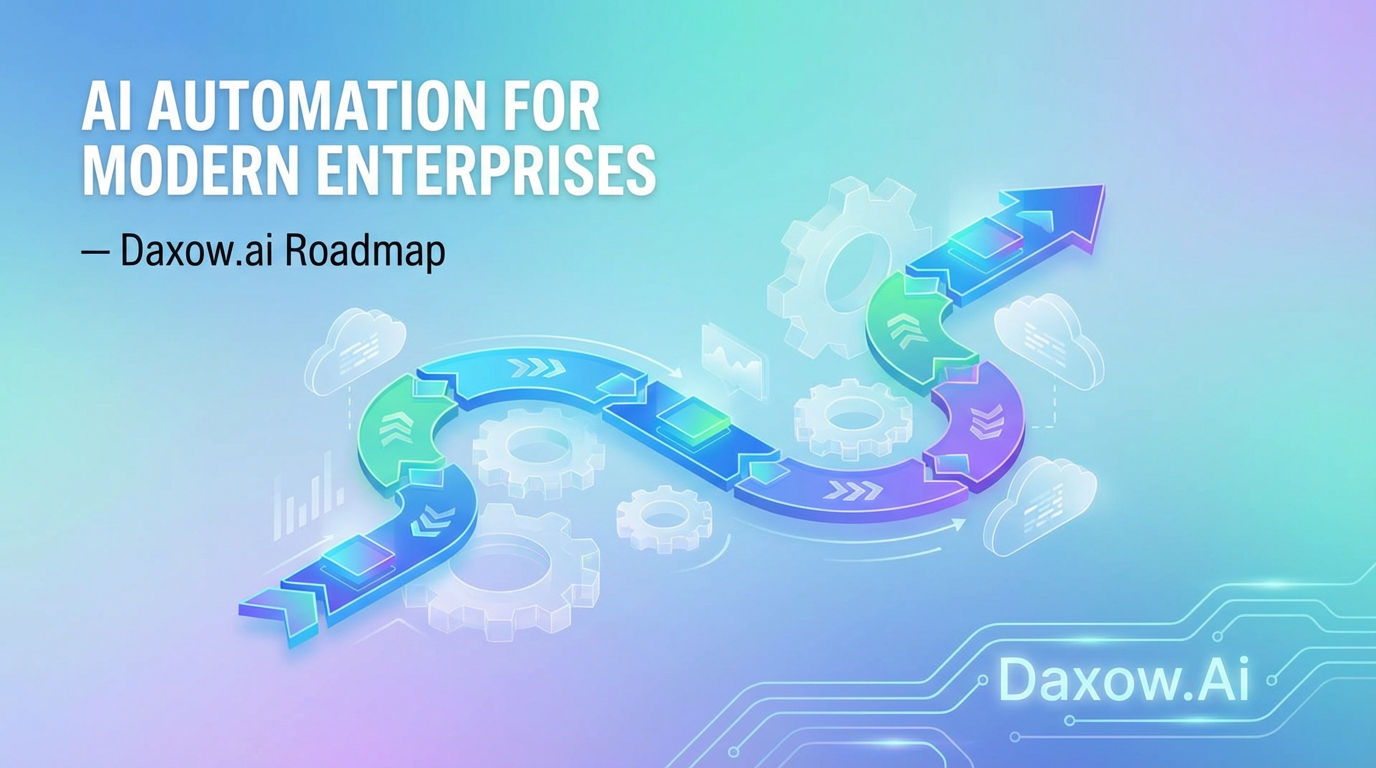
Explore how AI agents and workflow automation transform operations, cut costs, and drive ROI — practical roadmap, industry use cases, and Daxow.ai services.
AI Automation: Transforming Business Operations for the Modern Enterprise
Estimated reading time: 12 minutes
Key Takeaways
- AI automation integrates advanced technologies to streamline business workflows, reduce manual effort, and improve operational accuracy.
- Practical AI use cases span industries including e-commerce, healthcare, finance, real estate, HR, and customer support.
- Daxow.ai designs and deploys custom AI agents and workflow automation solutions fully integrated with existing tools and systems.
- Successful implementation requires clear goals, robust data readiness, cross-functional teams, iterative testing, and continuous monitoring.
- Measurable outcomes include significant cost savings, faster processing times, improved compliance, and enhanced customer and employee experiences.
AI Automation: Transforming Business Operations for the Modern Enterprise — Strategic Overview
AI automation integrates machine learning, generative AI, natural language processing and agentic systems into business workflows to replace repetitive work, enable predictive decision-making, and scale operations on demand. The strategic implications for leaders include faster response times, elimination of data silos, and the ability to redeploy human talent to higher-value tasks.
- Faster, more accurate operations: Targeted workflows—such as invoice processing and lead qualification—can see cost reductions of 20–50% and significant time savings.
- Predictive insights at scale: AI uncovers patterns from large datasets, enabling predictive maintenance, demand forecasting, and risk detection.
- Improved customer outcomes: Personalized, automated interactions increase satisfaction and conversion while reducing support overhead.
- Scalable productivity: AI agents work 24/7 without fatigue, amplifying workforce effectiveness and addressing talent shortages.
Core technologies behind business automation
- Machine learning for predictions and anomaly detection.
- Generative AI and large language models for summarization, drafting and conversational interfaces.
- Natural language processing to extract meaning from emails, documents and voice.
- AI agents that perceive data, make decisions and execute actions across systems.
- Workflow orchestration platforms that connect CRMs, ERPs, ticketing systems and databases.
Practical Use Cases of AI Automation Across Industries
E-commerce — Order-to-cash and conversion optimization
- What to automate: inventory forecasting, dynamic pricing, order validation, returns processing and conversational commerce.
- Business impact: reduce cart abandonment, shorten fulfillment cycles, and improve gross margins through smarter pricing and personalized recommendations.
- Example: An AI agent routes return requests, triggers refunds, updates inventory and recommends targeted offers—reducing manual returns handling by 70% and improving recovery rates.
- Daxow.ai role: design AI agents integrated with e-commerce platforms and CRMs, automate fulfillment workflows, and connect analytics to pricing engines.
Healthcare — Administrative automation and clinical triage
- What to automate: patient triage via conversational agents, appointment scheduling, billing reconciliation, and anomaly detection in records.
- Business impact: reduce administrative time by ~30%, speed up patient access, and improve compliance.
- Example: A triage agent collects symptoms, prioritizes cases, books appointments, and escalates flagged records to clinicians—reducing call center load and improving throughput.
- Daxow.ai role: ensure HIPAA-compliant system design, automate patient workflows, and integrate EMR systems with intelligent agents.
Finance — Fraud detection, reconciliation, and compliance
- What to automate: transaction monitoring, invoice reconciliation, compliance reporting and cash-flow forecasting.
- Business impact: reduce fraud exposure, accelerate month-end close and lower manual reconciliation errors to near zero.
- Example: An AI agent reconciles invoices against payments, flags anomalies for review, and prepares audit-ready summaries—cutting reconciliation time by 60%.
- Daxow.ai role: build secure pipelines to financial systems, tune models for fraud detection, and automate compliance reporting.
Real estate — Lead qualification and valuation
- What to automate: property valuation, lead qualification, viewing scheduling and listing optimization.
- Business impact: faster conversions, better lead prioritization and reduced manual paperwork.
- Example: A virtual agent fetches comparable sales, recommends pricing, pre-qualifies buyers and schedules viewings—accelerating time-to-contract.
- Daxow.ai role: integrate market data feeds, implement valuation models and automate CRM workflows.
HR — Recruitment and employee lifecycle automation
- What to automate: resume screening, interview scheduling, onboarding workflows and employee sentiment analysis.
- Business impact: reduce time-to-hire by 40%, improve candidate experience and detect retention risks early.
- Example: An AI pipeline screens resumes, ranks candidates, coordinates interviews, and triggers onboarding checklists—cutting recruiter workload and standardizing decisions.
- Daxow.ai role: implement secure candidate screening, integrate HRIS systems and build analytics dashboards.
Customer support and sales automation — Conversational agents and lead nurturing
- What to automate: ticket triage, SLA routing, knowledge-based chat support, and lead qualification.
- Business impact: 24/7 support, faster response times, and higher lead-to-opportunity conversion.
- Example: A support AI triages incoming tickets, resolves common issues via knowledge bases, escalates complex problems and logs insights for product teams—reducing first-response times by 50% and lowering repeat tickets.
- Daxow.ai role: design customer support automation, build AI agents that interact across channels, and connect outcomes to CRM for sales automation.
How AI Agents and Workflow Automation Drive Value
AI agents go beyond scripted chatbots. They combine reasoning, tool use and integrated workflows to execute real tasks across systems.
How agents create value:
- End-to-end automation: Agents can read an email, extract intent, update the CRM, generate documents, and close workflows without human intervention.
- Handling unstructured data: NLP models turn email threads, PDFs and voice notes into structured inputs for downstream automation.
- Continuous improvement: Agents learn from corrected outcomes and feedback loops to reduce errors over time.
- Tool integration: Agents orchestrate actions across ERP, CRM, ticketing and payment systems, creating a single automated loop.
Example workflow scenarios:
- Order-to-cash: automatic order validation → credit check → invoice generation → payment follow-up → exception handling.
- Invoice processing: extract data from PDFs → validate vs PO → update ERP → route exceptions for human review.
- Lead qualification: inbound lead captured → enrichment via public and proprietary data → qualification scoring → assignment to sales or nurture.
Daxow.ai builds and deploys these agentic systems, connecting them to your tech stack, monitoring performance, and embedding governance controls to prevent agent drift.
Implementation Roadmap and Best Practices for Business Automation
Implementing AI automation successfully depends on disciplined planning, data readiness and cross-functional collaboration. Below is a phased approach with practical actions.
Step 1 — Define clear goals and audit processes
- Identify high-impact workflows where AI can reduce manual effort and show quick returns.
- Set measurable KPIs (e.g., reduce processing time by 50%, cut error rates to <1%).
- Conduct task-level audits to capture volumes, exception rates and current costs.
Step 2 — Assess data quality and accessibility
- Inventory data sources and assess completeness, accuracy and compliance requirements.
- Standardize formats and create secure pipelines for model training and real-time inference.
Step 3 — Select tools and assemble the right team
- Choose scalable platforms that support integrations with CRM/ERP and offer enterprise security.
- Build cross-functional teams: domain experts, engineers, data scientists and change managers.
Step 4 — Prototype and test
- Start with controlled pilots on non-critical workflows.
- Use realistic validation datasets and test for edge cases.
- Measure precision, recall and operational KPIs before scaling.
Step 5 — Deploy, monitor and iterate
- Roll out in phases and provide dashboards for real-time performance monitoring.
- Retrain models regularly and incorporate user feedback.
- Maintain governance, audit trails and access controls to prevent "agentic sprawl."
Best practices
- Prioritize user adoption: include frontline teams early and design for ease of use.
- Embed governance: define ownership, access controls and audit logs.
- Measure continuously: compare performance to baselines and refine models against KPIs.
- Secure integrations: encrypt data in transit and at rest; adhere to compliance mandates.
KPIs and measurable ROI
- Operational time reductions: 30–70% on routine tasks.
- Error rate reductions: achievable below 1% for structured reconciliation tasks.
- Financial ROI: pilots often yield 3–5x return within 12 months; margin improvements of 20–30% are realistic for optimized processes.
- Example business case: a $50k pilot that automates invoice processing and dispute resolution can produce labor savings, faster cash collection, and a 3x payback in the first year.
Getting Started with Daxow.ai — From Process Analysis to Live Automation
Daxow.ai (founded in Estonia, 2024) specializes in designing custom AI automation solutions that deliver measurable business outcomes. Our services focus on practical deployment, robust integrations and sustained value creation.
How Daxow.ai helps:
- Process discovery and audit: We map workflows, quantify manual effort and identify high-ROI automation candidates.
- Custom AI system design: We architect agentic systems tailored to your business rules, data environment and compliance needs.
- End-to-end automation: We deliver workflow automation that ties together CRM, ERP and third-party tools, preventing data silos.
- Monitoring and optimization: We provide dashboards, retraining pipelines and governance frameworks to keep systems performant and auditable.
- Integration-first approach: We build connectors and APIs so AI agents can execute real tasks—create invoices, update records, schedule meetings and more.
Typical engagement milestones:
- Discovery & KPI definition (2–4 weeks)
- Data readiness & prototype (4–8 weeks)
- Pilot deployment & validation (6–12 weeks)
- Phased rollout & optimization (ongoing)
Because we focus on outcomes, Daxow.ai prioritizes early wins—automations that reduce manual work, accelerate revenue processes and improve customer satisfaction—then scales to broader transformations.
Learn more about our solutions on our Solutions and Services pages.
Frequently Asked Questions
What industries benefit most from AI automation?
AI automation delivers value across many sectors including e-commerce, healthcare, finance, real estate, HR, and customer support. Any industry with repetitive or data-intensive workflows can see measurable improvements.
How does Daxow.ai ensure data security and compliance?
Daxow.ai designs systems with enterprise-grade security, encryption, and compliance frameworks such as HIPAA for healthcare. We implement governance controls and audit trails to maintain trustworthiness.
What is the typical timeline for deploying AI automation?
Deployment timelines vary by scope but commonly include a discovery phase (2–4 weeks), prototype development (4–8 weeks), pilot deployment (6–12 weeks), followed by phased scaling and optimization.
Can AI agents integrate with existing CRM and ERP platforms?
Yes. Daxow.ai specializes in integration-first approaches, connecting AI agents to CRMs, ERPs, ticketing, and other enterprise systems to automate workflows seamlessly.