
AI Automation for Business Processes with Daxow.ai
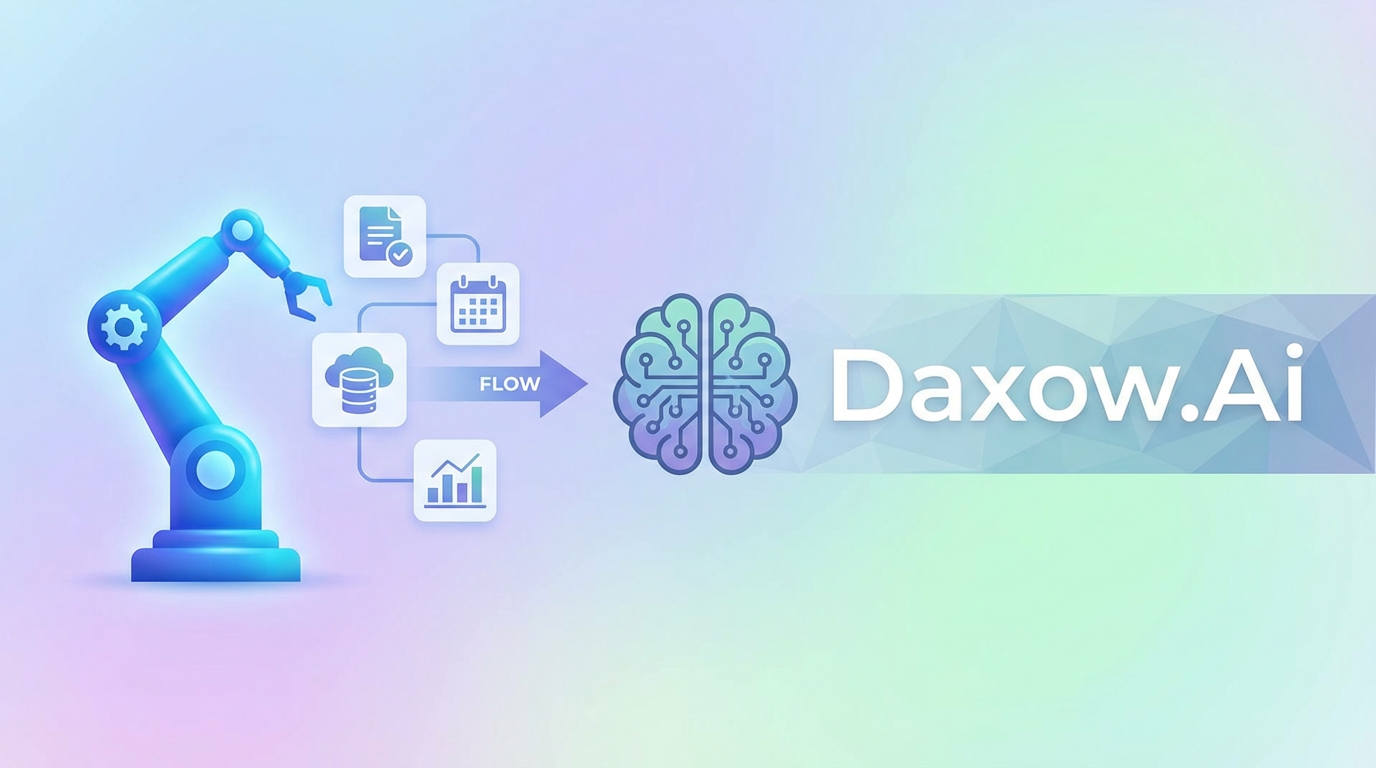
Learn how Daxow.ai uses AI agents and workflow automation to transform business processes, reduce manual work, and deliver measurable ROI across industries.
AI Automation: Transforming Business Processes for Competitive Advantage
Estimated reading time: 12 minutes
Key Takeaways
- AI automation enhances efficiency by automating repetitive tasks and improving customer experiences using AI agents and workflow automation.
- Key components include AI agents, workflow automation, and seamless integrations with enterprise systems.
- Industry use cases span e-commerce, healthcare, finance, real estate, and HR, each showing measurable impact in speed, accuracy, and compliance.
- A structured implementation framework ensures clear goals, data readiness, tool selection, testing, deployment, and ongoing governance.
- Daxow.ai delivers end-to-end custom AI solutions that reduce manual effort, boost productivity, and maximize ROI while ensuring ethical and scalable practices.
Table of Contents
- AI Automation: Transforming Business Processes for Competitive Advantage — What it Means for Your Company
- Key Components — AI Agents, Workflow Automation, and Integration
- Practical Use Cases and Industry Examples
- Implementation Framework — From Strategy to Continuous Improvement
- Reducing Manual Tasks and Increasing Productivity — Measurable Results
- Risk Management, Ethics, and Scalability
- How Daxow.ai Delivers End-to-End Business Automation
- Getting Started — A Practical Checklist
- Frequently Asked Questions
AI Automation: Transforming Business Processes for Competitive Advantage — What it Means for Your Company
AI automation combines artificial intelligence (machine learning, natural language processing, computer vision) with workflow automation and robotic process automation (RPA). The result is systems that can ingest data, make decisions, take actions across applications, and continuously learn. For business leaders this translates into:
- Faster, more accurate operations — automate high-volume rule-based tasks such as invoice matching, data entry, and scheduling to cut errors and cycle times.
- Scalable customer experiences — use chatbots and AI agents to provide 24/7 support and personalized service.
- Measurable ROI — pilots often show 3–5x returns from labor savings and error reduction; mature programs can deliver 20–50% efficiency improvements in targeted areas.
- Strategic workforce uplift — free staff from repetitive work so they can focus on analysis, complex problem-solving, and customer relationships.
Daxow.ai helps organizations realize these outcomes through end-to-end business automation: from workflow discovery and data preparation to building AI agents that execute real tasks and integrating solutions with existing tools and CRMs.
Key Components — AI Agents, Workflow Automation, and Integration
What are AI Agents in Business Contexts?
AI agents are autonomous or semi-autonomous systems that execute multi-step processes. They combine decision models, language understanding, and task orchestration to complete workflows end-to-end. Examples include agents that qualify leads, process invoices, route customer issues, or monitor operational anomalies.
- Capability: NLP for understanding customer inputs; ML models for predictions; RPA connectors for system actions.
- Benefit: Reduce manual tasks and handoffs; operate continuously with consistent rules.
Role of Workflow Automation and Integrations
Workflow automation orchestrates the sequence of actions — approvals, data transfers, notifications — and integrates with CRMs, ERPs, support platforms, and cloud data stores.
- Key requirement: Robust integrations and standardized data pipelines to eliminate silos.
- Outcome: Faster order-to-cash cycles, shortened claim processing, and real-time operational dashboards.
Daxow.ai specializes in designing integrations and building pipeline architectures so AI agents have clean, reliable access to the data and systems they need to act autonomously.
Practical Use Cases and Industry Examples
E‑commerce — Faster Fulfillment and Personalized CX
Use case:
- Automate order-to-cash processes: validate orders, check inventory, schedule fulfillment, trigger shipping labels, and update customers.
- Deploy NLP-driven chatbots for common inquiries and personalized product recommendations.
Impact:
- 40% faster fulfillment through automated routing and inventory checks.
- Reduced cart abandonment and higher repeat purchase rates.
How Daxow helps:
- Build AI agents that orchestrate order flows and integrate with e-commerce platforms and warehouses.
- Implement customer support automation that hands off complex issues to humans with full context.
Healthcare — Reduce Administrative Burden and Improve Compliance
Use case:
- Automate patient intake, appointment scheduling, and claims pre-processing.
- Extract structured data from medical documents to support diagnostics and billing.
Impact:
- Faster patient throughput, fewer rejected claims, and improved compliance.
- Administrative costs fall while clinician time increases for care delivery.
How Daxow helps:
- Create secure, auditable workflows with HIPAA-ready data handling.
- Train extraction models for clinical documents and integrate outputs with EMRs.
Finance — Fraud Detection, Reporting, and Invoice Matching
Use case:
- Automate invoice capture, three-way matching, exception routing, and regulatory reporting.
- Deploy predictive models for fraud and credit risk.
Impact:
- Higher accuracy and faster close cycles.
- Reduced financial risk and audit readiness.
How Daxow helps:
- Implement ML models for anomaly detection and end-to-end automation that posts exceptions to human reviewers with context.
- Connect with accounting systems and regulatory feeds to automate reporting.
Real Estate — Lead Qualification and Contract Automation
Use case:
- Automate lead capture, qualification, scheduling of viewings, and contract generation/review.
- Use computer vision for virtual tour enhancements and extraction of listing details.
Impact:
- Scaled lead handling with higher conversion rates and faster transaction times.
How Daxow helps:
- Design lead-qualification AI agents that score prospects and book viewings autonomously.
- Integrate contract review workflows and electronic signing for faster closings.
HR — Recruitment Screening and Onboarding Automation
Use case:
- Screen resumes, pre-screen candidates via AI-driven chat, automate onboarding documentation and IT provisioning.
Impact:
- Improved hire quality, reduced time-to-fill, and higher employee satisfaction.
- Lower administrative overhead for HR teams.
How Daxow helps:
- Build screening pipelines and onboarding workflows integrated with HRIS and payroll systems.
- Ensure bias mitigation and explainability in candidate scoring models.
Implementation Framework — From Strategy to Continuous Improvement
1. Define Clear Goals and Metrics
- Identify business priorities (reduce cost per ticket, speed up invoice processing).
- Set measurable targets (e.g., 20% cost reduction, 40% faster fulfillment).
- Align stakeholders and define success criteria.
2. Assess and Prepare Data
- Audit data sources for quality, completeness, and accessibility.
- Standardize ingestion pipelines and implement privacy controls.
- Prepare labeled datasets for supervised models and create synthetic data when needed.
3. Identify High-Impact Processes
- Map processes to find repetitive, rules-based tasks ideal for automation.
- Start with non-critical workflows to deliver quick wins and validate ROI.
4. Select Tools and Build the Right Team
- Choose platforms with strong APIs and integration support.
- Assemble a cross-functional team: data engineers, ML engineers, product managers, domain experts, and change managers.
- Provide training so teams can operate and optimize solutions post-deployment.
5. Test, Deploy, and Monitor
- Validate models with performance metrics (accuracy, F1, precision/recall).
- Deploy in phases with monitoring dashboards and alerting.
- Implement retraining schedules and feedback loops for continuous improvement.
6. Prioritize Change Management and Governance
- Communicate early wins to secure buy-in.
- Provide upskilling pathways for affected employees.
- Define governance to manage agent sprawl, ethical use, and model drift.
Daxow.ai supports each step by providing expert guidance, technical execution, and managed services for monitoring and model maintenance.
Reducing Manual Tasks and Increasing Productivity — Measurable Results
AI automation targets the highest-impact tasks to deliver concrete benefits:
- Reduce manual tasks such as data entry and routing, freeing staff for higher-value activities.
- Boost productivity through faster SLA adherence and fewer exceptions.
- Improve customer satisfaction with faster response times and consistent service.
- Lower operational costs with labor savings typically ranging from 30–50% in targeted areas.
Realistic ROI expectations:
- Early pilots commonly produce 3–5x returns in labor and error reduction.
- Mature programs that scale across departments often realize sustained efficiency gains of 20–50%.
Daxow.ai focuses on building measurable outcomes: baseline metrics, continuous monitoring, and financial models that tie automation improvements to bottom-line impact.
Risk Management, Ethics, and Scalability
Mitigating Risks
- Validate models rigorously before live deployment.
- Keep humans in the loop for high-risk decisions and exceptions.
- Monitor for drift and performance degradation.
Ethical and Regulatory Considerations
- Implement explainability and bias detection, particularly in hiring, lending, and healthcare applications.
- Ensure compliance with data privacy laws and industry regulations.
- Maintain audit trails and versioning for models and workflows.
Planning for Scalability
- Build modular, API-first architectures so new agents can reuse components.
- Standardize tooling and observability to manage multiple agents across teams.
- Create a center of excellence to coordinate strategy and governance.
Daxow.ai embeds governance, explainability, and compliance into every engagement to ensure scalable, secure, and responsible automation.
How Daxow.ai Delivers End-to-End Business Automation
Daxow.ai offers a practical sequence to convert opportunities into production value:
- Discovery and process mapping: locate automation targets and quantify benefits.
- Data engineering and integration: create reliable pipelines and integrate with CRMs, ERPs, and support tools.
- Prototype and pilot: build minimal viable AI agents for early validation.
- Production deployment: orchestrate workflows and integrate with monitoring and alerting systems.
- Continuous improvement: retrain models, expand use cases, and measure business KPIs.
Daxow.ai’s services include AI agents, workflow automation, chatbots & support automation, lead qualification systems, document extraction, and custom integrations — all tailored to industry and process requirements. Learn more about our services.
Getting Started — A Practical Checklist
- Identify 2–3 processes that are repetitive, high-volume, and have clear KPIs.
- Estimate baseline costs, error rates, and cycle times.
- Gather data sources and assess data quality.
- Choose an integration-first approach so automation links to your core systems.
- Plan a phased rollout with clear success metrics and governance.
Daxow.ai can run a rapid process analysis to prioritize opportunities and deliver a clear implementation roadmap. Discover how our process analysis can jumpstart your journey.
Frequently Asked Questions
What industries benefit most from AI automation?
AI automation delivers high value across industries such as e-commerce, healthcare, finance, real estate, and HR by improving operational efficiency, compliance, and customer experiences.
How does Daxow.ai ensure data privacy and compliance?
Daxow.ai incorporates privacy controls, audit trails, and compliance with data regulations such as HIPAA to secure sensitive data and maintain governance across automation projects.
What is the typical ROI timeline for AI automation?
Early pilot projects often produce 3–5x returns within months, while mature automation programs can deliver 20–50% efficiency gains as they scale.
Can AI automation replace human workers?
AI automation frees employees from repetitive tasks, enabling them to focus on higher-value activities such as analysis and decision-making rather than replacing the workforce.