
Master AI Workflow Automation for Business Transformation
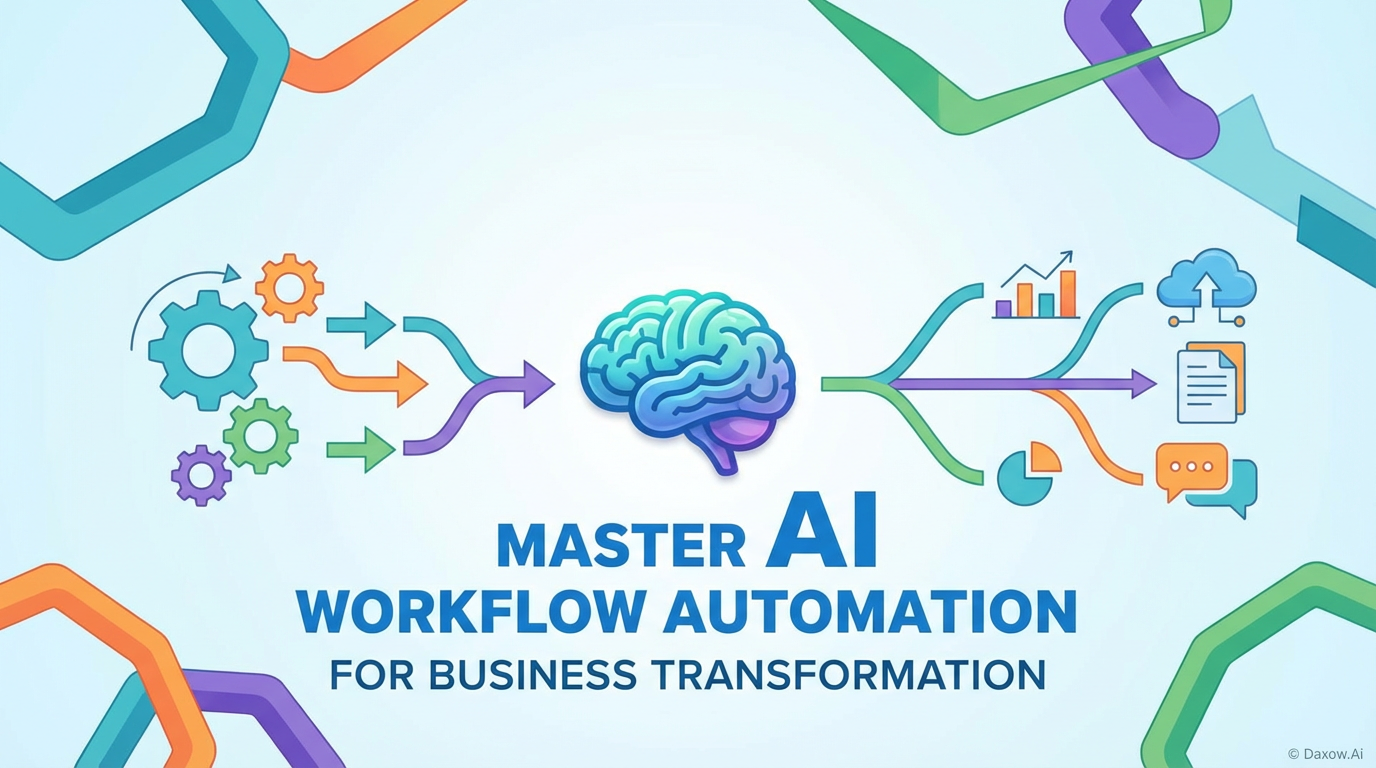
Discover how Daxow.ai implements AI workflow automation and agents to reduce manual tasks, improve productivity, and deliver measurable ROI across industries.
Mastering AI Workflow Automation: A Strategic Imperative for Business Transformation
Estimated reading time: 15 minutes
Key Takeaways
- AI workflow automation transforms manual, error-prone workflows into intelligent, measurable processes.
- Businesses can expect significant reductions in process times and error rates, with workforce hours reallocated to strategic activities.
- AI agents enable autonomous execution, adaptive behavior, and deep integration with existing systems.
- Implementing AI automation requires a structured phased approach, prioritizing data quality, stakeholder engagement, and ethical AI standards.
- Daxow.ai offers end-to-end AI workflow automation solutions that deliver fast ROI and scalable business impact.
Table of Contents
- Mastering AI Workflow Automation: A Strategic Imperative for Business Transformation
- What AI Workflow Automation Means for Businesses
- Practical Use Cases Across Industries
- How AI Agents and Automation Drive Results
- Implementation Steps and Best Practices
- Measuring ROI and Business Value
- How Daxow.ai Delivers End-to-End Business Automation
- Getting Started — A Practical Checklist
- Frequently Asked Questions
Mastering AI Workflow Automation: A Strategic Imperative for Business Transformation
Why this matters now
- Markets move faster, data volumes grow, and customer expectations rise. Manual processes create bottlenecks and risk.
- AI workflow automation leverages machine learning, generative AI, and systems integration to handle repetitive tasks and enable intelligent decision-making.
- The result: faster cycle times, fewer errors, and the ability to redeploy human talent to strategic work that drives growth.
Business outcomes to expect
- Reduced process times by 20–50%.
- Error rates driven below 5% in automated tasks.
- Reallocation of up to 30% of workforce hours toward higher-value activities.
- Typical payback timelines: 6–12 months for focused automation projects when implemented correctly.
What AI Workflow Automation Means for Businesses
From manual to intelligent processes
AI workflow automation combines rule-based automation with AI capabilities to:
- Automate high-volume transactional work (e.g., invoice processing, data entry).
- Apply intelligence for complex tasks (e.g., fraud detection, demand forecasting, sentiment analysis).
- Orchestrate end-to-end flows across systems, eliminating handoffs and ensuring consistent execution.
Strategic advantages
- Operational efficiency: fewer manual steps and faster throughput.
- Scalability: handle volume spikes without proportional headcount increases.
- Improved customer experience: faster responses and personalized interactions through customer support automation and chatbots.
- Risk reduction: continuous monitoring and anomaly detection reduce business disruption.
Practical Use Cases Across Industries
E-commerce — Order-to-cash, personalization, and returns
- Problem: Slow order processing, stockouts, and time-consuming returns handling.
- Solution: AI agents predict demand, automate inventory reconciliation, process returns, and manage customer inquiries through conversational bots integrated with CRM and fulfillment systems.
- Benefits: 10–15% uplift in sales through personalization, faster fulfillment, and reduced return processing time.
Healthcare — Scheduling, document automation, and triage
- Problem: Administrative burden on clinicians and long patient wait times.
- Solution: Automate patient scheduling, extract and summarize medical records, triage routine queries with virtual assistants, and flag anomalies for clinician review.
- Benefits: Reduced administrative workload, faster patient throughput, and improved compliance with medical record handling.
Finance — Fraud detection, compliance, and reporting
- Problem: High-volume transactions and manual compliance checks.
- Solution: AI agents monitor transactions in real-time, flag suspicious patterns, automate KYC and compliance checks, and generate audit-ready reports.
- Benefits: Lower fraud losses, faster audits, and significant reduction in manual compliance hours.
Real Estate — Lead qualification and contract automation
- Problem: Inefficient lead qualification and slow contract processing.
- Solution: AI agents qualify leads via automated outreach, schedule showings, extract contract terms from documents, and auto-populate contracts for review.
- Benefits: Faster deal cycles, higher lead-to-conversion rates, and reduced legal bottlenecks.
HR — Recruitment, onboarding, and performance tracking
- Problem: Time-consuming screening and onboarding tasks.
- Solution: Automate resume screening, match candidates to roles, generate personalized onboarding checklists, and monitor performance metrics.
- Benefits: Up to 50% reduction in hiring time, improved candidate experience, and lower administrative costs per hire.
How AI Agents and Automation Drive Results
What AI agents do differently
- Autonomous execution: perform tasks end-to-end, not just trigger single actions.
- Adaptive behavior: learn from feedback and update decisions based on new data.
- Integration capability: connect to CRMs, ERPs, ticketing systems, and databases to execute cross-system processes.
Combining automation and intelligence
- Automation handles scale and reliability (e.g., document population, scheduled processes).
- AI introduces judgment and prediction (e.g., prioritizing leads, forecasting demand).
- Together, they allow organizations to shift from reactive firefighting to proactive business management.
Example orchestration
In finance, an AI agent ingests invoices (data extraction), validates them against purchase orders (rule automation), flags anomalies for review (AI judgment), and posts approved payments to the ERP (integration). This reduces invoice cycle time and manual reconciliation.
Implementation Steps and Best Practices
Daxow.ai’s phased approach
- Define goals and audit processes
- Identify specific outcomes (e.g., reduce processing time by 40%, improve NPS by 10 points).
- Conduct task mining and process mapping to find high-impact automation opportunities.
- Assess and prepare data
- Audit data quality, standardize formats, and build secure pipelines.
- Ensure compliance with privacy regulations and governance standards.
- Select tools and assemble the team
- Choose scalable platforms with robust integrations and security.
- Form a cross-functional team: domain experts, engineers, product managers, and change leads.
- Prototype and integrate
- Start with a low-risk pilot that validates assumptions.
- Integrate early with legacy systems to surface interface challenges.
- Deploy, monitor, and optimize
- Roll out in phases with clear KPIs, retrain models as needed, and centralize governance to prevent shadow AI.
Core best practices
- Set measurable targets: define KPIs like time saved, error reduction, and cost per transaction.
- Prioritize ethical AI: monitor for bias and ensure transparent decision logs.
- Engage stakeholders: involve IT, legal, and front-line teams early to accelerate adoption.
- Scale incrementally: validate ROI in a pilot before enterprise-wide deployment.
Common pitfalls and mitigations
- Data quality issues: mitigate with a data cleansing and enrichment phase.
- Integration hurdles: mitigate with API-first design and phased rollouts.
- Resistance to change: mitigate through training, clear communication, and visible early wins.
Measuring ROI and Business Value
Quantifying impact
Use both leading and lagging metrics:
- Leading: process cycle time, automation rate, model accuracy.
- Lagging: cost savings, revenue uplift, customer satisfaction, time-to-resolution.
Typical impact benchmarks:
- 40–60% reduction in operational expenses for data-heavy tasks.
- 10–15% revenue uplift from predictive personalization in e-commerce.
- Error rates under 5% for automated document processing.
Long-term value
- Beyond immediate savings, AI workflow automation builds an AI-first culture.
- Continuous improvement and model retraining drive sustained 15–25% annual efficiency gains.
- Reinvested productivity enables new capabilities and innovation.
How Daxow.ai Delivers End-to-End Business Automation
From discovery to production
- Discovery and process analysis: we map workflows, identify automation candidates, and quantify expected ROI.
- Custom AI solution design: we architect AI agents, workflow automation, and integrations tailored to your tech stack.
- Implementation and integration: we build connectors to CRMs, ERPs, ticketing systems, and data stores to ensure seamless execution.
- Governance and monitoring: we establish KPIs, model monitoring, and governance practices to maintain performance and compliance.
- Ongoing optimization: we continuously refine models and expand automation to new processes.
Practical example — Sales automation implementation
- Discovery: Identify repetitive lead qualification steps using CRM logs.
- Design: Build an AI agent to score leads, auto-respond initial inquiries, and schedule qualified prospects.
- Integration: Connect the AI agent to the CRM, calendar system, and email platform.
- Outcome: Faster lead response, higher conversion rates, and reduced manual qualification work for sales reps.
Why partner with Daxow.ai
- Custom solutions: off-the-shelf tools rarely match specific operational needs. Daxow builds tailored systems that integrate with existing infrastructure.
- End-to-end delivery: from data pipelines to AI agents that execute tasks, we manage the full lifecycle.
- Focus on ROI: we prioritize automations that return measurable business value within months.
- Security and compliance: built-in governance and privacy safeguards for regulated industries.
Getting Started — A Practical Checklist
Quick readiness checklist
- List the top 5 repetitive processes consuming staff time.
- Gather sample data and estimate current process cycle times.
- Identify integration points (CRM, ERP, support platform).
- Define one clear KPI for your first pilot (cost per transaction, time-to-resolution, NPS).
- Appoint a cross-functional sponsor and project lead.
Pilot project ideas
- Automate invoice ingestion and approval routing (finance).
- Implement a customer support automation bot for tier-1 inquiries (customer support automation).
- Build an AI lead-qualification agent that integrates with your CRM (sales automation).
- Create an onboarding assistant that personalizes new hire checklists (HR automation).
Frequently Asked Questions
What is AI workflow automation?
AI workflow automation uses artificial intelligence to automate and optimize business processes by combining rule-based automation with machine learning, generative AI, and system integrations.
How quickly can businesses see ROI from AI automation?
Focused automation projects typically achieve payback within 6 to 12 months when implemented correctly with clear goals and strong stakeholder engagement.
What industries benefit the most from AI workflow automation?
AI automation delivers significant value across industries including e-commerce, healthcare, finance, real estate, and HR, among others.
Why choose Daxow.ai for AI automation solutions?
Daxow.ai offers custom-designed AI agents, seamless system integration, and a results-driven approach that prioritizes ROI, security, and ethical AI practices throughout the automation journey.