
AI Workflow Automation: Transform Operations with Daxow.ai
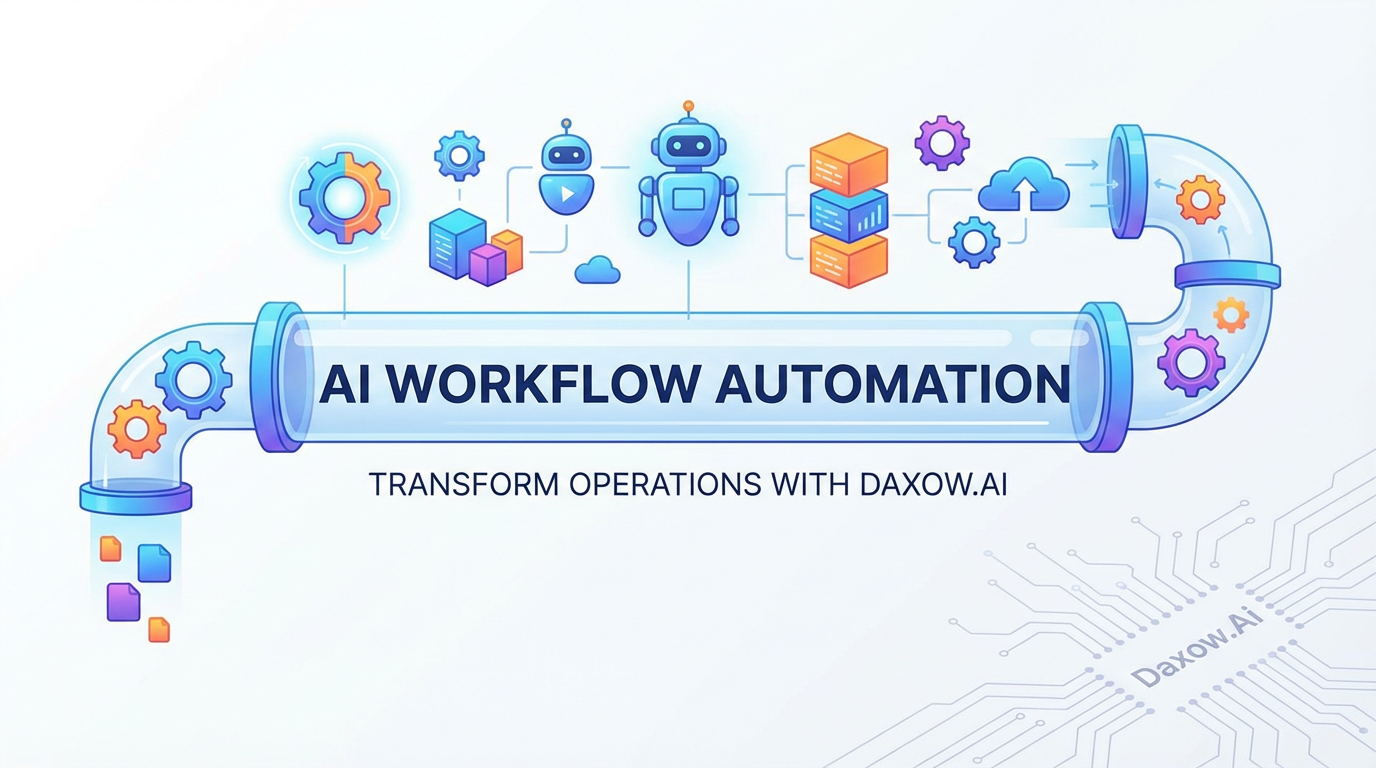
Daxow.ai explains AI workflow automation, use cases, pilot roadmap and ROI to cut costs, speed processes, and scale enterprise operations.
AI Workflow Automation: Transforming Business Operations for the Modern Enterprise
Estimated reading time: 15 minutes
Key Takeaways
- AI workflow automation integrates AI agents with traditional automation to optimize repetitive and high-volume business tasks.
- It drives measurable ROI through cost reductions, speed improvements, and enhanced customer experiences.
- Practical use cases span multiple industries including e-commerce, healthcare, finance, real estate, HR, and customer support.
- A phased implementation roadmap and best practices ensure successful deployment and continuous optimization.
- Daxow.ai provides custom AI system design, integration, deployment, monitoring, and governance services for scalable automation.
Table of Contents
- AI Workflow Automation: What It Means for Your Business
- How AI Agents and Automation Work Together
- Practical Use Cases: AI Workflow Automation in Action
- Implementation Roadmap and Best Practices
- Measuring ROI and Business Value
- How Daxow.ai Designs and Delivers AI Workflow Automation
- Getting Started — Pilot Opportunities and Next Steps
- Frequently Asked Questions
AI Workflow Automation: What It Means for Your Business
AI workflow automation integrates AI agents and traditional automation to execute repetitive, high-volume tasks with speed and accuracy. It combines rule-based automation for deterministic tasks with machine learning models that add prediction, classification, and natural language understanding. The result is a resilient system that both reduces errors and scales with demand.
Key business impacts:
- Reduce manual tasks such as data entry, invoice reconciliation, and ticket triage.
- Boost productivity by reallocating human resources to strategic activities.
- Improve customer outcomes through faster response times and contextual, personalised interactions.
- Lower operational costs, often yielding 20–50% savings in labor and process overhead.
- Scale without proportional headcount increases, supporting growth for years ahead.
Core capabilities in AI workflow automation:
- AI agents that perform autonomous actions, escalate exceptions, and interact with systems.
- Workflow orchestration that sequences tasks across systems (CRM, ERP, ticketing).
- Data extraction and document automation for invoices, forms, and contracts.
- Customer support automation including conversational AI, knowledge retrieval, and ticket routing.
- Sales automation for lead qualification and follow-up workflows.
How AI Agents and Automation Work Together
AI agents perform continuous tasks: they read incoming data, apply decision logic, enrich records, and take action. Automation handles high-volume rule-based steps while AI supplements with predictions (e.g., risk scoring) and natural language operations (e.g., intent detection). Together they:
- Resolve routine inquiries automatically and escalate complex cases.
- Extract data from unstructured documents and update backend systems.
- Route leads by likelihood to convert and trigger personalized sequences.
- Monitor exceptions and initiate human review when confidence is low.
Practical Use Cases: AI Workflow Automation in Action
E-commerce — Faster Fulfillment and Better Conversions
Use case:
- Automated order validation and inventory updates.
- AI agents predict demand spikes and trigger replenishment.
- Customer support automation provides instant order status and returns handling.
Business impact:
- Fulfillment times reduced by up to 40%.
- Lower cart abandonment through faster, personalised responses.
- Reduced order errors and returns handling costs.
How Daxow.ai helps:
- Build integrations between storefronts, warehouses, and ERPs.
- Deploy AI agents for order exception handling and predictive replenishment.
- Implement customer support automation that connects to product, order, and shipping data.
Healthcare — Efficient Administration with Compliance
Use case:
- Automated patient scheduling, insurance verification, and claims processing.
- Document automation for clinical forms, referral letters, and discharge summaries.
Business impact:
- Significant reduction in administrative workload.
- Improved accuracy and compliance with HIPAA-safe data handling.
- Faster claims cycle and fewer denials.
How Daxow.ai helps:
- Design HIPAA-compliant automation and audit trails.
- Integrate AI-powered data extraction with EMRs and billing systems.
- Create escalation flows for clinical exceptions to ensure safety.
Finance — Faster Reconciliation and Stronger Controls
Use case:
- Invoice processing with automated OCR and matching.
- Fraud detection and compliance checks during transaction processing.
Business impact:
- 20–50% cost savings in operations by reducing manual reconciliations.
- Faster order-to-cash cycles and reduced error rates.
- Improved auditability and regulatory compliance.
How Daxow.ai helps:
- Implement document automation and reconciliation bots connected to ledgers.
- Embed anomaly detection models to flag suspicious transactions.
- Provide secure integrations with accounting systems and compliance reporting.
Real Estate — Prioritised Leads and Faster Deals
Use case:
- AI agents qualify inbound inquiries, schedule viewings, and populate CRM records.
- Automated listing updates and virtual tour scheduling.
Business impact:
- Faster response to high-intent leads.
- Shorter sales cycles by focusing human agents on the highest-value prospects.
- Improved conversion through timely follow-up.
How Daxow.ai helps:
- Build lead qualification agents integrated with property portals and CRMs.
- Automate scheduling and follow-up workflows across channels.
- Tune models to local market signals to prioritise best opportunities.
HR — Smarter Hiring and Onboarding
Use case:
- Resume screening, interview scheduling, and onboarding checklist automation.
- Employee query bots for benefits, payroll, and policy questions.
Business impact:
- Hiring time reduced by up to 50% for screened roles.
- Consistent onboarding experiences and faster time-to-productivity.
- Better employee satisfaction through instant internal support.
How Daxow.ai helps:
- Create AI agents that match candidate profiles to job requirements.
- Automate background checks and documentation flows.
- Deploy internal support automation that connects to HRIS systems.
Customer Support and Sales Automation — Contextual, Fast Responses
Use case:
- Conversational AI resolves common queries 70–80% of the time.
- Sales automation qualifies leads and triggers nurture sequences.
Business impact:
- Improved CSAT and NPS through faster, consistent responses.
- Higher lead-to-opportunity conversion and faster pipeline movement.
How Daxow.ai helps:
- Build conversational AI that leverages company knowledge bases.
- Integrate support automation with ticketing tools, CRMs, and order data.
- Deliver agent-assist tools that provide suggested replies and summarised context.
Implementation Roadmap and Best Practices
Phase 1 — Assessment and Planning (4–8 weeks)
- Conduct a process audit to identify repetitive, high-volume tasks.
- Define measurable objectives (cost reduction, speed, CSAT).
- Assess data quality, integrations, and regulatory constraints.
- Deliverable: prioritised roadmap and success metrics.
Phase 2 — Technology Selection and Team Formation (6–12 weeks)
- Select scalable platforms compatible with your tech stack.
- Assemble a cross-functional team: IT, operations, product, and change leads.
- Choose no-code/low-code tools for rapid prototyping where appropriate.
- Deliverable: tech stack and project governance model.
Phase 3 — Data Preparation and Workflow Design (4–8 weeks)
- Cleanse and enrich data; build knowledge bases and decision trees.
- Map integrations with CRM, ERP, and other systems; define audit trails.
- Deliverable: data model, integration plan, and test datasets.
Phase 4 — Pilot Deployment and Iteration (4–20 weeks)
- Run a focused pilot (e.g., invoice processing or lead qualification).
- Monitor KPIs: automation rate, accuracy, processing time, CSAT.
- Iterate on models and rules based on feedback.
- Deliverable: validated pilot with ROI assessment.
Phase 5 — Scale and Continuous Optimization
- Roll out across teams, channels, and geographies.
- Implement monitoring dashboards, retraining cycles, and governance.
- Deliverable: enterprise-wide automation with continuous improvement.
Best practices to follow:
- Start small with a high-impact pilot to prove value quickly.
- Prioritise data quality; better data yields faster, more reliable automation.
- Build a cross-functional team to ensure alignment and adoption.
- Ensure deep integration with existing systems to preserve context.
- Monitor and iterate—automation models must evolve with business changes.
- Manage scope to prevent creep and retain measurable objectives.
Measuring ROI and Business Value
Quantifying benefits is essential for buy-in and continued investment. Typical outcomes observed across enterprises:
- Cost reductions: 20–50% lower operational costs by automating manual workflows.
- Speed improvements: 30–70% faster processing for common workflows.
- Revenue upside: 15–25% increase through improved customer experience and conversion.
- Time to value: measurable results within 6–12 months post-pilot.
Key metrics to track:
- Automation rate (%) of tasks fully handled by systems.
- Time-to-resolution or processing time improvements.
- Error reduction or decrease in exception rates.
- CSAT, NPS, and conversion uplift for customer- and sales-facing workflows.
- Total cost of ownership and payback period for automation investments.
How Daxow.ai Designs and Delivers AI Workflow Automation
Daxow.ai brings a pragmatic, end-to-end approach focused on business outcomes. Our services include:
Assessment and Process Analysis
- We map current workflows, quantify manual effort, and identify the highest-impact automation opportunities.
- We define clear KPIs and a phased roadmap for pilot and scale.
Custom AI System Design
- We design AI agents tailored to your processes—lead qualification bots, document extraction agents, support AI, and more.
- Models are trained on your data to ensure domain relevance and accuracy.
Integration and Systems Connectivity
- We connect AI systems to CRMs, ERPs, ticketing platforms, and knowledge bases.
- Our team ensures secure data flows, audit trails, and compliance with industry regulations.
Automation Build and Deployment
- We combine rule-based automation with ML and NLP to handle both deterministic and nuanced tasks.
- Pilots are delivered rapidly with no-code/low-code where appropriate to accelerate feedback.
Monitoring, Governance, and Ongoing Optimisation
- We provide monitoring dashboards, retraining pipelines, and performance governance.
- Continuous improvement cycles ensure the automation adapts to new products, regulations, and customer behaviour.
Business outcomes we enable:
- Reduce operational costs through labour displacement and error reduction.
- Improve ROI with rapid pilot validation and data-driven scaling.
- Enhance productivity by enabling teams to focus on strategic work.
- Deliver customer support automation that raises CSAT while lowering response times.
- Scale sales automation to prioritise and nurture high-value leads automatically.
Getting Started — Pilot Opportunities and Next Steps
To minimise risk and maximise impact, start with a tightly scoped pilot that addresses a high-volume pain point. Typical pilots we recommend:
- Invoice processing and accounts payable automation.
- Lead qualification and scheduling for sales teams.
- Customer support automation for common inquiry types.
- Onboarding and HR workflows for faster time-to-productivity.
How to begin:
- Request a process analysis for your company.
- Identify a pilot with clear KPIs and executive sponsorship.
- Collaborate on a roadmap that balances speed and scalability.
AI workflow automation is not a theoretical advantage — it is a practical, measurable way to reduce manual work, boost productivity, and transform customer and employee experiences. Daxow.ai helps organisations design and deploy custom AI agents and business automation that integrate with your systems, protect your data, and deliver tangible ROI.
Frequently Asked Questions
What is AI workflow automation?
AI workflow automation combines AI-powered agents and traditional automation to handle repetitive and high-volume tasks, increasing efficiency, reducing errors, and enabling better scaling.
Which industries benefit most from AI workflow automation?
Industries such as e-commerce, healthcare, finance, real estate, HR, and customer support see significant ROI and operational improvements from AI workflow automation.
How does Daxow.ai support automation deployment?
Daxow.ai offers end-to-end services including assessment, custom AI system design, integrations, pilot deployment, monitoring, and continuous optimization to ensure successful automation at scale.
What are typical results from AI workflow automation?
Organizations typically achieve 20-50% cost savings, 30-70% faster processing, and 15-25% revenue increases, with measurable benefits within 6-12 months of deployment.