
Mastering AI Agent Implementation for Enterprise Automation (2026)
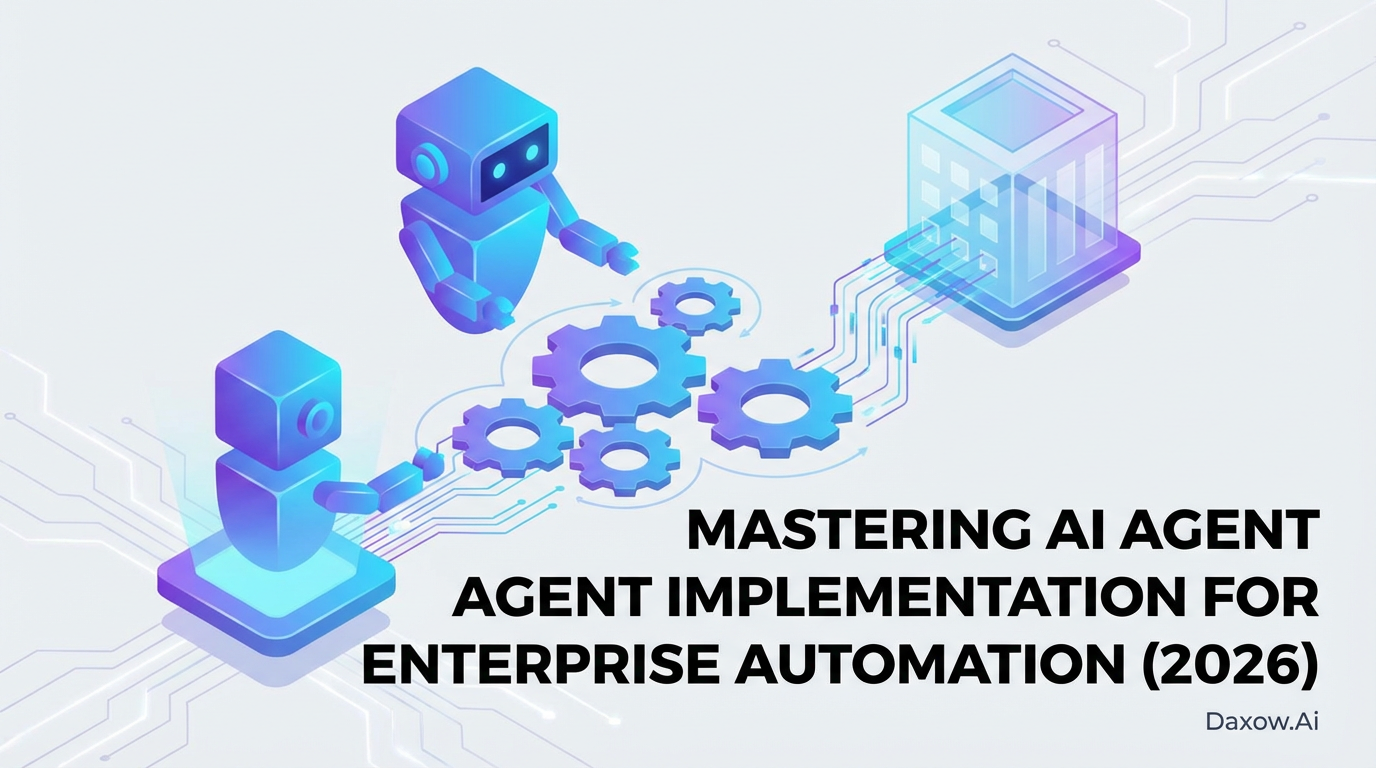
Practical roadmap to deploy enterprise AI agents in 2026, covering use cases, architecture, implementation steps, KPIs, ROI, and Daxow.ai's deployment approach.
Mastering AI Agent Implementation: Unlocking Enterprise-Scale Automation in 2026
Estimated reading time: 15 minutes
Key Takeaways
- AI agent implementation transforms manual processes into scalable, reliable enterprise automation systems.
- Industry-specific AI agents improve efficiency in E-commerce, Healthcare, Finance, Real Estate, and HR.
- Successful deployment depends on strategic planning, robust architecture, and continuous monitoring.
- Enterprises can realize measurable ROI, often achieving 3–5x returns within 6–12 months.
- Daxow.ai provides end-to-end AI agent solutions focusing on business outcomes and operational resilience.
Table of Contents
- Mastering AI Agent Implementation: Unlocking Enterprise-Scale Automation in 2026
- Practical Use Cases — AI agents across industries
- How AI agents and automation drive transformation
- Implementation steps and best practices
- Measuring ROI and business value
- How Daxow.ai helps you implement AI agent solutions
- Practical roadmap — from pilot to enterprise scale
- Frequently Asked Questions
Mastering AI Agent Implementation: Unlocking Enterprise-Scale Automation in 2026
Mastering AI Agent Implementation: Unlocking Enterprise-Scale Automation in 2026 is no longer theoretical — it is a practical roadmap for organisations that want to convert manual, error-prone processes into reliable, scalable systems. For business owners, operations leaders, CTOs and heads of customer support, this trend promises measurable cost savings, faster response times, and repeatable business value.
This article explains what AI agent implementation means for enterprises, walks through proven use cases across industries, presents a step-by-step implementation framework, and shows how Daxow.ai designs and deploys custom AI systems to deliver real-world ROI.
Why AI agent implementation matters now
AI agent implementation refers to deploying autonomous or semi-autonomous software agents that perceive inputs, make decisions, and execute tasks with minimal human intervention. In 2026 the technology and standards to support agent interoperability, secure data exchange, and continuous improvement have matured. The result: businesses can move beyond point automation to orchestrated, enterprise-scale AI automation that integrates with existing systems and supports end-to-end workflows.
- Business impact: Reduced manual tasks, fewer errors, faster cycle times, and improved customer experiences.
- Operational benefit: 24/7 execution, consistent policy enforcement, and scaled throughput without proportional headcount increases.
- Technical advantage: Modern architectures (cloud-native, API-first, data pipelines) enable secure, resilient AI agents that can be monitored and updated.
Key enterprise outcomes to measure
- Time-to-resolution improvement for customer queries.
- Percentage reduction in manual processing hours.
- Cost savings in operational activities.
- Accuracy and error-rate reduction in data processing.
- ROI payback period (typical pilots show 6–12 months).
Practical Use Cases — AI agents across industries
AI agents are most effective where work is repetitive, data-heavy, or requires rapid decisioning. Below are industry-specific, actionable examples you can adapt.
E-commerce — Order-to-cash and customer support automation
- Order processing agents validate orders, check inventory across warehouses, and trigger shipping workflows.
- Invoice automation agents extract, reconcile, and post invoices to ERP systems, reducing AP cycle time.
- Customer support automation uses NLP agents to handle routine queries, escalate complex issues, and route priority tickets to humans.
Business outcome: reduced cart abandonment, faster fulfillment, and lower support cost per ticket.
Healthcare — Triage, scheduling and records management
- Virtual triage agents classify incoming patient messages and surface urgent cases to clinical staff.
- Scheduling agents match patient preferences, provider availability, and compliance rules to automate appointments.
- Document automation extracts structured data from referral forms and medical records, ensuring audit trails and compliance.
Business outcome: improved patient response times, higher clinic utilization, and reduced administrative burden.
Finance — Reconciliation, fraud detection and sales automation
- Reconciliation agents match transactions with ledgers and flag anomalies for review.
- Fraud detection agents combine rule engines with anomaly detection to stop suspicious activity in near-real-time.
- Sales automation agents qualify leads, schedule demos, and push opportunities into CRM workflows.
Business outcome: lower error rates, reduced fraud losses, and higher-quality sales pipelines.
Real estate — Lead qualification and digital customer journeys
- Listing agents syndicate property data, update portals, and auto-generate marketing materials.
- Lead qualification agents score inquiries, schedule virtual tours, and generate preliminary valuation reports.
Business outcome: shorter time-to-contract and more efficient agent utilization.
HR — Talent screening and retention analytics
- Resume screening agents parse CVs, shortlist candidates based on role-specific criteria, and schedule interviews.
- Onboarding agents guide new hires through paperwork, training checklists, and equipment provisioning.
- Predictive agents analyze engagement signals to forecast turnover risk.
Business outcome: faster hiring cycles and improved employee experience.
How AI agents and automation drive transformation
AI agents combine autonomy with human oversight to balance speed and control. That mix produces three transformational capabilities:
- Autonomous decisioning: Agents handle dynamic scenarios such as fraud detection and personalized recommendations.
- Scripted automation: Agents execute rule-based tasks like data entry and document processing.
- Continuous learning: Agents ingest feedback and retrain to maintain or improve accuracy over time.
Daxow.ai builds AI agents that integrate into your technology stack via robust APIs and secure data pipelines. We prioritize reliability with monitoring, error handling, and human-in-the-loop checkpoints for high-risk decisions. This combination delivers resilient workflow automation that scales horizontally across departments.
Architecture patterns that work
- Cloud-native, microservice-based deployments to ensure scalability and fault tolerance.
- API-first integrations for clean connectivity with CRMs, ERPs, ticketing systems, and databases.
- Data validation layers and audit logs to maintain data quality and compliance.
- Monitoring and observability for performance metrics and model drift detection.
Implementation steps and best practices
1. Strategic assessment and planning
- Identify high-impact processes that are rule-based or data-rich.
- Set measurable KPIs (e.g., reduce manual hours by 30%, cut ticket response time by 50%).
- Choose agent types: use autonomous agents for complex decisioning and scripted agents for repetitive tasks.
- Define governance, compliance requirements, and stakeholder roles.
2. Technology architecture and design
- Build cloud-native infrastructure with secure API gateways.
- Design data pipelines that include validation and lineage tracking.
- Adopt interoperability standards where possible to simplify integrations.
- Plan for human-in-the-loop interfaces and exception handling.
3. Development and integration
- Prototype with limited scope and iterate quickly.
- Implement robust error handling and fallback strategies.
- Create admin dashboards for operations and non-technical stakeholders.
- Test with real-world scenarios and edge cases.
4. Deployment and change management
- Start with low-risk pilots to validate value and refine processes.
- Train teams on how agents interact with existing systems.
- Maintain human oversight for critical decisions and regulatory requirements.
- Communicate benefits and changes to end users to drive adoption.
5. Monitoring and optimization
- Track agent performance against KPIs and SLAs.
- Monitor model drift and retrain models when performance degrades.
- Use feedback loops to capture user corrections and improve accuracy.
- Scale successful pilots into adjacent use cases and departments.
Best practices summary
- Start small: run focused pilots to demonstrate rapid ROI.
- Prioritize data quality: clean, validated data prevents downstream errors.
- Implement governance: ensure compliance and manage operational risk.
- Align business and IT: cross-functional teams accelerate adoption.
- Iterate continuously: treat deployments as living systems that require maintenance.
Measuring ROI and business value
AI agent programs produce measurable outcomes when aligned to clear KPIs and phased scaling. Common metrics and expected ranges include:
- Operational cost reduction: up to 40% in automated workflows.
- Productivity gains: significant reduction in manual processing hours (varies by process).
- Time-to-value: pilots often pay back in 6–12 months.
- Accuracy improvements: lower error rates and fewer rework cycles.
- Customer satisfaction: faster response times improve CSAT and NPS scores.
Long-term value comes from continuous optimization. Regular model updates and expanding agents to new processes prevent stagnation and unlock incremental gains. At Daxow.ai, clients commonly achieve 3–5x ROI by focusing on high-impact workflows, automation governance, and phased scaling.
How Daxow.ai helps you implement AI agent solutions
Discovery and process analysis
- We map current workflows, identify automation opportunities, and quantify potential savings.
- We define KPIs and success criteria to measure pilot performance.
Custom design and development
- We design AI agents tailored to your processes: NLP agents for customer support, ML agents for forecasting, and RPA-style agents for integration-heavy tasks.
- We build secure, API-first architectures that integrate with CRMs, ERPs and other business systems.
Integration and deployment
- We deploy agents into production with robust monitoring, logging and human-in-the-loop capabilities.
- We run pilots to validate outcomes and refine models before scaling.
Ongoing optimization and governance
- We establish monitoring practices, retraining schedules, and governance frameworks to mitigate risk and ensure compliance.
- We provide operational support and managed services to keep agents performing at scale.
Example engagement outcomes
- A retail client automated order reconciliation and customer support triage, reducing manual FTE hours by 60% and cutting order errors by 45%.
- A financial services firm deployed reconciliation and fraud detection agents, shortening investigation times and improving detection rates with minimal false positives.
- A healthcare provider automated appointment scheduling and triage, increasing clinic throughput and improving patient satisfaction scores.
Practical roadmap — from pilot to enterprise scale
Phase 1: Pilot and prove
- Scope a single process with clear KPIs.
- Build an MVP agent and run a limited-scope pilot.
- Measure results and refine models.
Phase 2: Stabilize and integrate
- Harden data pipelines, error handling, and security.
- Integrate with core systems and create operator dashboards.
- Train staff and document procedures.
Phase 3: Scale and govern
- Expand to adjacent processes and departments.
- Establish enterprise governance and retraining cadence.
- Align budgeting and roadmap for continuous investment.
Phase 4: Optimize and innovate
- Use agent outputs to derive predictive insights and new business models.
- Integrate agents into strategic decision workflows.
- Continuously benchmark and optimize for cost and performance.
Closing — next steps for decision-makers
AI agents are a practical lever to reduce manual tasks, increase productivity, and transform customer and operational workflows. The path to enterprise-scale automation requires clear strategy, strong data foundations, and disciplined execution. Daxow.ai helps organisations from initial process analysis through custom development, secure integrations, and ongoing optimization.
Book a free consultation with Daxow.ai to request a process analysis for your company and learn how we can build a custom AI system that reduces operational costs and delivers measurable ROI. Contact us today to start your AI automation journey.
Frequently Asked Questions
What is an AI agent in enterprise automation?
An AI agent is an autonomous or semi-autonomous software system that perceives inputs, makes decisions, and executes tasks with minimal human intervention to automate workflows and improve efficiency.
How quickly can enterprises expect ROI from AI agent implementation?
Typical pilots show ROI payback periods between 6 and 12 months, with clients often achieving 3-5x return by scaling and optimizing workflows.
What industries benefit most from AI agents?
AI agents effectively improve efficiency and accuracy in industries like E-commerce, Healthcare, Finance, Real Estate, and HR, especially in repetitive or data-heavy workflows.
How does Daxow.ai support AI agent implementations?
Daxow.ai provides end-to-end services including process analysis, custom AI agent design, secure integration, deployment, ongoing monitoring, optimization, and governance to achieve business outcomes.