
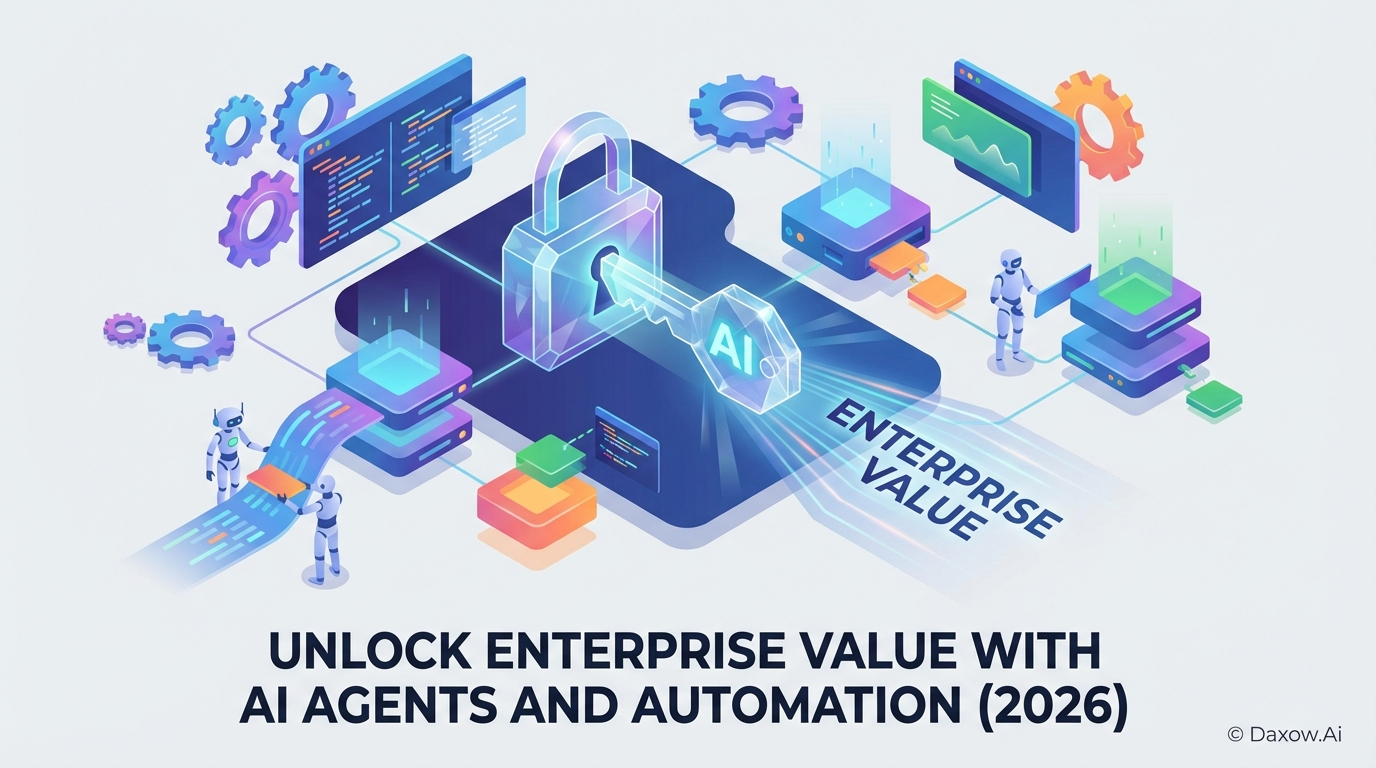
Unlock Enterprise Value with AI Agents and Automation (2026)
Practical roadmap to implement AI agents and workflow automation in enterprises—use cases, ROI expectations, and how Daxow.ai delivers measurable results.
Unlocking Enterprise Value: Implementing AI Agents and Automation in 2026
Estimated reading time: 12 minutes
Key Takeaways
- AI agents and workflow automation can deliver 30–50% efficiency gains and 3–5x ROI within 12–18 months.
- Practical use cases span ecommerce, healthcare, finance, real estate, and HR with measurable business impacts.
- Hybrid autonomous and deterministic approaches build resilient enterprise automation systems.
- Successful implementation relies on strategic planning, secure design, integration, and continuous optimization.
- Daxow.ai provides end-to-end AI automation solutions including custom agents, integrations, and governance.
Table of Contents
- Unlocking Enterprise Value: Implementing AI Agents and Automation in 2026
- Practical Use Cases Across Industries
- How AI Agents and Automation Drive Business Transformation
- Implementation Steps and Best Practices
- Measuring ROI and Business Value
- How Daxow.ai Delivers End-to-End AI Automation Solutions
- Frequently Asked Questions
Unlocking Enterprise Value: Implementing AI Agents and Automation in 2026
Unlocking Enterprise Value: Implementing AI Agents and Automation in 2026 is a strategic imperative for organizations seeking sustainable productivity gains and competitive differentiation. As AI agents evolve from simple chatbots into autonomous systems that perceive, decide, and act across enterprise systems, businesses can dramatically reduce manual work, streamline workflow automation, and deliver superior customer experiences. This article outlines a practical, actionable roadmap for decision-makers—showing where to start, how to measure impact, and how Daxow.ai partners with companies to design and deploy custom AI automation solutions that deliver measurable ROI.
Why this matters now
- Rapid advances in model capabilities and APIs enable AI agents to execute multi-step processes, not just respond to queries.
- Combined with workflow automation, these agents can handle high-volume, rule-based tasks and adaptive decisions, freeing teams to focus on strategic work.
- Targeted processes can achieve efficiency gains of 30–50%, with enterprise programs delivering 3–5x ROI within 12–18 months when prioritized correctly.
Core definitions for leaders
- AI agents: Autonomous software entities that perceive environment signals, reason using data, and act through APIs and integrations.
- Workflow automation: The orchestration of deterministic, rule-based tasks across systems to reduce manual intervention.
- Business automation: The combined use of AI agents and workflow automation to streamline end-to-end processes (e.g., order-to-cash, claims processing).
Practical Use Cases Across Industries
AI agents and automation deliver immediate business value when applied to high-volume, repetitive processes and decision points. Below are detailed, actionable use cases and the expected business impact.
E-commerce — Order-to-Cash and Returns Automation
Use case
- AI agent monitors incoming orders, validates inventory via API, triggers warehouse pick/pack workflows, and manages customer communications for exceptions and returns.
- Workflow automation reconciles payments, updates CRM, and kicks off personalized marketing based on buying behavior.
Business impact
- Reduces fulfillment errors by ~40%.
- Faster resolution times lead to higher NPS and lower support costs.
- Scales during peak demand without proportional headcount increases.
How Daxow helps
- We design API-first agents that integrate with e-commerce platforms, ERPs, and CRMs.
- Implement end-to-end workflows that combine deterministic order routing with adaptive agents for exception handling.
Healthcare — Scheduling, Triage, and Resource Allocation
Use case
- AI agents handle patient scheduling, pre-appointment triage, and dynamic allocation of staff and rooms based on predicted demand.
- Automation extracts data from intake forms, updates EHRs, and generates reminders.
Business impact
- Cuts administrative time by ~35%, improving throughput.
- Improves patient outcomes through timely interventions and reduced no-shows.
How Daxow helps
- We build secure, compliant data pipelines and privacy-preserving agent architectures.
- Provide monitoring and human-in-the-loop controls to ensure clinical safety and governance.
Finance — Reconciliation, Fraud Detection, and Compliance Reporting
Use case
- Agents reconcile invoices and payments, flag anomalies using anomaly detection models, and generate audit-ready compliance reports.
- Workflow automation routes suspicious transactions for investigation, retaining audit trails.
Business impact
- Lowers fraud losses up to 50% and accelerates audit cycles from weeks to hours.
- Reduces manual reconciliation workload by significant margins.
How Daxow helps
- Deploys robust data validation and lineage frameworks.
- Integrates with accounting systems and regulatory reporting tools, ensuring traceable, auditable processes.
Real Estate — Lead Qualification and Virtual Tours
Use case
- AI agents qualify inbound leads using property preferences and market data, schedule virtual tours, and push qualified prospects to agents with contextual summaries.
- Automation updates listings, manages follow-ups, and recommends pricing adjustments.
Business impact
- Increases lead conversion by ~25%, freeing agents to focus on negotiations and high-value deals.
How Daxow helps
- Creates lead-qualification workflows integrated with CRMs and marketing automation platforms.
- Designs conversational agents to handle first-touch contact and appointment scheduling.
HR — Recruitment and Onboarding
Use case
- AI agents screen resumes, conduct initial candidate assessments, schedule interviews, and automate onboarding documentation.
- Workflow automation ensures access provisioning and compliance checks happen automatically.
Business impact
- Shortens hiring time by ~40% and reduces bias with standardized evaluation processes.
How Daxow helps
- We implement screening agents that align with your competency models and integrate with ATS and HRIS systems.
- Provide governance to balance automation with legal and ethical hiring practices.
How AI Agents and Automation Drive Business Transformation
From cost reduction to new capabilities
- Operational efficiency: Automation eliminates repetitive tasks, reducing labor costs and error rates.
- Scalability: Cloud-native agent architectures scale dynamically with demand, avoiding linear headcount increases.
- Real-time decisioning: Agents use live data to adjust pricing, inventory, or support actions instantly.
- Customer experience: Faster responses and consistent service raise satisfaction and retention.
Hybrid design pattern: Autonomous + Deterministic
- Autonomous agents handle adaptive decisions, multi-step workflows, and exceptions.
- Deterministic automation enforces compliance and predictable outcomes in regulated processes.
- Combining both yields resilient systems that run 24/7 with human oversight for critical decisions.
System integration and interoperability
- Agents must be API-first to integrate with ERPs, CRMs, ticketing systems, and data lakes.
- Data connectors and secure pipelines are essential to preserve data quality and enable accurate predictions.
- Daxow’s integrations focus on real-time connectivity and robust error handling to maintain high availability.
Implementation Steps and Best Practices
Successful adoption follows a cyclical five-phase framework. Below is a practical, actionable plan for executives and operations leaders.
Phase 1 — Strategic Assessment and Planning
- Identify high-impact, low-risk processes for pilots (e.g., invoice reconciliation).
- Audit data quality and availability.
- Define clear KPIs: process speed, cost per transaction, error rates, NPS targets.
- Set success criteria for scaling beyond pilots.
Phase 2 — Technology Architecture and Design
- Choose agent types: autonomous for adaptive tasks, scripted for rule-based work.
- Design API-first integrations and robust data pipelines.
- Embed security and privacy guardrails from design stage onward.
Phase 3 — Development and Integration
- Build modular agents with reusable components.
- Implement rigorous testing across varied scenarios and edge cases.
- Provide clear operator interfaces and error-handling workflows.
Phase 4 — Deployment and Change Management
- Pilot in a controlled environment and gather qualitative and quantitative feedback.
- Train teams and define escalation procedures.
- Maintain human-in-the-loop controls for sensitive decisions.
Phase 5 — Monitoring and Optimization
- Continuously track KPIs and retrain models based on performance drift.
- Set up alerting and observability for pipeline failures and model anomalies.
- Iterate quickly: small, frequent improvements outperform large, infrequent releases.
Best practices summary
- Start small: pilots build confidence and surface integration challenges early.
- Govern data: data quality, lineage, and privacy are non-negotiable.
- Cross-functional alignment: include IT, operations, legal, and business stakeholders.
- Cloud-native, fault-tolerant design: ensures uptime and scalability.
- Human oversight: maintain accountability and safety in automated decisions.
Measuring ROI and Business Value
Key metrics to track
- Cost per transaction and labor hours saved.
- Process cycle time reductions.
- Error rates and exception volumes.
- Customer satisfaction (NPS) and retention.
- Revenue impacts: lead conversion, upsell rates, churn reduction.
Expected outcomes
- Efficiency uplifts of 20–40% across well-targeted workflows.
- Direct labor reductions of ~30% in automated processes.
- ROI of 3–5x within 12–18 months when pilots are carefully prioritized.
- Scalable value: once pipelines and agents are productionized, incremental cost to expand is low.
How to validate ROI quickly
- Run a controlled pilot with parallel measurement against current baseline.
- Use A/B testing for customer-facing automation to measure conversion and satisfaction impacts.
- Monitor continuous KPI dashboards and set governance cadences for review.
How Daxow.ai Delivers End-to-End AI Automation Solutions
Our approach
- We start with a process analysis to map current workflows and identify high-impact automation targets.
- We design custom AI agents and workflow automation that integrate with your existing systems and CRMs.
- We implement data extraction and document automation where unstructured inputs are a bottleneck.
- We ensure security, governance, and compliance are built in from day one.
Services we provide
- AI agents that execute tasks through APIs and tools.
- Workflow automation across departments—sales automation, customer support automation, HR, finance, and operations.
- Chatbots and support automation to reduce tickets and accelerate resolution.
- Lead qualification systems that route high-fit prospects to sales.
- Data extraction and document automation to reduce manual data entry.
- System integrations with ERPs, CRMs, ticketing systems, and analytics platforms.
Why choose Daxow
- End-to-end delivery: from strategy and architecture to deployment and monitoring.
- Industry experience: practical use cases implemented across e-commerce, healthcare, finance, real estate, and HR.
- Operational focus: measurable KPIs and governance for predictable outcomes.
- Scalable solutions: cloud-native designs with robust observability and 95%+ uptime in production deployments.
Practical next steps with Daxow
- We begin with a no-cost process analysis to prioritize automation candidates.
- We run a focused pilot to demonstrate value and fine-tune integrations.
- We scale successful pilots into enterprise-wide programs with ongoing optimization.
Frequently Asked Questions
What are AI agents and how do they differ from traditional automation?
AI agents are autonomous software entities capable of perceiving, reasoning, and acting within enterprise environments using APIs and integrations. Unlike traditional automation that follows fixed rules, AI agents adapt to complex scenarios, make decisions, and handle exceptions dynamically.
How quickly can a company expect ROI from AI automation initiatives?
When prioritized correctly, enterprise AI automation programs can deliver 3–5x ROI within 12 to 18 months thanks to efficiency gains, labor cost reductions, and improved customer outcomes.
Is human oversight necessary in AI automation?
Yes, human oversight remains critical to ensure accountability, governance, and safety—especially in sensitive or regulated processes. Hybrid approaches combine autonomous agents with deterministic workflows and human-in-the-loop controls for optimal balance.
How does Daxow ensure security and compliance?
Daxow implements secure, privacy-preserving architectures with embedded guardrails, compliance auditing, and real-time monitoring. Our solutions adhere to industry standards and regulatory requirements to safeguard data and operations.