
Implementing AI Agents and Automation for Business Growth
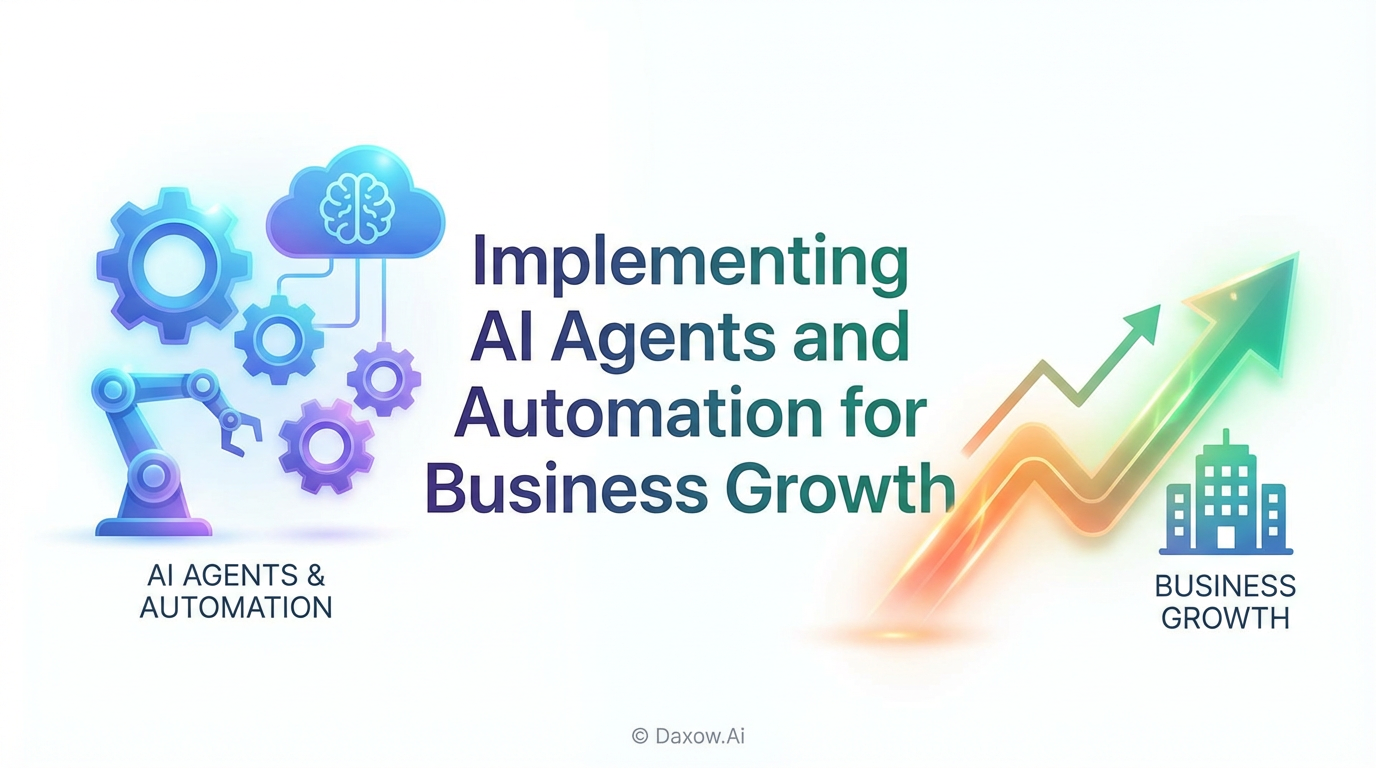
How AI agents and workflow automation reduce manual work, boost productivity and ROI across industries — practical use cases, implementation steps, and Daxow.ai services.
Unlocking Business Growth: Implementing AI Agents and Automation for Intelligent Process Optimization
Estimated reading time: 15 minutes
Key Takeaways
- AI agents and automation reduce manual tasks and enhance productivity by up to 50%.
- Integration of AI-driven workflows delivers predictive insights and better customer experience.
- Industry-specific use cases demonstrate significant ROI across e-commerce, healthcare, finance, real estate, HR, and sales.
- A structured implementation approach ensures success and scalability of AI automation projects.
- Daxow.ai offers end-to-end services from process discovery to live AI agent deployment.
Table of Contents
- Unlocking Business Growth: Implementing AI Agents and Automation for Intelligent Process Optimization
- How AI Agents and Workflow Automation Deliver Value
- Practical Use Cases Across Industries
- Implementation Steps and Best Practices
- Measuring ROI and Scaling Automation
- How Daxow.ai Helps — From Process Analysis to Live AI Agents
- Real-world Example
- Frequently Asked Questions
Unlocking Business Growth: Implementing AI Agents and Automation for Intelligent Process Optimization
Unlocking Business Growth: Implementing AI Agents and Automation for Intelligent Process Optimization is no longer an experiment — it is a strategic imperative for organisations that want to reduce manual tasks, increase productivity, and deliver measurable business outcomes. For business owners, CTOs, operations leaders and heads of customer support, this approach replaces repetitive work with scalable intelligence: AI agents that perceive, reason and act; workflow automation that enforces efficiency; and integrations that connect data and systems. This article explains why this trend matters, how to implement it successfully, concrete use cases across industries, and how Daxow.ai helps you design and deploy custom AI automation that drives ROI.
Why this matters for decision-makers
- Reduce manual tasks: Automate rule-based, repetitive processes such as data entry, invoice reconciliation, and ticket triage to free staff for higher-value activities.
- Improve productivity: Organisations routinely see large productivity gains when combining AI with workflow automation — often improving throughput by 30–50%.
- Enhance customer experience: Customer support automation and conversational AI agents provide faster responses, consistent answers and better resolution rates, boosting NPS and retention.
- Derive predictive insights: Machine learning models detect fraud, forecast supply chain disruptions and surface trends from data that humans cannot scale to review.
- Accelerate decision cycles: Automated processes enable faster approvals, more accurate data and better downstream forecasting.
These outcomes translate into measurable business value: lower operational cost, faster time-to-serve, improved compliance and the ability to reallocate talent toward innovation.
How AI Agents and Workflow Automation Deliver Value
What AI agents and workflow automation actually do
- Autonomous task execution: AI agents monitor queues, extract data, take actions (update CRM, create invoices, trigger escalations) and learn from outcomes.
- Natural language processing: NLP-powered agents read emails, chat transcripts and documents to categorize intents and extract structured data.
- Integration and orchestration: Workflow automation ties systems together — CRM, ERP, support platforms, cloud storage — so actions in one system trigger end-to-end processes.
- Analytics and monitoring: Dashboards track accuracy, throughput, cycle time and exceptions to continuously refine the system.
Key architectural considerations
- Data accessibility and quality: Reliable automation requires accurate, accessible, and governed data pipelines.
- Security and compliance: Embed privacy and compliance controls from day one to mitigate risk.
- Modularity and integration: Build components that integrate with CRMs and collaboration platforms to avoid disrupting existing operations.
- Observability and retraining: Implement monitoring and retraining loops so models stay accurate as business conditions change.
Practical Use Cases Across Industries
E-commerce — boost conversion and reduce support load
Problem: High volume of product queries, returns processing and manual review of reviews and social comments.
Solution: Deploy AI agents to handle order inquiries, automate returns workflows, generate personalized product recommendations and summarize customer feedback for product teams.
Impact:
- Faster response times and higher first-contact resolution.
- Increased conversion via personalized content and timely follow-ups.
Daxow.ai role: Build chatbots for customer support automation, integrate with storefront and CRM, implement lead qualification bots to prioritize promising customers.
Healthcare — reduce administrative burden, improve triage
Problem: Clinician time is lost to manual data capture, appointment scheduling and patient intake forms.
Solution: Use AI agents to extract and normalize patient data from forms, triage inquiries via symptom-checking agents, and predict resource needs from historical patterns.
Impact:
- Reduced administrative hours per clinician.
- Faster triage and improved patient satisfaction.
Daxow.ai role: Implement document automation for medical forms, integrate agents with EMR systems, and build monitoring dashboards to ensure data accuracy and compliance.
Finance — detect fraud and accelerate reconciliation
Problem: Manual reconciliation and delayed fraud detection increase risk and cost.
Solution: Use ML models to monitor transactions, flag anomalies, and automate invoice matching and reconciliation workflows.
Impact:
- Reduced fraud losses and faster dispute resolution.
- Faster close cycles and fewer manual corrections.
Daxow.ai role: Design ML pipelines and integrate agents with core banking and accounting systems, provide governance processes for model validation and audit trails.
Real estate — qualify leads and automate listings
Problem: Inbound leads are inconsistent and slow to qualify; listings need frequent updates across channels.
Solution: Deploy AI agents to qualify leads via chat, extract buyer preferences, update listings automatically and generate market trend reports.
Impact:
- Faster lead-to-showing time and higher conversion rates.
- Better market positioning through timely data-driven pricing insights.
Daxow.ai role: Build lead qualification agents, sync listings with property portals and CRM, and create predictive models for pricing and demand.
HR — speed hiring and improve compliance
Problem: Sifting resumes and screening candidates is time-consuming and prone to bias.
Solution: Use AI to screen resumes, extract candidate metadata, schedule interviews and surface top matches based on objective criteria.
Impact:
- Shorter time-to-hire and improved candidate experience.
- Standardised screening and better compliance documentation.
Daxow.ai role: Deploy resume parsing, integrate with ATS systems, and implement monitoring to reduce bias and maintain auditability.
Sales & Support — automate qualification and escalation
Problem: Sales teams spend time on low-quality leads; support teams are overwhelmed with repetitive tickets.
Solution: AI agents qualify leads, assign priority, draft follow-up messaging and automate routine support tasks while escalating complex issues to humans.
Impact:
- Higher sales productivity and improved win rates.
- Reduced ticket backlog and higher CSAT.
Daxow.ai role: Build sales automation workflows, integrate agents into CRMs, and create automated playbooks that execute based on lead score and behavior.
Implementation Steps and Best Practices
A structured, iterative approach
-
Define clear goals and prioritise processes
- Start with measurable objectives (e.g., reduce average response time by 40%, achieve 20% cost savings).
- Prioritise repetitive, high-volume tasks with strong ROI potential such as ticket sorting, lead qualification and invoicing.
- Metric examples: cost savings target, NPS uplift, reduction in manual hours.
-
Assess and prepare data
- Audit data quality and accessibility across silos.
- Build pipelines that ensure consistent formats and privacy controls.
- Target: data accuracy >95% for critical fields before deployment.
-
Select tools and integration strategy
- Choose AI and automation platforms that support robust APIs and secure integrations with existing systems.
- Match technology to task (NLP for text, ML for predictions, RPA for UI-driven tasks).
-
Assemble a cross-functional team
- Include data engineers, ML engineers, product owners, domain SMEs, and compliance leads.
- Set clear responsibilities and training programs for end users.
-
Test, deploy and monitor
- Pilot with limited scope, measure accuracy (precision/F1), and implement feedback loops.
- Deploy dashboards, alerts and automated retraining triggers.
- KPIs: accuracy, throughput, retrain frequency.
-
Scale with change management
- Communicate value to frontline teams, provide training and discourage shadow AI.
- Incrementally expand automation, monitoring impact against KPIs.
Best practices to avoid common pitfalls
- Embed compliance from day one to mitigate risk.
- Avoid scope creep: measure against KPIs and stop when metrics plateau.
- Ensure human-in-the-loop for exceptions and continuous improvement.
- Integrate with existing tools to reduce friction and increase adoption.
Measuring ROI and Scaling Automation
What to measure
- Cost reduction: hours saved, lower processing costs.
- Speed improvements: average response time, cycle times.
- Quality and accuracy: error rates, dispute rates, model precision.
- Customer impact: NPS, CSAT, retention metrics.
- Business outcomes: conversion rates, revenue per agent, fraud reduction.
Typical ROI timelines and expectations
- Many organisations recoup automation investments within months, driven by labour savings and reduced error costs.
- Productivity gains of 30–50% are common when combining AI agents with workflow automation.
- Long-term value comes from scalability: once integrated, automation scales with business growth at marginal incremental cost.
How Daxow.ai Helps — From Process Analysis to Live AI Agents
End-to-end services that deliver business value
- Process discovery and analysis: We map your workflows to identify automation candidates and quantify potential ROI.
- Custom AI agent design: We design agents that execute tasks autonomously, from lead qualification to invoice processing.
- Workflow automation and orchestration: We create end-to-end flows that connect your CRM, support platforms and backend systems.
- Data extraction and document automation: We extract structured data from invoices, contracts and forms with high accuracy.
- Customer support automation: We build chatbots and escalation workflows that improve response times and consistency.
- Integrations and system connectivity: We link AI agents to existing tools (CRMs, ERPs, collaboration platforms) for frictionless operations.
- Monitoring, retraining and governance: We deliver dashboards, retraining pipelines and compliance controls to keep systems performant and auditable.
Typical engagement and value delivery
- Phase 1 — Discovery and ROI assessment: We identify high-impact processes and define KPIs.
- Phase 2 — Pilot and build: We develop minimum viable agents and integrate with core systems.
- Phase 3 — Scale and govern: We expand automation, implement monitoring and conduct change management.
- Outcome: measurable reductions in manual work, improved productivity, and a clear path to scaling automation across the organisation.
Real-world example
Scenario: A mid-sized e-commerce company faced high support volume and slow lead follow-up.
- Challenge: 60% of support tickets were repetitive; many qualified leads were lost.
- Daxow.ai solution: Implemented a chatbot for common inquiries, an AI agent to qualify leads and a workflow that pushed qualified leads to the sales CRM with suggested next steps.
- Results: 45% reduction in manual ticket handling, 30% faster lead response time, measurable uplift in conversion and customer satisfaction.
Frequently Asked Questions
What types of tasks can AI agents automate?
AI agents automate rule-based, repetitive tasks such as data entry, ticket triage, invoice processing, lead qualification, and customer inquiries.
How do I measure the success of AI automation?
Success metrics include cost reduction, productivity improvements, accuracy rates, customer satisfaction scores, and revenue impact.
Is integration with existing systems complicated?
With a modular architecture and robust APIs, AI agents and automation workflows can seamlessly integrate with CRMs, ERPs, and other enterprise platforms to minimize disruption.
How does Daxow.ai support compliance and security?
Daxow.ai embeds security and privacy controls from design to deployment, including data governance, audit trails, and ongoing monitoring to ensure compliance with industry standards.