
Implementing AI Agents and Automation for Enterprise Growth
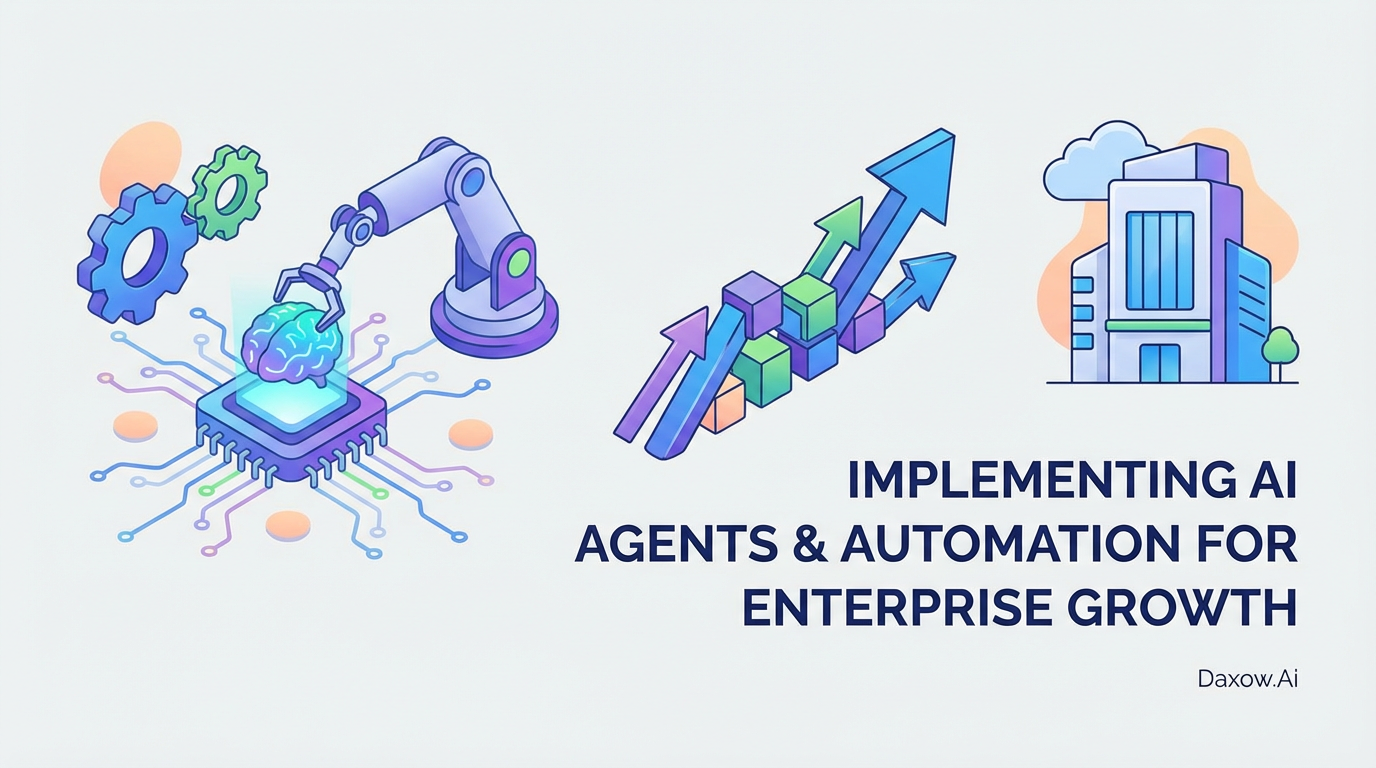
Practical guide to implementing AI agents and automation to reduce costs, boost productivity, and scale enterprise operations, with roadmap, use cases, and Daxow.ai services.
Unlocking Business Growth: Implementing AI Agents and Automation for Enterprise Success
Estimated reading time: 15 minutes
Key Takeaways
- AI agents and automation reduce operational costs by 40–60% and accelerate strategic goals 3–5 times faster.
- Organizations achieve 20–50% productivity gains while scaling service levels without proportional headcount increases.
- Industry-specific AI use cases deliver measurable business impacts, from e-commerce to finance and healthcare.
- Successful implementation requires strategic planning, robust API-first technology, governance, and human-in-the-loop oversight.
- Daxow.ai offers end-to-end AI automation solutions, ensuring continuous optimization and sustained ROI.
Table of Contents
- Unlocking Business Growth: Implementing AI Agents and Automation for Enterprise Success
- Strategic Implications for Businesses
- Practical Use Cases Across Industries
- Implementation Roadmap — From Assessment to Continuous Improvement
- Best Practices and Common Pitfalls
- Measuring ROI and Demonstrating Business Value
- How Daxow.ai Helps — From Strategy to Autonomous AI Agents
- Example Project Briefs — How Results Translate into Business Outcomes
- Next Steps — Build a Roadmap to Scaled Automation
- Frequently Asked Questions
Unlocking Business Growth: Implementing AI Agents and Automation for Enterprise Success
Unlocking Business Growth: Implementing AI Agents and Automation for Enterprise Success begins with a clear strategy that converts repetitive work into measurable business value. Organizations that adopt AI automation and AI agents can reduce manual tasks, accelerate decision-making, and deliver better customer experiences—often achieving 40–60% cost reductions in targeted processes and reaching strategic goals 3–5 times faster than ad-hoc projects. This article explains why this topic matters for decision-makers, presents a practical implementation framework, outlines industry-specific use cases, and shows how Daxow.ai designs custom AI systems to deliver end-to-end automation and sustained ROI.
Why CIOs and Business Leaders Should Prioritize AI Agents and Automation
- Compete in a digital-first economy. AI agents orchestrate complex workflows while automation handles high-volume rule-based work, freeing teams to focus on strategic initiatives.
- Reduce operational overhead. Targeted implementations commonly produce 40–60% cost reductions in areas like customer support, back-office processing, and compliance.
- Improve productivity and speed. Organizations report 20–50% productivity gains, with the ability to scale service levels without proportional headcount increases.
- Deliver measurable business outcomes. Use KPIs—cost per transaction, first-contact resolution, time-to-decision—to quantify value and accelerate adoption.
Strategic Implications for Businesses
Operational and Competitive Benefits
AI agents and workflow automation convert data into action. Real-time insights reduce risk and uncover new revenue streams through predictive analytics. For CTOs, API-first architectures and robust data pipelines are essential to scale agents without introducing deployment failures or data silos.
Governance and Organizational Readiness
Successful projects require early governance, clear ownership, and workforce upskilling. Establish roles, compliance checks, and human-in-the-loop policies for high-stakes decisions to mitigate bias and regulatory risk.
Practical Use Cases Across Industries
E-commerce — Increase Conversions and Cut Friction
- Use case: Conversational AI agents handle order queries, issue refunds, and suggest personalized upsells.
- Business impact: Reduce cart abandonment and improve conversion rates through timely, contextual recommendations.
- Automation examples: Dynamic pricing engines, inventory synchronizations with Shopify-like platforms, and automated returns processing.
Healthcare — Streamline Patient Flow and Administration
- Use case: Virtual triage agents assess symptoms via NLP, book appointments, and route urgent cases to clinicians.
- Business impact: Reduce administrative burden by up to 50%, lower no-show rates, and improve patient satisfaction.
- Automation examples: Insurance verification, prior authorization workflows, and EHR data validation.
Finance — Strengthen Risk Controls and Speed Decisions
- Use case: AI agents monitor transactions for fraud, approve low-risk loans, and prepare compliance reports.
- Business impact: Faster approvals, fewer false positives, and accelerated audit cycles with enhanced regulatory adherence.
- Automation examples: Reconciliation bots, KYC document extraction, and automated reporting pipelines.
Real Estate — Shorten Sales Cycles and Improve Lead Conversion
- Use case: Virtual assistants qualify leads, schedule viewings, and produce market-backed valuations.
- Business impact: Shorten sales cycles by ~30% through rapid response and automated market data ingestion.
- Automation examples: MLS integration, contract generation, and lead nurture sequences.
HR — Accelerate Hiring and Improve Experience
- Use case: Recruitment agents screen resumes, coordinate interviews, and automate onboarding documents.
- Business impact: Speed hiring by ~40% and reduce bias through governed shortlisting workflows.
- Automation examples: Automated reference checks, benefits enrollment, and probation check-ins.
Implementation Roadmap — From Assessment to Continuous Improvement
1. Strategic Assessment and Planning (4–8 weeks)
- Define precise, measurable goals (e.g., 30% cost reduction, 20% faster response).
- Inventory processes and data sources; prioritize high-volume, low-complexity tasks for quick wins.
- Establish KPIs and a business case that ties automation to revenue, cost, or customer metrics.
2. Technology Selection and Preparation (6–12 weeks)
- Choose API-first platforms and tools that support secure integrations.
- Clean and normalize data; build knowledge bases and decision trees for agents.
- Document workflows and escalation paths; plan for change management and training.
3. Pilot Deployment
- Launch with a contained pilot for a specific use case and audience.
- Measure baseline metrics and iterate on agent behavior and automation rules.
- Involve cross-functional stakeholders for faster validation and adoption.
4. Gradual Rollout and Optimization
- Expand capabilities across channels and departments once pilots reach targets.
- Implement governance: roles, policies, audit trails, and retraining schedules.
- Maintain human oversight for mission-critical outcomes while increasing agent autonomy where safe.
5. Continuous Improvement
- Monitor performance against KPIs and conduct regular model retraining.
- Collect operational feedback and refine processes; keep stakeholders aligned through transparent reporting.
- Scale horizontally (more processes) and vertically (more complex tasks) as maturity grows.
Best Practices and Common Pitfalls
Best Practices
- Start small, deliver value quickly. Prioritize high-impact, low-complexity processes.
- Build robust data pipelines. Real-time access and validation are critical for reliable automation.
- Adopt API-centric integrations. This enables modular, maintainable systems across tools and CRMs.
- Enforce governance early. Policies and auditability reduce compliance risk and build trust.
- Keep humans in the loop. For ambiguous or high-risk decisions, ensure escalation and oversight.
Pitfalls to Avoid
- Poor data quality. Unreliable inputs rapidly degrade agent performance.
- Scope creep. Expanding features before stabilizing foundational workflows leads to delays.
- Lack of executive alignment. Without leadership support, projects stall at deployment.
- Ignoring change management. Teams need training, guidelines, and incentives to shift to automated processes.
Measuring ROI and Demonstrating Business Value
Key Metrics to Track
- Cost per transaction or ticket before and after automation.
- First-contact resolution and average resolution time for customer support.
- Time-to-decision for finance approvals and HR processes.
- Conversion rates, average order value, and cart abandonment metrics in e-commerce.
- False-positive rates in fraud detection and compliance errors.
Typical Payback and Long-term Value
- Many organizations see payback within 6–12 months, depending on scale and scope.
- Expected outcomes include 3–5x faster goal achievement, 40–60% cost reductions in targeted operations, and durable efficiency gains of 25–35% annually through continuous optimization.
- Long-term benefits also include the ability to handle 10x query volumes without proportional staffing increases and the strategic advantage of predictive insights.
How Daxow.ai Helps — From Strategy to Autonomous AI Agents
End-to-End Process Analysis and Design
Daxow.ai begins with a structured process analysis to identify automation opportunities that align with strategic KPIs. Our consultants map workflows, evaluate data readiness, and prioritize quick wins that demonstrate immediate ROI.
Custom AI Agents and Workflow Automation
We design and implement AI agents that execute real tasks—handling customer support automation, sales automation, lead qualification, and document processing. Agents are built to operate across channels and connect to core systems and CRMs via secure APIs.
Integrations and Data Connectivity
Daxow.ai engineers integrate AI systems with your existing stack—ERPs, CRMs, e-commerce platforms, and document repositories—ensuring real-time data flows and robust pipelines for accuracy and performance.
Governance, Security, and Human-in-the-Loop
We establish governance frameworks, audit trails, and role-based controls to manage risk. Our solutions retain human oversight where needed and implement escalation rules for compliance-sensitive decisions.
Continuous Optimization and Managed Services
Beyond deployment, Daxow.ai provides ongoing monitoring, retraining, and iterative improvements. Our managed services ensure your AI agents evolve with new data, business needs, and regulatory requirements—maintaining performance and ROI.
Example Project Briefs — How Results Translate into Business Outcomes
Customer Support Automation for a Mid-Sized Retailer
- Challenge: High support volumes, long response times, and rising labor costs.
- Solution: Deploy chatbots and backend automation to resolve common issues and automate refunds.
- Outcome: Resolved 70–80% of queries autonomously, reduced average response time by 60%, and cut support costs by 45%.
Loan Processing Automation for a Regional Bank
- Challenge: Slow loan approvals and manual compliance checks.
- Solution: AI agents pre-screen applications, validate documents, and flag exceptions for human review.
- Outcome: 3x faster approvals for low-risk loans, 30% reduction in internal processing costs, and improved auditability.
Recruitment Acceleration for a Technology Firm
- Challenge: High volume of applicants causing long time-to-hire.
- Solution: Automated resume screening and interview scheduling augmented with sentiment analysis.
- Outcome: Time-to-hire reduced by 40%, and candidate experience scores improved through faster communication.
Next Steps — Build a Roadmap to Scaled Automation
If your organization is ready to reduce manual tasks, increase productivity, and unlock measurable business value, the path is clear: begin with a focused assessment, prove impact with a pilot, then scale with governed, API-first AI automation.
- Identify one high-volume process to automate within 30 days.
- Set measurable KPIs tied to cost, speed, or customer satisfaction.
- Engage Daxow.ai to map processes and build a pilot AI agent that integrates with your systems.
Frequently Asked Questions
What are AI agents, and how do they differ from standard automation?
AI agents are autonomous software entities that can understand, learn, and make decisions based on data, orchestrating complex workflows. Standard automation follows predetermined rules and operates in fixed, repetitive tasks. AI agents bring adaptability and intelligence beyond basic automation.
How long does it typically take to implement AI automation in an enterprise?
Implementation timelines vary, but a typical roadmap from strategic assessment to full rollout ranges from 4 to 12 months. Pilot deployments often occur within the first few months to validate impact before scaling.
What industries benefit most from AI agents and automation?
AI agents and automation benefit a wide range of industries including e-commerce, healthcare, finance, real estate, and human resources by improving efficiency, reducing costs, and enhancing customer experiences with tailored use cases.
How does Daxow.ai ensure data security and regulatory compliance?
Daxow.ai implements governance frameworks, role-based access controls, audit trails, and human-in-the-loop escalation rules to ensure data security and compliance with industry regulations, tailored for each client’s requirements.